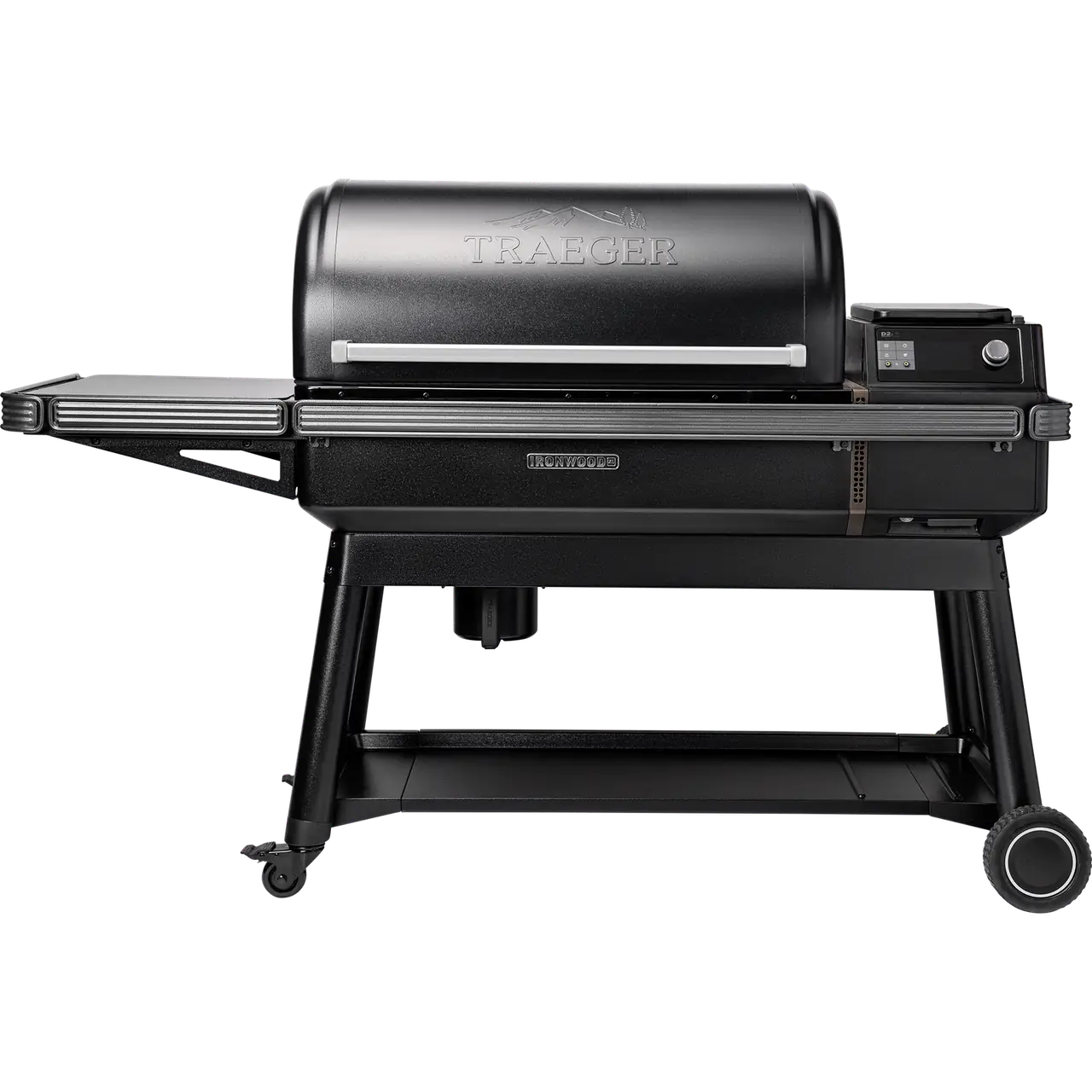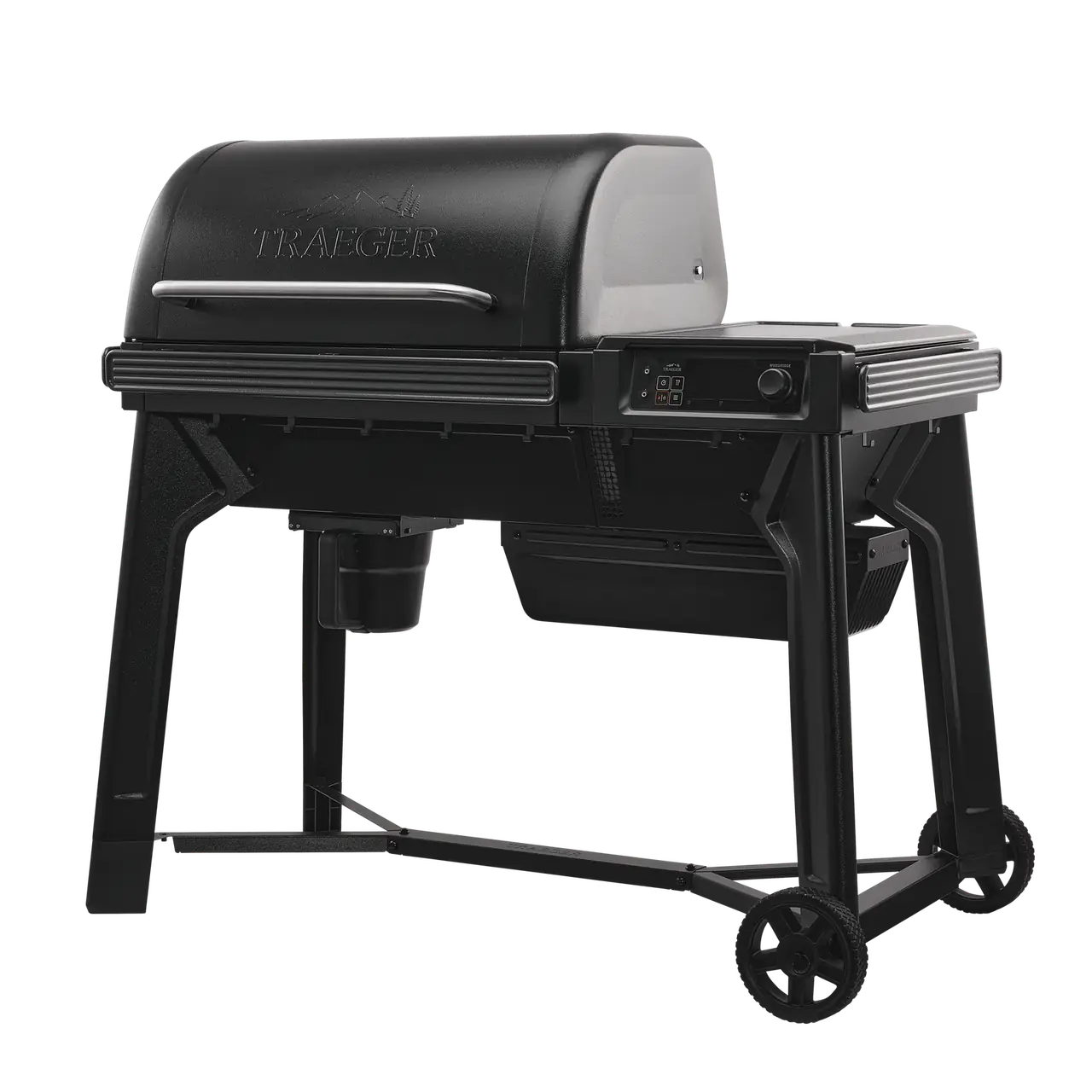
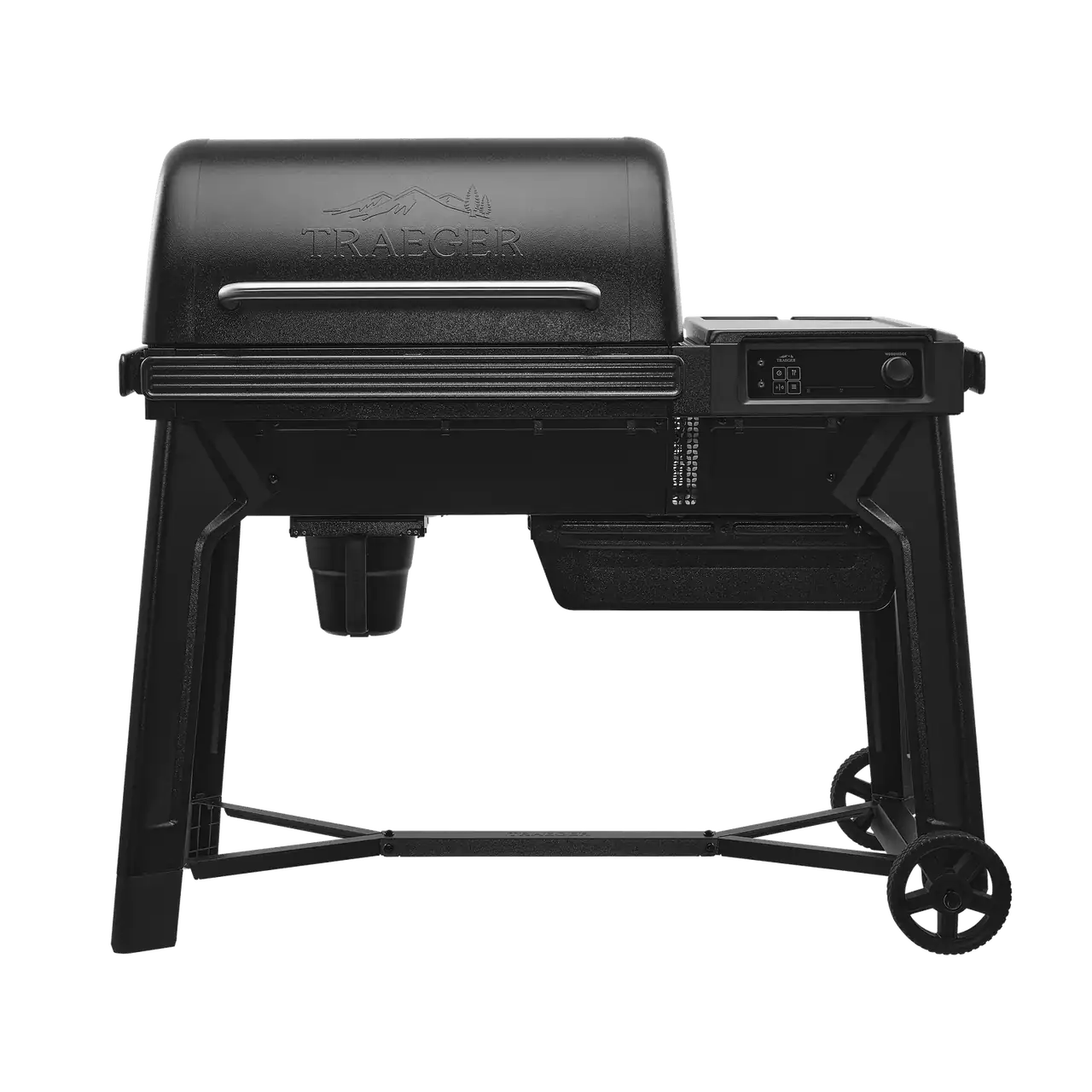
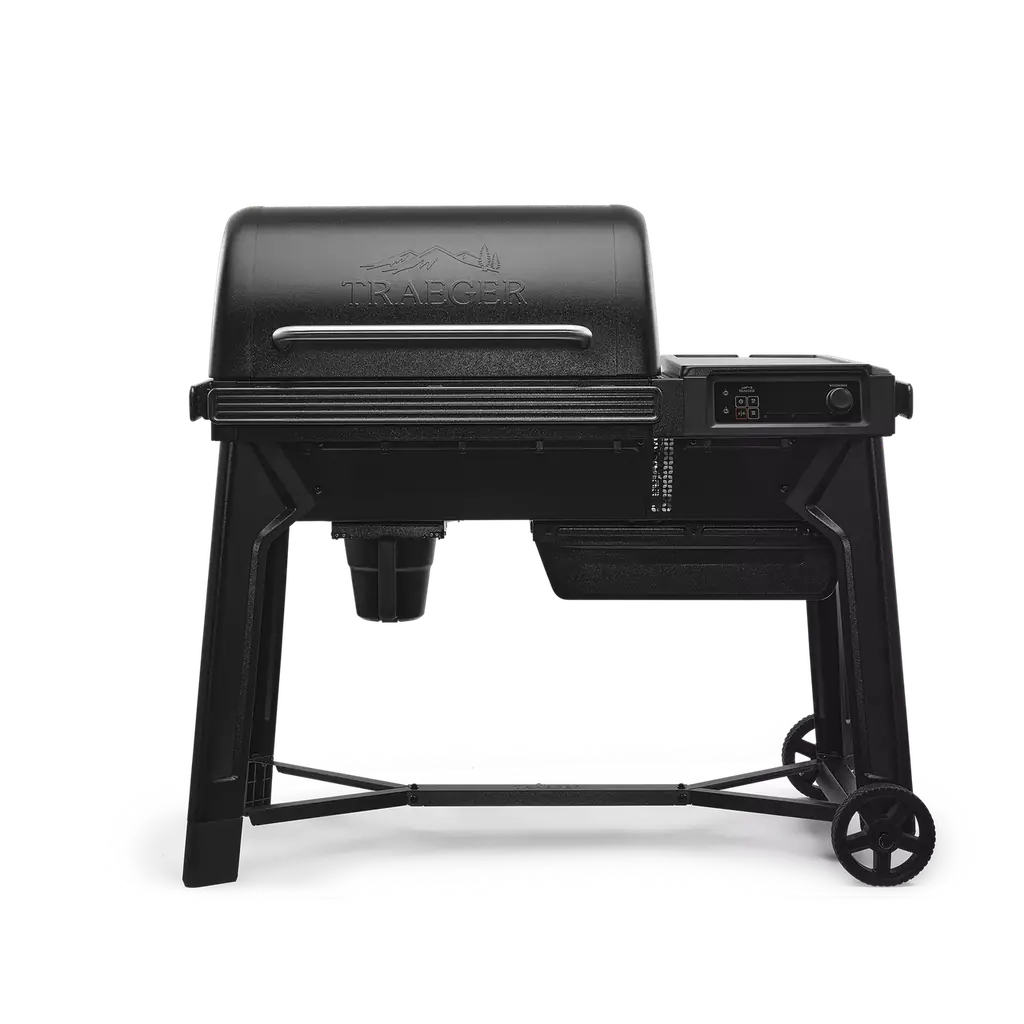
Traeger Woodridge
By Traeger · Pellet Grills · Kitchen & Cooking
- 860 sq
- 500 F max temperature
- 24 lbs. pellet hopper capacity
- 138 lbs total weight
Lowest price seen
$899.00
from $899.00 at Texas Star Grill Shop · Checked Oct 4, 2026
- Texas Star Grill Shop $899.00View at Texas Star Grill Shop
- Abt $899.95View at Abt
- Scheels $899.99View at Scheels
- TraegerView at Traeger
- The Home DepotView at The Home Depot
- Burns & Sons ApplianceView at Burns & Sons Appliance
- Best BuyView at Best Buy
- Jay's Sporting GoodsView at Jay's Sporting Goods
- WayfairView at Wayfair
- BBQGuysView at BBQGuys
- eBayView at eBay
- eBay (used) eBay: used, open-box, refurbishedView at eBay (used)
- AmazonView at Amazon
Prices are snapshots. Check the current price with the store.
Summary
Traeger’s base full-size pellet grill, with 860 square inches of cooking surface, a 24 lb hopper, WiFIRE app control and a 10-year body warranty, aimed at cooks who want set-and-forget low-and-slow barbecue. Check your smoke expectations before you buy: the most instrumented test found milder smoke than rival pellet grills, and 500°F is a setpoint rather than a measured chamber temperature.
Strengths
- Holds setpoint temperature well: Wirecutter measured 5-10°F swings and checked the panel reading against an external thermometer.
- Food & Wine logged about 5°F of fluctuation across two cooks, with three sensors agreeing within 5-10°F.
- Large cooking area for the money: 860 sq. in. across two racks plus a 24 lb hopper.
- Set-and-forget cooking that needs no grilling skill, and one removable keg for drippings and ash.
- Reviewers consistently single out WiFIRE app control as a highlight.
- Ten years on the smoker body, three years on parts, plus a published parts catalog with step-by-step procedures.
Weaknesses
- Slow preheat: Wirecutter clocked over 28 minutes to 325°F, against 18 minutes for a Pit Boss Navigator 1300.
- Mild smoke: Wirecutter found less smoky meat than its Camp Chef and Pit Boss picks in every test, with lighter bark and skin.
- 500°F is a setpoint, not a chamber temperature. Food & Wine measured 425-450°F after the first lid opening.
- Weak searing: burgers got a sear but no char, and Smoked BBQ Source could not sear steaks even with the ModiFIRE Sear Grate.
- Uneven heat: Wirecutter’s biscuit test found the right quarter of the cooking surface noticeably cooler.
- Light build: Wirecutter says the construction feels flimsier next to its Camp Chef and Pit Boss picks, and no source publishes a steel gauge.
Verified specifications
| Cooking area | 860 sq. in. (5548 sq. cm), split 520 sq. in. on the main rack and 340 sq. in. on the upper rack. |
|---|---|
| Stated food capacity | 6 chickens, 8 rib racks or 6 pork butts. |
| Controller range | 180°F to 500°F in 5-degree steps, read off the dial. |
| Hopper | 24 lb (11 kg) of wood pellets, with a clean-out function for switching flavors. |
| Weight | 138 lb assembled, about 62.6 kg. Traeger’s support page pairs it with a wrong 17.2 kg figure. |
| Dimensions | 50 × 27 × 46 in (127 × 69 × 117 cm). Traeger calls the 27 in figure a width on the support page and a depth on the series page. |
| Power | electric, 120 V in the US. |
| Controller | fully digital, with a retro-style LED display, one selection dial and separate buttons for timer, probe, ignition and menu. |
| Connectivity | WiFIRE built in; the Traeger app on Android and iOS changes setpoint, runs timers and reads the probe. The grill works offline, and Traeger recommends staying connected for software updates. |
| Probes | one wired meat probe in the box; Bluetooth meat thermometers also work. Traeger does not publish a probe-port count. |
| Temperature sensing | RTD rather than a thermocouple, which Traeger says it chose for accuracy. |
| Grease and ash | the EZ-Clean Grease & Ash Keg under the grill collects drippings and pellet ash in one removable container. |
| Accessories | P.A.L. rails on both sides and the front, plus ModiFIRE grates. Staging hooks are built in for hanging grates while cleaning. |
| Absent on the base model | Super Smoke Mode, pellet sensor, added insulation, flame broiler and chamber probe calibration. |
| Firmware | 02.12.02, with config 2303.014 for the US and Canada and 2311.001 internationally. |
| In the box | wired meat probe, digital controller, P.A.L. rails, staging hooks, grease and ash keg, grates, drip tray and assembly tools. |
Full research notes and sources
Preheat and temperature holding
If all you care about is whether the grill holds temperature, the testing is reassuring. Wirecutter measured swings of about 5 to 10 degrees and confirmed with a ThermoWorks Smoke external thermometer that the control panel was roughly accurate, though the grill’s own probe read consistently about 5 degrees high in the centre of the main rack. Food & Wine smoked chicken thighs at 250°F for about two hours and a 3 lb brisket at 225°F for five hours, then 275°F for four hours to 205°F internal, and saw only about 5°F of fluctuation with three sensors within 5-10°F of each other. Serious Eats ran it through a bitter Vermont February without losing target temperature.
Buy a third-party thermometer anyway, because the display is not the chamber. Wirecutter found no way to calibrate the cooking chamber probe, and Food & Wine set 500°F, opened the lid, and watched the chamber settle at 425-450°F instead of recovering. Nobody has measured this grill’s actual chamber temperature from a cold start at a 500°F setpoint, so treat 500°F as the highest number the dial will give you. Engadget’s reviewer did vouch for holding 500°F and slightly above, which is the honest counterweight to that finding.
Smoke flavor and searing
Smoke is where reviewers disagree, and the split is genuine. Wirecutter found the Woodridge produced noticeably less smoky meat than its Camp Chef and Pit Boss picks in every test, most visibly on longer cooks, and a three-person tasting panel was split, with 20% to 40% preferring the lighter result depending on the cut. Smoked BBQ Source found the same mild profile on brisket and ribs. Engadget reported the opposite, saying the grill still imparts significant smoke at 300°F and above. Wirecutter’s is the more instrumented of those tests, so plan on a light smoke profile rather than a heavy one. Pellet Grill Life notes that smoke flavor drops off in most pellet grills past 325°F, and Traeger’s own FAQ says food cooked between 165-225°F picks up more smoke flavor than hotter cooking. Heavier smoke at low temperatures means Super Smoke Mode, which belongs to the Pro and Elite, so on this grill you would be adding a wood-chip box.
Searing is the other soft spot. Food & Wine cooked 4 oz burgers at a 500°F setpoint and got a sear but not the char they expected. Smoked BBQ Source could not achieve a proper steak sear even with the ModiFIRE Sear Grate. Serious Eats says the grill doesn’t get hot enough for a great Maillard reaction. One owner on the Traeger Owners Forum reported no sear and no smoke at 500°F on his first cook. Leave aside the forum figure that circulates about actual temperature near 440°F at a 500°F setpoint, because that post is about an Ironwood 885, not this grill. There is no factory burner here, so regular searing means buying a griddle or a cast-iron sear plate separately.
Repairs, parts and upkeep
Repairability is the strongest ownership argument. Traeger publishes a full service-parts catalog with SKU numbers and step-by-step procedures for the controller (KIT0922), RTD (KIT0929), auger box (KIT0936), 120 V ignitor (KIT0927), induction fan (KIT0925), firepot (KIT0926), Grease & Ash Keg (KIT0963), main grates (KIT0934 large and KIT0933 small), upper grate (KIT0935), grease chute, ash cap, heat baffle, hopper assembly, lid, hinges, P.A.L. rails, wheels and wire harnesses.
The only first-hand electronics failure in the sources is GearJunkie’s: the control unit died about two months into ownership, the display went out and the grill was nearly impossible to set. Traeger shipped a replacement within days, the swap took about 15 minutes, and the reviewer says it worked flawlessly for the year after. Traeger also publishes troubleshooting articles for a blank or unresponsive controller, failed ignition, an ER13 auger motor error, temperature jumping at startup, smoke coming out of the hopper and temperature dropping mid-cook. Those are known failure modes, but nobody has published how often they happen, so there is no failure rate to plan around. Because the base model has no one-button auger prime, Traeger documents a manual priming procedure for the auger and bushing instead.
Upkeep is ash and grease rather than parts. Ash in the firebox needs periodic cleaning, because excessive ash can stop pellets igniting and redirect smoke back up through the hopper. Do not hose the grill down or power wash it. Assembly is the tedious part: Traeger quotes about 60 minutes, Wirecutter took about two hours solo with the included tools, and Food & Wine received the grill on a freight pallet at close to 160 lb and needed a hand truck. Traeger allows an unopened grill to be exchanged or fully refunded within 45 days, with return shipping possibly applying. The warranty is a limited 10 years, which Wirecutter and Food & Wine both read as 10 years against rust on the smoker body and three years on most mechanical and electric parts.
Is it worth it?
It launched in January 2025 at about $800: Tom’s Guide reported $799 at Traeger, and GearJunkie says the price has since risen by $100. Traeger lists the grill at $899.99. Wirecutter saw $800 from The Home Depot and $900 from Wayfair; Food & Wine saw $900 at Cabela’s, $900 at Traeger and $800 at The Home Depot. The Home Depot Canada page showed CAD 1299.99 on 2026-08-12, so expect roughly $100 of spread between US stores. Check the store panel above for what stores are charging.
At the $799-800 launch price, the area, the app, a working grease system and a 10-year body warranty are hard to match in a connected full-size pellet grill. Between $850-900 it is still defensible, and Smoked BBQ Source kept the base model as its value pick among Traegers while suggesting about $250 more for the Pro. Above $900 it stops making sense, because the limits that turn up in testing — slow preheat, mild smoke, weak searing, a cooler right quarter, light construction — are mechanical rather than money problems. Your running costs are pellets, which GearJunkie lists as the model’s one named con, plus a grill cover, grease-and-ash keg liners that Traeger sells as a 5-pack, and electricity.
Pellet Grill Life argues that above about 300°F the base model cooks essentially like the Pro, since Super Smoke only matters at low temperatures. Wirecutter argues the other way for low-and-slow smokers, who need Super Smoke or a chip box for heavier smoke. Owners and prospective buyers split on the same question, whether the extra money for the Pro is worth it, and the thread on the Traeger Owners Forum also contains one buyer who went back to charcoal after a first cook. Skip this grill if you sear often, want heavy smoke or need a pellet sensor. Everyone else gets a large, app-controlled grill with a strong warranty and a documented parts channel.
Which model this is
This is the base Woodridge, the entry grill of the series: US model TFB86MLH, TFB86MLHC in Canada, TFB86MLHCEU in Europe, UPC 63486894686. It is not the Woodridge Pro (970 sq. in., Super Smoke Mode, pellet sensor), the Pro Plus (970 sq. in., cabinet) or the Elite (970 sq. in., side burner, insulated lid). Listings mix these models together, so check what you are buying: 860 sq. in. of area and no pellet sensor are the tells for the base grill. The series replaced the Pro Series, and Smoked BBQ Source notes the Pro 575 was replaced by the Woodridge. Do not carry Pro Series 22 data across, since the Pro 22 is a different, non-WiFIRE, 572 sq. in., 450°F grill. The Amazon listing for this page is ASIN B0DQTBRS3M, and the grill runs firmware 02.12.02.
Sources
Manufacturer:
- Traeger Woodridge wood pellet grill product page
- Woodridge series overview and model comparison table
- Woodridge support guide: dimensions, parts catalog and firmware
- Replacing a Woodridge series controller and knob
- Replacing a Woodridge series auger and bushing, with manual priming
- Replacing a Woodridge series RTD
- Replacing a Woodridge series grease chute
- Woodridge series grill not igniting
Independent reviews:
- The best pellet grills of 2026 (NYT Wirecutter, updated 2026-04-21)
- Which Traeger pellet grill should you buy in 2026 (Smoked BBQ Source)
- Pellet grill reviews index and Woodridge Pro review (Smoked BBQ Source)
- Traeger Woodridge review: a big upgrade for the entry-level pellet grill (Engadget)
- Traeger Woodridge: we tested the new pellet grill (Field & Stream, 2026-01-23)
- This Traeger pellet grill made me fall in love with grilling (Serious Eats)
- Traeger Woodridge pellet grill, tested and reviewed (Food & Wine, updated 2025-06-17)
- Traeger Woodridge review after 14 months of use (GearJunkie)
- Traeger grill reviews: every current model rated (Pellet Grill Life)
- Traeger launched three new pellet grills in January 2025 (Tom’s Guide)
Owner reports:
- New Woodridge grill issues (Traeger Owners Forum)
- About to buy a Woodridge unless someone changes my mind (r/Traeger)
Retail listings: