SUNLU AMS Heater
By SUNLU · Filament Dryers · 3D Printing · More from SUNLU
- Heats to 70°C in 20 min
- 220 W rated power
- 4-spool (AMS) capacity
- 363×278×131 mm dimensions
- 1.7 kg net weight
Price not listed
- SUNLUView at SUNLU
- eBay (used) eBay: used, open-box, refurbishedView at eBay (used)
- eBayView at eBay
- AmazonView at Amazon (paid link)
Stores are listed in a fixed order, never by price or commission. Prices are snapshots. Check the current price with the store.
Summary
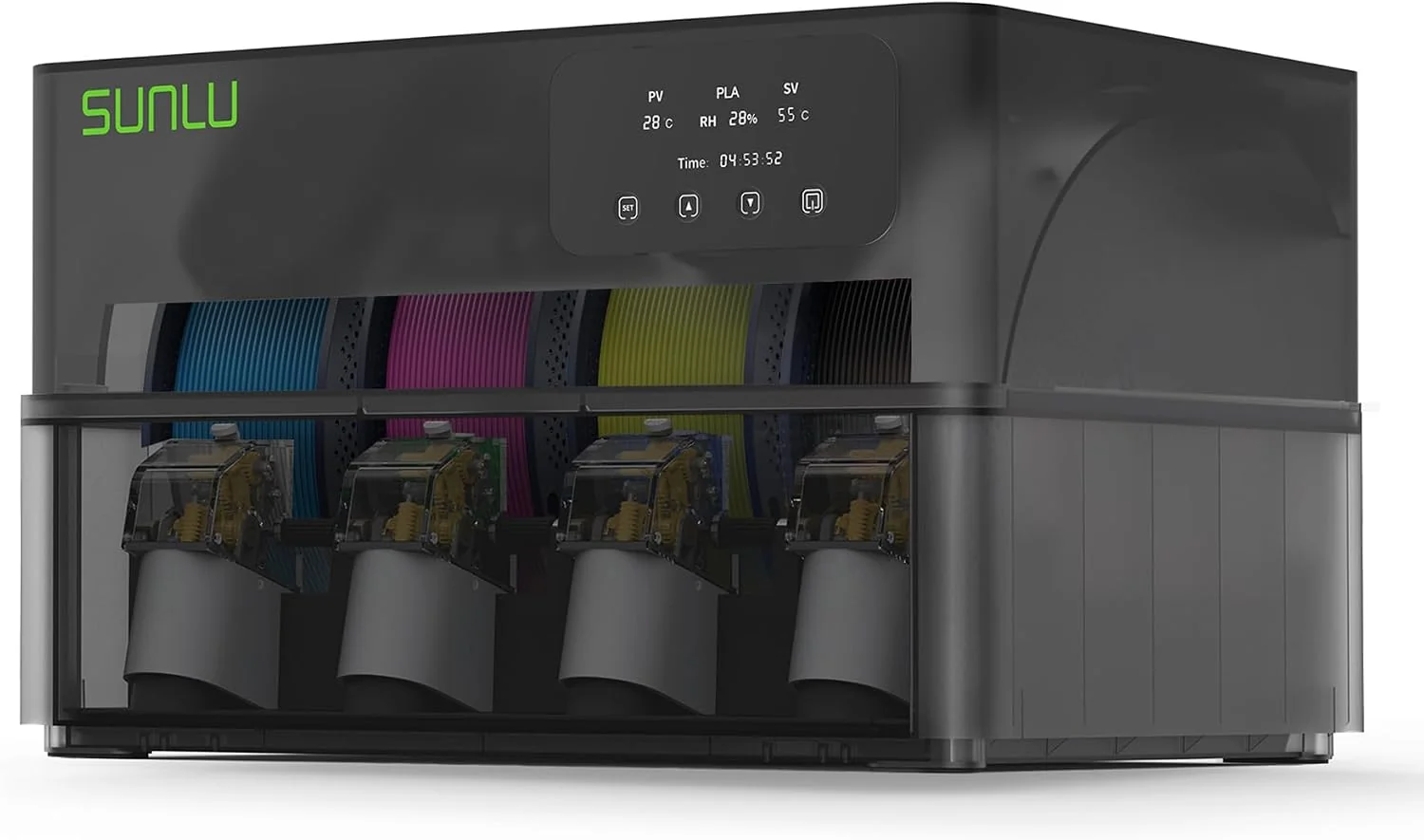
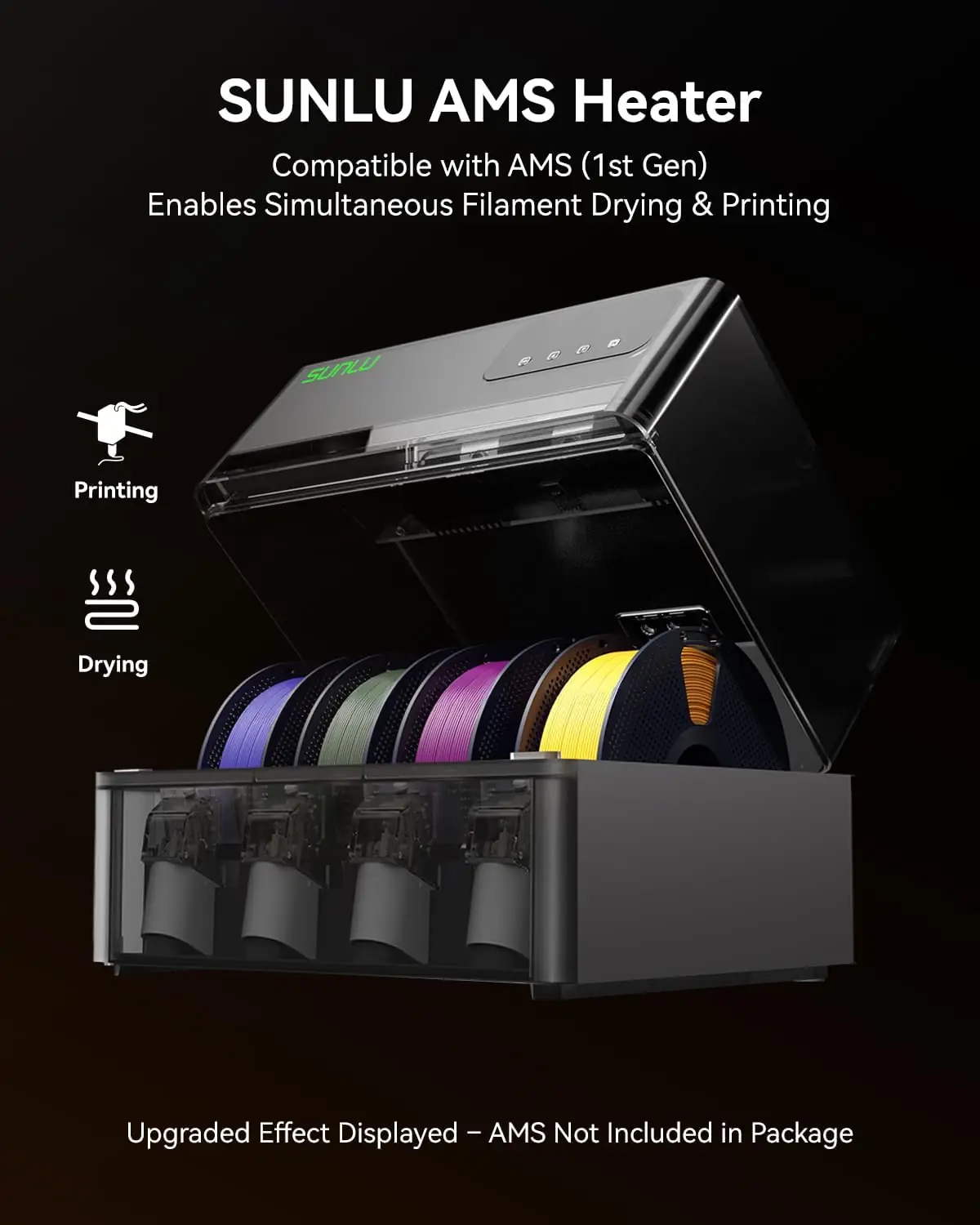
A heated replacement lid for the original enclosed Bambu Lab AMS that dries four loaded spools and, per SUNLU, can dry while you print. It fits only the first-generation enclosed AMS, so check your AMS version and your spools’ heat limits before buying.
Strengths
- Fits an existing first-generation AMS and keeps its four-slot feeding; installation is a hinge swap with the bundled hex key.
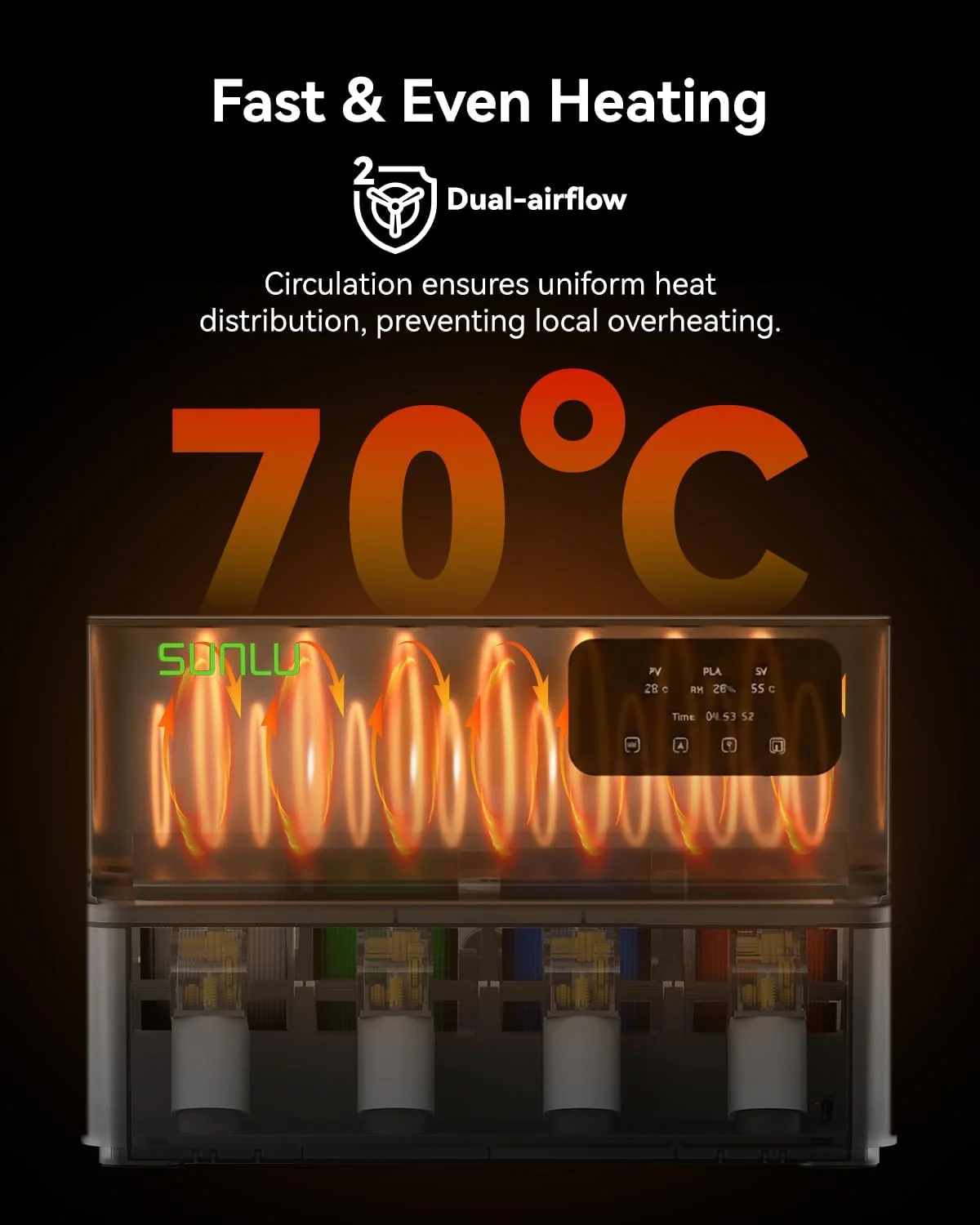
- Dries four loaded spools at once using two internal fans, and SUNLU says it can run while the AMS is feeding a print.
- Adjustable humidity mode with a 25–50% trigger and a 20% stop, plus timers up to 99 hours.
- Replaces the existing top, so it needs no second table-top box.
- SUNLU publishes full electrical specs and a model-specific ETL certificate.
Weaknesses
- One temperature for all four slots, so mixed materials share a single setting.
- Owners report PLA softening and jams when the heater runs during a print.
- An owner reported an original AMS hub and motor binding after repeated 50–60°C sessions.
- One owner documented visible arcing near the board after about 100 hours.
- Humidity rebounds within 1–2 h of shutdown, and owners found it holds RH worse than the stock lid.
- The vent has to be moved by hand, and the flat lid is harder to lift one-handed.
Verified specifications
| Model | SUNLU AMS Heater, built for the first-generation enclosed Bambu Lab AMS. The separate AMS Lite Heater does not fit. |
|---|---|
| In the box | heated lid ×1, replacement hinges ×4, Allen screws ×8, Allen wrench ×1, AC power cable ×1 and a paper manual ×1. The AMS base, motors, rollers, RFID readers, desiccant and spools are not included. |
| Dimensions | 363 × 278 × 131 mm (14.29 × 10.94 × 5.16 in); 1.7 kg net, 2.3 kg gross. Once fitted it sits higher than the stock lid, so check stacking clearance. |
| Electrical | AC 110 V / 60 Hz US version, with a separate 220 V / 50 Hz version abroad. 220 W rated, 390 W maximum, 0.6 W standby; 4.15 A maximum at 120 V and 2.2 A at 230 V. |
| Temperature | adjustable 35–70°C, with SUNLU claiming 70°C in about 20 minutes. |
| Environment | ambient 10–35°C and up to 95% relative humidity; the humidity display covers 10–90% RH and the timer runs 0–99 hours. |
| Controls | front touch panel showing actual and set temperature, RH percentage, filament preset and remaining time, with presets for PLA, PETG, TPU, ABS, PA and PC. |
| Suggested programs | about 50–55°C for PLA, wood, PETG and TPU for 4–6 h; 65–70°C for PVA, PVB, ASA and ABS for 4–6 h; 65–70°C for PA and PC for 10–12 h. |
| Humidity mode | default 50% activation and 20% stop, with the activation threshold adjustable from 25–50% RH. |
| Vent | a manual sliding top cover that you open while drying and close for storage. |
| Cool-down | double-tapping power stops the heater, then the fan runs for about three more minutes. |
| Error codes | ER1 for temperature detection, ER2 for a left PTC fan fault and ER3 for a right PTC fan fault. |
| Listing | an Intertek ETL authorization to mark dated December 5, 2025, control no. 5033524, naming the AMS Heater under UL 499. |
| No filter, pump or water tank | water leaves by heating and ventilation, and the AMS desiccant still works for passive storage. |
Full research notes and sources
What it is and what fits
This is a powered lid, not a whole material system. You keep your original Bambu Lab AMS and swap its top for SUNLU’s heated one; the AMS chassis, rollers, feeder and RFID readers stay put. That is why it costs far less than a complete Bambu AMS 2 Pro, and also why it cannot upgrade old feeders, drive motors or sealing to that hardware. The unit is made for the first-generation enclosed AMS, and SUNLU sells a different AMS Lite Heater for the open four-arm AMS Lite; the two lids are not interchangeable.
Drying and heat limits
The heater uses one shared chamber, so all four spools sit at the same temperature. SUNLU’s manual suggests about 50–55°C for PLA, wood, PETG and TPU, and 65–70°C for ABS, ASA, PA and PC, but it also warns you to confirm the spool material tolerates more than 70°C. Owners have run into that limit: one reported two ABS spools warping during a six-hour 55°C cycle while cardboard spools survived, and others describe PLA going soft inside the feeder and jamming. A separate owner says an original AMS hub and motor started binding after repeated 50–60°C sessions and that Bambu replaced the parts. If you print a lot of PLA, or mix materials in one load, treat the shared temperature as the main constraint.
Humidity and the vent
Drying here is heat plus ventilation, not refrigeration. You slide the top vent open while drying so vapor can escape and close it for storage, and the humidity mode switches the heater on at 25–50% RH and off at 20%. Owners report the display drops to 18–20% while running but rebounds toward 50% within 1–2 h once the heater stops, and some found the AMS humidity indicator got worse than with the stock lid even with fresh desiccant. One owner saw 17–20% on the SUNLU display while Bambu’s app still read D or E, so the two sensors can disagree. Nobody has published a calibrated accuracy figure, so treat the percentage as a rough guide.
Safety, repairs and running costs
The one hard safety signal is an owner report of visible arcing around the main board after about 100 hours of use, alongside earlier fan resonance; the poster switched it off. That is a single case, not a recall, but a heater with a 120/230 V board is not a self-service item — if it buzzes, smells hot or sparks, cut power and contact SUNLU. The manual specifies a one-year warranty and lists AMS Heaters under its 12-month electronic-dryer coverage, and support runs through support@sunlu.com with an initial reply in 1–2 working days. SUNLU does not publish standalone spare-part prices, so heat-related damage to the AMS itself is the real risk: a Bambu AMS mainboard is $54.99, and an AMS desiccant pack is $3.99 for six.
Running costs are modest. SUNLU lists 220 W rated and 390 W maximum, and at an assumed $0.20 per kWh a six-hour cycle is about $0.26, or $0.47 at the full 390 W. Four hours a week for a year lands near $9–17 plus about $1 of standby, and leaving it in humidity mode all year could add roughly $35. There is no filter, cartridge or subscription.
Is it worth it?
SUNLU’s US store lists the lid at $99.99 against an advertised $119.99, and a Walmart seller listing showed $67.82 reduced from $84.99, though that page carried stale delivery text. Early-bird pricing in 2025 was $109.99 against a $119.99 nominal. At $81–100 it is the standard maker price; buy it for integrated four-spool drying and a smaller bench footprint, not because drying during a print is proven safe for every Gen-1 AMS. Above $120 a separate dryer makes more sense: SUNLU’s own FilaDryer S4 Pro is $139.99 with two independently settable zones up to 85°C, and Creality’s SpacePi X4 is $159. A Bambu AMS 2 Pro is $359 and replaces the whole feeder, but it is a different purchase.
Sources
Manufacturer:
- SUNLU AMS Heater product page
- SUNLU AMS Heater user manual, January 2026 (PDF)
- SUNLU US store listing
- Intertek ETL authorization to mark (PDF)
- SUNLU warranty statement
- SUNLU after-sales support
Independent reviews:
Owner reports:
- Visible arcing near the board (r/BambuLab)
- Original AMS hub and motor binding after heat (r/sunlu)
- Spools deformed at a displayed 55°C (r/sunlu)
- Humidity rebounds after shutdown (r/sunlu)
- SUNLU RH reading vs Bambu humidity categories (r/BambuLab)
- Vent placement and desiccant humidity (r/BambuLab)
- Vent handling and accidental touch buttons (r/BambuLab)
- PLA softening and jams (r/3DPrinterComparison)
- Generic TPU feeding not enabled (r/BambuLab)
- RH display worsens during PETG drying (r/BambuLab_Community)
Parts and stores: