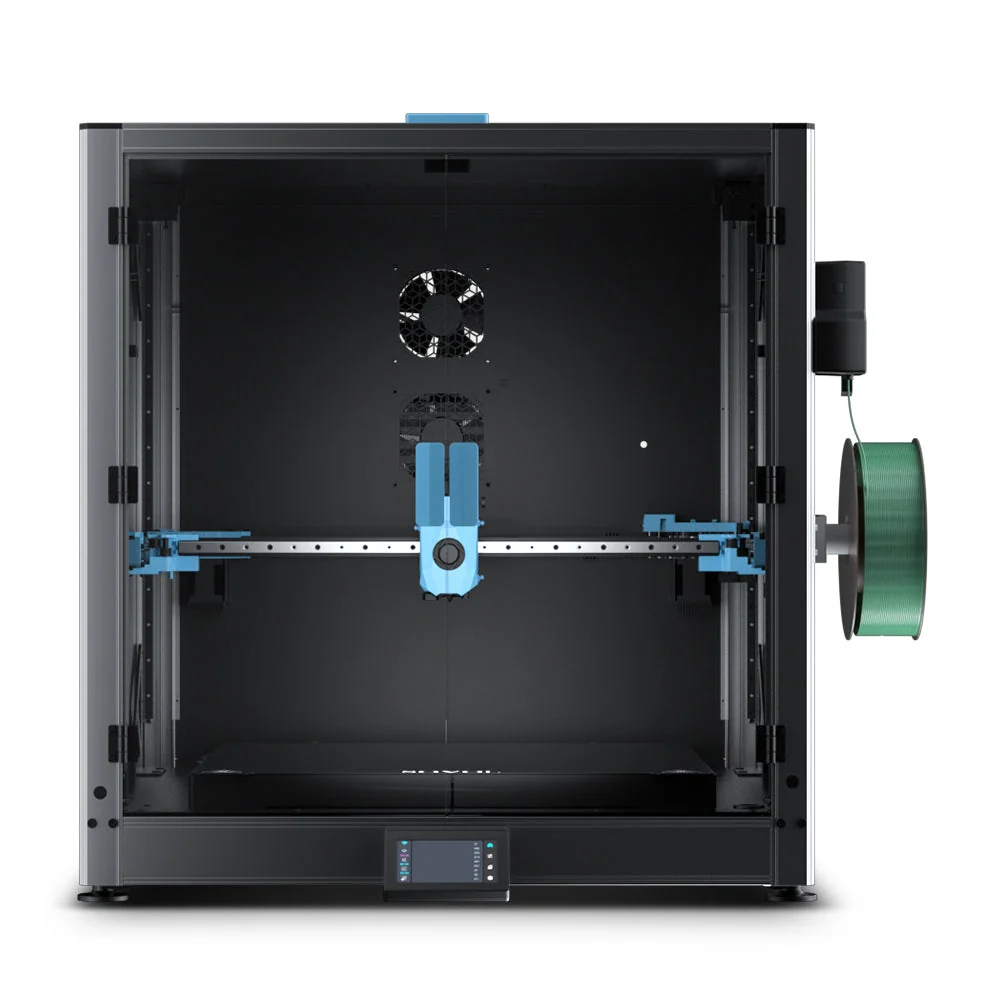
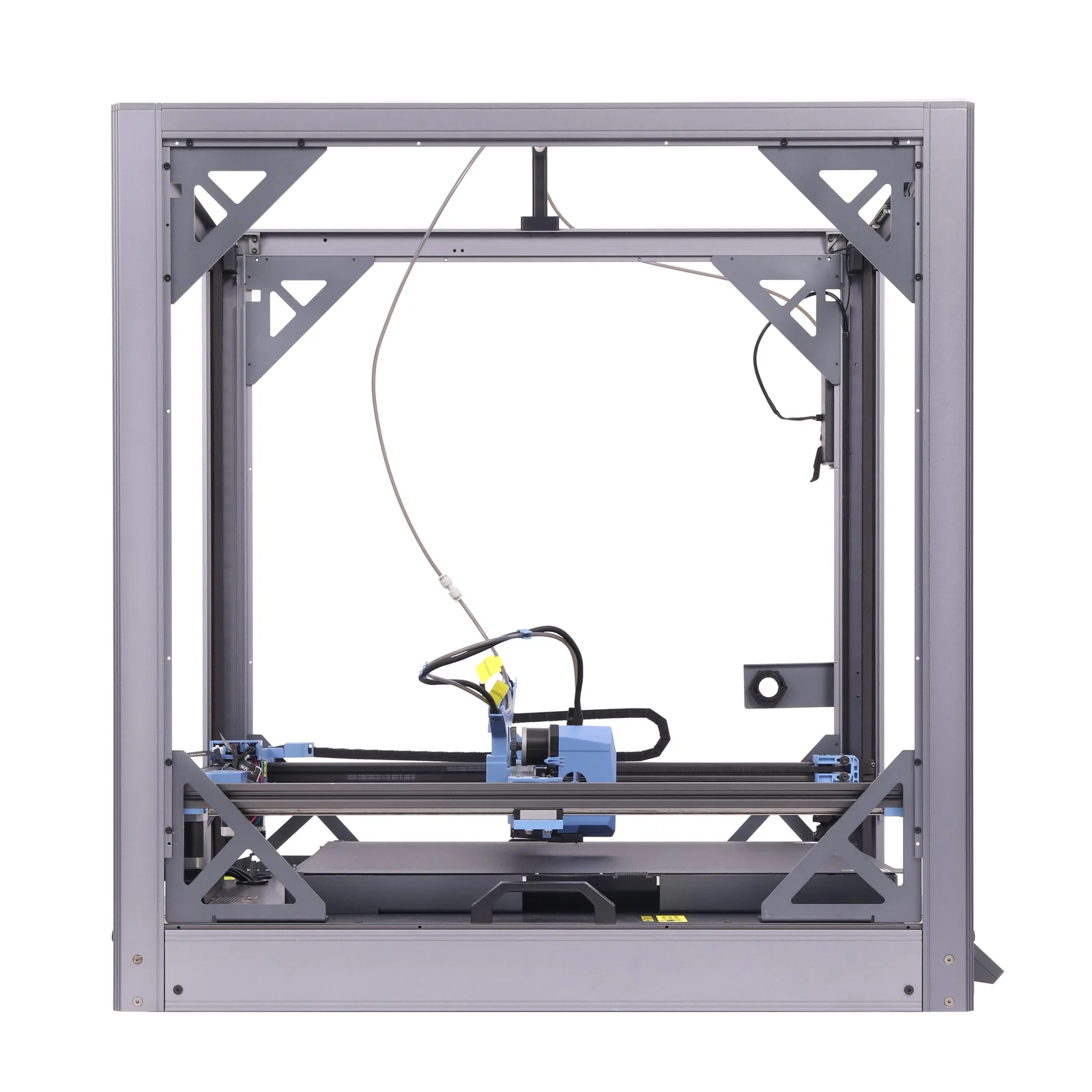
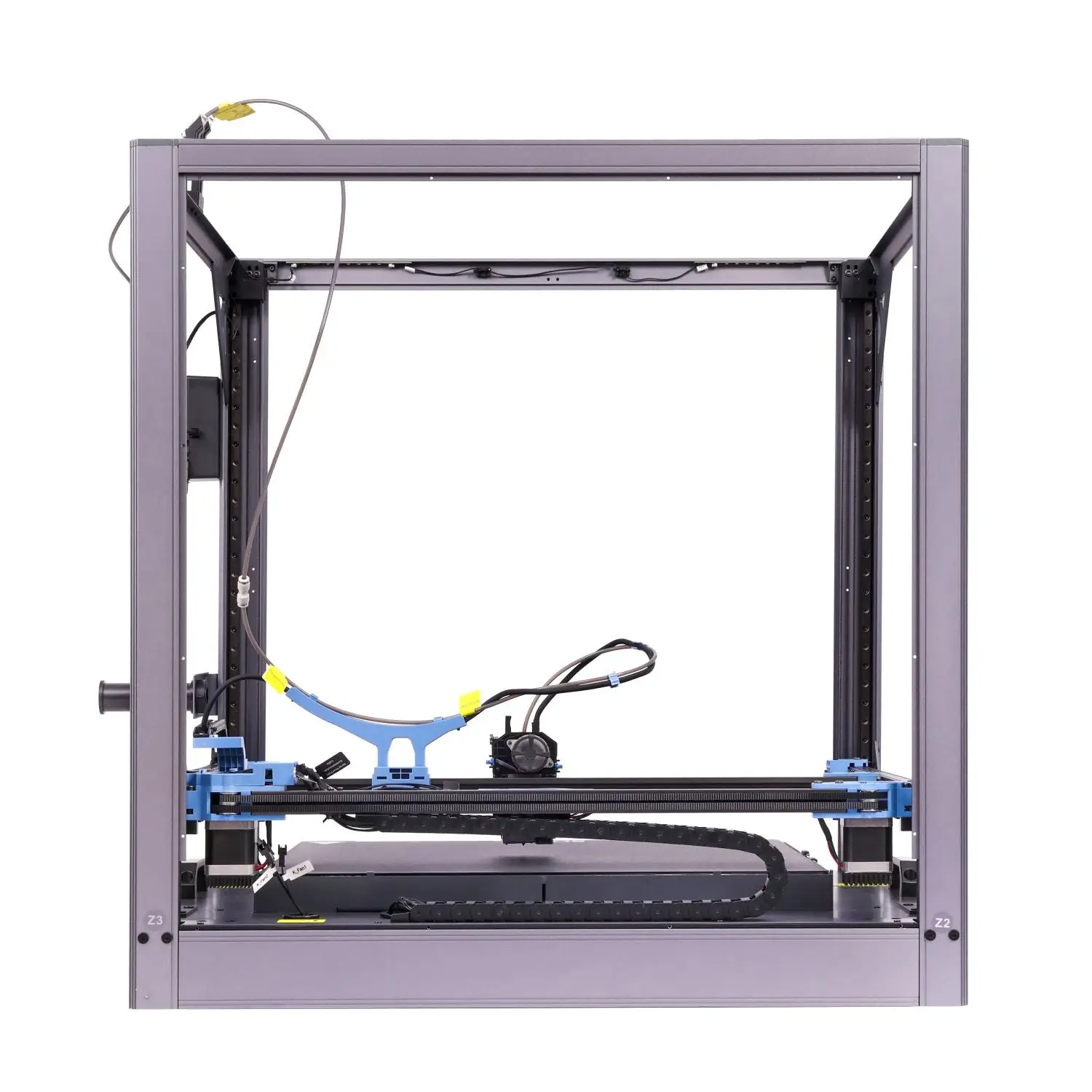
Sovol SV08 Max
By Sovol · 3D Printers · 3D Printing
- 500 x 500 x 500 mm build volume (450 mm height with enclosure kit)
- Max speed 700 mm/s, acceleration up to 40,000 mm/s2
- Nozzle up to 300 C, heated bed up to 100 C
- Klipper firmware, CoreXY
Lowest price seen
$928.99
from $928.99 at eBay · Checked Oct 13, 2026
- eBay $928.99View at eBay
- comgrow.com $999.00View at comgrow.com
- West3D $1,099.00View at West3D
- IIID MAX $1,099.00View at IIID MAX
- SovolView at Sovol
- eBay (used) eBay: used, open-box, refurbishedView at eBay (used)
- AmazonView at Amazon
Prices are snapshots. Check the current price with the store.
Summary
A large-format CoreXY printer with a 500 x 500 x 500 mm build volume that drops to 450 mm tall with the optional enclosure, and the cheapest route to this size in the consumer class. Expect to finish the calibration yourself: owners report wrong factory belt and E-step settings, and the auxiliary filament feeder is the machine’s most repeated failure point.
Strengths
- The 500 mm cube is the cheapest credible route to this build volume in the consumer class.
- One full independent review found the hardware solid and the finished test parts good once tuned.
- Eddy current levelling is fast and contactless, and the four-motor Z gantry keeps the large bed flat.
- The auxiliary feeder does push difficult filament such as TPU through the long Bowden path.
- Vanilla Klipper is an advantage for anyone willing to work on the machine.
- Once dialled in, long-term owners report large speaker enclosures and equipment cases printing well.
Weaknesses
- The auxiliary filament feeder is the most repeated complaint: false “clog detected” pauses, weak spring grip and units that stop feeding filament entirely.
- Factory calibration is reported wrong out of the box, including belts, E-steps and a nozzle temperature reading 10-15 °C low.
- The default 40,000 mm/s² acceleration is a headline figure; one owner reports near-inevitable layer shifts above 10,000 mm/s².
- The bed is heavy and needs a long heat soak, and first-layer adhesion is a repeated source of failed prints.
- The enclosure’s magnetic door catches do not hold the doors, which rattle at speed, and with it fitted the usable height is 450 mm, not 500 mm.
- Returns are only 14 days and the printer warranty is one year, which matters given the calibration reports.
Verified specifications
| Build volume | 500 x 500 x 500 mm open frame; 500 x 500 x 450 mm with the enclosure kit. |
|---|---|
| Kinematics | CoreXY flying gantry with a fixed bed, and a Z gantry driven by four independent stepper motors. |
| Linear rails on the X, Y and Z axes. | |
| Max print speed | up to 700 mm/s claimed. |
| Max acceleration | up to 40,000 mm/s² claimed. |
| Max volumetric flow | 50 mm³/s claimed. |
| Hot end | direct drive, two 0.4 mm hardened steel nozzles fitted, with 0.4, 0.6 and 0.8 mm options and a 300 °C maximum nozzle temperature. |
| Heated bed | an 8 mm aluminium plate with a 1300 W heater, up to 100 °C. |
| Build plate | double-sided PEI spring-steel sheet, magnetic and removable. |
| Bed levelling | eddy current automatic scanning, stated to scan the bed in 80 seconds, plus pressure-based touch calibration. |
| Firmware | Klipper on a Sovol fork; ships with OrcaSlicer and a machine profile. |
| Connectivity | 4.3-inch LED touchscreen, USB, Ethernet and Wi-Fi on both 2.4 GHz and 5 GHz bands, with an integrated monitoring camera. |
| Filament | 1.75 mm, with runout, tangle and clog detection; PLA, PETG, TPU, ABS, ASA, PC and PA up to 300 °C, with ABS, ASA, PC and PA needing the enclosure. |
| Dimensions and weight | 700 x 710 x 750 mm; 29.5 kg (65.03 lb) without the enclosure, close to 100 lb with it. |
| In the box | printer and enclosure flat-packed, tool kit, USB drive with assembly video and manual, spare nozzle, sample filament and printed build guide. |
| Release date | June 3, 2025. |
| Warranty | 1 year on the printer, 3 months on the extruder unit and 1 month on accessories; print plates and nozzles are excluded, and returns run 14 days. |
Full research notes and sources
Size, setup and calibration
This is a machine that does not fit a normal desk: 700 x 710 x 750 mm and 29.5 kg without the enclosure, close to 100 lb with it, and Tom’s Hardware’s reviewer could not get it through a door without disassembly. It arrives flat-packed and needs real assembly, including bolting on the enclosure, and the setup expects you to finish the calibration. With the enclosure fitted the usable Z height is 450 mm, and the machine will not warn you, so set the build height by hand or the toolhead will hit the top.
Multiple owners report the factory settings are off. A September 2026 owner found the A/B belt tuning “wasn’t even close to right”, wrong E-steps and a nozzle that read far from the target temperature, and spent weeks and at least 3 kg of PETG before a decent print. Another measured his hot end 10-15 °C low and rewrote the printer configuration to compensate, and a third commanding a 100 mm extrude measured about 90 mm of filament fed. Tom’s Hardware lost five large attempts and about half a spool to Z-offset and first-layer problems before adding roughly 0.2 mm and letting the bed heat soak for about 20 minutes. The headline 40,000 mm/s² acceleration is not a usable default: one experienced owner reports near-inevitable layer shifts above 10,000 mm/s² and runs 8500 mm/s² as his maximum.
The auxiliary feeder and the Klipper fork
The auxiliary feeder is the machine’s defining weakness. Owners describe prints pausing for a clog that is not there, a buffer spring too weak to grip the filament, and feeders that stop driving filament mid-print, and Sovol’s own forum calls the feeder “known to be troublesome”. Because the runout sensor sits in the feeder there is no automated recovery, so a runout means pulling filament out of a five-foot Bowden tube by hand. Some owners replace the stock feeder outright, and documented fixes use larger-ID PTFE to cut resistance in the long path.
The machine runs Klipper on a Sovol fork that one forum participant says has not been released publicly, which is why owners lean on a community macro package to disable clog detection, wait for the bed to settle and fix the unload routine. The toolhead and mainboard are otherwise conventional: one owner got close to 200 hours of useful printing before intermittent communication loss with the extra MCU began. A separate cluster of reports covers bed-heater faults, with a Klipper “not heating as expected” shutdown traced in one case to loose bolts securing the 1300 W heater.
Running costs and parts
Filament and electricity dominate operating cost. The bed heater alone is rated at 1300 W, and Tom’s Hardware used 2.5 spools of PLA for one large table print while losing about half a spool dialling in another. As a high-side illustration, running the 1300 W bed at full power for 10 print-hours a week would equal 676 kWh a year, about $123.78 at the July 2026 US residential average of 18.31 cents/kWh, but that is not a measured whole-printer bill because the bed cycles and the hotend, steppers and fans also draw power.
Parts are sold through Comgrow, which lists an SV08 Max extruder assembly kit at $99.99, a flexible steel build plate kit at $79.99 and the enclosure kit at $198 (Comgrow, October 2026), and a spare nozzle ships in the box. There is no mandatory subscription. Calibration labour is the real recurring cost, and Sovol’s warranty excludes print plates and nozzles as consumables.
Is it worth it?
Sovol’s US policy gives 1 year on the printer, 3 months on the extruder unit and 1 month on accessories, and returns are 14 days from receipt. That short return window is the term that matters most, because the calibration and feeder complaints often surface only once you start printing. At $1,099 for the open frame, or about $1,318.99 with the $219.99 enclosure (Sovol US, October 2026), it is worth it only if you specifically need a 500 mm cube and are willing to tune it. If you need large-ish prints rather than this size, the same money buys a smaller machine with a shorter list of problems: the Anycubic Kobra 3 Max is 420 x 420 x 500 mm at $493, and the much larger Elegoo OrangeStorm Giga is about $2,499 at 800 x 800 x 1000 mm. Sovol’s own 350 x 350 x 345 mm SV08 is $549. Add the enclosure only if you print ABS, ASA, PC or PA, and note that Sovol supplies no carbon filter. Treat the 700 mm/s and 40,000 mm/s² figures as headline numbers.
Which model this is
This page covers the Sovol SV08 Max, the 500 x 500 x 500 mm CoreXY machine, ASIN B0FK9NR69S. It is not the smaller 350 x 350 x 345 mm SV08, nor the Sovol Zero, though the Zero shares the nozzle and much of the toolhead including the eddy current sensor. Two retail variants exist: open frame and open frame plus enclosure kit.
Sources
Manufacturer:
- Sovol SV08 Max product page — Sovol US
- Sovol SV08 Max official wiki and troubleshooting hub
- Sovol returns, refund and warranty policy
- SV08 Max enclosure kit — Sovol US
- SV08 Max 1300 W heated bed specification — Sovol EU
- Sovol SV08 product page
- Sovol FAQ
- Sovol product list
Independent reviews:
Owner reports:
- SV08 Max major quality problems (r/Sovol)
- Nozzle ramming into the bed (r/Sovol)
- SV08 Max clog detected (r/Sovol)
- Insane value for the money thread (r/Sovol)
- Inconsistent first layers and eddy-probe drift (r/Sovol)
- Toolhead and extra-MCU communication failure (r/Sovol)
- Sovol 08 Max should not have been released (Sovol forum)
- Bed heater shutting down during pre-heat (Sovol forum)
- Filament feeder failures (Sovol forum)
- Auxiliary feeder issue (Sovol forum)
- External feeder assist replacement (Sovol forum)
- SV08 Max extruder temperature calibration (Sovol forum)
Parts and alternatives: