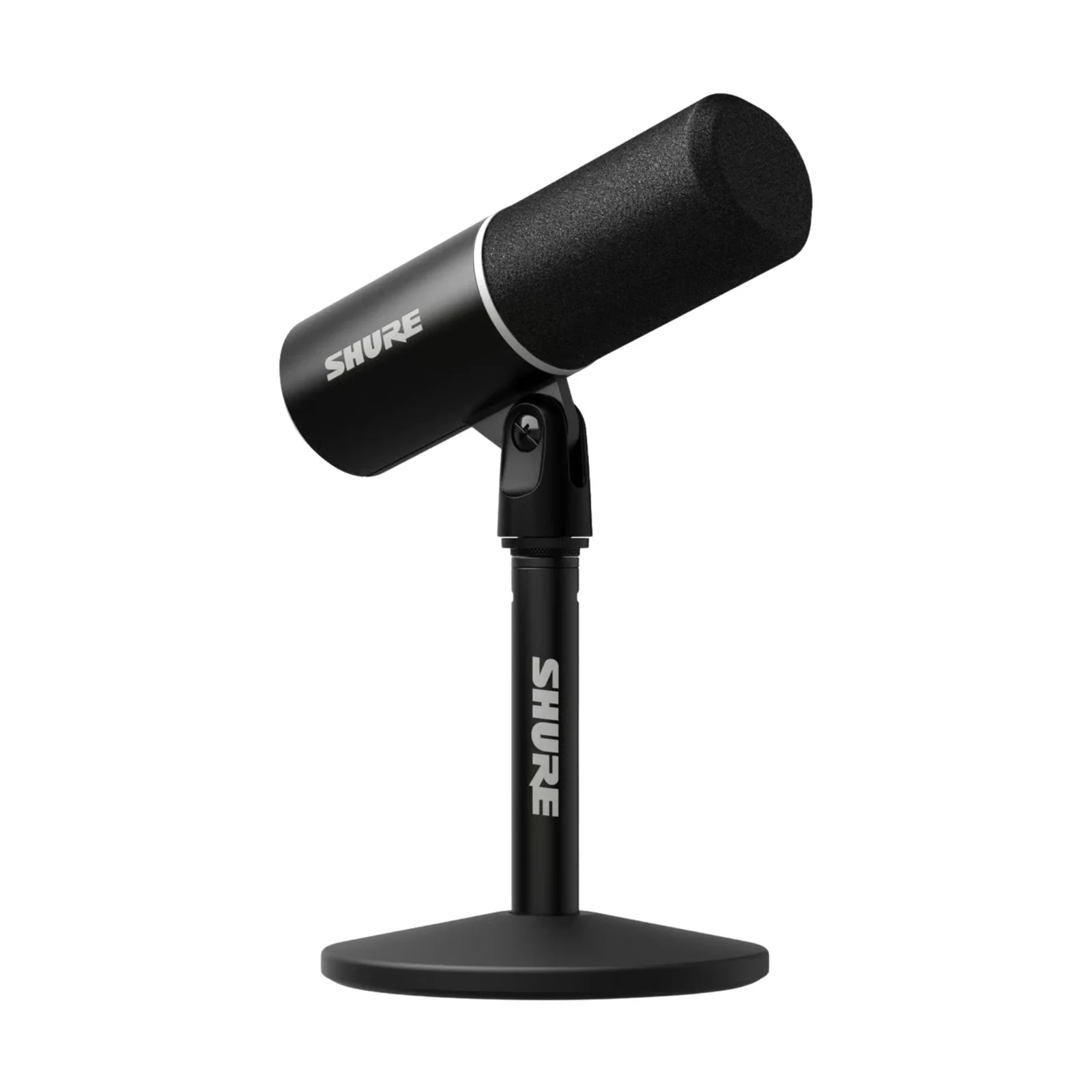
Shure MV6 Gen 2 Usb Microphone
By Shure · USB Microphones · Desk & Streaming Setup · More from Shure
- USB-C connection
- Adjustable Auto Level Mode
- Adjustable real-time Denoiser
- 5-band EQ
- Digital Popper Stopper
Price not listed
- ShureView at Shure
- eBayView at eBay
- AmazonView at Amazon (paid link)
- eBay (used) eBay: used, open-box, refurbishedView at eBay (used)
Stores are listed in a fixed order, never by price or commission. Prices are snapshots. Check the current price with the store.
Summary
Shure’s second-generation MV6 keeps the cardioid dynamic capsule, USB-C single-cable setup and desktop stand of the 2024 original, and puts its changes into software: adjustable Auto Level, an adjustable Real-Time Denoiser, a five-band EQ and three presets, all saved inside the microphone. Two things to check before buying: the denoiser does not remove mechanical-keyboard noise, and the included stand passes desk bumps up its hollow shaft with no damper in the box.
Strengths
- Warm, broadcast-level speech quality out of the box, with no tweaking needed.
- Auto Level rides whisper-to-shout gaming dynamics without obvious correction artifacts.
- Zero-latency headphone monitoring because the processing runs inside the mic.
- Single-cable plug-and-play across PC, Mac, iOS and Android, with settings stored in the mic.
- MOTIV Mix handles up to five audio channels and two MV6 mics on one PC.
Weaknesses
- The denoiser cuts appliance and footstep noise but not a mechanical keyboard.
- Desk bumps travel up the hollow stand shaft; no damper is included, and one reviewer fixed it with polymer clay.
- Every control except mute lives in the MOTIV apps, and the mute button can trigger accidental mutes unless disabled in software.
- No XLR output and no onboard gain knob, so buyers wanting hardware control or an interface need another mic.
Verified specifications
| Model | MV6 USB Gaming Microphone Gen 2; black SKU MV6G2-K, white SKU MV6G2-W. |
|---|---|
| Capsule | dynamic (moving coil), unidirectional cardioid. |
| Capture quality | 24-bit/48 kHz. |
| Onboard DSP | adjustable Auto Level Mode (selectable gain threshold and response time), adjustable Real-Time Denoiser intensity, Digital Popper Stopper, high-pass filter, a Dark/Natural/Bright tone slider and a 5-band EQ. |
| Smart Audio Presets | Speech (Auto Level, denoiser and Digital Popper Stopper active), Singing (denoiser off) and Instrument (unprocessed signal). |
| Max SPL | 128 dB. |
| Connectivity | USB-C, plug-and-play, no drivers; PC, Mac, iOS and Android. USB 2.0. |
| Monitoring | 3.5 mm headphone output with zero-latency monitoring of the mic and system audio. |
| Frequency response | 50 Hz–15,000 Hz (from the original MV6 spec sheet; Gen 2 materials don’t restate it). |
| Gain | 0 to +36 dB adjustable; sensitivity -34.7 dBFS/Pa at 1 kHz at minimum gain in flat mode (original MV6 figures). |
| Apps | MOTIV Mix desktop on Windows 10+ and macOS 14+ (2 GB RAM, 500 MB disk); MOTIV Audio & Video mobile on iOS 17+ and Android 14+. |
| Mute | tap-to-mute button with no audible click; it can be disabled in the MOTIV apps. |
| Settings storage | saved in the microphone itself, so a configured sound follows it across devices. |
| Multi-mic | MOTIV Mix mixes and controls up to five audio channels; two MV6 mics can run on one PC. |
| Colors | black and white; the white pairs with a space-gray flocked windscreen. |
| In the box | microphone, a 2 m USB-C to USB-C cable, a 12 cm round-base desktop stand with an isolation base, and a threaded adapter for 1/4-inch and 5/8-inch mounts. |
| Dimensions | not published for Gen 2; the original MV6 shares the body and stand at 169 × 51 mm mic only and 295 × 169 × 127 mm (11.6 × 6.6 × 5 in) with the base, at 1,287 g (2.83 lb). |
| Warranty | not stated for Gen 2; the original MV6 was listed with a 2-year limited warranty. |
Full research notes and sources
What changed in Gen 2
The Gen 2 is a DSP-and-accessory revision, not a redesign: same cardioid dynamic capsule, same USB-C single-cable design, same desktop stand, and a $169 US launch price. Shure’s documented changes are adjustable Auto Level for gain threshold and response time, an intensity slider on the Real-Time Denoiser, a five-band EQ alongside the Dark/Natural/Bright tone slider, and Speech, Singing and Instrument presets. Settings are stored in the microphone, so a configured sound travels with it. The bundled cable doubles from 1 m to 2 m, and there is a new white colorway with color-matched accessories.
One caveat on the marketing: Shure lists the “Built-in Digital Popper Stopper” among the Gen 2 upgrades, but the original MV6’s 2024 spec sheet already included a Digital Popper Stopper and Real-Time Denoiser. Treat “new” as revised, not first-time.
Sound, noise and the stand
Early coverage is positive. CGMagazine scored it 9/10, calling it the most substantial gaming mic it had tested and the strongest option under $200 for podcast-level streaming audio, with auto-level transitions it described as very smooth and never overcorrecting. Windows Central praised the out-of-the-box sound and the expanded DSP control, and GamingTrend rated it Excellent, describing the capsule as close to the MV7 and monitoring as delay-free.
The denoiser is the feature to understand. CGMagazine found it removed water-heater, dehumidifier and upstairs footstep noise, but it did not remove mechanical-keyboard sound, and it only reduced rumble coming through the stand tubes. Nobody has published a failure rate for any of this, so treat it as a known limit rather than a defect. No instrumented measurements of the Gen 2 exist yet; the product launched about three weeks before this check, and aggregated Reddit sentiment exists only for the original MV6, at 87% positive.
The stand has an isolation base for desk bumps, but CGMagazine still found vibration travelling up the hollow stand shaft and fixed it with polymer clay; no rubber plug or damper is in the box. If you type while recording, plan for a boom arm or a damper rather than trusting the included stand.
Controls, apps and connections
The mute button can be disabled in software to stop accidental mutes, a detail seller listings rarely mention. There is no XLR output and no interface or mixer is needed; buyers who want XLR should look at Shure’s MV7 line instead. The 3.5 mm jack monitors the mic and system audio with no delay because the processing is internal.
At launch the Gen 2 is $169 in the US, the same figure Sweetwater lists for the black unit. CGMagazine’s comparison puts it $50 above the HyperX QuadCast 2 and $60 above the Blue Yeti or Maono PD300X, and Windows Central names the Razer Seiren V3 Chroma and HyperX QuadCast 2 S as direct competition. In the UK the RRP is £159; European press releases say €150, while the Shure Europe shop listed €185 for the same SKU.
There are no subscriptions and no consumables, so the only extras are optional: a boom arm, which the included threaded adapter supports, and a stand damper. The original MV6 commonly street-priced around $150, and a Reddit deal thread showed it brand new at $109.99. Gen 2 warranty terms are not stated in public materials; the original was listed with a two-year limited warranty.
Which model this is
This page covers the second-generation MV6, sold as MV6G2-K in black and MV6G2-W in white; the two colorways appear cosmetically different only. Don’t confuse it with the original 2024 MV6, the MV7, the MV7+, the SM7B or the PodMic USB. The US Amazon listing is ASIN B0HD9VYLY7.
Sources
Manufacturer:
- MV6 Gen 2 USB Gaming Microphone (Shure USA)
- Shure introduces the next generation of the MV6
- MV6 Gen 2 spec sheet (PDF)
- Original MV6 spec sheet (PDF)
Independent reviews:
- Sound on Sound: MV6 gets a Gen 2 upgrade
- audioXpress: Shure makes the new MV6 smarter for gamers
- The Verge: Shure’s next gaming mic
Owner reports: