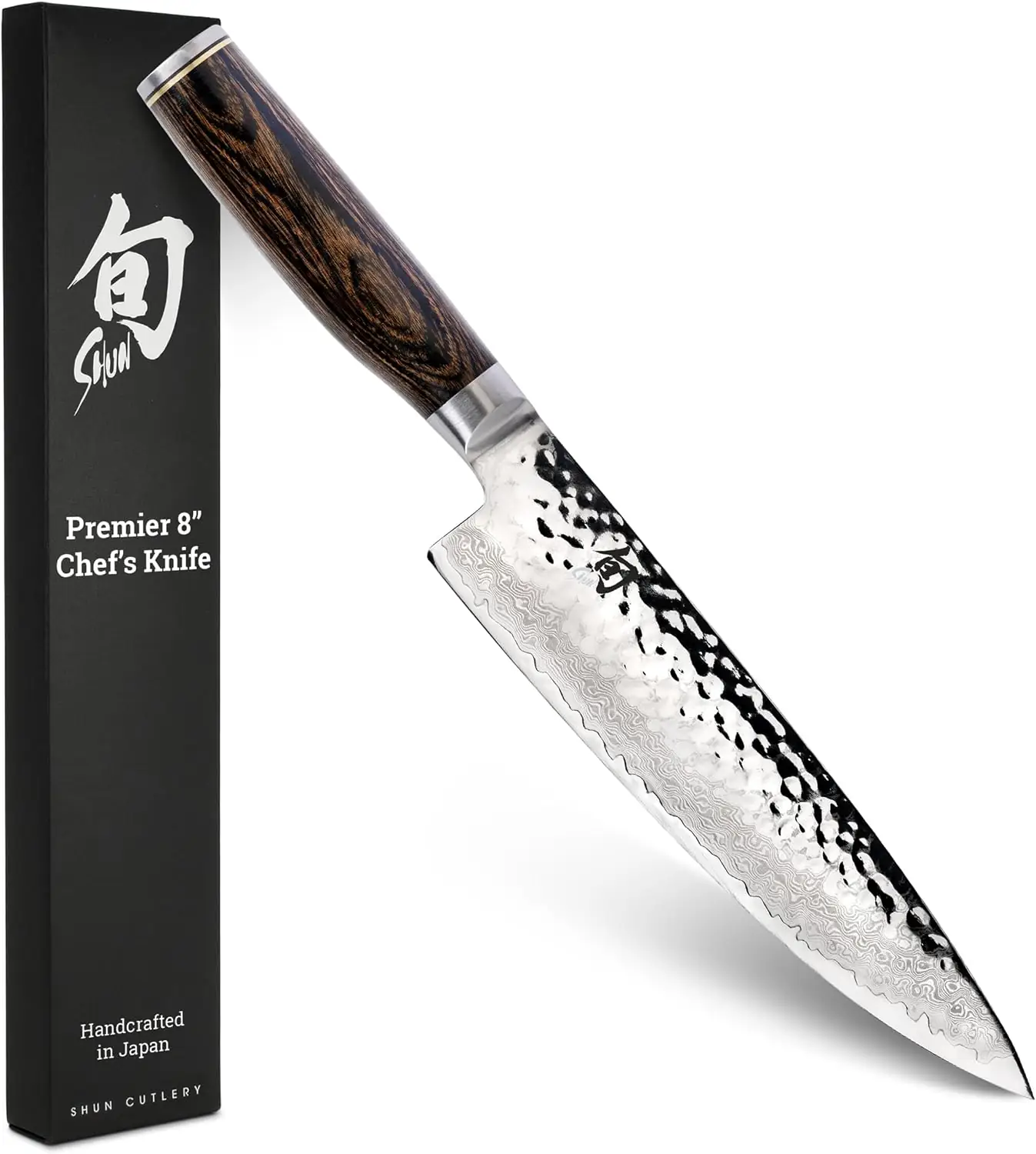
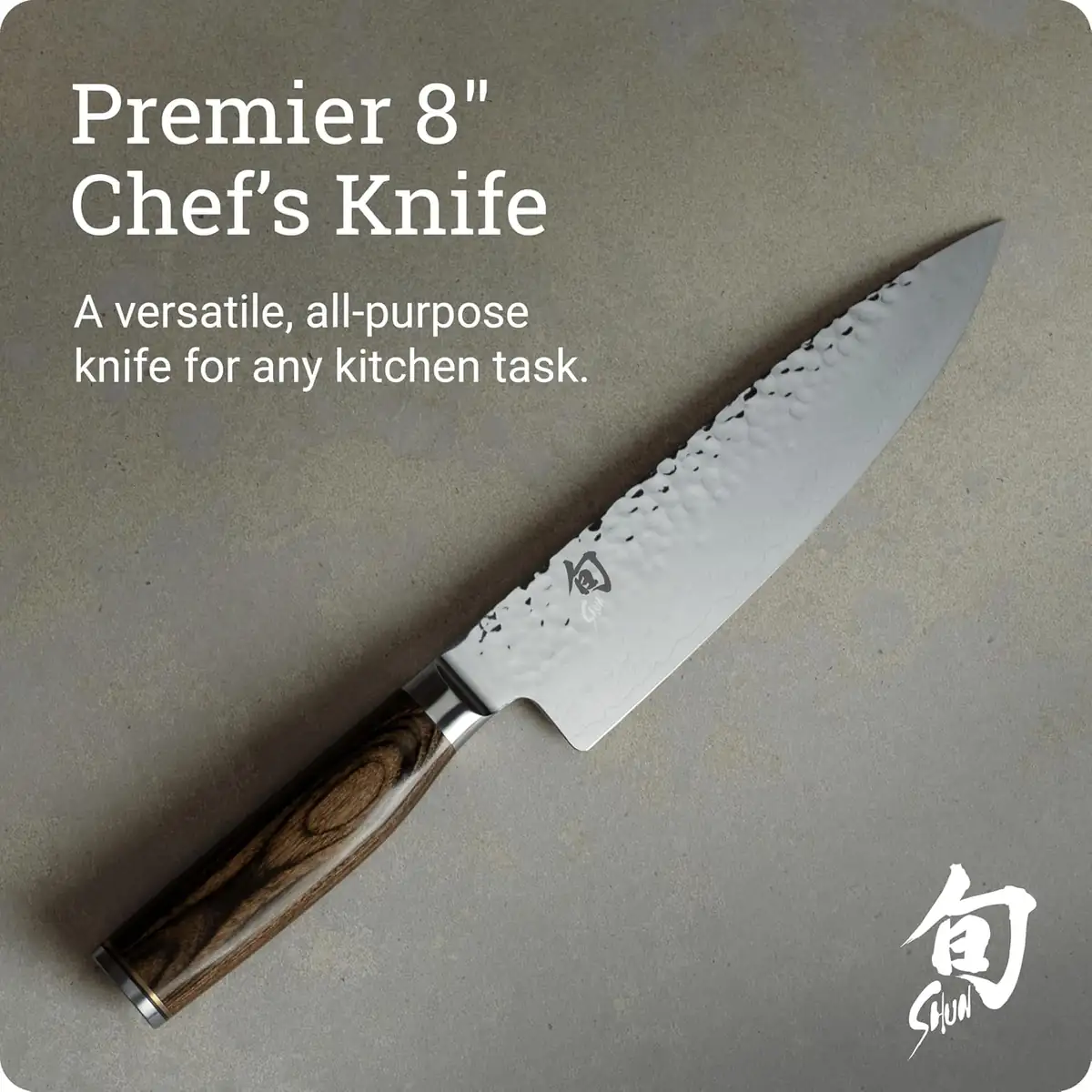
Shun Premier 8" Chef's Knife
By Shun · Kitchen Knives · Kitchen & Cooking · More from Shun
- 8 in (203 mm) blade
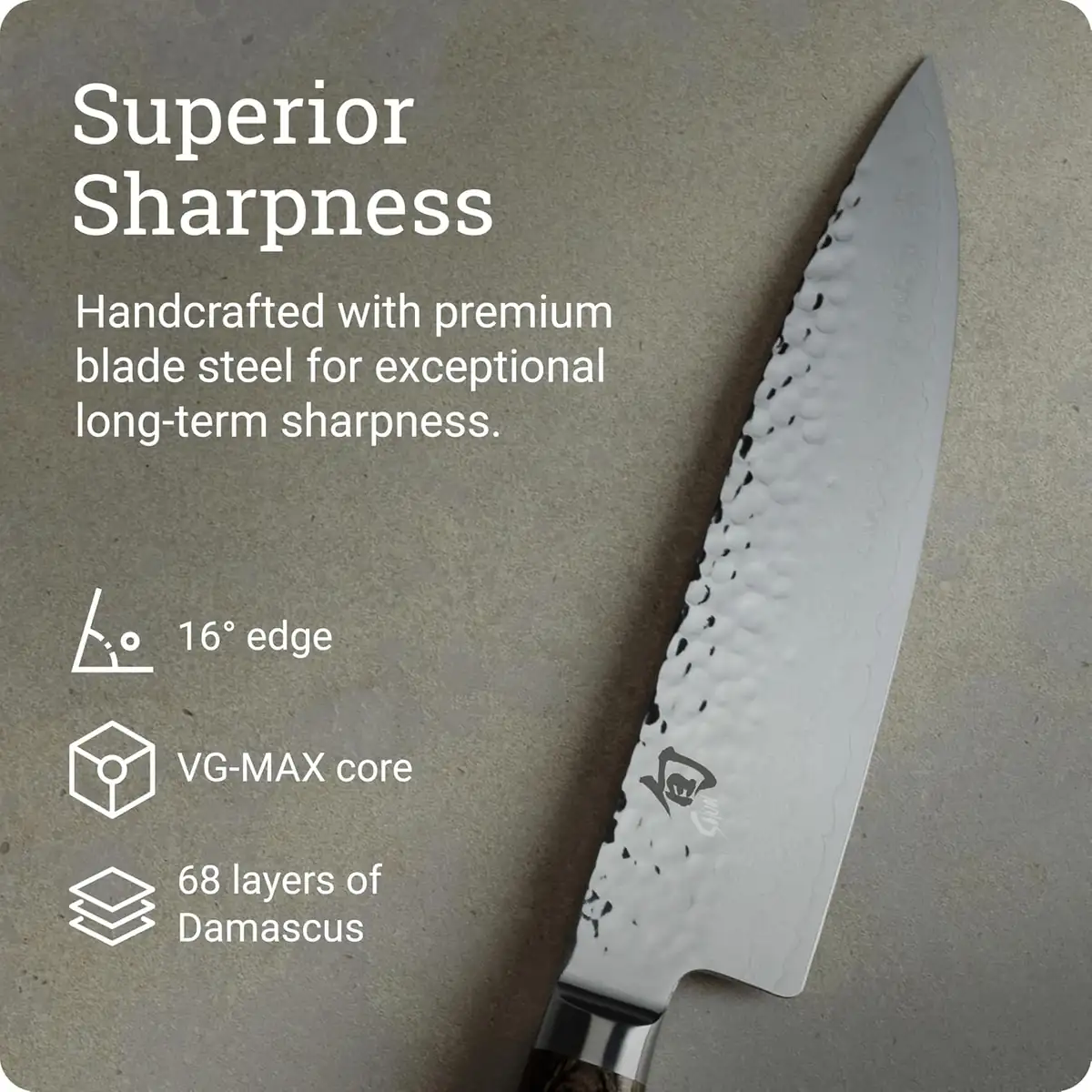
- VG-MAX core 60-61 HRC
- 69-layer Damascus
- 16° edge per side
- 7.4 oz (210 g) weight
Price not listed
- ShunView at Shun
- eBay (used) eBay: used, open-box, refurbishedView at eBay (used)
- eBayView at eBay
- AmazonView at Amazon (paid link)
Stores are listed in a fixed order, never by price or commission. Prices are snapshots. Check the current price with the store.
Summary
A handcrafted Japanese chef’s knife with a Western blade profile, a VG-MAX steel core hardened to 60–61 HRC and a contoured walnut Pakkawood handle, for cooks who want a very sharp, light blade and will treat it carefully. The edge is thin and brittle, so decide whether you can live without cutting bones, frozen food or thick-skinned squash before you buy.
Strengths
- Extremely sharp out of the box: the specialist reviewer called it the best factory sharpness he had tested, cutting tomatoes, onions, carrots and bacon with little effort.
- Light and well balanced, with a wide handle that suits a pinch grip over a full prep session.
- The hard VG-MAX core (60–61 HRC) holds an edge well.
- Backed by a limited lifetime warranty and free lifetime sharpening for the original owner.
- Handcrafted in Seki City, Japan, in at least 100 steps.
- Owners consistently praise the handle, the finish and the edge holding.
Weaknesses
- The thin, hard edge chips on chicken bone, thick-skinned squash, frozen food or sideways scraping.
- Food release is mediocre; the reviewer found the tsuchime divots sit too high on the tall blade to help.
- The spine is not crowned and can bite a finger during a pinch grip.
- The factory edge angle is disputed (12° vs 16° per side), so expect a delicate edge and verify on the actual unit.
- Not user-serviceable: repair means sending it to Shun, and a chip beyond factory repair means replacement.
- Not dishwasher-safe; dry it immediately, because moisture on the thin edge can cause corrosion-related micro-chipping.
Verified specifications
| Model | TDM0706. |
|---|---|
| Blade length | 8 in (203 mm) per the manufacturer; some retailers list 200 mm. |
| Blade steel | VG-MAX core, wear- and corrosion-resistant. |
| Cladding | 34 layers of Damascus stainless per side; the “69 layer” figure counts the core, and the same product copy also says “68 micro layers”. |
| Hardness | 60–61 HRC. |
| Handle | contoured walnut-color Pakkawood, full tang, embossed stainless end cap. |
| Handle length | 5.0 in (127 mm) per the manufacturer. |
| Weight | 7.4 oz (210 g) per the manufacturer; independent and retailer figures run 7.3–7.68 oz. |
| Country of origin | Japan (Seki City). |
| Warranty | limited lifetime. |
| Sharpening | free for the life of the knife for the original owner; the buyer pays shipping. |
| Dimensions | 13.6 × 1.9 × 0.8 in (L × H × W) per the manufacturer. |
Full research notes and sources
Blade, steel and edge
The blade is a VG-MAX core clad in 34 layers of Damascus stainless per side and finished with a hammered tsuchime pattern. Shun hardens the steel to 60–61 HRC, which is what keeps the edge going but also what makes it brittle.
The “69 layer” claim counts the core, not 69 cladding sheets; the cladding is 34 layers per side, and the same product copy also says “68 micro layers”. The hammered finish is meant to reduce drag, but the reviewer found the divots sit too high on the tall blade to help much and called food release “pretty bad”.
Chipping, care and sharpening
This is the knife’s defining trade-off. The hard, thin edge will chip on chicken bone, thick-skinned squash or cantaloupe, frozen food, or if you scrape it sideways; forum users who restore Shun Premiers say the damage is usually from misuse. Shun’s own FAQ adds that micro-chips can come from corrosion at the very thin edge if moisture is left on it, and that ceramic, glass or marble boards will damage the edge.
Care is standard for a Japanese knife: no dishwasher, dry it immediately, and hone or sharpen on stones. The safety net is Shun’s free lifetime sharpening for the original owner, with the buyer paying shipping; the company also repairs chipped edges and broken tips to a degree. That support is a real advantage over most rivals.
Street pricing in October 2026 ranged widely. Shun’s own site listed the knife at a $175.95 special against a $275.00 regular price, Williams-Sonoma showed a $149.95 sale against a $209.95 compare-at, and Crate & Barrel and Cutlery and More both listed $219.95. KitchenKapers ran a $199.95–$249.95 range. The gap between the $275.00 regular price and the $150–220 street prices suggests frequent discounting.
Around $150 it is strong value for a handcrafted Seki knife with a lifetime warranty and free sharpening. At $200–220 it is fair to weak, because the specialist review says tougher or better-tested alternatives sit at similar money. Near the $275.00 regular price it is hard to defend. The only recurring ownership cost is an optional honing steel, listed at $55.95 on Shun’s own site; there are no consumables.
What owners say
Owner sentiment is broadly positive but flags brittleness. A KitchenKnifeForums member wrote that the Premiers “solidly outperform” the Henckels, Wüsthof and Victorinox knives they came from, and others call them very sharp out of the box and good-looking. On Reddit, owners praise the handle and the edge holding, though one called the Premier handle “a little bulkier” for bigger hands. The caution is consistent: a forum user who restores them says the blades are “very very thin and brittle”, and a Reddit thread on a Premier Nakiri reported chipping on two knives in a row.
Which model this is
This page covers the Shun Premier 8" Chef’s Knife, model TDM0706, the walnut-handle version. The Premier line also comes in Blonde (TDM0706W) and Grey (TDM0706G) handles, and this is not the Shun Classic, the older Premier Western Cook’s Knife, or the Blonde 6" utility. The Amazon listing for this model is ASIN B003B66YKA.
Sources
Manufacturer:
- Shun Premier 8" Chef’s Knife (Kai USA)
- Shun FAQ: hardness, care and chipping guidance
- Shun Premier series page
Independent reviews:
- Shun Premier Chef’s Knife review (Nothing But Knives)
- Shun knives buyer’s guide (KitchenKnifeGuru)
- The best chef’s knives, according to tests (Food & Wine)
- The best chef’s knives (WIRED)
Owner reports:
- Opinions on Shun Premier (Kitchen Knife Forums)
- VG10-MAX vs VG-10 chipping problems (Kitchen Knife Forums)
- I paid a fortune for a Kai Shun and its sucks! (r/chefknives)
- Chipping issues on Shun Premier Nakiri (r/chefknives)
- Are “Shun” knives a quality knife? (r/chefknives)
Parts and stores: