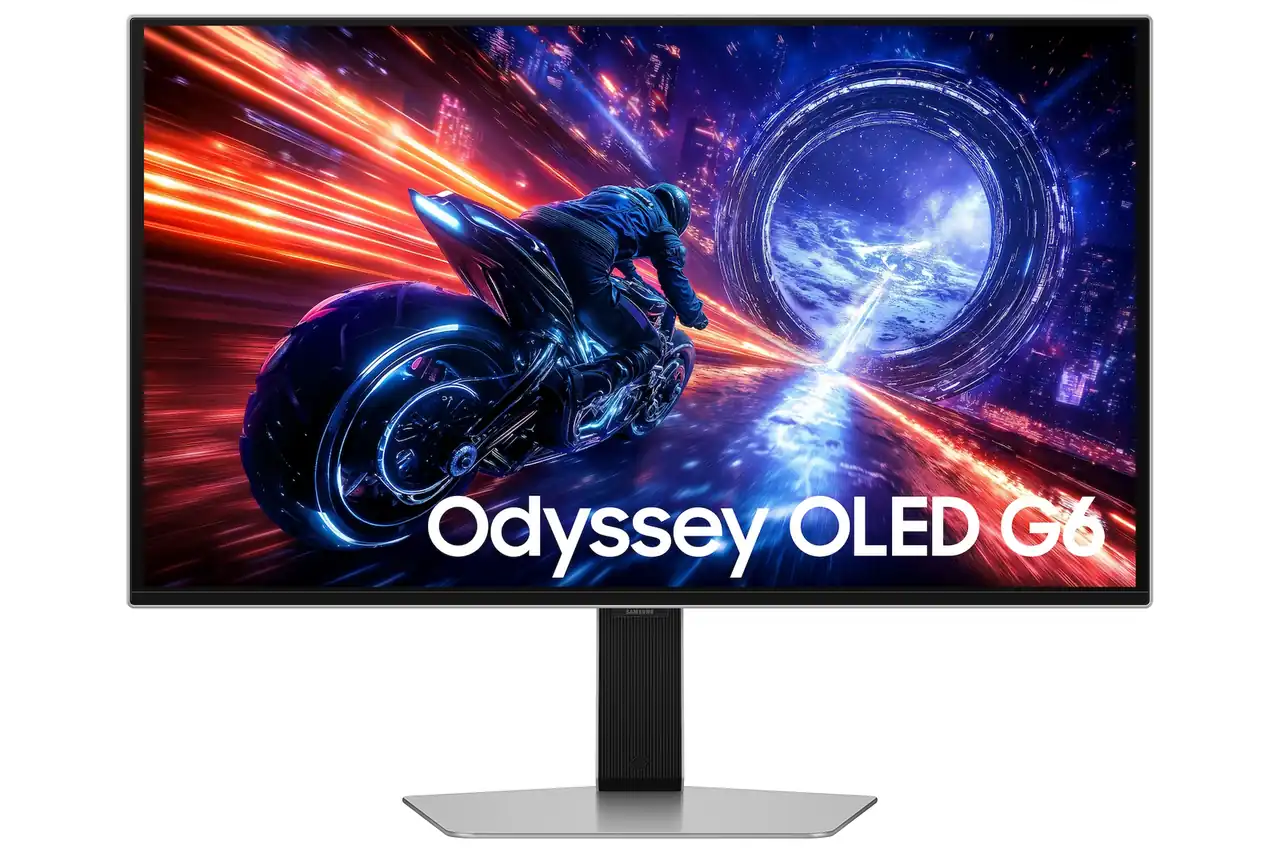
Samsung Odyssey OLED G6 G60SF (LS27FG602SNXZA)
By Samsung · Gaming Monitors · Audio & Electronics · More from Samsung
- 27-inch QD-OLED, 2560 x 1440, 500Hz
- 0.03ms response time
- VESA DisplayHDR True Black 500
- Two HDMI 2.1, one DisplayPort 1.4, USB-A hub
- G-Sync Compatible, glare-free coating
Price not listed
- SamsungView at Samsung
- eBayView at eBay
- AmazonView at Amazon (paid link)
- eBay (used) eBay: used, open-box, refurbishedView at eBay (used)
Stores are listed in a fixed order, never by price or commission. Prices are snapshots. Check the current price with the store.
Summary
A 27-inch 1440p QD-OLED gaming monitor built around a 500Hz panel made for competitive play. Check your cables and your laptop before you buy: the 500Hz figure needs DisplayPort, and there is no USB-C input and no internal speakers.
Strengths
- The 500Hz panel (over DisplayPort) and 0.03ms GTG response target competitive 1440p play directly.
- QD-OLED color: 99% DCI-P3 coverage, measured at 107.76% by Tom’s Hardware, accurate out of the box with no calibration needed.
- Both NVIDIA G-Sync Compatible and AMD FreeSync Premium Pro are supported.
- HDR10 and HDR10+ are both included, with DisplayHDR True Black 500 certification.
- The metal rear carries a heat pipe for cooling, and the stand adjusts for height, tilt, swivel and pivot.
Weaknesses
- 500Hz requires DisplayPort; over HDMI the monitor tops out at 120Hz per Micro Center.
- No USB-C input, which limits laptop docking and sharing one screen between a desktop and a laptop.
- No internal speakers; audio is a 3.5mm headphone jack only.
- The large external power supply enables the slim chassis but hurts cable management.
- The panel is not Samsung’s newest QD-OLED: no RGB-stripe subpixel structure and no newer ambient-light filter against purple tint.
- SDR handling draws criticism: TechRadar calls the SDR calibration disappointing, and Tom’s Hardware lists no variable SDR brightness as a reason to avoid.
Verified specifications
| Panel | Samsung QD-OLED, flat, 27-inch class. |
|---|---|
| Resolution | QHD 2560 × 1440, 16:9 aspect ratio. |
| Refresh rate | up to 500Hz over DisplayPort; Micro Center lists 120Hz over HDMI. |
| Response time | 0.03ms GTG. |
| Brightness | 300 cd/m² typical SDR (200 cd/m² minimum), 500 nits HDR, 1,000 nits peak HDR at 3% APL. |
| Contrast ratio | 1,000,000:1 static. |
| Color | 1.07B colors, 99% DCI-P3 (CIE1976); Tom’s Hardware measured 107.76% DCI-P3. |
| HDR | VESA DisplayHDR True Black 500, HDR10 and HDR10+. |
| Adaptive sync | NVIDIA G-Sync Compatible and AMD FreeSync Premium Pro. |
| Glare treatment | Glare Free coating; Pantone Validated. |
| Burn-in protection | Samsung OLED Safeguard+ with Dynamic Cooling System, Thermal Modulation, Logo and Taskbar Detection and Screen Saver. |
| Audio | no internal speakers; 3.5mm headphone output only. |
| Video inputs | 2× HDMI 2.1, 1× DisplayPort 1.4 (PCWorld). |
| USB | 1× USB 3.2 upstream, 2× USB 3.2 downstream. |
| Power draw | 49.6W at 200 nits (Tom’s Hardware). |
| Stand | height, tilt, swivel and pivot adjustment, 120mm of height travel, 100 × 100 mm VESA mount. |
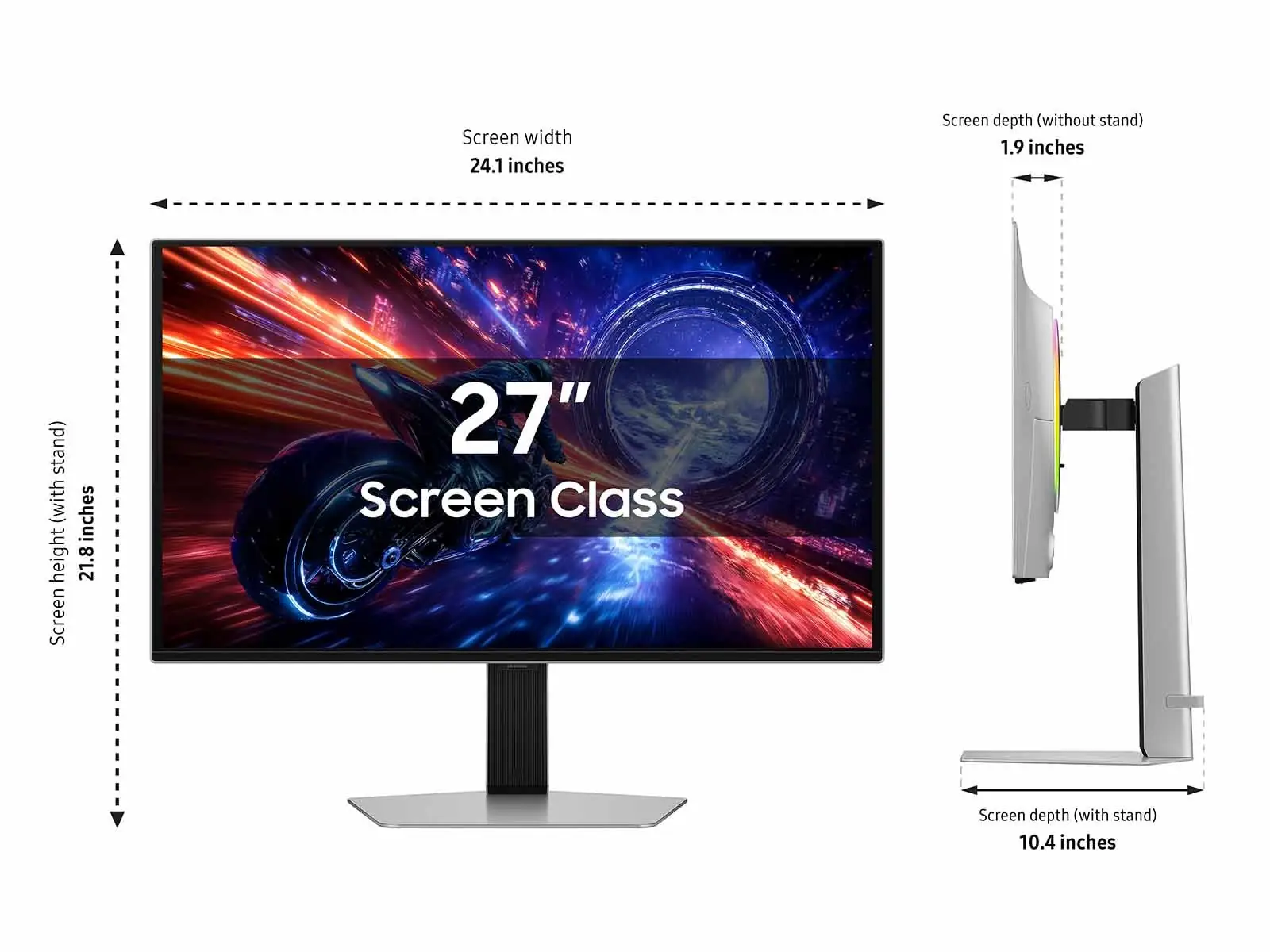
| Dimensions | 24.1 × 16.9–21.6 × 10.4 in (612 × 429–549 × 264 mm) with the stand; panel thickness 1.9 in (48 mm). |
| Weight | 33.44 lb (15.2 kg). |
| Materials | silver metal rear with an RGB LED “Infinity Core Lighting” ring. |
| In the box | monitor, DisplayPort cable, HDMI cable, power cable, USB Type A-to-B upstream cable. |
| Warranty | burn-in at normal usage is covered within warranty, excluding commercial, abuse or misuse; the length is disputed — Micro Center lists 1 year limited parts and labor, while Tom’s Hardware states 3 years including burn-in coverage. |
Full research notes and sources
Speed, panel and picture
The headline is the refresh rate. Samsung announced the G60SF as the world’s first 500Hz OLED gaming monitor, and that mode runs over DisplayPort; Micro Center lists 120Hz over HDMI, so HDMI-only buyers do not get the headline number. The 0.03ms GTG response and both adaptive-sync standards round out the speed pitch, and Tom’s Hardware measured 49.6W of power draw at 200 nits.
The picture side is classic QD-OLED: DisplayHDR True Black 500 certification, 300 cd/m² typical SDR brightness, 500 nits HDR and 1,000 nits peak HDR at 3% APL, and 1,000,000:1 static contrast. Tom’s Hardware measured 107.76% DCI-P3 and called the color accurate out of the box with no calibration needed.
The panel is not Samsung’s newest QD-OLED generation. TechRadar reports it lacks the RGB-stripe subpixel structure and the newer panel filter that reduces the purple-tint problem in bright ambient light, and describes the purple-tint behavior as carried over from earlier generations. SDR is the weak spot: TechRadar calls the SDR calibration disappointing with limited SDR presets, and Tom’s Hardware lists no variable brightness for SDR among its reasons to avoid. If you game in a bright room, check how the panel handles ambient light before you commit.
Ports, power and desk reality
The slim chassis is enabled by a large external power supply with right-angle plugs, and reviewers single the brick out as a cable-management and desk-tidiness downside. Video inputs are 2× HDMI 2.1 and 1× DisplayPort 1.4, plus a USB hub (1× USB 3.2 upstream, 2× USB 3.2 downstream) and a 3.5mm audio jack. The missing port is USB-C: no USB-C input means no single-cable laptop docking, and both PCWorld and TechRadar flag its absence. There are no internal speakers, so audio means headphones on the 3.5mm jack or speakers of your own.
The stand adjusts for height, tilt, swivel and pivot with 120mm of height travel, and a 100 × 100 mm VESA mount is there if you prefer an arm. With the stand, the monitor measures 24.1 × 16.9–21.6 × 10.4 in (612 × 429–549 × 264 mm) and weighs 33.44 lb (15.2 kg); the silver rear is metal, not plastic, with the Infinity Core Lighting RGB ring.
Burn-in, warranty and what owners say
Burn-in is the standard OLED worry. Samsung answers it with OLED Safeguard+ — a Dynamic Cooling System, Thermal Modulation, Logo and Taskbar Detection and a Screen Saver — and states that burn-in at normal usage is covered within warranty, excluding commercial, abuse or misuse. Warranty length is where the sources disagree: Micro Center lists 1 year limited parts and labor, while Tom’s Hardware states a 3-year warranty including burn-in coverage. Treat the length as unresolved until Samsung’s own documentation settles it.
Owner signals are thin but real. One Samsung US store review reports the plastic power and menu joystick breaking after about six months of normal use — a single data point, not a failure rate — and several reviews on that store carry incentivized-review flags. A Best Buy reviewer calls it ideal for first-person shooters and immersive for open-world games. Nobody has published a long-term failure rate for the G60SF.
Is it worth it?
The monitor launched in the US in August 2025 at $999.99, $100 more than the comparable Asus 500Hz QD-OLED at launch. Prices have fallen hard since: Samsung’s US store lists it at $699.99 as of October 2026, and deal coverage in May 2026 reported $649.99–650 via Woot, a new low. TechRadar listed it at $799 in its review.
At or below $650 it is a compelling high-refresh OLED for competitive 1440p play. From $651 to $750 it stays attractive for esports-focused buyers, though the 360Hz G60SD sibling and other 27-inch 1440p OLEDs that have sold below $500 deserve a look. Above $900 the value is weak unless 500Hz specifically is the reason you are buying. The running-cost story is about what is missing rather than what you pay: no USB-C can mean a dock or adapter, and no speakers means budgeting your own.
Which model this is
The Amazon listing is ASIN B0FJYRV9TK.
Sources
Manufacturer:
- Samsung US — 27-Inch 500Hz Odyssey OLED G60SF Gaming Monitor
- Samsung Newsroom — Samsung launches world’s first 500Hz OLED gaming monitor: Odyssey OLED G6
- Samsung Newsroom Canada — Samsung launches 500Hz OLED gaming monitor: Odyssey OLED G6
Independent reviews:
- TechRadar — I tested Samsung’s outrageously fast 500Hz OLED gaming monitor
- PCWorld — Samsung Odyssey OLED G6: this monitor hits 500Hz in style
- The Verge — Samsung’s 500Hz OLED monitor now available in the US
Owner reports:
Parts and stores:
- Micro Center — Samsung Odyssey OLED G6 G60SF 27-inch 500Hz gaming monitor
- B&H Photo — Samsung Odyssey OLED G6 G60SF 27-inch 1440p 500Hz gaming monitor
- PCWorld — Samsung’s 500Hz 1440p OLED gaming monitor hits new low price: $650
- Tom’s Hardware — Score this 500Hz 27-inch Samsung Odyssey OLED at its lowest ever price, $649.99