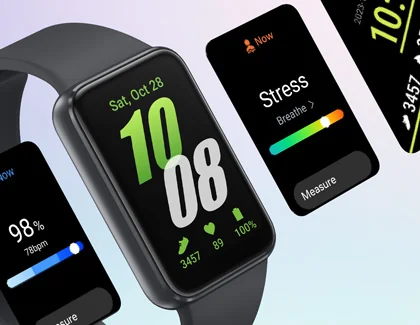
Samsung Galaxy Fit3
By Samsung · Fitness Trackers · Phones & Computers · More from Samsung
- Display: 1.6 inch AMOLED
- Battery life: up to 13 days
- Battery capacity: 208 mAh
- Water and dust rating: 5 ATM and IP68
- Workout types: 100+
Lowest price seen
~$59.99 (approx.)
from $59.99 at Amazon
- Amazon ~$59.99 (approx.)View at Amazon
- SamsungView at Samsung
- eBay (used) eBay: used, open-box, refurbishedView at eBay (used)
- eBayView at eBay
Prices are snapshots. Check the current price with the store.
Summary
A budget Android fitness tracker with a bright AMOLED screen, heart rate accuracy that holds up against smartwatches, and battery life measured at over a week per charge. Check your phone before you buy — it does not work with iPhones, and it has no built-in GPS, so it cannot track a run unless your phone comes along.
Strengths
- Heart rate stays close to the reference: within 3–7 bpm of an Apple Watch Ultra 2 during steady cardio (PCMag).
- PCMag measured 7.5 days of battery with always-on off; TechGearLab nearly matched the 13-day claim.
- Light at 0.65 oz and comfortable enough for sleep tracking.
- Bright AMOLED display with an always-on option.
- Fall detection and an SOS emergency feature (press the side button 5 times).
- PCMag gave it a Editors’ Choice award at a $69.99 MSRP, and it has often sold for less.
Weaknesses
- No built-in GPS: CNET’s phone-free 5K came out about 0.5 km short.
- iPhone owners cannot use the band at all.
- PCMag logged recurring ~30-minute gaps in sleep stage data, underestimating sleep.
- Owners report workouts and heart rate readings that never reach the Samsung Health app.
- Pairing takes three separate apps, and updates can unpair the band.
- Some owners report ~20% per hour battery drain even with features switched off.
Verified specifications
| Model | Samsung Galaxy Fit3 (SM-R390), 40mm case. |
|---|---|
| Display | 1.6-inch (40.0mm) AMOLED touchscreen, 256 × 402 pixels. |
| Battery | 208 mAh; Samsung claims up to 13 days, or 3.5 days with always-on display. |
| Tested battery life | 7.5 days with always-on off, 4.5 days with it on (PCMag); a full charge took 71 minutes. |
| Water and dust | 5 ATM and IP68; Samsung rates the band for 50 meters. |
| Weight | 18.5 g without the band, 36.8 g with it. |
| Dimensions | 42.9 × 28.8 × 9.9 mm (H × W × D). |
| Case and band | aluminum case, polycarbonate back, silicone sport band with quick-release pins. |
| Charging | magnetic cable in the box; no power adapter included. |
| Sensors | accelerometer, barometer, optical heart rate sensor, light sensor, gyroscope. |
| Connectivity | Bluetooth v5.3. No GPS, no NFC, no speaker, no microphone. |
| Phone compatibility | Android 10 or later with 1.5 GB RAM (PCMag); the manual states Android 11.0+. No iOS support. |
| Health tracking | heart rate, SpO2, heart rate variability, sleep, stress, fall detection with emergency SOS. |
| Workouts | 100+ tracked types. |
| Software | FreeRTOS with a fixed app set; no third-party apps. |
Full research notes and sources
Heart rate, steps and GPS
Heart rate is the Fit3’s strongest suit. PCMag tested it against an Apple Watch Ultra 2 during running and HIIT and saw it stay within 3–7 bpm in steady-state cardio and 5–10 bpm in intervals. CNET measured 2–5 bpm from a Polar chest strap at peak effort, with a few seconds of lag, and TechGearLab found it within a few bpm of a chest strap too. Step counting is weaker: owners on Reddit and in the Samsung Community report ghost steps, double counting and delayed registration, and TechGearLab found distance ran about 5% short with a fluctuating real-time pace. There is no GPS in the band — routes come from your phone, and CNET’s phone-free 5K was off by about 0.5 km. Sleep tracking has holes too: PCMag saw periodic ~30-minute gaps on multiple nights, and CNET’s “Excellent” 91 sleep score on a 6.5-hour night looked generous.
Battery life
Samsung claims up to 13 days. PCMag measured 7.5 days with always-on display off and 4.5 days with it on, with a full charge in 71 minutes. CNET got 3 days with always-on, full notifications, sleep tracking and daily workouts, while TechGearLab said the band nearly met the 13-day claim. Real-world battery depends heavily on notification volume and which features stay on. On the Samsung Community, some owners report severe drain — about 20% per hour — even with features switched off. Charging uses a magnetic cable, and the manual says to keep the contacts clean and use only Samsung-approved charging gear.
Sync, pairing and the Samsung phone requirement
The Fit3 runs FreeRTOS, not Wear OS, with a fixed app set and no third-party apps. Getting it paired takes three separate apps — Galaxy Wearable, Samsung Health and a Fit3 plugin — and owners report updates that unpair the band. A Samsung Community review documents workouts started on the band over phone GPS that never transfer to the Samsung Health app, and Reddit users report heart rate data that fails to sync until the app cache is cleared or the band is factory-reset. Snoring detection, camera control and alarm syncing require a Samsung Galaxy phone. Some workout sync failures appear tied to GPS plugin permissions. Nobody has published failure rates for any of this, so treat the sync problems as known annoyances rather than confirmed defects.
Is it worth it?
At its $69.99 MSRP the Fit3 covers the health basics well for Android users, and the street price has been lower: PCMag logged $55 in February 2025 and $47 later that year, CNET saw $36–$47 at points in 2025, and CNET and Tom’s Guide listed $59–$60 at launch. The value math is simple — strong at $40 or less, fair-to-good from $41 to $60, and weak above $70, where Wear OS watches with GPS and ECG become the alternatives. There are no mandatory subscriptions for the core fitness features; the only recurring cost is an optional replacement band. Value depends on your phone: without an Android handset the band does not work at all, and without a Samsung phone you lose snoring detection, camera control and alarm syncing.
Which model this is
This page covers the Samsung Galaxy Fit3, model SM-R390, in a 40mm case with Dark Grey, Silver and Pink Gold color options. The Amazon listing for this model is ASIN B0DPB9YBDR. Do not confuse it with the older Galaxy Fit2, which lacks the barometer, SpO2 and fall detection, or the Galaxy Watch line, which runs Wear OS with GPS and ECG at higher prices.
Sources
Manufacturer:
- Samsung Galaxy Fit3 user manual (SM-R390)
- Samsung Galaxy Fit3 user guide (Syndigo PDF)
- Samsung Galaxy Fit3 support and features
- Galaxy Fit3 product page (Samsung, Latin America)
- Galaxy Fit3 product page (Samsung, Thailand)
Independent reviews:
- Samsung Galaxy Fit3 review — PCMag
- I Tested Samsung’s $60 Galaxy Fit 3 — CNET
- Samsung Galaxy Fit3 Hands-On — Tom’s Guide
- Samsung Galaxy Fit3 Review — TechGearLab
Owner reports:
- Galaxy Fit3 long-term review (r/GalaxyFit)
- Galaxy Fit 3 review after 15 days of usage (r/GalaxyFit)
- Galaxy Fit 3 heart rate not syncing to Samsung Health (r/GalaxyFit)
- Galaxy Fit 3 workout not syncing to phone (r/GalaxyFit)
- Galaxy Fit 3 step counting issue — double counting (Samsung Community)
- Fit 3 incorrect step count (Samsung Community)
- One-week full review of the Galaxy Fit3 (Samsung Community)
- Galaxy Fit 3 battery drain (Samsung Community)
- Unable to pair Galaxy Fit3 with Android phone (Samsung Community)