Reolink Battery Video Doorbell (2nd Gen)
By Reolink · Video Doorbells · Cleaning & Smart Home
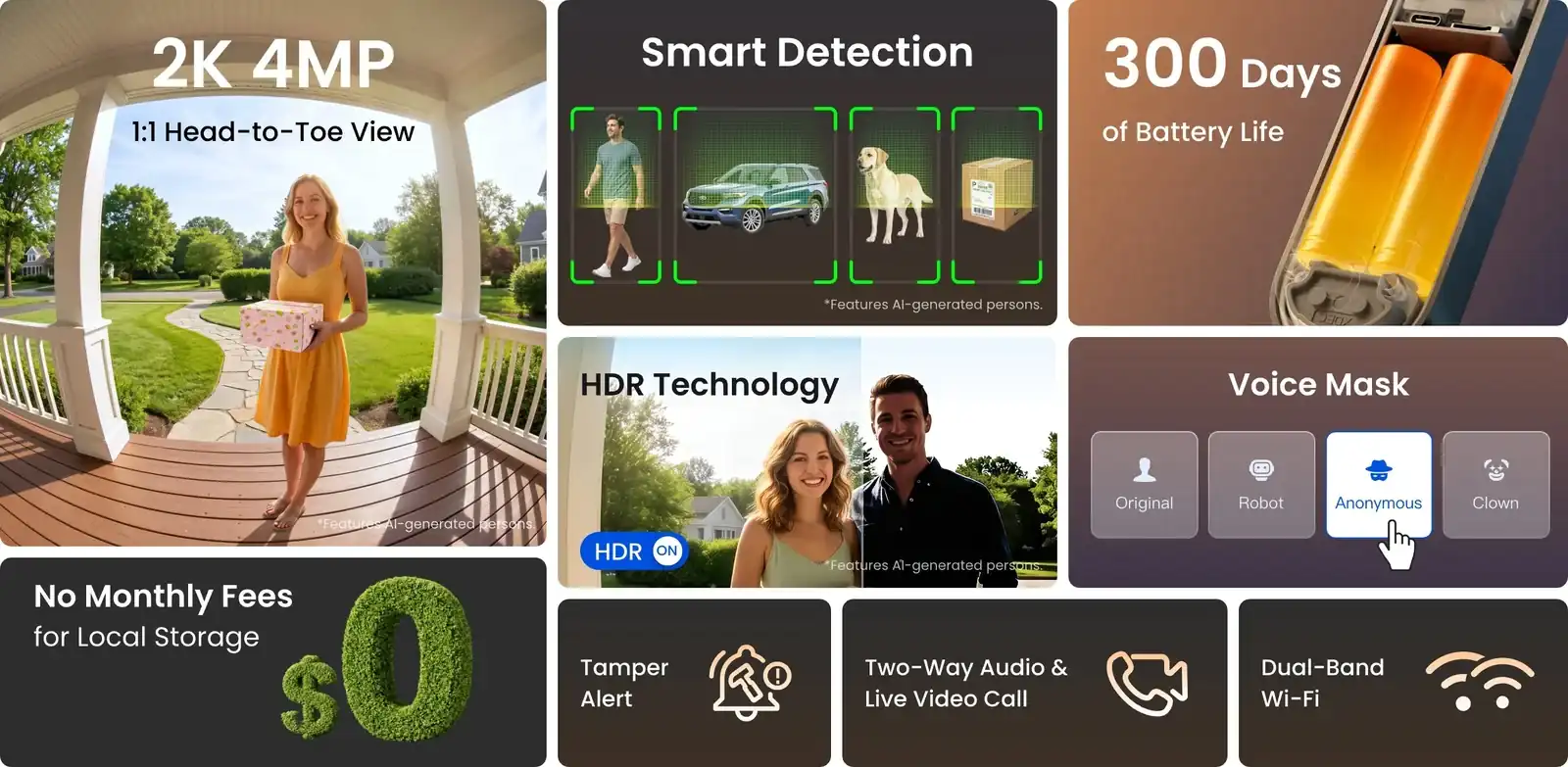
- Resolution 2048 x 2048 (4 megapixels) @15fps on a 1/3" CMOS sensor, H.264/H.265
- Field of View: Diagonal 180°, Horizontal 150°, Vertical 150° (1:1 head-to-toe framing)
- Battery up to 300 days of battery life (Based on 5-min recordings per day)
- microSD Card Slot supports max. 512GB with no monthly fee
Lowest price seen
~$149.99 (approx.)
from $149.99 at Amazon
- Amazon ~$149.99 (approx.)View at Amazon
- ReolinkView at Reolink
- NeweggView at Newegg
- eBayView at eBay
- eBay (used) eBay: used, open-box, refurbishedView at eBay (used)
Prices are snapshots. Check the current price with the store.
Summary
The Reolink Battery Video Doorbell (2nd Gen) is a 4MP battery-first doorbell with a square 1:1 head-to-toe view, on-device person, vehicle, animal and package detection, and local microSD recording with no subscription. Check your wiring and your traffic before buying: the 300-day battery claim assumes only 5 minutes of recording a day, and wiring it unlocks the 24/7 recording and pre-recording that fix the wake-up delay.
Strengths
- A 4MP 2048 x 2048 square sensor at 15 fps with a head-to-toe 1:1 view of 150° horizontal, 150° vertical and 180° diagonal.
- On-device person, vehicle, animal and package detection with microSD storage up to 512 GB and no subscription required.
- Optional Wired Power Mode on 16-24 V AC / 24 V DC unlocks always-on operation, 24/7 recording, pre-recording and RTSP/ONVIF.
- Reolink rates battery life at about 300 days at 5 minutes of recording per day, roughly double the 1st Gen.
- IP65 weatherproofing, dual-band Wi-Fi, two-way audio, HDR and infrared night vision.
- A 2-year limited warranty with a 30-day money-back guarantee, and a compatible solar charger.
Weaknesses
- The 300-day battery figure assumes only 5 minutes of recording a day; Reolink itself gives about 6 months at 10 minutes a day, and owners report 4-5 week or monthly recharges on busy frontages.
- PIR wake-up latency of 6-12 seconds in battery mode, with no pre-recording to cover the gap.
- Recording is capped at 15 fps with no higher frame-rate option, against 28 fps on the comparison Nest unit.
- No chime is included, and the older Reolink Chime V1 and V2 do not work; a mechanical chime in wired mode needs the sold-separately RLA-PK1 or a jumper cable that bypasses it.
- 24/7 recording is standalone-only and reverts to motion events when the doorbell is added to an NVR or Home Hub.
- 24/7 recording, pre-recording and RTSP/ONVIF all require Wired Power Mode, and the battery must be removed from its mount to charge.
Verified specifications
| Image sensor | 1/3" CMOS. |
|---|---|
| Resolution | 2048 x 2048 (4 megapixels) at 15 fps. |
| Lens | f=1.2 mm, F=1.8, fixed. |
| Field of view | 180° diagonal, 150° horizontal, 150° vertical, with a 1:1 head-to-toe aspect ratio. |
| Compression | H.264 / H.265. |
| Audio | two-way, with two built-in microphones and one speaker. |
| Wi-Fi | IEEE 802.11 a/b/g/n, 2.4 GHz and 5 GHz dual-band, WPA/WPA2. |
| Battery claim | up to 300 days based on 5-minute recordings per day; Reolink gives about 10 months on the same basis and about 6 months at 10 minutes per day. |
| Hardwire, Battery Power Mode | 8-24 V AC, 24 V DC. |
| Hardwire, Wired Power Mode | 16-24 V AC, 24 V DC. |
| Recording | motion-triggered in battery mode; 24/7 recording and pre-recording in wired mode. |
| Storage | microSD card up to 512 GB, plus Reolink Home Hub, NVR and FTP, with no monthly fee. |
| Charging | USB Type-C, using a DC 5 V / 2 A adapter and the included cable; solid green LED when full. |
| Smart detection | motion, person, vehicle, animal, package and visitor detection. |
| Other features | rich notifications, quick replies, live video call, tamper alert, zone-loitering alert, voice masking, HDR, infrared night vision, time-lapse and smart playback. |
| Smart home | Google Assistant, Amazon Alexa and IFTTT listed; Home Assistant direct connection works in both power modes; RTSP and ONVIF only in Wired Power Mode with Reolink App 4.62 or later. |
| Operating conditions | -10 °C to 55 °C, 10% to 90% humidity, IP65 weatherproofing. |
| Dimensions and weight | 160.0 x 48.0 x 29.5 mm, 231 g. |
| Warranty | 2-year limited, with a 30-day money-back guarantee. |
Full research notes and sources
Power modes and what they unlock
The pitch that matters is not resolution. The 2nd Gen’s resolution, 1:1 aspect ratio and detection set are identical to the 1st Gen’s; what is new is power and behaviour. Reolink documents three configurations: battery-only; battery plus trickle charge on 8-24 V AC/DC, where the unit stays in Battery Mode and can still drive a mechanical chime; and an optional Wired Power Mode on 16-24 V AC/DC that runs the camera as a permanently powered device and unlocks always-on operation, 24/7 continuous recording and pre-recording. The 2nd Gen adds tamper alert, zone-loitering alert and voice masking, supports the RLA-PK1 power kit and the Reolink Doorbell Solar Charger, and Reolink rates it at about 10 months per charge versus 5 months for the 1st Gen. RTSP and ONVIF are unavailable in Battery Mode and require Wired Power Mode plus Reolink App 4.62 or later, so Home Assistant users should note that a direct Home Assistant connection does work in both modes even though RTSP does not. Two gating rules are easy to miss: 24/7 recording disappears if the doorbell is added to an NVR or Home Hub, and switching to Wired Power Mode over an NVR needs NVR firmware v3.6.5 or later.
Battery life versus the headline
Reolink’s 300-day figure assumes roughly 5 minutes of recording per day, and its own FAQ says to expect around 6 months at 10 minutes per day; event count, PIR sensitivity, Wi-Fi distance, temperature and per-event duration all move it. Independent evidence lands well short of the headline. One reviewer, running the doorbell beside a four-year-old Google Nest, saw charge fall from 51% at installation to 32% at day 12 at roughly a dozen events per day, and said 12 days is too short to extrapolate but that 2-3 months per charge would be acceptable. On Reolink’s community forum, one owner reports charging after a single month and blames out-of-the-box sensitivity that triggered on passing cars and shadows, while a second charges every 4-5 weeks at about 20 minutes of daily activity. None of this contradicts the spec sheet arithmetically, but all of it contradicts 300 days as something to plan around. The same architecture produces the second limitation: because the camera sleeps on PIR, there is a 6-12 second delay before recording starts, against about 2 seconds on a PoE camera, and pre-recording only exists in Wired Power Mode.
Picture, latency and the hands-on evidence
On picture quality the hands-on evidence is good. Mounted alongside a Google Nest Battery Doorbell and run through the same visitors, sunlight and night conditions, the Reolink showed more of the doorstep and driveway, showed faces more clearly at distance, held detail in direct morning sun where the Nest clipped, and reached materially deeper into the driveway under infrared at night, with distortion the reviewer considered modest for the width. Two measurable trade-offs came out of that test: recording is capped at 15 fps against the Nest’s 28 fps, and microphone capture was clearer and louder while the speaker was much louder but less natural, with wind handling slightly better on the Nest. Detection tuning takes work, with adjustable sensitivity, size limits and exclusion zones, but once configured the reviewer saw minimal false alerts and no missed events. One unverified owner post reports the 2nd generation unit running live view at only 1-2 Mbps with no push notifications firing, which conflicts with the reviewer’s experience and is recorded only as a signal that firmware and app quality may vary. Google ecosystem integration is weaker than native: the reviewer calls Google’s AI event descriptions and single-app integration with other Nest cameras the thing he will miss most.
Accessories, warranty and which model this is
Plan the accessories. No chime is in the box, and the Reolink Chime V1 and V2 do not work with this model; you need Chime Plus or Chime 2.1. If you want an existing mechanical chime to ring in Wired Power Mode, you need the separately sold RLA-PK1 Power Kit, because using a jumper cable bypasses the mechanical chime so it will not ring when the button is pressed. The battery is internal and charged in place over the rear USB Type-C port, so the unit must be lifted off its mounting plate to charge, which partly undercuts the no-drilling convenience that motivates the battery choice. Trust Alexa cautiously: the spec table and press release both list Amazon Alexa support, but the product page’s own smart-home tile still reads Coming Soon, so treat voice control as announced rather than confirmed live. The warranty is a 2-year limited term with a 30-day money-back guarantee, and the compatible Reolink Doorbell Solar Charger reduces how often the unit must be recharged remotely. This page covers the Reolink Battery Video Doorbell (2nd Gen), also sold as the Reolink Video Doorbell (2nd Gen), with internal model designation D340B and the listing this page covers as ASIN B0FX3LNLLQ. It is a separate product line from the Reolink Video Doorbell WiFi and PoE, which is 5MP in 4:3, and from the 1st Gen Video Doorbell (Battery), which shares the dimensions but has 5-month battery life and no Wired Power Mode.
Sources
Manufacturer:
- Reolink Battery Video Doorbell (2nd Gen) product page and US spec sheet
- FAQs, Reolink Battery Video Doorbell (2nd Gen) — Reolink Support
- Reolink releases the Video Doorbell 2nd Gen
- Battery Video Doorbell (2nd Gen) product specifications — Reolink Support
- How to install and uninstall the Reolink Video Doorbell (Battery) — Reolink Support
- Introduction to Reolink video doorbell cameras — Reolink Support
- Reolink Client user manual (PDF)
- Reolink Video Doorbell (2nd Gen) owner review aggregation page
Independent reviews:
- Reolink Video Doorbell 2nd Gen review: better than my Google Nest? — CarPlay Life
- The best video doorbells we’ve tested — PCMag
Owner reports: