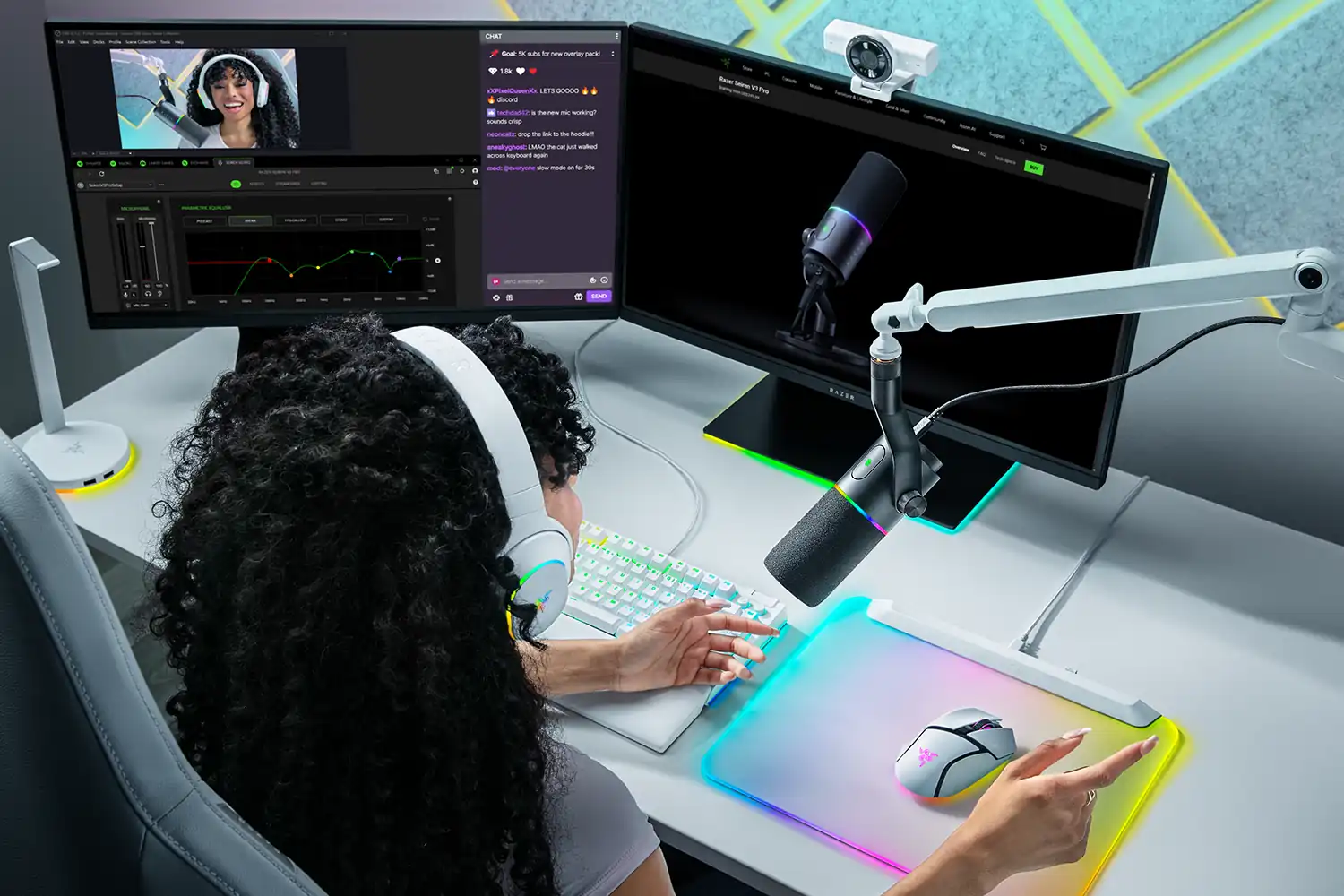

Razer Seiren V3 Pro
By Razer · USB Microphones · Desk & Streaming Setup · More from Razer
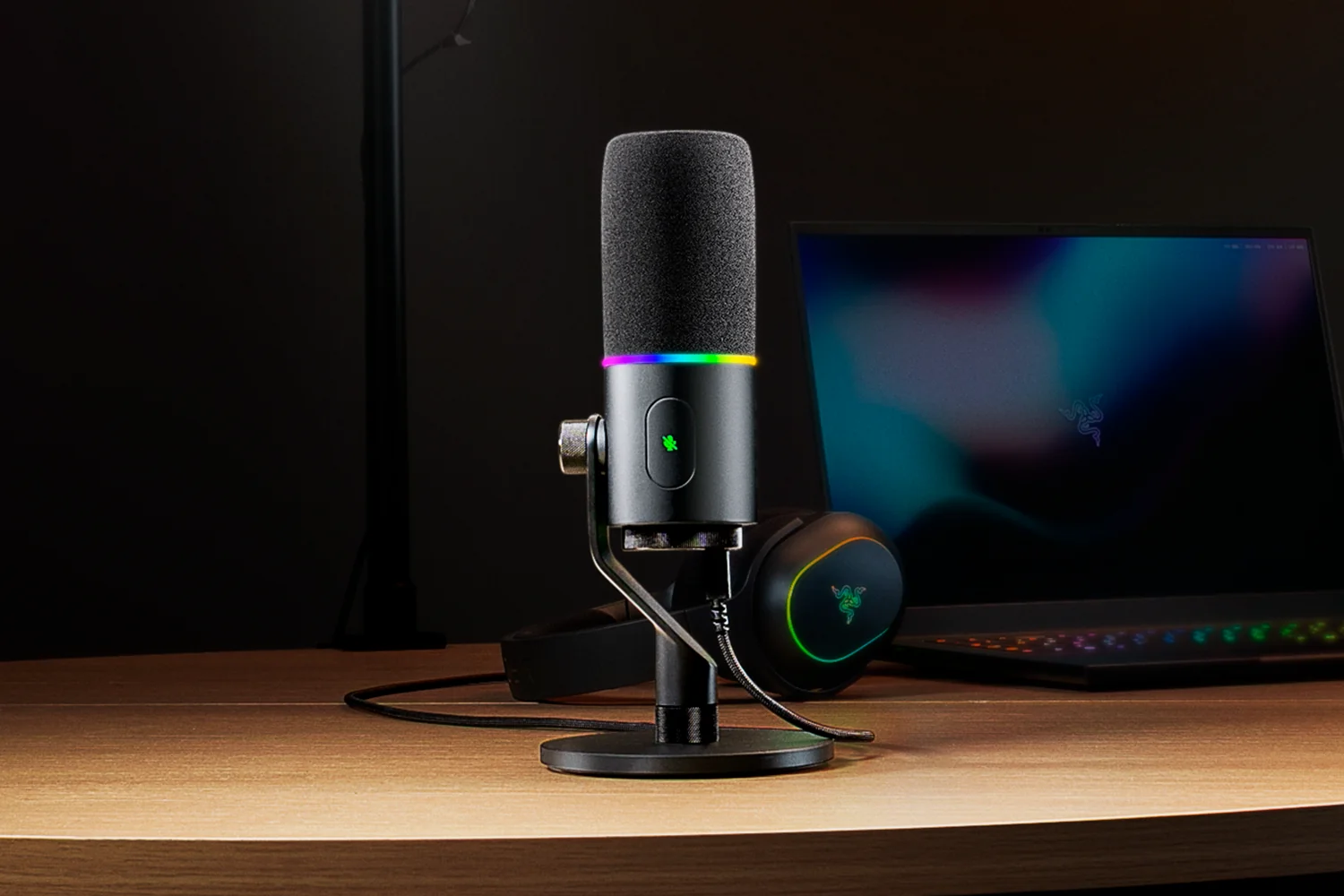
- Dynamic microphone with 30 mm capsule
- USB-C and XLR connections
- 32-bit float recording through Razer Synapse
- Built-in DSP with AI noise remover
- Touch mute button and gain control wheel
Price not listed
- RazerView at Razer
- eBayView at eBay
- AmazonView at Amazon (paid link)
- eBay (used) eBay: used, open-box, refurbishedView at eBay (used)
Stores are listed in a fixed order, never by price or commission. Prices are snapshots. Check the current price with the store.
Summary
Razer’s first XLR-capable streaming microphone: a 30 mm dynamic cardioid mic with dual USB-C and XLR outputs, onboard DSP and Windows-only 32-bit float, for creators who want USB plug-and-play now and an interface-based rig later.
Strengths
- Dual USB-C and XLR outputs let you start plug-and-play and move to an interface later without buying a new mic.
- The bundle is complete: stand, shock mount, pop filter and a 3 m cable with adapter in the box.
- The touch mute button gets called flawless by every reviewer who tried it.
- Onboard DSP runs on the mic itself, not on your PC.
- The zinc unibody feels solid, and the Chroma ring integrates with the rest of a Razer setup.
- 32-bit float over USB removes the fear of clipped takes.
Weaknesses
- The USB output is quiet even at maximum gain — normal for a dynamic mic, but it demands close placement.
- The auto-setup wizard repeatedly mis-sets gain and clips the start of words with an over-aggressive noise gate.
- The pop filter fits loosely and slips out of position.
- The matte black finish shows fingerprints badly.
- Over XLR the RGB ring is unpowered and the mute button does nothing; the advanced features are USB-only.
- At $249.99 it costs real money for a capsule reviewers call good but not class-leading.
Verified specifications
| Capsule | 30 mm dynamic, end-address. |
|---|---|
| Polar pattern | cardioid. |
| Frequency response | 50 Hz–16,000 Hz. |
| Sensitivity | -50 dB (1 V/Pa at 1 kHz). |
| Impedance | 300 ohms. |
| Max sound pressure | 150 dB over XLR, 125 dB over USB; one outlet labels the same figures as signal-to-noise ratio, so treat the metric as unconfirmed. |
| Recording | 24-bit and 32-bit float at 48/96 kHz; 32-bit float is USB-only, enabled through Razer Synapse on Windows. |
| Gain | manual dial with a 40 dB range. |
| Connectivity | USB Type-C, three-pin XLR, 3.5 mm headphone monitoring jack. |
| Onboard DSP | AI noise remover, compressor, limiter and expander, processed on the mic rather than the PC. |
| Software | Razer Synapse; full features require Windows 11 or higher. |
| Controls | capacitive touch mute button and a manual gain dial. |
| Lighting | Chroma RGB ring showing gain, mute and peak status. |
| Thread mount | 5/8-27, also fits 3/8-16 boom arms. |
| Body | matte black zinc unibody. |
| Dimensions | 8.39 × 2.25 in (213 × 57.15 mm); just under 10 in (254 mm) long with the swing arm, 3.55 in (90 mm) wide including it. |
| Weight | just under 1.5 lb — Tom’s Hardware’s spec table says 640 g, its own text and Basic Tutorials say about 670 g. |
| Power | bus-powered over USB-C. |
| In the box | mic, removable pop filter, built-in shock absorber, adjustable vibration-dampened arm mount, removable desktop stand, 10 ft (3 m) braided USB-C-to-USB-A cable with a USB-A-to-USB-C adapter. |
| Desktop stand | about 4.75 in (120 mm) diameter, just over 7 oz (200.5 g), metal, with a 5/8 in threaded mount and a rubber non-slip base. |
| Warranty | up to 2 years from Razer, plus 14-day risk-free returns from the RazerStore. |
Full research notes and sources
Sound and the USB output
Tom’s Hardware calls it “a little quiet” and “boring”, but still a great mic for a small audience. The 50 Hz–16 kHz band is narrower than a studio condenser but in line with the Shure MV7+ and the SM58, according to Engadget. Tom’s Guide spent a week with it and came away impressed — easy for casual users, deep enough for serious ones. Nobody has published a standardized lab measurement of this model — no frequency, self-noise or polar plots — so treat all of this as hands-on impression.
Setup and software
Razer Synapse runs the show: the AI noise remover, compressor, limiter and expander are processed on the mic itself. The standout complaint is the auto-setup wizard — PC Gamer and Windows Central both report it mis-configuring gain and setting a noise gate so aggressive it clips the start of words, and both recommend ignoring it or heavily adjusting it. Even set low, the gate can dampen the voice and let background hiss through, and the AI noise remover reduces but does not fully eliminate noise, occasionally cutting the voice during quiet moments. The 32-bit float recording, parametric EQ and advanced mixing need Windows Synapse over USB; macOS gets no feature parity. Over XLR the signal is analog and bypasses all of it — the RGB ring is unpowered and the mute button does nothing. Sources disagree on whether USB and XLR can be connected at once: PC Gamer says you cannot, Windows Central says both cables can stay plugged in with dynamic switching on Windows.
Bundle, build and upkeep
In the box: the mic, a removable pop filter, a built-in shock absorber, a vibration-dampened arm mount, a desktop stand and a 3 m braided cable with a USB-A adapter — it works before you buy any XLR gear. The pop filter fits loosely and slips, and the matte finish picks up fingerprints. In the r/razer launch thread, a user notes the USB-C port finally sits on the bottom of the mic, which improves cable management when it is mounted. Routine care is limited to keeping the grille and pop filter clean; no user-serviceable parts, replacement-part catalog or teardown exists for this model. The warranty covers up to two years, with 14-day risk-free returns from the RazerStore. The mic is PC-focused, and Razer does not guarantee it with PlayStation, Xbox or Nintendo Switch consoles.
Is it worth it?
Razer’s US store lists it at $249.99 (£249.99 in the UK, €289.99 in the EU), and reviewers put it roughly $40–45 below the Shure MV7+. The value is weakest for buyers who will stay USB-only, never touch 32-bit float and do not care about Chroma. The XLR path has its own costs: no XLR cable is included, and you need an audio interface or a mixer.
Which model this is
This page covers the Razer Seiren V3 Pro, part number RZ19-05500100-R3U1, announced and launched June 9, 2026 — Razer’s first XLR-capable streaming microphone. The Amazon listing for the black variant is ASIN B0H1DW8HXQ. Do not confuse it with the Seiren V3 Chroma (RZ19-0506), a USB-only condenser mic with a tap-to-mute sensor and stream-reactive lighting, or with the Seiren V2 Pro, the dynamic predecessor without dual connectivity or 32-bit float. Owner reports of buzz and hiss exist for the V3 Chroma, but that is a different product and not evidence about the V3 Pro.
Sources
Manufacturer:
- Razer Seiren V3 Pro product page
- Razer Seiren V3 Pro Master Guide (PDF)
- Razer Newsroom: Studio Sound. Simply Effortless
- Razer Blog: How to set up the Razer Seiren V3 Pro
Independent reviews:
- Tom’s Guide: a week with the Seiren V3 Pro
- Engadget: Razer announces the Seiren V3 Pro
- TechPowerUp launch coverage
- Pokde.Net launch coverage
Owner reports: