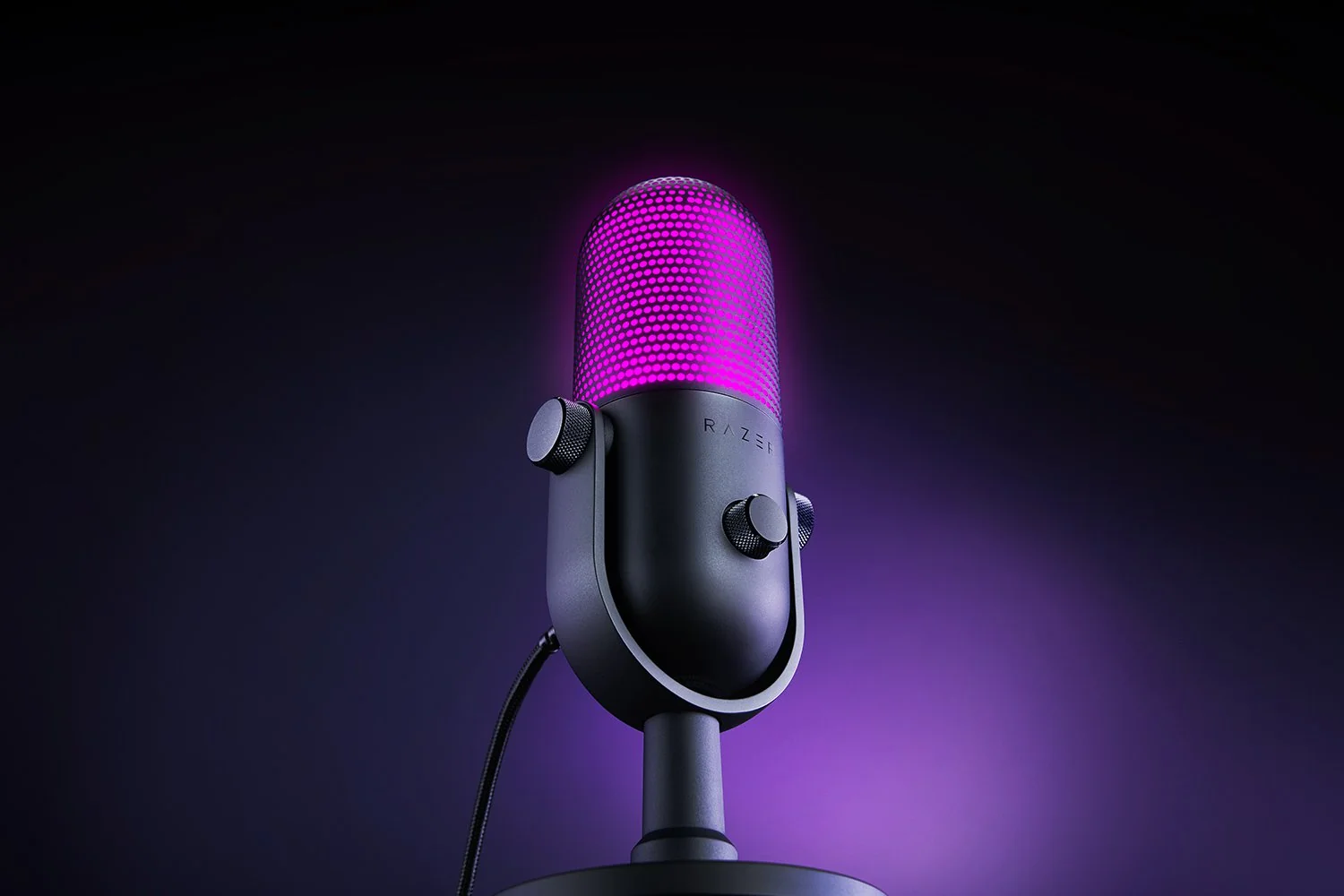
Razer Seiren V3 Chroma
By Razer · USB Microphones · Desk & Streaming Setup · More from Razer
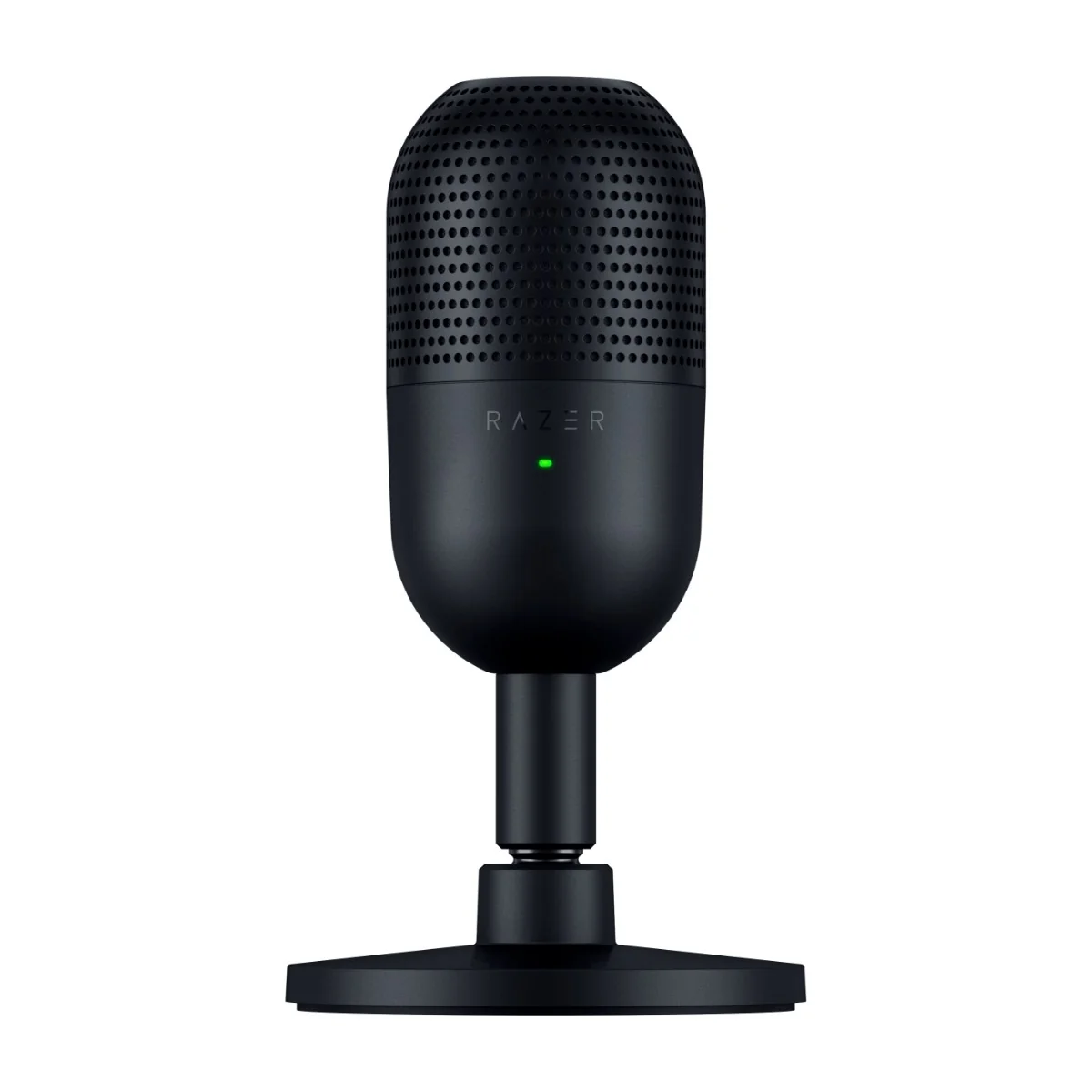
- Supercardioid condenser capsule
- USB-C connection
- Tap-to-mute sensor on top
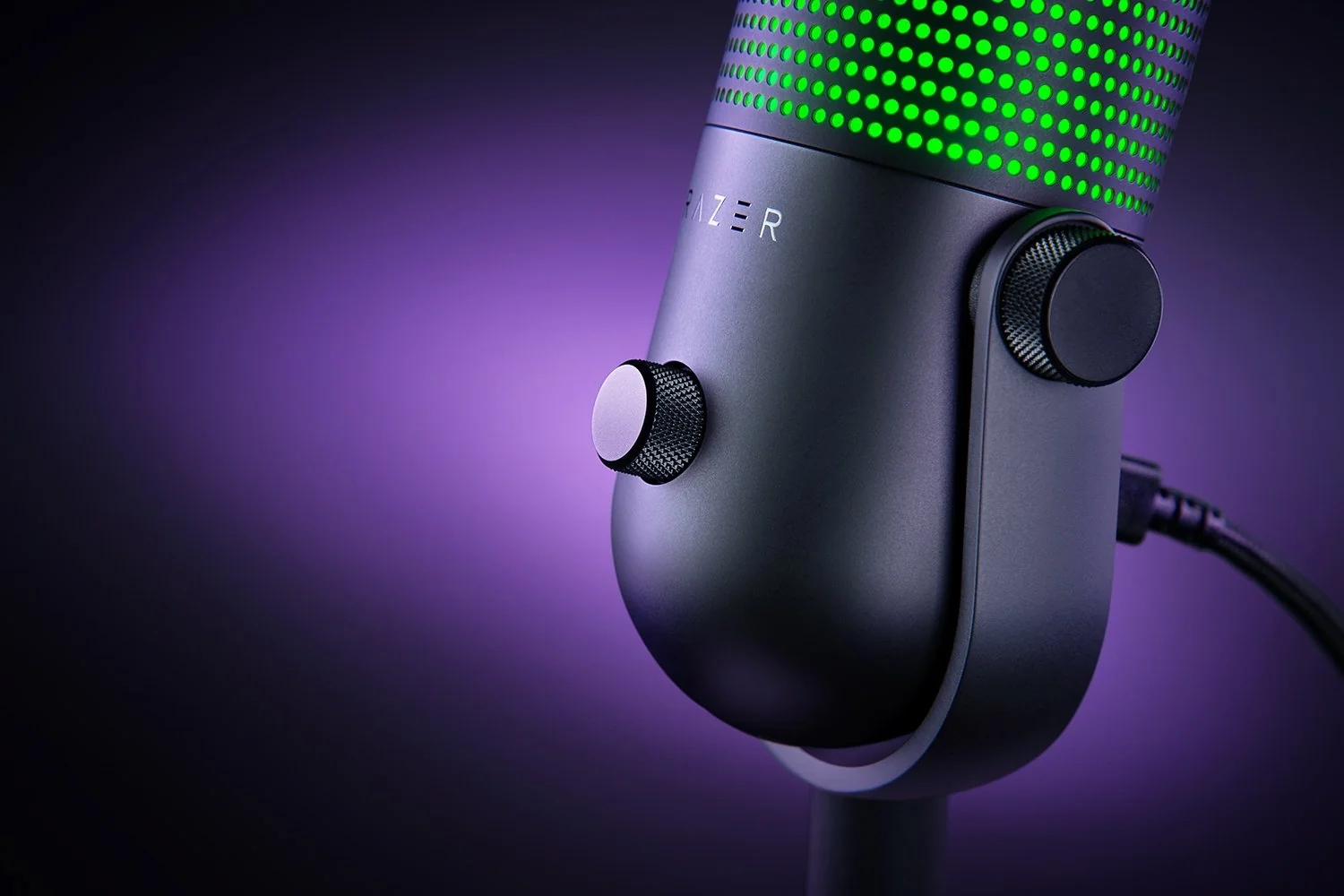
- Front dial for microphone or headphone level
- Headphone jack on the back
Price not listed
- RazerView at Razer
- eBayView at eBay
- AmazonView at Amazon (paid link)
- eBay (used) eBay: used, open-box, refurbishedView at eBay (used)
Stores are listed in a fixed order, never by price or commission. Prices are snapshots. Check the current price with the store.
Summary
A compact USB-C supercardioid condenser microphone for streaming and calls, with tap-to-mute, a front gain dial and Chroma RGB that doubles as a live level meter. Check your noise tolerance before you buy: reviewers consistently fault its background-noise pickup, and the bundled software offers only a basic noise gate.
Strengths
- True plug-and-play: no drivers, and onboard memory keeps your settings without Synapse.
- The default tone is warm and round, and the digital gain limiter tames peaks well.
- The metal lower body and stand give a low center of gravity; the compact pill body leaves desk room.
- The supercardioid capsule limits side and rear noise.
- Tap-to-mute is instant, with the RGB ring doubling as a level meter.
- The front dial can switch between mic gain and headphone volume without software.
Weaknesses
- Every reviewer found it picks up keyboard clicks, PC fans and room noise.
- Synapse offers only a simple noise gate — no noise-reduction algorithm and no custom EQ beyond a “radio voice” preset.
- Owners report hiss or buzz even at low gain, and one Razer Insider thread says the noise gate died after nearly a year.
- Owners report Synapse 3 freezing for 15–30 seconds with the mic connected; another says the mic stopped working with only partial RGB left.
- The included stand is sensitive to vibrations and the mic to plosives (SlashGear).
- “V3 Chroma” specs found online now often describe the 32-Bit DSP successor, not this model.
Verified specifications
| Capsule | 16 mm condenser. |
|---|---|
| Polar pattern | supercardioid. |
| Recording | 24-bit / 96 kHz. |
| Frequency response | 20 Hz – 20 kHz. |
| Sensitivity | −34 dB (1 V/Pa at 1 kHz). |
| Max SPL | 110 dB (THD < 1% at 1 kHz). |
| Signal-to-noise ratio | 96 dB. |
| Power | USB bus-powered at 5 V / 500 mA; no external adapter. |
| Dimensions | 213.1 x 90.2 x 90.2 mm (8.39 x 3.55 x 3.55 in) per Windows Central. |
| Weight | sources disagree — 408 g (Windows Central), 474 g (PCGamesN), 600 g (Pokde). |
| Mute | capacitive tap-to-mute on top; a tap mutes and turns the RGB red, double/triple taps are remappable. |
| Front dial | selectable between microphone gain and headphone/sidetone volume. |
| Headphone jack | 3.5 mm, on the rear. |
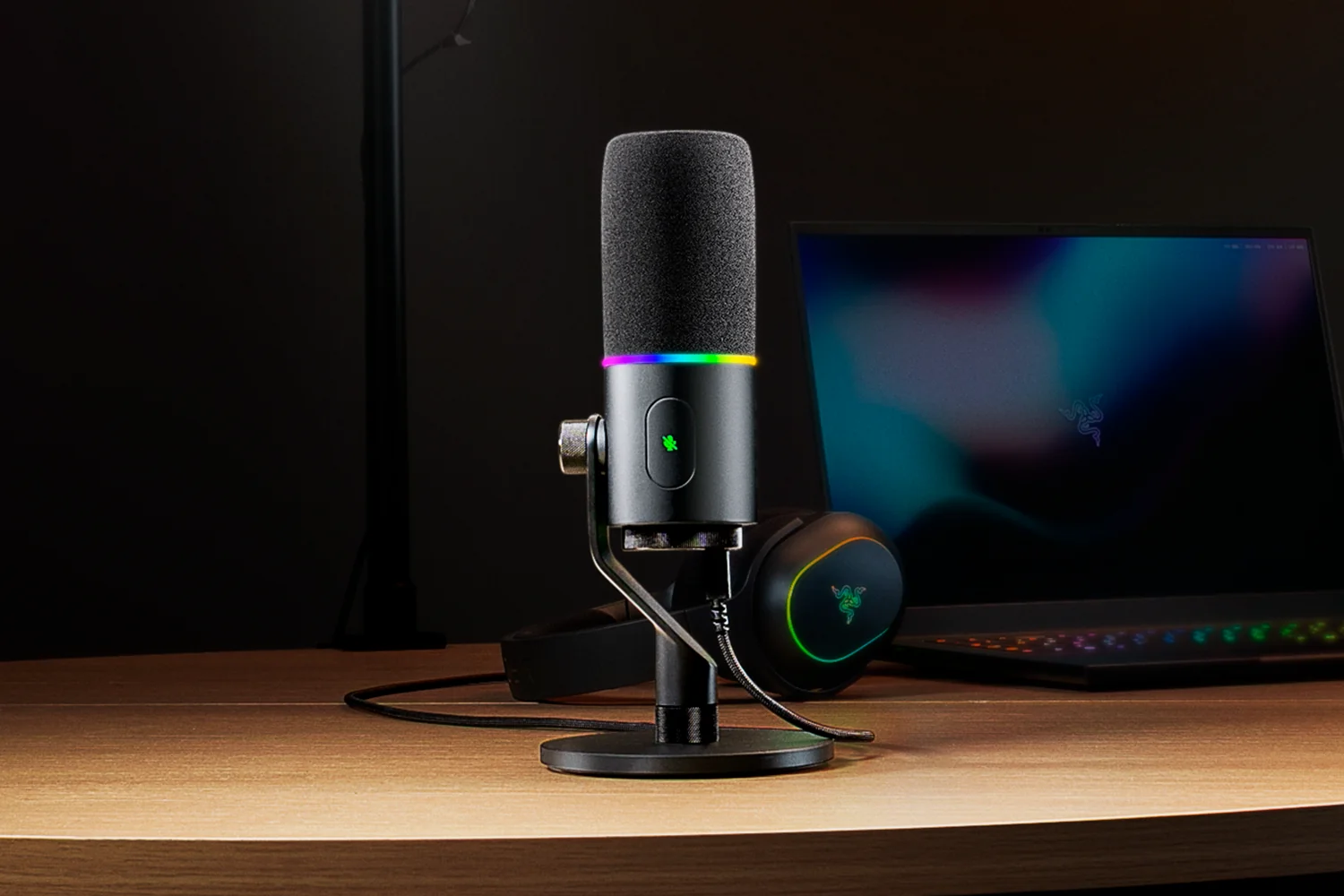
| RGB | multi-zone Chroma ring; doubles as a live gain indicator (red = too loud, green = good). |
| Boom arm | standard 5/8" thread, adapter not included. |
| In the box | microphone, desk stand base, braided USB Type-A to Type-C cable. |
| Software | onboard memory works without Synapse; full settings require Razer Synapse on Windows. |
| Warranty | 12 months; RazerStore purchases add 14 days risk-free returns. |
| Colors | black, white, Quartz pink. |
Full research notes and sources
Setup, controls and build
The Seiren V3 Chroma is genuinely plug-and-play: it needs no drivers, runs over a single USB-C connection at 5 V / 500 mA, and has onboard memory so your settings travel with the mic. A capacitive sensor on top mutes with a single tap and turns the RGB ring red; double and triple taps can be remapped to lighting and the digital gain limiter. The front dial switches between microphone gain and headphone/sidetone volume, and a 3.5 mm jack on the rear gives you monitoring while you record.
Build is a clear strength. The lower half of the mic and stand is metal, giving a low center of gravity that keeps it planted on a desk, and the pill-shaped body takes up little room. Published weights disagree — 408 g (Windows Central), 474 g (PCGamesN) and 600 g (Pokde) — most likely mic-only versus mic-plus-stand, though no source says so directly. The desk stand is part of the box, along with a braided USB Type-A to Type-C cable; a 5/8" boom-arm thread is built in, but the adapter is not included.
Sound and noise pickup
By default the tone is warm and round. PC Gamer called it “fairly warm, round”, Windows Central heard voices “clear and detailed with a fair amount of warmth”, and the digital gain limiter does a solid job of taming peaks. SlashGear went furthest, calling the recording quality “phenomenal”.
There are no instrumented measurements for this model — no published frequency response, self-noise or distortion figures — so everything here is listening-based, and the reviewers tested in untreated rooms at different distances and gain settings.
Noise is the weak point, and the complaints line up. Windows Central’s keyboard came through “every single click and clack” at full volume; GamesRadar’s noise suppression “really struggled” with a PC fan and typing; Trusted Reviews also heard keyboard noise at lower volumes. PC Gamer recorded a distinct buzz with a little hiss in dead air, present across USB ports and distances. Only SlashGear (“acceptable noise suppression”) and Laptop Mag (“clear and well-isolated even without additional background noise cancellation tools”) were kind about isolation.
The reason is software as much as hardware. Synapse gives you a high-pass filter, a digital gain limiter and auto gain control, but no noise-reduction algorithm and no custom EQ beyond a “radio voice” preset. Nobody has published a failure rate, so treat this as a known annoyance rather than a defect.
Synapse software
You can use the mic without Synapse — onboard memory holds your settings — but full control needs Razer Synapse on Windows. The software side has been rocky. Its dial control also lags what Logitech’s Yeti GX offers.
Owners report worse. In a Razer Insider thread, Synapse 3 froze for 15–30 seconds when switching tabs or changing settings with the mic connected; disconnecting the mic stopped the freezes, which came back after a profile sync. Another owner says the mic stopped working after use, with only partial Chroma behavior, and a Reddit report describes a “weird echo” appearing after a move with no settings changes, cause never pinned down. These are recurring community reports, not a measured defect rate. Mac users do not get the full Synapse feature set, either.
Is it worth it?
It depends on the price and your tolerance for fan noise. At the $129.99 launch MSRP (February 2024) the value case was mixed, since rivals like the Logitech G Yeti GX, SteelSeries Alias and HyperX QuadCast S offered better isolation or more features at the same money. Windows Central had it at $129.99 at Best Buy and Razer in October 2024, with Best Buy’s white model at $99.99 and a later deal box at $92.99.
At under $100 it is a reasonable buy for someone who wants the compact metal design and RGB and is willing to add third-party noise-suppression software — that is the cheap fix for its main weakness. From $101 to $120 it is fair, and above $120 it is weak unless the design or the Razer ecosystem specifically matters to you.
There are no running costs beyond a PC: the mic is USB bus-powered. The one extra owners end up paying for is optional noise-suppression software, since Synapse doesn’t include it.
If you are comparing today, weigh the original against that newer model before deciding.
Which model this is
This page covers the original Seiren V3 Chroma, Razer part number RZ19-0506, announced in February 2024 at a $129.99 / €149.99 MSRP in black, white and a Razer-exclusive Quartz pink.
The black US variant is ASIN B0CT7D7JVR.
Don’t confuse it with the Seiren V3 Chroma 32-Bit DSP, which Razer announced in July 2026 and which carries different specs — 120 dB max SPL and 112 dB SNR versus this model’s 110 dB and 96 dB. Razer’s current page under the “Seiren V3 Chroma” name now serves the DSP model, so specs pulled from razer.com today often describe the wrong microphone. The V3 Pro and V3 Mini are different models too.
Sources
Manufacturer:
- Razer Seiren V3 Chroma & Mini launch newsroom
- Razer Seiren V3 Chroma support & FAQs (RZ19-0506)
- Razer Seiren V3 Chroma product page
- Razer Seiren V3 Chroma 32-Bit DSP (US)
- Razer Seiren V3 Chroma 32-Bit DSP Master Guide (PDF)
Independent reviews:
Owner reports: