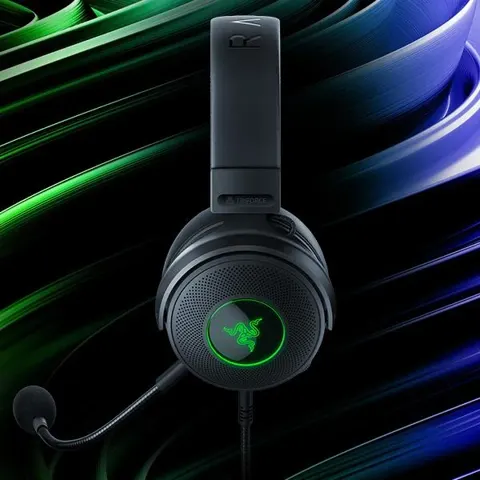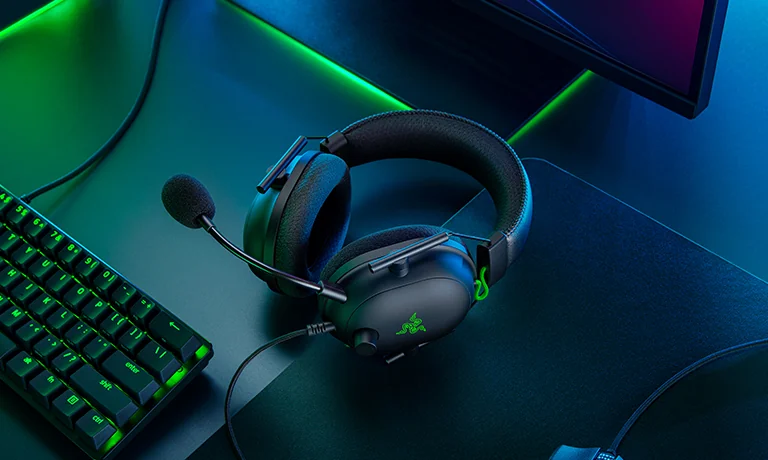
Razer BlackShark V2 Gaming Headset
By Razer · Gaming Headsets · Audio & Electronics · More from Razer
Compare all Gaming Headsets side by side →
- 50mm titanium drivers
- THX Spatial Audio
- 12 Hz - 28 kHz frequency response
- Detachable HyperClear cardioid mic
- 3.5mm jack + USB sound card
Price not listed
- RazerView at Razer
- Best Buy15-day returns · store policyView at Best Buy
- eBayView at eBay
- B&H Photo30-day returns · store policyView at B&H Photo
- Walmartfree shipping $35+ · store policyView at Walmart
- eBay (used) eBay: used, open-box, refurbishedView at eBay (used)
Stores with a price are sorted lowest first; commission never changes the order. Prices are snapshots. Check the current price with the store.
Summary
A lightweight wired esports headset with 50mm TriForce Titanium drivers, a detachable cardioid microphone and a USB sound card that enables THX Spatial Audio on PC. Check the cable and the software before you buy: the main cable is permanently hardwired and the full feature set depends on Razer Synapse.
Size in context
Weight 262 g (9.2 oz): about 1.3 times a smartphone (~200 g).
Strengths
- Light at 262 g, and owners praise comfort over long gaming sessions without clamping fatigue.
- The detachable HyperClear microphone transmits voice clearly out of the box.
- Free 50mm TriForce Titanium drivers with a balanced, game-tuned frequency response.
- The USB sound card unlocks THX Spatial Audio profiles for competitive play.
- Ear cushions and the microphone capsule are both replaceable.
Weaknesses
- The main audio cable is hardwired to the left earcup and cannot be swapped.
- Adjusting the sliding metal struts while wearing the headset is fiddly and unbalances easily.
- On Windows, advanced spatial audio and microphone settings need Razer Synapse.
- Glued earcup assemblies make user repair hard.
- Owners and reviewers report good but not leading virtual surround localization.
Verified specifications
| Model | Razer BlackShark V2, RZ04-0323 (RZ04-03230100-R3U1). |
|---|---|
| Drivers | 50mm TriForce Titanium dynamic drivers. |
| Frequency response | 12 Hz – 28 kHz. |
| Impedance | 32 Ω @ 1 kHz. |
| Connectivity | 3.5mm 4-pole audio jack plus a USB sound card DAC. |
| Surround sound | THX Spatial Audio 7.1 through the USB sound card and Synapse. |
| Microphone | detachable Razer HyperClear cardioid mic, 100 Hz – 10 kHz. |
| Weight | 262 g (9.2 oz). |
| Materials | matte black plastic earcups, metal headband support rods, synthetic leather headband top with fabric memory foam ear pads. |
| In the box | headset, USB sound card DAC, detachable cardioid microphone, audio splitter/extension adapter, cloth carrying pouch, product documentation. |
| Warranty | Razer standard 2-year limited hardware warranty. |
Full research notes and sources
Sound and positional audio
The 50mm TriForce Titanium drivers cover 12 Hz – 28 kHz, and professional test benches rate the response as well balanced for gaming, with strong mid-range presence that carries positional cues and solid bass without distortion at high volume. Directional imaging works in competitive titles, though the virtual surround from the THX profiles is rated as good rather than industry-leading.
Playing through the 3.5mm jack alone gives you standard analog stereo. The USB sound card is what enables the THX Spatial Audio 7.1 profiles on PC, so keep the dongle if you care about virtual positioning.
Microphone
The detachable Razer HyperClear cardioid mic runs from 100 Hz – 10 kHz and is rated as clean and crisp, outperforming many competitors without any adjustment. Only the mic comes off the headset; the main audio cable stays attached. The capsule and the foam pop filter are replaceable, which is the one repair path owners have.
Comfort and build
At 262 g (9.2 oz) the frame stays light, and owners single out the breathable FlowKnit memory foam ear cushions as the reason they can game for hours without ear fatigue. The build uses matte black plastic earcups, metal headband support rods and a synthetic leather headband top.
The adjustment is the weak point. The cylindrical struts that hold the earcups have no notched height markers, so getting both sides level while the headset is on your head is a slow, uneven task.
The USB sound card and Synapse
The USB sound card DAC is the reason the dongle exists, but it also pulls the headset into software territory. On PC you need Razer Synapse for the THX Spatial Audio profiles and for the advanced microphone options; plug in through the 3.5mm jack alone and you get plain analog stereo with no virtual surround. Native behaviour of the included DAC on non-Windows systems without extra configuration is not something the research established, so check before you switch platforms.
Repairs and upkeep
Expect to clean the ear cushions and keep the mic windscreen fresh. Ear pads, generic windscreens and the microphone capsule are all available aftermarket, and there are no recurring subscription costs to own the headset. Real repairability is low: the earcup assemblies are glued and the audio cable is hardwired, so a frayed or damaged main cable means soldering or replacing the headset.
Is it worth it?
At $60 or less this is excellent value for a tournament-grade wired headset with a USB DAC. Between $61 and $80 it is a fair to good street price. Razer lists the MSRP at $99.99, and at full MSRP it competes closely with wireless alternatives and newer iterations, so sales and bundles are the better route. Authorized electronics retailers have commonly offered it on sale between $50.00 and $70.00.
Which model this is
This page covers the wired Razer BlackShark V2, model RZ04-0323, with 3.5mm analog audio plus the USB sound card. Do not confuse it with the BlackShark V2 X, which has a simpler fixed rubber cable, no USB sound card and non-titanium drivers, or with the wireless BlackShark V2 Pro.
Sources
Manufacturer:
Independent reviews: