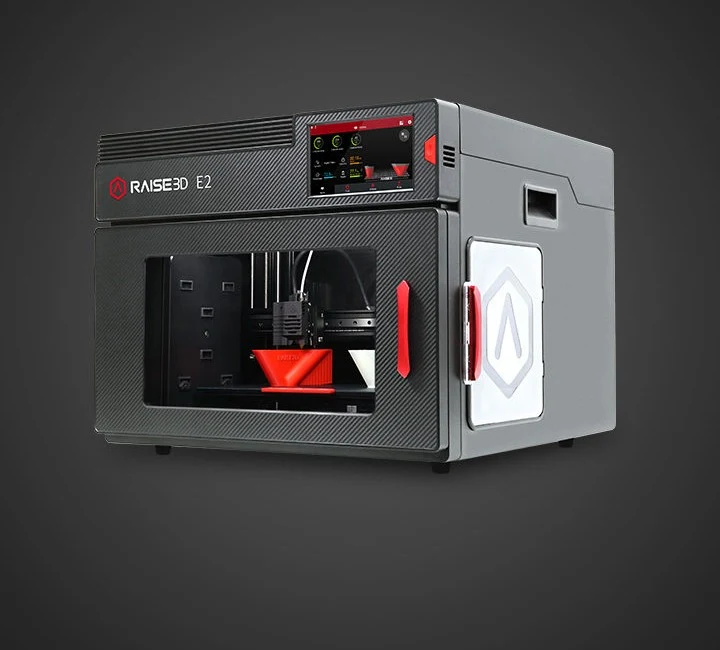
Raise3D E2 Desktop 3D Printer
By Raise3D · Enclosed 3D Printers · 3D Printing
Compare all Enclosed 3D Printers side by side →
- Build Volume: 330 x 240 x 240 mm
- Dual IDEX Extruders
- Max Nozzle Temp: 300°C
- Layer Height: 0.1-0.5 mm
- 7-inch Touchscreen
Lowest price seen
$2,999.00
from $2,999.00 at Shop3Duniverse · Checked Nov 22, 2026
- Shop3Duniverse $2,999.00View at Shop3Duniverse
- Profound3D $2,999.00View at Profound3D
- Ultimate3Dprintingstore $3,499.00View at Ultimate3Dprintingstore
- Raise3DView at Raise3D
- AmazonView at Amazon (paid link)
More on eBay (1)
- eBayView at eBay
- eBay (used) eBay: used, open-box, refurbishedView at eBay (used)
Stores with a price are sorted lowest first; commission never changes the order. Prices are snapshots. Check the current price with the store.
Summary
The Raise3D E2 is a professional enclosed FDM printer for schools, offices and small production teams that need two independent extruders and stable conditions for difficult materials. Check the available floor space and workflow first: the machine weighs 35 kg, and filament loading and ideaMaker setup take more steps than on many desktop printers.
Size in context

60.7 cm · 23.9 in (W) × 59.6 cm · 23.5 in (D) × 46.5 cm · 18.3 in (H) · Drawn to scale from the maker's stated dimensions, next to everyday objects.
Strengths
- The IDEX system prints identical parts in duplicate or mirror mode, cutting their production time in half.
- The enclosed chamber and HEPA filter help control fumes and keep material conditions stable.
- TechRadar measured average dimensional error of 0.13 mm across several test targets.
- Fine flow control, negative features and bridging each earned the maximum score in TechRadar testing.
- Auto bed leveling, runout detection and power-loss recovery support unattended prints.
- Owners in professional and educational settings praise the build quality, reliability and touchscreen.
Weaknesses
- Filament loading requires removing the Bowden tube and inserting filament directly into the extruder.
- ideaMaker needs several steps to position, slice, upload and start a model.
- Owners report occasional PLA clogs during long prints or with the cover closed.
- The 35 kg machine is difficult to move and needs two people for setup.
- Magnetic build-plate alignment needs care, and a misaligned plate can cause printing problems.
- The 800 × 600 camera is adequate for monitoring but weak for detailed inspection.
Verified specifications
| Model | Raise3D E2 |
|---|---|
| Build volume, single extrusion | 330 × 240 × 240 mm |
| Build volume, dual extrusion | 295 × 240 × 240 mm |
| Print technology | FDM (FFF) |
| Print head system | Independent Dual Extruders (IDEX) |
| Filament diameter | 1.75 mm |
| Layer height | 0.02–0.25 mm |
| Default nozzle diameter | 0.4 mm |
| Optional nozzle diameters | 0.2, 0.6, 0.8 and 1.0 mm |
| Maximum nozzle temperature | 300°C |
| Maximum build plate temperature | 110°C |
| Build plate | flexible steel plate with magnetic attachment and BuildTak surface |
| Bed leveling | 9-point standard or 63-point advanced probing across multiple zones |
| Dimensions | 607 × 596 × 465 mm |
| Net weight | 35 kg |
| Power input | 100–240 V AC, 50/60 Hz |
| Power supply output | 350 W |
| Connectivity | Wi-Fi, Ethernet and USB 2.0 |
| Live camera monitoring | included |
| User interface | 7-inch capacitive touchscreen at 1024 × 600 |
| Camera resolution | 800 × 600 at 10 fps |
| Motion controller | Atmel ARM Cortex-M4 120 MHz FPU |
| Logic controller | NXP ARM Cortex-A9 Quad 1 GHz |
| Filter | HEPA filter with activated charcoal |
| Slicing software | ideaMaker |
| Included | two spools of Raise3D Premium PLA, heat-resistant gloves, scraper, tweezers, spare PTFE tubes with couplers, hex wrenches, metal leveling card, spool rollers, fuses, 8 GB USB drive and nozzle unclogging rod |
Full research notes and sources
Print quality and IDEX production
TechRadar’s test targets showed average dimensional error of 0.13 mm. Flow control, negative features and bridging received the maximum score, while the overall performance score was 28/30. The tester described precise extrusion and excellent print quality, with minor stringing and PLA flecks appearing at the lowest settings.
The two IDEX extruders move independently along the X-axis. That allows duplicate and mirror modes to produce two identical parts at once, which TechRadar described as superb and roughly halves production time for matching parts. The heads cannot print two different models simultaneously. Dual-color transitions between materials came out smooth in testing.
Enclosure, filtration and materials
The enclosed chamber helps maintain temperature stability for materials such as ABS and polycarbonate. Its HEPA filter and activated charcoal reduce fumes and particulates, making the printer more suitable for shared classrooms and offices. The filter still does not replace proper room ventilation.
The heated build plate reaches 110°C, and the nozzle reaches 300°C. Automatic bed leveling checks nine points in standard mode or 63 points in advanced mode; full 63-point calibration takes 10–20 minutes. Basic setup takes about 20 minutes, while complete calibration takes about an hour.
Workflow and unattended printing
The physical controls are straightforward. Owners repeatedly describe the 7-inch touchscreen as intuitive and best in class. The harder part is preparing and starting work in ideaMaker: you position the model, choose settings, slice it, upload it, connect the printer and select the file.
The printer pauses if a door is opened, a useful safeguard in education settings. Filament sensors pause a print after a runout, and power-loss recovery resumes the print after power returns. Firmware can be updated from the touchscreen or over the air.
Maintenance and ownership
Clean the chamber, filament path and hotend regularly. The HEPA filter needs periodic replacement for proper fume control, and nozzles may need replacing. Re-level the bed after moving the machine or changing the build plate. The research does not establish replacement-filter intervals, replacement-part costs beyond the warranty, or long-term filter pricing, so budget for those consumables after asking the manufacturer for current figures.
Changing nozzles for different materials is less convenient than on some competing machines. Owners also report that switching filament involves manual tube removal, and the PLA clogging reports are most common in long prints or a closed chamber. Customer support is described as responsive and helpful. The standard warranty is one year, although some promotional listings mention two years.
Is it worth it?
This is a production tool, not a casual home printer. Its case rests on IDEX duplicate printing, an enclosed chamber, measured print accuracy and features for unattended operation. The extra room it needs, 35 kg weight and manual filament handling make it a harder fit for a small office or apartment.
The research places the printer in the $2,999–$3,499 range across retailers, but it does not identify a dated retailer price. The strongest value is for teams that repeatedly make identical parts or need dual materials in a shared environment. A single-extruder printer will be simpler if you rarely use either advantage.
Which model this is
It is not a Raise3D Pro2. The US-market listing uses ASIN B085NWLGZG.
Sources
Manufacturer:
Independent reviews:
Owner reports: