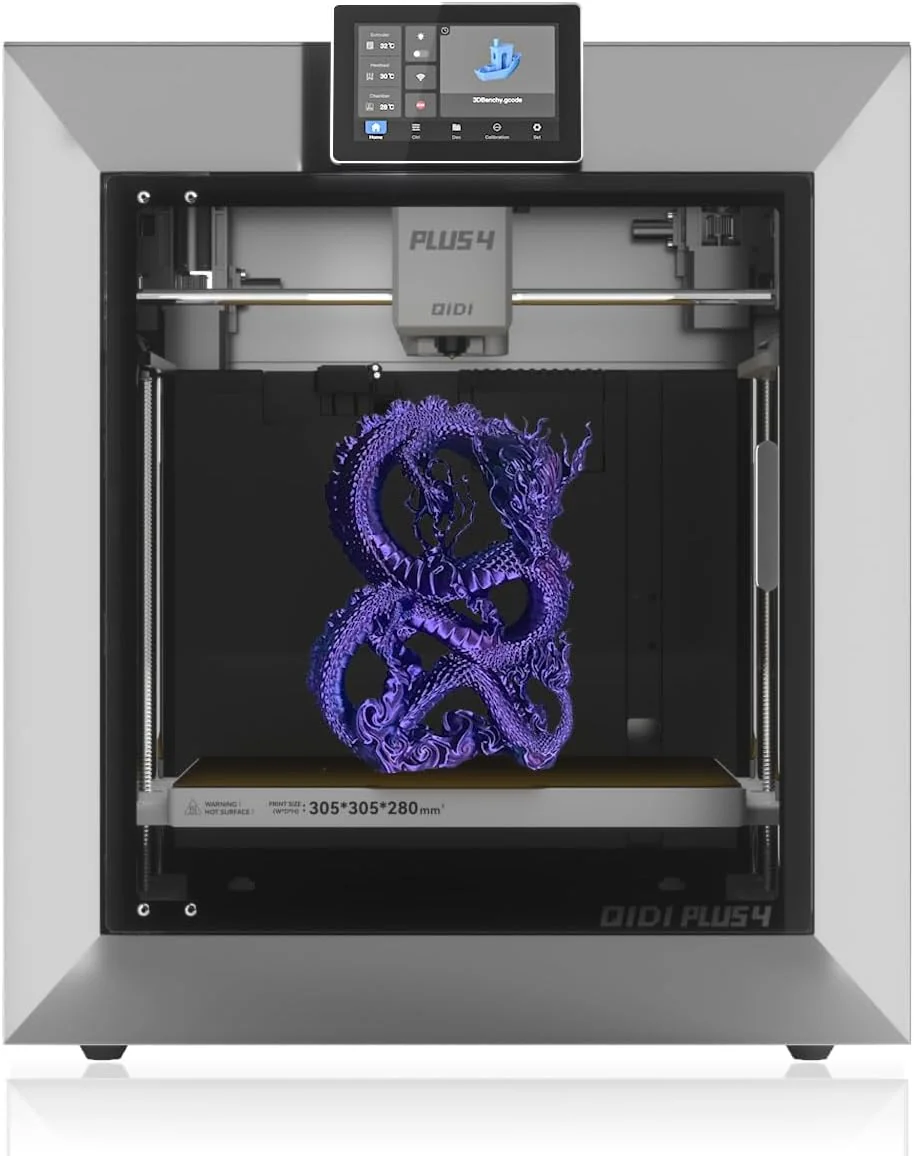
QIDI Plus4
By QIDI · Enclosed 3D Printers · 3D Printing
- Build volume 305x305x280 mm
- Max tool head speed 600 mm/s
- Nozzle up to 370 C
- Active chamber heating up to 65 C
- Heated bed up to 100 C
Lowest price seen
$649.00
from $649.00 at fabreeko · Checked Oct 12, 2026
- fabreeko $649.00View at fabreeko
- qidielectronics $699.00View at qidielectronics
- QIDIView at QIDI
- eBay (used) eBay: used, open-box, refurbishedView at eBay (used)
- eBayView at eBay
- AmazonView at Amazon
Prices are snapshots. Check the current price with the store.
Summary
An enclosed CoreXY FDM printer with active chamber heating for engineering materials like ABS, ASA, PC, and nylon. Check the Z-offset calibration issue at high bed temperatures before buying, and confirm you are comfortable with a discontinued model.
Strengths
- Active chamber heating to 65°C enables reliable printing of ABS, ASA, PC, nylon, and carbon-fiber composites.
- Print quality and dimensional accuracy compared favorably to the Prusa MK4 and Bambu Lab X1 Carbon.
- Build quality described as industrial-grade with steel chassis and glass panels.
- Some owners report responsive customer support with same-day email responses.
- The toolhead filament cutter is widely praised by owners.
Weaknesses
- Z-offset calibration can fail at high bed temperatures (90°C+ for ABS/ASA), causing nozzle crashes into the PEI sheet; the issue persists through firmware v1.7.3.
- Early-production SSR board defect posed a fire risk; fixed in units manufactured after December 2024.
- The 5-inch touchscreen UI is laggy, with slow preview image loading.
- Bed leveling requires re-running mesh leveling after every build plate swap.
- Filament loading requires firm pushing and the purge chute makes it hard to verify proper loading.
- No AI features like spaghetti detection.
Verified specifications
| Build volume | 305×305×280 mm. |
|---|---|
| Motion | CoreXY with 9 mm 1.5GT belt. |
| Max toolhead speed | 600 mm/s. |
| Max acceleration | ≤20,000 mm/s². |
| Nozzle max temperature | ≤370°C (80 W heater, ceramic heat break). |
| Heated bed max temperature | ≤120°C, 6 mm aluminum substrate. |
| Chamber heating | 2nd generation PTC heater, up to 65°C, independently controlled. |
| Extruder | direct drive, hardened steel gears, bimetal nozzle (0.4 mm standard; 0.2/0.6/0.8 mm optional). |
| Build plate | dual-sided textured PEI magnetic plate. |
| Bed leveling | automatic with piezoelectric sensor. |
| Display | 5-inch 800×480 touchscreen. |
| Connectivity | 2.4 GHz Wi-Fi, Ethernet, USB. |
| Storage | 32 GB eMMC + USB 2.0. |
| Camera | up to 1080P, timelapse supported. |
| Rated power | 450 W main + 400 W chamber heating. |
| Supported filament | PLA, ABS, ASA, PETG, TPU, PA, PC, carbon/glass fiber reinforced polymers. |
| Dimensions | 505×487×550 mm (HWD); 19.8 × 19.17 × 21.65 inches. |
| Net weight | 27 kg (60 lb); gross weight: 32 kg (77 lb). |
| Warranty | 1 year (US). |
Full research notes and sources
Chamber heating and materials
The Plus4’s active chamber heating is its defining feature. A 400 W PTC heater brings the chamber to 60°C in 5 minutes, with a maximum of 65°C. This enables reliable printing of ABS, ASA, PC, nylon, and carbon-fiber composites that would warp or fail on passively enclosed or open-frame machines. PCMag called ABS printing a particular strength. Tom’s Hardware reported a Benchy print time of 12 minutes 58 seconds at 300 mm/s, one of the fastest they had tested.
Z-offset calibration issue
The most significant unresolved issue is Z-offset calibration failure at high bed temperatures. When printing ABS/ASA at bed temperatures of 90°C+, the automatic Z-offset calibration can fail, causing the nozzle to drag into the PEI sheet. Multiple users on GitHub report the problem persisting through firmware v1.7.3 (December 2025). The suspected cause is piezoelectric sensor signal degradation at high temperatures. Workarounds include preheating the chamber to only 38°C before leveling, using OrcaSlicer instead of QIDI Studio, and manually adjusting Z-height before each print. Some users received replacement piezo sensors with mixed results.
UI and usability
The 5-inch 800×480 touchscreen is consistently described as laggy, with slow preview image loading. PCMag, TechRadar, and the QIDI official review all noted this. The QIDI Studio slicer cannot automatically find the printer over the network; you must manually enter the IP address. Bed leveling requires re-running mesh leveling every time the magnetic build plate is flipped or swapped, because Z-offset and mesh compensation are tied to the plate’s exact thickness and position.
Support and warranty
QIDI’s US warranty covers manufacturing defects for 1 year. The EU store lists 2 years. Support experiences vary widely: PCMag reported same-day email responses, while other owners describe support as unhelpful or dismissive. One Reddit user reports QIDI support refusing to honor their warranty. An official Wiki page documents board replacement and other repairs, and a community wiki documents additional fixes including toolhead bearing replacement and mainboard cooling mods.
Is it worth it?
The Plus4 is now discontinued, with the Plus5 (320×320×300 mm) as its successor. For users who specifically need engineering material performance in an enclosed, actively heated chamber, it remains a capable option. Buyers should weigh the discontinued status, the Z-offset calibration issue, the early-production SSR concern, and the mixed warranty support reports. If you primarily print PLA or PETG, a cheaper open-frame or passively enclosed printer may be more appropriate.
Which model this is
This page covers the QIDI Plus4 (also styled Plus 4, X4 Plus), an enclosed CoreXY FDM printer. The US Amazon listing is ASIN B0DNF39MML. It is not the same as the QIDI Q2, Q2C, Max4, or Plus5.
Sources
Manufacturer:
- QIDI Plus4 product page (US store)
- QIDI Plus4 tech specs
- QIDI Plus4 review (official)
- QIDI Plus4 All3DP award
- QIDI warranty statement
- QIDI US warranty policy
- QIDI EU store product page
- QIDI manuals
Independent reviews:
Owner reports:
- Owner experiences after owning a Plus4 (r/QIDI)
- QIDI Box and Plus4 experience after a week (r/QIDI)
- First impressions of Plus4 (r/QidiTech3D)
Community: