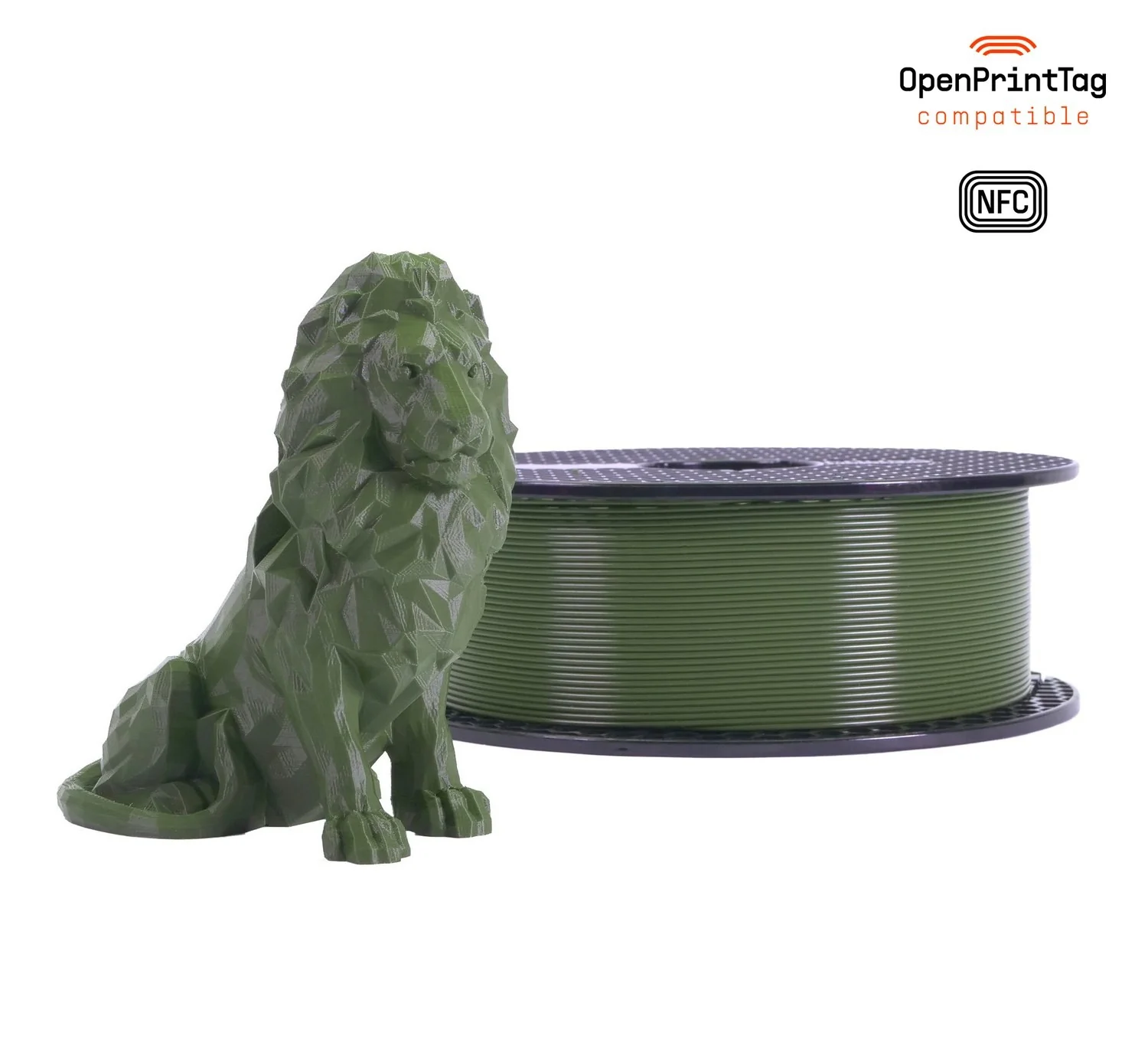
Prusament Premium PLA Army Green 1.75mm 1kg
By Prusament · Filament & Resin · 3D Printing
- 1.75 mm filament diameter
- 1 kg spool
- 215 °C nozzle temperature
- 50-60 °C bed temperature
- ±0.02 mm diameter tolerance
Price not listed
- PrusamentView at Prusament
- eBayView at eBay
- AmazonView at Amazon (paid link)
- eBay (used) eBay: used, open-box, refurbishedView at eBay (used)
Stores are listed in a fixed order, never by price or commission. Prices are snapshots. Check the current price with the store.
Summary
Standard PLA filament in a muted military green, sold as a 1 kg, 1.75 mm spool by Prusa Polymers, with per-spool measured diameter and ovality and an advertised 1.75 ± 0.02 mm tolerance.
Strengths
- Per-roll quality data: Prusa continuously measures diameter and ovality and exposes the readings from the spool code; rare transparency for a filament, though the readings are the manufacturer’s own.
- Documented color recipe: Prusa states it uses a spectroscopic recipe and checks batches, which helps multi-part prop sets match; color uniformity is a vendor claim, not an independent spectrophotometer test.
- Straightforward print window: 215°C nozzle, 50–60°C bed, low warp, and PrusaSlicer support; suited to indoor visual models, prototypes, organizers and props.
- 2023 owner observation: a November 12, 2019 Army Green spool printed successfully with the same g-code and storage that failed on a Royal Blue roll. One anecdote, not evidence about current lots.
- Documented material: the official TDS lists thermal, density, moisture and mechanical test context, so the limits are as informative as the benefits.
Weaknesses
- Brittle on impact: the material is hard and brittle, so avoid flexed clips, impact mounts and any part with safety consequences.
- No independent verification: no independent caliper or laser QC audit of random 2026 Army Green reels, and no color-specific mechanical coupon series.
- Price ambiguity: displayed prices vary by storefront context ($25.49, $20.46, $24.07, $37.99); compare delivered checkout prices for the same reel generation.
- Reel-generation risk: older cardboard-centered spools can loosen above 45°C, and a catalog title without an NFC label may ship older stock.
- No verified defect rate: no published rate of tangles, diameter outliers, or nozzle blockages for this color.
Verified specifications
| Material | PLA (polylactic acid), Army Green, 1 kg net, 1.75 mm nominal. |
|---|---|
| Diameter tolerance | 1.75 ± 0.02 mm (1.73–1.77 mm); Prusa records continuous diameter and ovality, readable from the spool code. |
| Print profile | 215°C nozzle, 50–60°C heated bed, 0.4 mm brass nozzle. |
| TDS profile (2022) | 210 ± 10°C nozzle, 40–60°C bed, up to 200 mm/s, 100% part cooling. |
| Density | 1.24 g/cm³; melt flow 9–11 g/10 min at 210°C/2.16 kg. |
| Thermal | HDT 55°C at 0.45 MPa (also 55°C at 1.80 MPa). |
| Mechanical (TDS coupons) | tensile yield 57 ± 1 MPa; interlayer adhesion 17 ± 3 MPa; horizontal 51 ± 3 MPa, vertical-XZ 59 ± 2 MPa; flexural 83 ± 6 / 99 ± 1 MPa; Charpy unnotched 13 ± 1 / 14 ± 1 kJ/m². |
| Drying | 45°C for 6 hours when needed; store sealed with desiccant. |
| Reel | from October 2025, reusable plastic spool with rewritable OpenPrintTag NFC; new spool tolerates up to 90°C reel drying, older cardboard-centered reel may loosen above 45°C. |
| Approximate length | about 335 m per 1 kg (calculated from 1.24 g/cm³, not guaranteed). |
| Identifiers | NFC version IDF 17628, IDS 3412; older clearance IDF 2633, IDS 587. |
Full research notes and sources
Printing profile and bed adhesion
The exact-item guidance is 215°C nozzle, 50–60°C heated bed and a 0.4 mm brass nozzle. The broader 2022 TDS lists 210 ± 10°C nozzle, 40–60°C bed, up to 200 mm/s and 100% part cooling in its reference setup; treat the TDS as general test guidance, not a high-flow limit for every machine. Prusa lists smooth PEI, textured or powder-coated and satin steel sheets as supported, and advises cleaning a cold plate with isopropyl alcohol. A supported plate does not guarantee adhesion on every large print without a brim. A May 2020 Opal Green owner reported corner lifting at 215°C nozzle and 60°C bed on a textured MK3S sheet despite an acceptable first layer; advice included trying a smooth sheet or adjusting cooling. That is a related-shade troubleshooting example, not a verified Army Green defect.
Heat and strength limits
The TDS gives 55°C HDT at 0.45 MPa (also 55°C at 1.80 MPa) and Prusa’s guide says parts begin losing mechanical strength above about 60°C. Long sun exposure, heat near motors and electronics, and car interior heat can exceed PLA’s safe margin. The material is relatively stiff, hard and brittle on impact, with limited UV and heat resistance. Dry sanding can soften and deform localized features because of friction heat; wet sanding and adhesive joining are the suggested approach. Test coupons used an Original Prusa i3 MK3 at 100% rectilinear infill, 0.2 mm layers, 215°C nozzle and 60°C bed, and real household parts with different geometry, raster and infill cannot inherit those values unconditionally.
Color and quality control
Prusa says it uses a documented spectroscopic color recipe and checks batches. For cosplay prop sets and models assembled from multiple PLA parts, that offers a better-grounded consistency claim than an untracked olive spool. Color uniformity remains a vendor assertion. A January 2023 owner comparison found a November 12, 2019 Army Green spool printed successfully while a Royal Blue roll failed with identical g-code and storage; that cuts against treating all Prusament colors as performance-identical, but it is a 2019-date anecdote, not a current batch notice. A May 2026 hobbyist published a six-spool break-test comparison in which a Prusament sample showed strong longitudinal tensile strength but comparatively poor layer adhesion on their settings; the color was not established as Army Green, the sample was three coupons per outcome, and it cannot establish a brand-wide statistic.
Moisture, drying and storage
PLA needs less routine drying than nylon but can develop bubbles, strings or rough surfaces when wet. Prusa prescribes 45°C for 6 hours when drying is needed, followed by dry storage. That is a material limit; it does not authorize drying PLA at the higher temperature the new spool’s plastic can tolerate. The new black spool tolerates up to 90°C reel exposure, while the older black-flange or cardboard-core design may loosen above 45°C; identify the reel revision before experimenting, and still dry PLA at 45°C. Keep filament in a sealed container with desiccant.
Is it worth it?
Observed offers in pages dated October 23, 2026, in USD, with differing shipping contexts and reel generations: Prusa’s NFC page showed $25.49 with a Japan destination and USD currency, which is a currency-denominated posted value rather than a confirmed US checkout quote; the no-NFC clearance page showed $20.46 in one snapshot and $24.07 in an older US-destination view; Printed Solid US listed the exact NFC SKU 17628 at $37.99, in stock, with free domestic shipping on orders over $50. No credible twelve-month historical median or independently tracked sale minimum was found.
At or below $22 delivered, a sealed legitimate 1 kg standard Army Green spool is a good buy, including an older no-NFC reel if NFC and a reusable spool are not needed. Between $23 and $28 delivered, the purchase is worth considering for color match and spool-specific quality history; Jessie Premium PLA Army Green was $24.99. At $30 to $38, other options offer better nominal cost: Micro Center’s Inland Military Green 1 kg was listed at $14.99, sometimes $11.99 in local promotions, with a claimed ±0.03 mm tolerance and a cardboard spool; Polymaker PLA Pro Army Green was in the $23.99 to $24.99 family range with claims of increased impact resistance, though its page was variant-sensitive and showed unavailable on the default selection.
Raw filament cost works out to $0.02549 per gram at $25.49 per kg, or about $2.55 for a 100 g print and $6.37 for a 250 g print, and $0.03799 per gram at $37.99 per kg, or about $3.80 per 100 g and $9.50 per 250 g. A hypothetical 250 g item differs by about $3.13 in raw filament between those two prices. Illustrative annual volumes: 3 kg per year at $25.49 per kg is $76.47, and 12 kg per year is $305.88; the same volumes at $37.99 per kg cost $113.97 and $455.88 before freight and taxes. Neither figure is a population average or a price prediction. Electricity, dryer power and failure scrap cannot be quantified from the checked sources.
Prusa allows a 60-day change-of-mind return from delivery but excludes opened or used filament spools; return postage is subtracted from the refund unless the wrong item shipped. Printed Solid’s listing says the SKU includes a 1-year standard manufacturer warranty, but it does not define coverage for partially used filament, UV discoloration or drying damage; treat it as a storefront summary. Printed Solid can be reached at (302) 439-0098 or sales@printedsolid.com. Defect claims should retain the spool’s unique identifier, manufacture data and photographs or measurements, then contact Prusa support via live chat, citing the nominal ±0.02 mm claim. Whether a half-used spool qualifies for replacement is a separate determination, not documented as an unconditional entitlement.
This page covers the standard Prusament PLA Army Green, nominal 1.75 mm diameter, 1 kg net. The current single-spool page labels it Prusament PLA Army Green 1 kg (NFC), IDF 17628, IDS 3412; Printed Solid identifies its NFC SKU as 17628. The same color also exists as an older no-NFC clearance spool, IDF 2633, IDS 587, plus an Army Green 2 kg package and a ten-spool multipack. These are distinct purchase options, not proof that an unspecified roll includes NFC. Do not confuse Army Green with Prusa Pro Green, Simply Green, Olive or Army Beige, and do not transfer specifications from a PLA Blend, PETG or PETG-CF variant.
Sources
Manufacturer:
- Prusa: older Army Green 1 kg clearance without NFC, IDF 2633
- Prusa: ten-pack Army Green NFC 1 kg multipack
- Prusa Polymers: Prusament PLA 2022 technical datasheet
- Prusament: official PLA materials guide
- Prusa Knowledge Base: storing and drying filament
- Prusa blog: OpenPrintTag and redesigned spool, October 31, 2025
- Prusa: refund and returns policy
Independent reviews:
- None found in the checked sources.
Owner reports:
- Reddit r/prusa3d: Royal Blue problem compared with successful November 2019 Army Green roll
- Reddit r/prusa3d: owners on printing different Prusament colors
- Reddit r/prusa3d: Opal Green adhesion problems, different shade
- Reddit r/3Dprinting: small independent PLA break comparison, Prusament shade unspecified
Parts and stores: