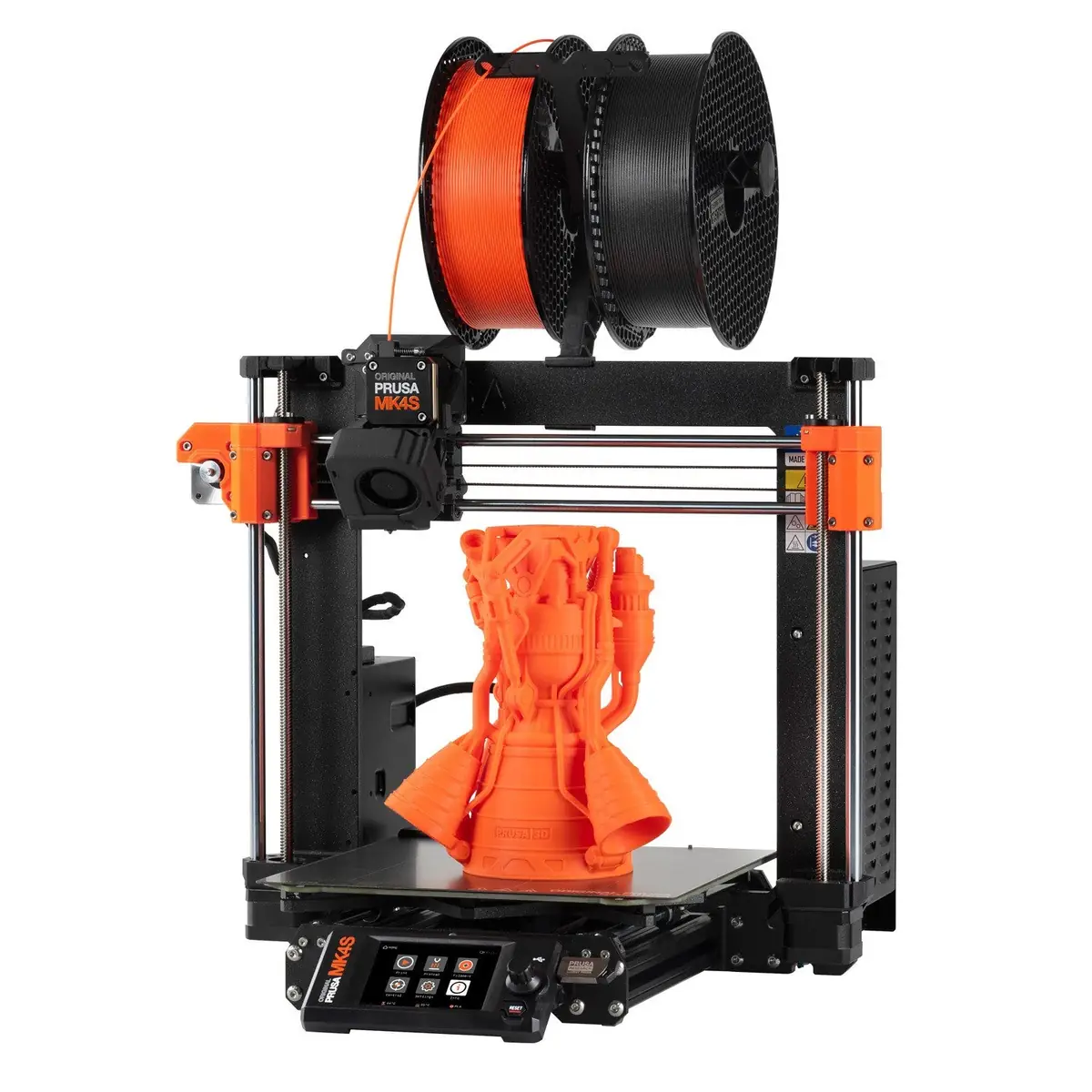
Prusa Original Prusa MK4S DIY Kit High-Speed FDM 3D Printer
By Prusa · 3D Printers · 3D Printing
- CoreXY-independent i3-style motion with 250 x 210 x 220mm build volume
- Input shaping and pressure advance, up to ~400mm/s effective speed
- Automatic calibration including load cell first-layer probing
- Nextruder 0.4mm nozzle, quick-swap system
- Open-source hardware and firmware, fully upgradeable
Lowest price seen
$709.00
from $709.00 at Additive Innovators · Checked Oct 9, 2026
- Additive Innovators $709.00View at Additive Innovators
- West3D $799.00View at West3D
- Top3DShop $1,010.00View at Top3DShop
- Printed Solid $1,149.00View at Printed Solid
- PrusaView at Prusa
- eBay (used) eBay: used, open-box, refurbishedView at eBay (used)
- eBayView at eBay
- Voxel FactoryView at Voxel Factory
- MDDC PrintView at MDDC Print
- AmazonView at Amazon
Prices are snapshots. Check the current price with the store.
Summary
The MK4S is Prusa’s i3-style bed-slinger 3D printer kit, sold as a no-solder build with a high-flow nozzle and load-cell first-layer probing. It is the quality-and-repairability pick rather than the fast-per-dollar one, so weigh the price against much cheaper CoreXY rivals before you buy.
Strengths
- Measured print quality is excellent: 30/30 from TechRadar at 0.097 mm average dimensional error.
- The high-flow Bondtech CHT nozzle raises Prusament PLA flow to 24 mm3/s, 50 percent above the MK4.
- The 360-degree cooling handles 75-degree overhangs without supports.
- Load-cell probing sets the first layer automatically, so no manual Z adjustment is needed.
- Fully open design: no welded or glued parts, and everything comes apart with Allen keys.
- Sold as a no-solder kit or fully assembled, and it runs offline with free PrusaSlicer.
Weaknesses
- Expensive next to much faster budget CoreXY machines; both reviews from 2024 named price as the main drawback.
- Open frame, so TechRadar recommends the optional enclosure for schools and workplaces.
- Print sheets are consumables and are excluded from warranty.
- Nextruder auto-feed and random-stop-extruding reports recur in the MK4-family forum.
- Layer-shift and belt-loosening threads recur in the MK4-family help forum.
- Wi-Fi setup has drawn owner complaints in the forum.
Verified specifications
| Build volume | 250 × 210 × 220 mm (9.84 × 8.3 × 8.6 in). |
|---|---|
| Layer height | 0.05–0.30 mm. |
| Filament diameter | 1.75 mm. |
| Nozzle | high-flow brass CHT, 0.4 mm, all-metal hotend with an aluminum heatsink. |
| Max nozzle temperature | 290°C (554°F). |
| Max heatbed temperature | 120°C (248°F). |
| Power | 240 W Delta PSU with Power Panic; 80 W in PLA settings, 120 W in ABS settings. |
| Extruder | Nextruder direct drive with a 10:1 planetary gearbox. |
| Motion | 0.9-degree X and Y stepper motors, Trinamic 2130 drivers. |
| Frame | aluminum extrusions and a powder-coated die-cast aluminum alloy frame. |
| Print surface | magnetic heatbed with removable PEI spring steel sheets; a smooth PEI sheet is supplied. |
| Bed calibration | automatic mesh bed leveling and fully automatic first-layer calibration via a load cell. |
| Connectivity | Ethernet, an NFC receiver and a removable ESP Wi-Fi module included. |
| Display | 3.5-inch color screen. |
| Electronics | custom 32-bit xBuddy board with STM32. |
| Multi-material | only with the optional MMU3. |
| Cooling | a 360-degree shroud lets overhangs reach 75 degrees without supports. |
| Dimensions | 500 × 550 × 400 mm (19.6 × 21.6 × 15.7 in); 7 kg, or 7.6 kg per Tom’s Hardware. |
| In the box | tool kit, 1 kg spool of Galaxy Black Prusament PLA, USB stick, handbook and stickers. |
| Kit assembly | no soldering; cables are cut to length and plug in. |
Full research notes and sources
Print speed and measured quality
TechRadar scored print quality 30 out of 30, with 0.097 mm average dimensional error across 25/20/15/10/5 mm targets (X 0.092 mm, Y 0.102 mm). It printed Rudolf Krcmar’s bowl in 3 h 29 min where the Creality K1C needed 7 h 05 min and the Bambu Lab P1P 4 h 41 min. Tom’s Hardware measured 24 mm3/s volumetric flow with Prusament PLA, 50 percent above the MK4’s 16 mm3/s, with PETG up 44 percent, and printed a two-part cone puzzle in 2 h 59 min against 3 h 23 min for the P1P. Ten consecutive 3D Benchy prints all came out exceptional. The measured wall speeds were around 250/200 mm/s at roughly 4000 mm/s2 average acceleration, against 200/300 mm/s at about 6000 mm/s2 on the P1P — the MK4S wins on flow and cooling, not top speed.
Open frame and cooling
The 360-degree cooling shroud runs its fan at about 70 percent and lets the printer handle overhangs up to 75 degrees without supports. The flip side is the open bed-slinger frame: TechRadar recommends the optional enclosure for schools and workplaces. Wi-Fi setup is by NFC tap with a phone, and the printer can stay offline if you prefer.
Parts, upkeep and running costs
There are no welded or glued parts, and Prusa says everything can be taken apart with a set of Allen keys. The MK4/S has a dedicated spare-parts category, published manuals and free open-source PrusaSlicer, and a $99 MK4-to-MK4S upgrade kit exists for existing owners. Filament, replacement PEI sheets and nozzles are the recurring costs; print sheets are excluded from warranty because their coatings wear. Prusa runs over 700 of its own printers around the clock and logged more than 1,000,000 print hours of pre-launch testing on the MK4 generation. The Prusa Reward Program pays a $30 e-shop voucher for sharing your experience.
Is it worth it?
Prusa direct listed the kit at $689.82 and the assembled unit at $957.40 when checked on 2026-10-08, below the $729 kit and $999 assembled comparison-table prices; the kit saves roughly $268 against the assembled unit and needs no soldering. The competition is cheaper: Tom’s Hardware’s 2026 guide puts the Bambu Lab X2D at $649 standalone or $899 as a combo and the Prusa CORE One at $1,299, while the Elegoo Centauri Carbon lists at $299, the Bambu P1S at $369 and the Snapmaker U1 at $849. Both reviews from 2024 called the MK4S expensive. Buy it for measured quality, repairability and the parts channel; if you want the fastest print per dollar, the sub-$700 CoreXY machines are the better fit.
Which model this is
This page covers the Original Prusa MK4S DIY kit, an i3-style Cartesian bed slinger sold both fully assembled and as a kit that requires no soldering. The Amazon listing for the black kit is ASIN B0DLHJB9HW. Don’t confuse it with the earlier MK4, the MK4-to-MK4S upgrade kit for existing owners, or the CORE One, MINI and XL.
Sources
Manufacturer:
- Original Prusa MK4S user manual
- Original Prusa MK4S product page
- Original Prusa MK4S 3D printer kit
- MK4/S and MK3.9/S spare parts
- MK4 family firmware and drivers
- Clogged nozzle troubleshooting
- Prusa Reward Program
- Original Prusa MK4S category page
Independent reviews:
- Tom’s Hardware: Prusa MK4S review
- TechRadar: Original Prusa MK4S review
- Tom’s Hardware: best 3D printers
- CNET: best 3D printers
Owner reports: