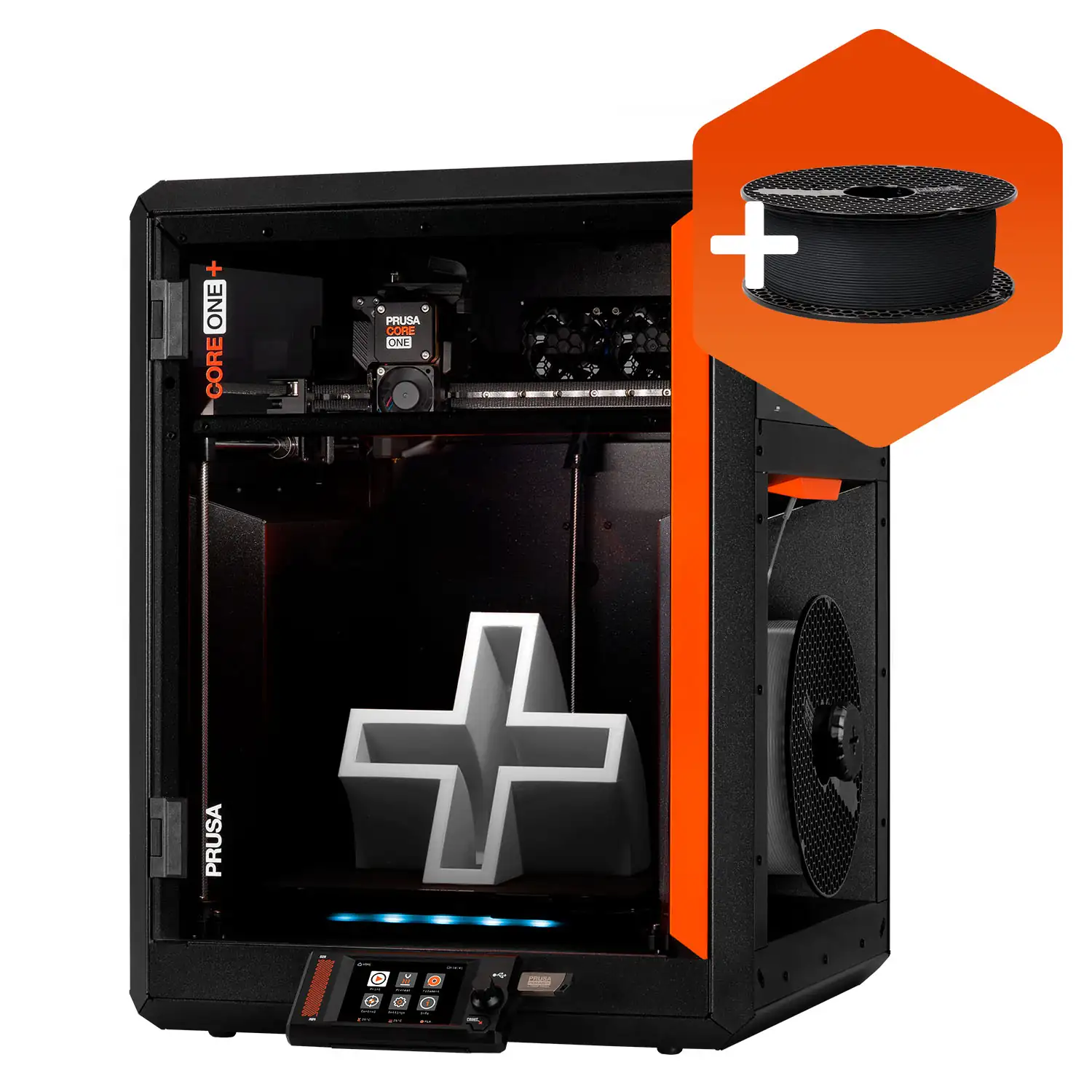
Original Prusa CORE One+ (assembled)
By Original Prusa · Enclosed 3D Printers · 3D Printing
- Build volume 250 x 220 x 270 mm (9.8 x 8.6 x 10.6 in)
- Max chamber temperature 55 C / 131 F
- Max nozzle temperature 290 C (400 C w/ HT), max heatbed 120 C / 248 F
- 3.5-inch graphic 65k color touchscreen
Lowest price seen
$1,449.00
from $1,449.00 at Printed Solid · Checked Oct 5, 2026
- Printed Solid $1,449.00View at Printed Solid
- Original PrusaView at Original Prusa
- eBayView at eBay
- eBay (used) eBay: used, open-box, refurbishedView at eBay (used)
- AmazonView at Amazon
Prices are snapshots. Check the current price with the store.
Summary
An enclosed CoreXY printer for people who keep a machine for years: 250 × 220 × 270 mm build volume, a chamber controlled to 55 °C, a 290 °C Nextruder hot end and an all-steel frame built around serviceable modules. Check your workflow first — the camera, advanced filtration and multi-material hardware are optional add-ons, and owners still name price as the main drawback.
Strengths
- Tom’s Hardware found the platform very quiet and accurate, with excellent first layers and easy maintenance.
- Owners who fitted the Gen 2 belt and wiper upgrade report visible print-quality improvements.
- Nextruder, belts, sheets and nozzles are separate modules you can replace or upgrade individually.
- Firmware, PrusaSlicer and Prusa Connect are not subscription-priced.
- Owners coming from Bambu printers single out parts quality, electronics design, documentation and Prusa support.
- One 2026 owner runs PLA, PETG, ABS, ASA, PP and PP-GF on theirs and calls it rock solid.
Weaknesses
- Price is the most repeated complaint, from owners who like the machine anyway.
- No integrated camera; it is a bundle item rather than standard equipment.
- Advanced filtration and multi-material printing need separate hardware, an MMU3 or INDX.
- Independent instrumented testing covers the older CORE One or the INDX build, not a standalone Gen 2.
- Belt tension matters after a Gen 2 upgrade: owners report worse artifacts until the belts are recalibrated.
- A February 2026 new owner described a rough first experience with an assembled CORE One+ plus MMU3.
Verified specifications
| Build volume | 250 × 220 × 270 mm. |
|---|---|
| Kinematics | enclosed CoreXY on an all-steel exoskeleton. |
| Layer height | 0.05–0.30 mm; filament diameter 1.75 mm. |
| Machine dimensions | 415 × 444 × 555 mm, 22.5 kg. |
| Mainboard | xBuddy, 32-bit STM32; Trinamic 2130 stepper drivers; 0.9° X/Y steppers. |
| Extruder | direct-drive Nextruder with a 10:1 planetary gearbox. |
| Nozzle | high-flow 0.4 mm brass CHT. |
| Maximum temperatures | 290 °C nozzle, 120 °C bed, 55 °C chamber. |
| Power | about 90 W printing PLA, 110 W printing ABS (Prusa business specification). |
| Heatbed | magnetic, with removable spring-steel sheets. |
Full research notes and sources
Quiet motion and first layers
Tom’s Hardware’s test of the original CORE One found the underlying platform very quiet, accurate and easy to maintain, with excellent first layers, and criticised the premium pricing and the missing integrated camera. Its September 2026 work then tested the current Gen 2 platform in INDX form — the multi-tool version, not a bare printer — and again praised quiet operation, perfect first layers and CoreXY speed. TechRadar’s September 2026 INDX 8-tool review lands in the same place on precision, speed, reliability and serviceability.
The mechanical changes are where owners see the biggest gain. August and September 2026 reports in r/prusa3d describe the Gen 2 belt and wiper changes cutting vertical fine artifacts on large surfaces, and call retrofitting them an easy upgrade to live with. The same owners carry the caveat: belt tension decides the result, and loose belts keep printing visible artifacts until the machine is recalibrated.
No independent base-only Gen 2 test exists yet, and nobody has published a field failure rate for the current belts, Nextruder or chamber electronics. Treat the quiet-and-accurate verdict as strong platform evidence rather than a measurement of this exact revision.
Which model this is
The name covers more than one machine. Prusa’s current page describes the base CORE One+ as an enclosed CoreXY printer offered assembled or as a kit, and the current hardware revision is Gen 2. The original CORE One, the larger CORE One L+ and the CORE One+ INDX multi-tool variants are separate products.
Bundle marketing blurs the rest. Camera, Advanced Filtration, extra sheets and nozzles appear in Ultimate Edition material but are bundle-dependent, and HEPA filtration is an option on the base machine. Multi-material capability also depends on optional MMU3 or INDX hardware rather than being built in. The Amazon listing for the assembled Gen 2 unit is ASIN B0G65QTG7W.
Repairs and upgrades
Repairability is the reason this machine costs what it costs. Prusa designs the platform around serviceable modules, open documentation and upgrade paths rather than sealed replacement, and the Nextruder, belts, sheets, nozzles and many mechanical and electronic assemblies are replaced one at a time. Owners demonstrate the path in practice: existing CORE One machines get taken to CORE One+ hardware and then to Gen 2 instead of being discarded.
Running it costs what any Prusa machine costs: filament, build sheets, nozzles and whatever optional hardware you add. Nobody has published a warranty duration for the assembled base unit, and Prusa does not publish a reliability percentage for the field, so confirm the warranty term yourself before buying.
What owners report
A July 2026 kit owner who came from Bambu printers described the machine as built for long-term ownership and praised parts quality, electronics design, documentation and Prusa support. A June 2026 owner reported rock-solid results across PLA, PETG, ABS, ASA, PP and PP-GF. The recurring complaint is cost: satisfied owners still say it costs more than comparably sized closed printers, and one April 2026 discussion makes the same point from the value side.
The rough edges show up around optional hardware rather than the printer itself. That February 2026 owner paired an assembled CORE One+ with an MMU3 and had a difficult first experience, which is worth weighing if multi-material is your reason to buy.
Is it worth it?
Prusa direct lists the assembled CORE One+ starting at about $1,299 (Prusa, 2026-10), and Ultimate Edition bundles cost more because they add camera, filtration and extra plates and nozzles. Check the store panel above for current prices.
The premium buys repairability, support, an upgrade path and control that stays local, and buyers who value those things can justify it. Buyers chasing build volume per dollar or the most automation per dollar will find cheaper machines, as the reviews and owners both note. Firmware and the slicer stay free with no subscription.
Sources
Manufacturer:
- Prusa CORE One+ (Gen 2) base product and technical parameters
- Prusa CORE One+ (Gen 2) kit and product comparison
- Prusa CORE One+ Business technical specification
- Prusa CORE One+ Ultimate Edition assembled
Independent reviews:
- Tom’s Hardware: Original Prusa CORE One review
- Tom’s Hardware: Prusa CORE One+ INDX review
- TechRadar: Prusa CORE One+ INDX 8-Tool review
Owner reports: