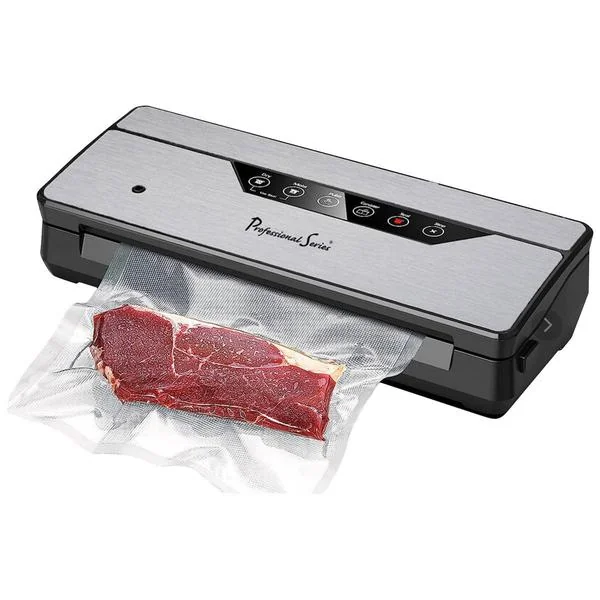
Professional Series Double-Seal Vacuum Sealer
By Professional Series · Vacuum Sealers · Kitchen & Cooking
Compare all Vacuum Sealers side by side →
The short version
✓ Why people buy it: Dry, Moist, Pulse and Seal Only modes give control beyond a single automatic button.
✗ Watch out for: The manual requires at least 20 seconds between seals and lengthy 25-minute batch cooldowns.
Prices at 3 stores ↓ · Will it fit? Size check ↓ · All 6 catches ↓
- Airtight double heat seal
- 0.65 bar rated vacuum pressure
- Built-in roll storage
- Dry, Moist, Pulse and Seal Only modes
- 11.8-inch format
Price not listed
- CEM Global / Professional SeriesView at CEM Global / Professional Series
More on eBay (1)
- eBayView at eBay
- eBay (used) eBay: used, open-box, refurbishedView at eBay (used)
Stores with a price are sorted lowest first; commission never changes the order. Prices are snapshots. Check the current price with the store.
Summary
An 11.8-inch household external-suction sealer with a built-in cutter, roll holder, Dry/Moist/Pulse settings and an accessory-hose port. The manufacturer gives unusually clear batch limits: pause between seals and cool the machine after extended work; availability and the full terms behind the advertised five-year limited warranty also need checking.
Size in context

39.4 cm · 15.5 in (W) × 19.7 cm · 7.8 in (D) × 12.1 cm · 4.8 in (H) · Drawn to scale from the maker's stated dimensions, next to everyday objects.
Strengths
- Dry, Moist, Pulse and Seal Only modes give control beyond a single automatic button.
- Integrated roll storage and cutter make creating custom-length bags easier.
- Standard embossed vacuum film avoids dependence on a unique cartridge or bag brand.
- Included accessory hose extends the machine to compatible rigid canisters.
- Manufacturer provides exact-model instructions, support contact and thermal guidance.
- Retailers advertise five-year limited coverage, potentially valuable if written terms support the claim.
Weaknesses
- The manual requires at least 20 seconds between seals and lengthy 25-minute batch cooldowns.
- Nominal 0.65-bar suction is lower on paper than many advertised 90–95 kPa models.
- Retail double-heat-seal language conflicts with the manual’s unspecified two-line geometry.
- No independent exact-model noise, speed, vacuum or long-term durability study was found.
- Factory replacement gaskets and heater tape are not documented as readily orderable parts.
- Retail availability is restricted, and the full five-year warranty contract remains unverified.
Verified specifications
| Identity | Professional Series PS-VS119, listed under that exact number by CEM Global, Menards and Boscov’s. |
|---|---|
| Machine type | external-suction bag sealer for household use, not a chamber or commercial machine. |
| Maximum seal length | 11.8 in (30 cm), according to the exact manual. |
| Vacuum | retailers specify a nominal 0.65 bar vacuum; manual describes a pressure range of −0.50 to −0.70 bar, neither independently instrument-tested. |
| Cord | removable, 53 in long per the model-specific retailer listing. |
| Controls | automatic Dry and Moist, manual Pulse Vacuum, Seal Only, Canister and Stop. |
| Sealing | Menards and Boscov’s market an “airtight double heat seal”; exact manual describes a seal line up to 3 mm but does not establish two separately measured finished welds. |
| Roll storage | integrated compartment sized for a roll of approximately 5 m according to the manual; manual sliding cutter. |
| Bags | compatible with standard textured/embossed external-vacuum film, rather than a proprietary cartridge. |
| External accessory | vacuum hose included and Canister button provided; the rigid container is sold separately. |
| Lid | two side release buttons, locking points at each end, foam gaskets above and below the vacuum chamber. |
| Heater construction | heating bar covered by protective PTFE/Teflon tape, paired with a silicone sealing bar. |
| Materials | stainless-steel cover with other structural materials; not confirmed to be an all-metal chassis. |
| Dimensions | Menards’ explicitly model-numbered 15.5 × 7.75 × 4.75 in and 4 lb; matching Target metadata differs. |
| Certification | Menards identifies the product as ETL listed; independent certificate ID was not obtained. |
| Starter kit | machine, five 20 × 30 cm pre-cut bags, hose and manual; no canister in the box. |
| Seal pacing | at least 20 seconds between sealing operations. |
| Thermal recovery | allow 25 minutes after heat protection stops the unit, and take a 25-minute break after sealing more than 20 bags continuously. |
| Storage | leave lid unlocked when the unit is not in use. |
| Warranty | Menards lists a five-year limited manufacturer warranty; full legal coverage and parts/shipping terms were not located. |
| Availability | Menards directs customers to inquire at physical stores rather than completing an online purchase; Boscov’s lists it out of stock. |
Full research notes and sources
Vacuum pressure, double sealing and the household duty cycle
The name Professional Series sounds as though this appliance is meant for nonstop processing, but the exact PS-VS119 instruction manual states the opposite. It calls the product household-only and specifically excludes commercial use. In practical terms, that makes it suitable for modest home food-prep work rather than a machine for packaging restaurant orders throughout a shift. The restrictions come from the manufacturer, not from extrapolating a motor’s power rating or a few customer impressions.
Its nominal vacuum is 0.65 bar, a nominal vacuum pressure difference. These statements are broadly compatible; the retailer’s single figure falls within the manual’s range. Neither figure is the outcome of a known independent pressure-gauge test, and the manual does not supply a comparable liters-per-minute pump airflow number. An appliance with a stronger nominal vacuum may compress a bag more tightly, but pressure alone does not tell you how quickly its motor removes a known air volume. There is no documented exact-model one- or two-liter canister evacuation timing.
Compared with the many budget sealers now advertising 90–95 kPa, the PS-VS119 is relatively modest on paper. That does not prove it has inadequate suction for ordinary portions of meat, cheese or vegetables. It means the user should not expect the highest vacuum figures on the basis of branding.
The sealing specification is less clear than the retail title. Menards and Boscov’s explicitly advertise an airtight double heat seal. The exact owner’s manual, however, describes a sealing line up to 3 mm without specifying two separate finished welded lines or giving a photograph with measured spacing. A different Professional Series product has a retailer reference to two 2-mm lines, but it is not the PS-VS119 and should not be used to fill that gap. “Double heat seal” can be reported as a retailer-described feature, not proof that two individual 3-mm seams were physically tested.
That distinction matters when comparing wet-food performance or sous-vide suitability. Two properly formed lines may provide a second barrier if a small flaw affects the first. But no two-line geometry, heating-pressure uniformity, leak rate or submersion endurance test has been published for this exact appliance. Both welds can fail if juice and fat contaminate the plastic, or if the bag is torn near a sharp bone. A marketing phrase cannot substitute for visually checking the cooled seam along its entire length.
The user manual gives precise operating intervals. Wait at least 20 seconds between heat seals. Under heavy use the appliance may switch off to protect itself from overheating; if that occurs, allow 25 minutes for cooling before restarting. The general safety instructions add that after more than 20 consecutive bags, users should wait at least 25 minutes before the next session. These are not independently measured maximum-endurance limits and do not imply that every machine will shut down exactly at bag 21. They are documented manufacturer precautions that materially affect throughput.
For a modest session of a few freezer portions, the pause may be barely noticeable because measuring, filling and wiping bags already take time. During large-scale meal prep, however, it becomes part of the workflow. The machine is not suitable for someone who needs uninterrupted production of dozens or hundreds of individually sealed bags. Even its maximum sealing length of 30 cm describes the width of the heating bar, not a promise that it will handle an unlimited length of rolls with no rest.
The easiest way to respect the limitation is to prepare several portions and pre-cut the film before starting the vacuum cycles. Allow the bar to cool between welds and inspect each finished bag. Do not press Seal repeatedly when the housing is hot or try to bypass a protective shutdown. A wrinkled or melted seam is a signal to pause and clean the bag mouth, not to add more heat. The instruction manual’s precautions are the most actionable performance information available for this model.
Bags, liquids, canisters and everyday care
The everyday workflow is simple but should be followed in order. Use a textured or embossed pouch compatible with an external-suction appliance. If cutting a bag from a roll, draw out enough film to fit the food plus a sealing margin, move the built-in cutter across it and use Seal Only to close one end. The manual states that the internal holder supports a roll of approximately five meters. That is an example of suitable roll capacity, not evidence that every fifty- or hundred-foot bulk roll will fit beneath the cover. Larger compatible rolls can be cut outside the machine.
The PS-VS119 ships with five 20 × 30 cm pre-cut bags and an accessory hose. It does not necessarily include a starter roll. The user manual recommends leaving at least two inches of open film between food and the bag mouth so that the plastic can contract and lay flat inside the vacuum channel. Pull the mouth squarely into the channel before closing the lid. Both locking points should click; if one side remains partly open, the gasket may not compress evenly and the pump can struggle to build vacuum.
Dry runs the automatic air-removal and heat-sealing cycle for dry items. Moist is intended for food with some surface moisture; it does not permit unlimited liquid to flow into the channel. Pulse gives you control over the suction endpoint when packaging soft foods or portions that are likely to release juice. Stop the pump early enough that liquid does not reach the heater. Seal Only is also useful for forming the first end of a roll-made bag or for closing film that should not have more air removed.
For soup, broth and sauce, the manufacturer’s instructions advise pre-freezing until solid before vacuum packaging. Juicy meat and fish may also benefit from partial freezing. The manual suggests a folded paper towel in the bag, below the intended seal, to absorb limited juice. Wiping the bag mouth matters: liquid or fat between the film layers can interrupt heat transfer and leave a channel for air to re-enter. Even a retailer-described double seal will not make up for an improperly positioned wet pouch.
The manual also warns that fine powders can be sucked into the machine and reduce pump life. It recommends leaving powdery goods such as flour inside their original package and then putting that package within the vacuum bag. This decreases the chance that flour or dust enters the air path. It is not an assurance that an open bag full of fine powder can be safely vacuumed at maximum pressure. Likewise, sharp edges in food can puncture an otherwise well-sealed pouch. Protect or avoid vulnerable corners instead of relying only on the seam.
The Canister button and included hose are intended for rigid containers with a suitable lid valve. The manual directs you to lock the lid, connect the hose from the machine to the canister, run the accessory cycle and remove the hose after it stops. The canister is not included. No official compatibility table for third-party container lids was found, nor a verified one-liter or two-liter canister evacuation time. A hose included in the box is a useful feature, but checking the physical adapter matters before purchasing several containers.
Cleaning does not require special supplies. Unplug the appliance first, wipe food and moisture out of the vacuum chamber with a damp cloth and mild dish soap, and dry everything before restarting. Do not immerse the electrical base or use abrasives on the heater cover. The manual specifically identifies upper and lower sealing gaskets, a silicone sealing bar and a Teflon-covered heating bar as service-sensitive parts. Inspect these surfaces if a bag leaks, develops an incomplete seam or appears melted. Do not tear off the protective Teflon tape when wiping the sealing area.
Finally, store the lid unlocked. Leaving the locking mechanism clamped while the machine is not in use can keep the upper and lower gaskets compressed and degrade suction. The habit costs nothing and follows the precise manufacturer instructions. It is as relevant for someone who uses the appliance only once a month as it is for frequent meal preparation.
Vacuum sealing removes some air but does not sterilize food. The instruction manual explicitly states that perishables which need chilling must still be refrigerated or frozen. It also warns about low-oxygen microorganisms, making proper food preparation, chilling and storage essential. Do not treat the sealer as a substitute for safe temperature control.
Repairs, warranty and ownership costs
The main consumable is vacuum-bag film. The PS-VS119 is marketed as compatible with most standard textured vacuum rolls and pouches; no proprietary bag cartridge or recurring subscription was found. The exact manual recognizes ordinary external-suction bags, so you can compare replacement film by width and usable length. For example, NESCO listed a pack of fifty 8.6 × 11.8-inch quart-sized vacuum bags for $23.99 in the original ownership-cost research. That works out to roughly $0.48 per bag before shipping, and larger compatible rolls may lower the effective cost for irregular portions. These figures are historical retail comparisons, not a required Professional Series bag purchase.
At a full hour of continuous rated draw the theoretical energy use would be 0.16 kWh, but real vacuum/sealing cycles are short and separated by manufacturer-required rest intervals. Electrical running cost is therefore unlikely to be the main expense. The larger question is what happens to the foam gasket, heater cover or latch after years of use.
The manual identifies upper and lower sealing gaskets and points directly to them when vacuum performance falls. If a gasket is worn, cracked or no longer seated, the machine can admit air even while the motor runs. The same troubleshooting section recommends checking whether the bag mouth has folds, punctures, food particles or moisture. A machine that cannot finish its vacuum cycle may be overheating, incorrectly latched or leaking at the chamber rather than simply having a weak motor. Follow these checks before assuming the pump has failed.
The heating bar has a Teflon tape cover which the manual warns users not to tear away. It also has a silicone sealing bar. If a bag melts or will not close cleanly, the advice is to let the machine cool, inspect the pouch and heater area and try again after the prescribed interval. On the manual-hosting website, one reader asked where to buy a replacement heater cover. That is a single support question, not evidence of a frequent failure. It illustrates why the lack of a published replacement-parts catalog matters.
No confirmed PS-VS119 part number or readily orderable factory listing for its foam gaskets, Teflon cover, heating bar, cutter or motor was found. A replacement gasket for another model, even another Professional Series sealer, should not be assumed to have the same profile. The instruction manual says not to service the appliance yourself and directs malfunctioning units to authorized after-sales service. That makes reliable support more important than the apparent simplicity of the plastic and stainless-steel case.
Menards’ exact PS-VS119 listing specifies a five-year limited manufacturer warranty, and a matching Target listing also displays five years. This is a legitimate retailer-published term for the model, but a complete manufacturer warranty contract giving the covered parts, labor, exclusions, proof-of-purchase conditions, shipping costs and exact claim process was not found. “Limited” is important: a five-year label does not guarantee free replacement for worn gaskets, damaged heater tape or damage from liquid ingress. CEM Global maintains a Professional Series product page and a North American contact channel, but that alone does not prove parts can be delivered rapidly.
The machine is expressly described as household-only by its manual. Commercial uses, or attempting internal repairs despite instructions, could affect coverage even if a buyer expects longer service from the “Professional” name. Retain the receipt and verify warranty terms through the actual seller or manufacturer when making a purchase. A documented five-year offer is useful at a low price; it should not be treated as equivalent to five years of no-cost repairs until the specific obligations are clear.
There is little direct owner history to quantify these risks. A casual 2025 user video describes the PS-VS119 as an inexpensive, basic sealer that worked as expected, but it does not measure pump output or report multi-year usage. Exact-model retailer and forum feedback is too thin to estimate failure rates. The many weak-vacuum and failed-seal complaints found for an older PS-VS005 are not valid evidence about PS-VS119. Likewise, the more powerful PS-VS219 is a distinct model, not proof of what the VS119 motor can handle.
This machine is attractive when it can genuinely be bought at a budget price. Menards listed PS-VS119 at $49.29 during the September 2026 research. A brief early-October sale showed $45.99, with an additional eleven-percent mail-in rebate that created a later store-credit value, not an instant reduction in the checkout payment. Those dated offers must not be reused as though they are guaranteed today, and a rebate check usable on future Menards purchases should never be represented as cash refunded at the till.
Current store-access questions are more consequential than the difference between a couple of historical sale prices. The Menards page for the exact model says it is not available for online purchase and directs buyers to seek local-store information. Boscov’s shows $59.99, reduced from a ticketed $79.99, but marks the product out of stock. The corresponding Target item had been shown at $69.99 and out of stock in the research. There is no verified nationwide in-stock delivery offer from these sources. An item page remaining online does not prove units can actually be shipped.
A liquidation auction sold a Professional Series 11.8-inch sealer for about $15, plus a fifteen-percent buyer premium, in April 2026. That is not a representative new retail selling price. Auction lots have different packaging, return rights and sometimes uncertain condition. Someone buying a new appliance with a manufacturer warranty should compare it with other retail offers, not with an isolated overstock bid.
At $50 or less, the PS-VS119 has a credible case as an inexpensive domestic sealer. Its roll holder, cutter, pulse button, accessory hose and listed long warranty are useful at that price. From $51 to $60, it remains reasonable for occasional freezer meals if the retailer has actual stock and explains coverage. Beyond the lower price bands, the value is only fair because stronger or better-tested models become easier to find in adjacent ranges. Above $70, the unknown service parts and lower nominal vacuum reduce its appeal unless its exact set of controls is a priority.
For perspective, NESCO’s VS-101-S had a $79.99 direct-store reference in the original comparison research, with an 11.8-inch format, integrated cutter and roll storage. The NESCO VS-12P has independently published suction data under a defined test method, and Anova markets a model intended for far more consecutive seals. Those are different products with their own trade-offs and prices; they show why a machine with a documented gasket part, more testing or higher duty capability may justify additional spending for heavy users. PS-VS119’s main economic advantage appears only when its low retail price and a workable return channel can both be secured.
Which model this is
The exact product is the Professional Series PS-VS119 from CEM Global’s Professional Series brand. CEM Global’s product page names the model and its 11.8-inch form factor. Menards identifies PS-VS119 directly, as does Boscov’s item 844680. The Target product with TCIN 1010750623 and UPC 765167872272 closely matches the controls, nominal 0.65-bar pressure and warranty, but the available Target title does not explicitly give PS-VS119. This is a high-confidence retail correspondence, not a reason to overwrite manufacturer identity details with unmatched marketplace metadata.
There is a particularly important dimensions discrepancy. Menards names PS-VS119 and specifies approximately 15.5 × 7.75 × 4.75 inches at 4 lb, while Target describes a similar item with substantially smaller dimensions and lower weight. Since Menards explicitly identifies the model, its figures are the stronger evidence for PS-VS119. But if the appliance must fit inside a narrow cupboard, verify physical measurements and opened-lid clearance for the exact shipped item.
Do not confuse PS-VS119 with PS-VS005, an older Professional Series vacuum sealer with its own customer complaints, or PS-VS219, which Menards lists as a distinct 0.75-bar model with additional controls. The “Professional Series” name spans products with materially different pumps and sealing systems. Similarly, a sibling’s claimed two 2-mm lines does not establish the precise double-seal construction of PS-VS119. The manual’s up-to-3-mm seal reference remains the narrowest precise description tied to this machine.
No verified exact PS-VS119 ASIN was established from the available sources, so this page does not assign one based on a vaguely matching marketplace image or a sibling’s identifier. Shopping by the model number and retailer item gives more reliable results than browsing all appliances that include the words “Professional Series” in their title.
Sources
Manufacturer:
- CEM Global Professional Series PS-VS119 page
- PS-VS119 user manual
- CEM Global North America contact and support
Independent reviews:
Owner reports:
Retail listings and parts:
- Menards PS-VS119 listing
- Boscov’s PS-VS119 listing
- Target matching PS-VS119 listing
- Target sibling listing checked only to avoid conflation
- Metzger overstock auction lot
- NESCO VS-05B 50 pre-cut quart vacuum sealer bags
- Target Professional Series 8-inch sealing rolls
- NESCO Deluxe Vacuum Sealer VS-101-S
- NESCO Deluxe Vacuum Sealer VS-12P
- Anova Precision Vacuum Sealer Pro