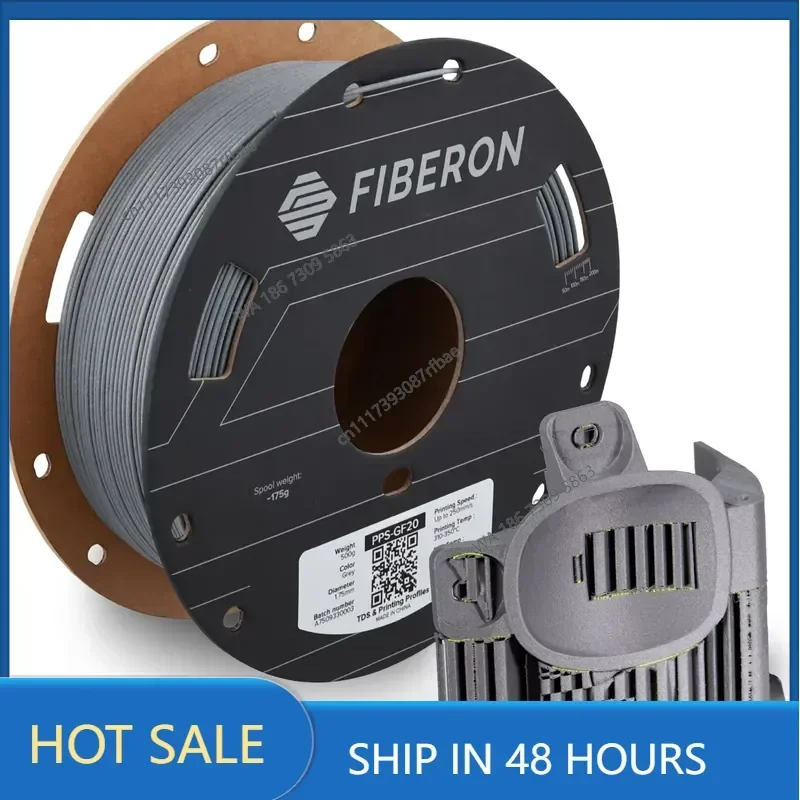
Polymaker PPS-GF20 3D Printer Filament
By Polymaker · Filament & Resin · 3D Printing · More from Polymaker
- Density 1.36 g/cm³
- Tensile strength 64.1 MPa (XY)
- Bending strength 102.3 MPa (XY)
- Young's modulus 4552 MPa
- HDT 236.3°C (0.45 MPa, annealed)
Price not listed
- PolymakerView at Polymaker
- eBayView at eBay
- B&H PhotoView at B&H Photo
- AmazonView at Amazon (paid link)
- eBay (used) eBay: used, open-box, refurbishedView at eBay (used)
Stores are listed in a fixed order, never by price or commission. Prices are snapshots. Check the current price with the store.
Summary
A 20% glass-fiber-reinforced PPS filament for experienced users with a 310–350°C-capable printer and a wear-resistant nozzle. Check your hardware before buying: a machine capped at 300°C is a poor fit, and the headline 236.3°C heat resistance is measured at 0.45 MPa after a 130°C/10 h anneal.
Strengths
- High annealed low-load HDT of 236.3°C suits rigid fixtures and prototypes under modest load.
- Glass-fiber formulation has measured dielectric properties, making it a candidate for electrically insulating housings.
- Low moisture uptake of 0.11% equilibrium at 70% RH is less humidity-sensitive than many nylon workflows.
- Stiff: XY bending strength 102.3 MPa and XY Young’s modulus about 4.55 GPa.
- Available from multiple US routes, including B&H at $59.99 for FM02001 in stock.
Weaknesses
- Requires a 310–350°C nozzle, hardened nozzle and controlled feed path; a 300°C machine is a poor fit.
- Brittle on the spool: the filament can snap under tight bends and AMS guidance conflicts.
- Z-direction weakness: 22.9 MPa tensile and 1.1% elongation make layer-oriented tabs a poor use case.
- Annealing changes dimensions; heat treatment is required to reach published properties.
- UL94 V-0 is a manufacturer specimen test, not certification of a finished part.
- Surface resistivity above 10^12 ohms does not establish ESD-dissipative behavior.
Verified specifications
| Material | PPS with 20% glass-fiber reinforcement, gray (#75787B), 1.75 mm diameter. |
|---|---|
| SKU | 500 g FM02001; a 3 kg spool is also offered. |
| TDS | Fiberon PPS-GF20 V1.1. |
| Density | 1.36 g/cm³ at 23°C. |
| Melt index | 27 g/10 min at 300°C/5 kg. |
| Thermal | glass transition 95.0°C; melting 279.6°C; crystallization 225.8°C; Vicat 272.5°C. |
| HDT | 236.3°C at 0.45 MPa and 125.8°C at 1.8 MPa, after annealing at 130°C for 10 h. |
| Tensile (annealed) | 64.1 MPa XY and 22.9 MPa Z; Young’s modulus 4552.0 MPa XY and 2557.2 MPa Z. |
| Bending (annealed) | 102.3 MPa XY and 45.7 MPa Z. |
| Charpy (annealed) | notched 7.3 kJ/m² XY; unnotched 27.3 kJ/m² XY and 4.3 kJ/m² Z. |
| Electrical | dielectric strength 6.05 kV/mm; dielectric constant 2.62 at 1 kHz and 2.71 at 1 MHz; surface resistivity above 10^12 ohms. |
| Flammability | UL94 V-0 at 1.5 mm on manufacturer-tested printed specimens. |
| Print settings | 310–350°C nozzle, 80–90°C bed, fan off, room-temperature chamber; up to 250 mm/s marketed. |
| Nozzle | 0.4 mm minimum, abrasion-resistant. |
| Moisture | 0.11% equilibrium at 23°C/70% RH; dry at 100°C for 10 h if wet; store below 20% RH. |
| Annealing | 130°C for 10 h. |
| Annealed cube test (40 mm) | XY 39.81 mm and Z 39.56 mm from 39.86 mm and 39.76 mm printed; 10 mm hole 9.89 mm from 9.95 mm. |
Full research notes and sources
Printing requirements
The manufacturer specifies a 310–350°C nozzle, 80–90°C bed, fan off and a room-temperature chamber, with a marketed ceiling of 250 mm/s that is not a guaranteed volumetric flow. Polymaker’s own test specimens were printed at 330–350°C, 90°C bed, 100% infill and zero part cooling, which can differ from economical day-to-day prints. A 0.4 mm minimum abrasion-resistant nozzle is required; brass erodes frequently. A nozzle rated to 350°C alone does not upgrade the temperature sensor, heater, heatbreak or firmware, so verify the complete machine.
Annealing and dimensional change
The published mechanical and thermal results assume annealing at 130°C for 10 h. The manufacturer’s 40 mm calibration cube shrank measurably, so print oversized qualification coupons and assess fit after heat treatment. Geometry, wall thickness, orientation and heat-treatment method can change deformation.
Electrical and flammability
Measured dielectric strength is 6.05 kV/mm with dielectric constants of 2.62 at 1 kHz and 2.71 at 1 MHz, plus surface resistivity above 10^12 ohms. These characterize specimens, not verified clearance, creepage, printed defects, wall thickness, voltage certification or ESD-dissipative behavior of a fabricated part. UL94 V-0 at 1.5 mm is a manufacturer-reported specimen test, and Polymaker links an internal FR test report rather than a third-party listing. Do not describe an arbitrary printed part as UL-listed or certified.
Moisture and storage
Equilibrium moisture absorption is 0.11% at 23°C/70% RH, which is low for the class but not zero. If wet, dry at 100°C for 10 h and store below 20% RH. Drying and annealing require suitable, independently controlled equipment; not every filament dryer or kitchen oven holds those temperatures reliably.
Feed path and AMS
Polymaker states the filament is brittle on the spool and can break under tight bends. Current PPS-GF20 documentation calls it AMS compatible but advises avoiding tight curves, while an older general print-tips page says not to use it in an AMS due to abrasiveness. Test the specific feed path rather than guaranteeing automated operation.
B&H listed FM02001 in stock at $59.99 with free standard shipping on the October 2026 snapshot, while Polymaker direct marked the same part sold out or backordered. Prusa listed gray 500 g at $67.50. MatterHackers listed a 3 kg variant at $289.99, and a dated August 2026 catalog cited $279.99 for 3 kg. A wholesale portal offered $44.99 per 500 g with a $1,000 minimum order and backorder status. Editorial thresholds: at or below $50 per 500 g is attractive for an already-equipped user, $51–$60 is the normal defensible buy zone, $61–$70 only if delivery or support is materially better, and above $70 is generally poor value against the $59.99 in-stock B&H option.
Running costs
No subscription is required. At $59.99 per 0.5 kg, consuming 0.5 kg per year costs $59.99, 1 kg per year costs $119.98 and 3 kg per year costs $359.94, before tax and shipping. A 10-hour anneal at 130°C in an appliance averaging an assumed 200 W uses 2 kWh, or $0.40 at an illustrative $0.20/kWh; both the wattage and the rate are assumptions, not measured owner statistics. Nozzle wear, purge waste and failed prints are additional and unquantified.
Support and warranty
Polymaker’s US refund policy updated April 6, 2026 gives a 60-day return window for unopened, unused direct-store purchases with proof of purchase. Opened filament is not normally eligible for preference return except for defective, incorrect or nonconforming goods. Buyers ordinarily pay return shipping for change-of-mind returns, and defects should be reported to support@polymaker.com with order number, photographs, spool or batch sticker and print settings. These terms apply to direct Polymaker purchases, not to B&H, Prusa or MatterHackers. The TDS states that typical mechanical properties should not be used as design specifications or quality-control standards.
Which model this is
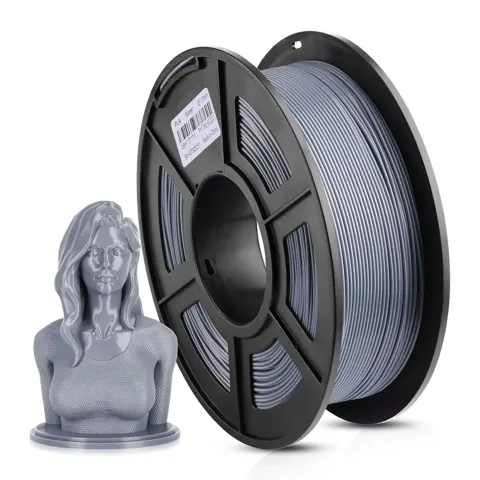
This page covers Polymaker Fiberon PPS-GF20, a 20% glass-fiber-reinforced PPS in gray at 1.75 mm, manufacturer SKU FM02001 for the 500 g spool, with a 3 kg spool also offered. Do not confuse it with Fiberon PPS-CF10 (carbon-filled), PET-CF17 or PA6-GF25, or with other brands’ PPS-GF. Gray is the confirmed color; B&H’s product headline confusingly says Black while its specifications and Polymaker both specify gray, so verify the package on receipt.
Sources
Manufacturer:
- Polymaker Fiberon PPS-GF20 product page
- Polymaker wiki: PPS-GF20 handling, FAQ and printing
- Polymaker Fiberon PPS-GF20 TDS V1.1 (PDF)
- Polymaker general material print tips
- SimplyPrint: PPS-GF20 material and printer requirements
Independent reviews:
- No independent test reviews were found in the research.
Owner reports:
- Reddit r/3Dprinting: early PPS-GF20 reports from H2D and Q1 Pro owners
- Reddit r/3D2A: PPS-GF20 owner printing and excessive plate adhesion
Stores and parts:
- B&H: Polymaker Fiberon PPS-GF20 FM02001 500g in stock
- Polymaker direct US store: PPS-GF20 SKU and $59.99 backorder
- MatterHackers: PolyMaker Fiberon catalog, PPS-GF20 3kg listing
- Polymaker US wholesale: PPS-GF20 $44.99 restricted bulk offer
- Voxel Factory: PPS-GF20 500g Canadian storefront pricing
- Phaetus: tungsten-carbide PS/V6 high-temperature nozzle
- Bambu Lab US: H2D compatible 350°C hardened hotend/nozzle
- Polymaker direct US: PolySupport for PA12 PW01001
- Polymaker US refund policy, April 6, 2026