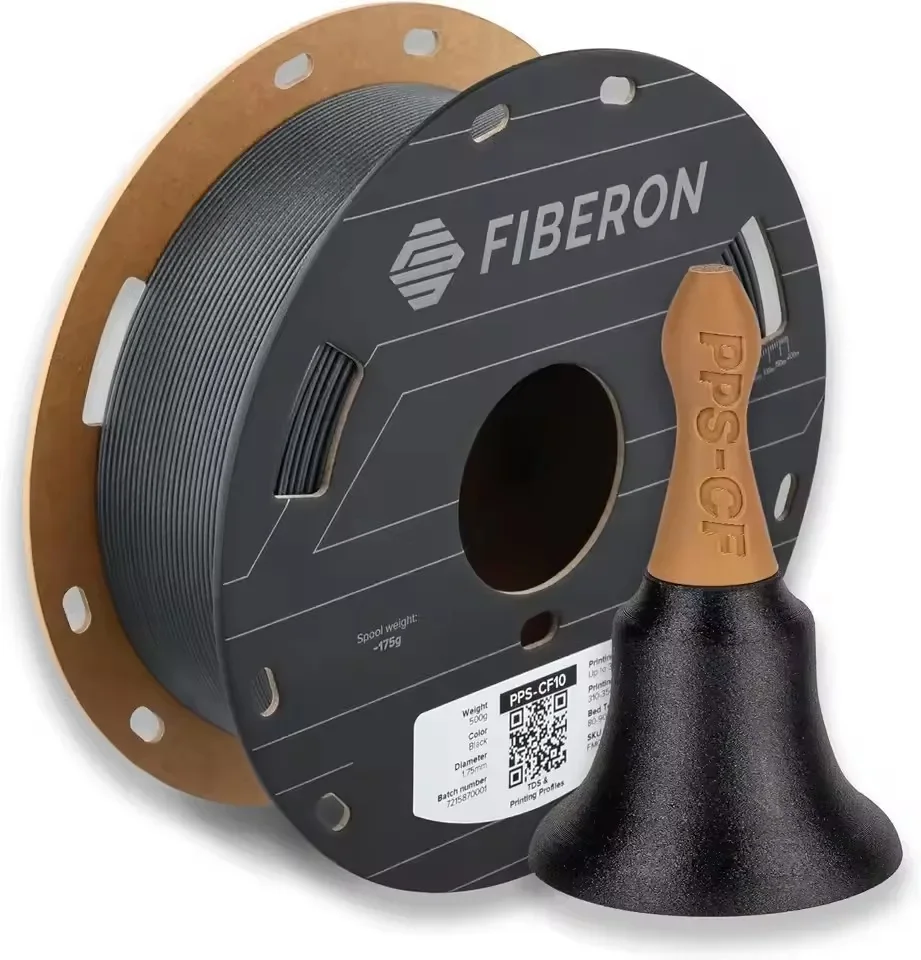
Polymaker PPS-CF10 3D Printer Filament
By Polymaker · Filament & Resin · 3D Printing · More from Polymaker
- 10% carbon-fiber-reinforced PPS
- Print temperature 310-350°C
- Build plate 80-90°C
- Print speed up to 300 mm/s
- UL94 V-0 flame retardancy
Price not listed
- PolymakerView at Polymaker
- eBayView at eBay
- B&H PhotoView at B&H Photo
- AmazonView at Amazon (paid link)
- eBay (used) eBay: used, open-box, refurbishedView at eBay (used)
Stores are listed in a fixed order, never by price or commission. Prices are snapshots. Check the current price with the store.
Summary
A 10% carbon-fiber-reinforced PPS filament for experienced users making stiff, heat-resistant and chemically exposed fixtures. Check your hardware before buying: the published 252.5°C heat resistance is measured at 0.45 MPa on an annealed specimen, it falls to 133.0°C at 1.8 MPa, and the nozzle must sustain 310–350°C.
Strengths
- Real high-temperature potential: 252.5°C HDT at 0.45 MPa after annealing, well above easy-printing composites.
- High stiffness: Young’s modulus over 5.4 GPa in XY with low elongation suits rigid, deflection-limited parts.
- Less chamber dependence than many high-temperature polymers: room-temperature chamber works with a 310–350°C nozzle and 80–90°C bed.
- Dimensional stability: published annealed cube changes are small, useful for precision jigs when orientation and annealing are controlled.
Weaknesses
- Requires a 310–350°C nozzle, hardened nozzle and controlled feed path; a 300°C machine is a poor fit.
- Brittle on the spool: filament snaps under tight bends and AMS guidance conflicts.
- Weak layer bonding below the supported range: 300°C may work only very slowly with reduced adhesion.
- HDT drops sharply with load: 133.0°C at 1.8 MPa, not the headline 252.5°C.
- UL94 V-0 and surface resistivity over 10^12 ohms are manufacturer specimen results, not certification of a finished part or proof of ESD-safe discharge.
- Low elongation and Z impact of 4.1 kJ/m² make thin or layer-oriented features fragile.
Verified specifications
| Material | PPS with 10% carbon-fiber reinforcement, black, 1.75 mm diameter. |
|---|---|
| SKU | 500 g FM01001; 3 kg FM01002; TME lists EAN 6938936714583. |
| TDS | Fiberon PPS-CF10 V1.1. |
| Density | 1.29 g/cm³ at 23°C. |
| Melt index | 26.2 g/10 min at 300°C/2.16 kg. |
| Thermal | glass transition 97.7°C; melting 279.7°C; crystallization 218.8°C; Vicat 267.5°C. |
| HDT | 252.5°C at 0.45 MPa and 133.0°C at 1.8 MPa, after annealing at 125°C for 16 h. |
| Tensile (annealed) | 59.4 MPa XY and 32.0 MPa Z; Young’s modulus 5446.7 MPa XY and 2790.0 MPa Z. |
| Elongation (annealed) | 1.4% XY and 1.6% Z. |
| Impact (annealed) | notched Charpy 5.3 kJ/m² XY; unnotched 11.4 kJ/m² XY and 4.1 kJ/m² Z. |
| Electrical | surface resistivity over 10^12 ohms (out of range high). |
| Flammability | UL94 V-0 at 1.5 mm on manufacturer-tested printed specimens; Polymaker states PPS-CF10 does not currently hold UL94 certification. |
| Print settings | 310–350°C nozzle, 80–90°C bed, fan off, room-temperature chamber acceptable; up to 300 mm/s marketed. |
| Nozzle | 0.4 mm minimum, abrasion-resistant. |
| Moisture | about 0.225% equilibrium at 23°C/70% RH; dry at 100°C for 10 h if wet; store below 20% RH. |
| Annealing | 125°C for 16 h. |
| Annealed cube test (40 mm) | XY 39.96 mm and Z 39.90 mm from 39.95 mm and 39.94 mm printed; 10 mm hole 9.79 mm both states. |
| Spool | inner hole 55 mm, outer diameter 200 mm, width 65.6 mm, spool weight 190 g. |
Full research notes and sources
Printing requirements
The manufacturer specifies a 310–350°C nozzle, 80–90°C bed, fan off and a room-temperature chamber acceptable, with an advertised ceiling of 300 mm/s that is a guideline rather than a guaranteed volumetric flow. An actively heated chamber is not required by the TDS, but Polymaker’s comparison guide recommends an enclosure. A 0.4 mm minimum abrasion-resistant nozzle is required; brass abrades frequently. Verify the complete machine rating, not just the nozzle.
Annealing and dimensional change
Published properties assume annealing at 125°C for 16 h. The manufacturer’s 40 mm cube changed little, but that is one geometry and not a guarantee for large or tall parts. Design fit after heat treatment, not before.
Electrical and flammability
Surface resistivity over 10^12 ohms indicates a very resistive specimen in this test; it does not establish ESD-safe discharge or certified electrical enclosure performance. UL94 V-0 at 1.5 mm is a manufacturer-reported test result, and Polymaker’s FAQ states PPS-CF10 does not currently have UL94 certification. Do not market a printed part as independently UL-listed from the rating alone.
Moisture and storage
Equilibrium moisture absorption is about 0.225% at 23°C/70% RH, low but not zero, despite marketing phrases about moisture insensitivity. If wet, dry at 100°C for 10 h and store below 20% RH. Drying and annealing require suitable, independently controlled equipment.
Feed path and AMS
Polymaker’s FAQ states this composite is brittle on the spool and can break through a path with sharp turns, and it discourages AMS as the default despite a separate compatibility chart. A 2026 owner reported a twisted feed breaking during loading. Route directly from a drybox or spool holder with large-radius bends and test the specific unit.
Polymaker listed 0.5 kg FM01001 at $69.99 and 3 kg FM01002 at $299.99, both backorder or unavailable at the captured check. West3D, 3DPrintiverse and Ready To Print 3D also showed $69.99 for 500 g, mostly sold out. TME showed $73.40 for one roll. MatterHackers showed $69.99 for 500 g and $299.99 for 3 kg, with changing stock. A wholesale portal offered $37.79 per 500 g with a $1,000 minimum order, backorder status and a discontinued, final-sale notice. Editorial thresholds: at or below $55 per 500 g is a good niche buy for an already-equipped user, $56–$70 is the expected list zone, and above $75 compare PPS-GF20 at $59.99 if electrical insulation suffices or PET-CF17 at $24.99 if 250°C-class performance is unnecessary. A 3 kg spool saves $119.95, or 28.6%, against six 500 g rolls at $419.94, before shipping and tax.
Running costs
No mandatory annual software subscription applies. At observed list prices, 0.5 kg per year costs $69.99, 1 kg per year costs $139.98 and 3 kg per year costs $299.99. An illustrative scenario consuming 2 kg annually costs $279.96, plus a $53.49 wear-resistant nozzle if one must be purchased, for $333.45 in first-year spending; that assumes the nozzle fits and is rated for the thermal use. Annealing at 125°C for 16 h and drying at 100°C for 10 h are real time targets but reveal no watt-hours; an appliance averaging an assumed 200 W over 16 h uses 3.2 kWh, or $0.64 at a hypothetical $0.20/kWh. Both wattage and rate are assumptions. No trustworthy material-specific annual kWh average, waste rate or nozzle life was found.
Support and warranty
Polymaker’s US refund policy updated April 6, 2026 gives a 60-day return window for unopened, unused direct-store purchases with proof of purchase. Opened filament is normally not returnable unless defective, incorrect or not as contracted. Buyers ordinarily pay shipping for change-of-mind returns, and defects should be reported to support@polymaker.com with invoice, color, diameter, weight and lot label plus oven, nozzle and printer settings. The wholesale portal’s discontinued, final-sale terms with a $1,000 minimum do not supersede ordinary retail direct-sale policy, and other retailers may have separate procedures. No universal filament-performance warranty term was found; a spool is a consumable, so brand-wide guarantee language should not be read as free replacement for ordinary use, nozzle wear or a mismatched 300°C printer.
Which model this is
This page covers Polymaker Fiberon PPS-CF10, a 10% carbon-fiber-reinforced PPS in black at 1.75 mm: 500 g under SKU FM01001 (reseller code POL2779BLA) and 3 kg under FM01002, with TME listing EAN 6938936714583. Do not confuse it with Fiberon PPS-GF20 (glass-filled), PET-CF17 or PA6-GF25, or with other brands’ PPS-CF. The manufacturer’s PDF TDS reports 59.4 MPa XY tensile strength, while its live material-comparison chart shows 32.0 MPa XY; the two should not be silently merged, and clarification should be requested before engineering sign-off.
Sources
Manufacturer:
- Polymaker Fiberon PPS-CF10 overview
- Polymaker Fiberon PPS-CF10 product wiki and FAQ
- Polymaker Fiberon PPS-CF10 TDS V1.1 (PDF)
- Polymaker Fiberon material comparison
Independent reviews:
- No independent test reviews were found in the research.
Owner reports:
- Reddit r/3D2A: owners discuss Fiberon PPS-CF10 adhesion and print issues
- Reddit r/elegoo: PPS-CF user filament snapping, purging and layer adhesion
Stores and parts:
- Polymaker direct US store: Fiberon PPS-CF10 0.5 kg FM01001
- Polymaker direct store: Fiberon PPS-CF10 3 kg FM01002
- MatterHackers US Polymaker filament catalog
- West3D US: Fiberon PPS-CF10 500g Black
- TME US: Polymaker FM01001 stock, MPN and EAN
- 3DPrintiverse US: PPS-CF10 500 g sold-out offer
- Ready To Print 3D: PPS-CF10 500 g listing
- Polymaker US wholesale: PPS-CF10 $37.79 sale and discontinued notice
- MatterHackers US: E3D hardened nozzle catalog
- Polymaker official Fiberon PPS-GF20 0.5 kg alternative
- Polymaker official Fiberon PET-CF17 alternative
- QIDI US Store: PPS-CF 750g pricing
- QIDI official technical printing guide for its own PPS-CF
- Polymaker official US retail refund policy, April 2026