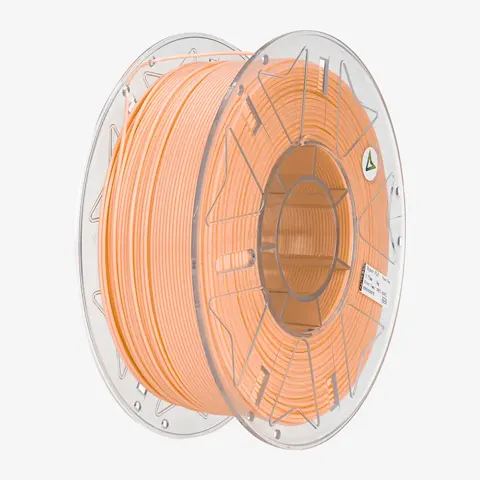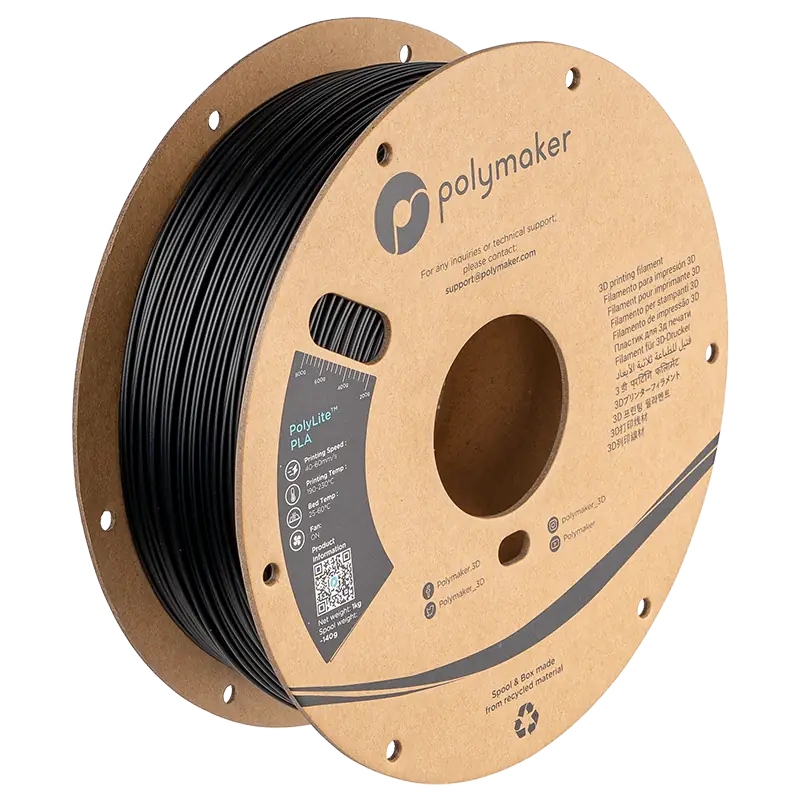
Polymaker PLA Filament 1.75mm Black 1KG
By Polymaker · Filament & Resin · 3D Printing · More from Polymaker
- Diameter 1.75 mm
- Net weight 1 kg
- Printing temperature 190-230 °C
- Bed temperature 25-60 °C
- Density 1.19 g/cm³
Price not listed
- PolymakerView at Polymaker
- eBayView at eBay
- AmazonView at Amazon (paid link)
- eBay (used) eBay: used, open-box, refurbishedView at eBay (used)
Stores are listed in a fixed order, never by price or commission. Prices are snapshots. Check the current price with the store.
Summary
PolyLite PLA is a standard PLA for everyday prints — organizers, prototypes, and decorative parts — with a 190–230 °C nozzle range and 1.17 g/cm³ density. Check your printer’s spool holder before buying: the cardboard spool can fit tightly on some holders and AMS units.
Strengths
- Consistent spool-to-spool diameter and extrusion across printer brands.
- Low warping and reliable first-layer adhesion on PC and textured PEI.
- Smooth semi-gloss surface with good detail for an everyday PLA.
- Low odor during printing.
- Strong price-to-quality ratio at about $20/kg.
- Works with many printer profiles with little tuning.
Weaknesses
- Standard PLA limits: softens near 60 °C and stays brittle under impact.
- Stringing and cobwebs on generic profiles; temperature and retraction tuning often needed.
- Cardboard spool can fit tightly on some holders and AMS units.
- Filament can snap in the feed path when moist or old.
- Color saturation marginally lower than some premium PLAs per reviewers.
- Fewer specialty color and effect options than some brands.
Verified specifications
| Material | standard PLA (PolyLite PLA). |
|---|---|
| Diameter | 1.75 mm (also 2.85 mm, being discontinued). |
| Net weight | 1 kg (also 3 kg and 5 kg). |
| Nozzle temperature | 190–230 °C. |
| Bed temperature | 25–60 °C. |
| Printing speed | 50–200 mm/s (TDS); 40–60 mm/s is a conservative starting range. |
| Cooling fan | on. |
| Retraction | 1–3 mm distance, 20–40 mm/s. |
| Drying | 55 °C for 6 h if damp. |
| Enclosure | not required. |
| Density | 1.17 g/cm³ at 23 °C. |
| Melt index | 7–11 g/10 min at 210 °C, 2.16 kg. |
| Glass transition | 61 °C. |
| Melting temperature | 150 °C. |
| Crystallization temperature | 114 °C. |
| Decomposition temperature | 325 °C. |
| Vicat softening | 63 °C. |
| Heat deflection | 58 °C at 1.8 MPa; 60 °C at 0.45 MPa. |
| Young's modulus | 3426.9 MPa (XY), 3064.9 MPa (Z). |
| Tensile strength | 52.3 MPa (XY), 40.5 MPa (Z). |
| Elongation at break | 6.3% (XY), 1.8% (Z). |
| Bending modulus | 3230.9 MPa (XY). |
| Bending strength | 86.9 MPa (XY). |
| Notched Charpy impact | 3.3 kJ/m² (XY). |
| Equilibrium water absorption | 0.51%. |
| Chemical resistance | good to weak acids and oils/grease; fair to weak alkalis; poor to strong acids and strong alkalis. |
| Build surface | PC and textured PEI. |
| Recommended supports | PolySupport and PolyDissolve S1. |
| Dimensions | cardboard spool roughly 200 mm diameter × 65.6 mm wide, 55 mm center hole (1 kg). |
Full research notes and sources
Print settings and drying
PolyLite PLA prints at 190–230 °C nozzle and 25–60 °C bed, with a TDS speed range of 50–200 mm/s; a conservative starting point is 40–60 mm/s. Cooling fan on, retraction 1–3 mm at 20–40 mm/s, enclosure not required. If the spool is damp, dry at 55 °C for 6 h. Build on PC or textured PEI; glue when needed. Polymaker recommends PolySupport and PolyDissolve S1 for supports.
Heat, impact and outdoor use
Standard PLA limits apply. Glass transition is 61 °C, heat deflection 58 °C at 1.8 MPa (60 °C at 0.45 MPa), and a gradually heated weighted bar failed at 65 °C in one test. Tensile strength is 52.3 MPa (XY) and 40.5 MPa (Z); elongation at break 6.3% (XY) and 1.8% (Z); notched Charpy impact 3.3 kJ/m² (XY). Keep parts out of hot cars and sustained loads. Filament Oracle lists UV sensitivity and poor outdoor durability; food safety is listed as “not food-safe” by Filament Oracle, not confirmed by the manufacturer TDS.
Stringing and spool fit
Generic profiles can leave cobwebs; a 2020 comparison saw fine points and good bridging at 215 °C with some stringing and more warping than PolyMax PLA. The cardboard spool can fit tightly on some holders and AMS units; Polymaker states hardened spool edges work in Bambu AMS, but Bambu guides still recommend adapters.
Is it worth it?
At about $20/kg from Polymaker’s shop, PolyLite PLA is strong everyday value given consistency and low warping. Review sites report $21–28/kg, with one listing at $35 that conflicts with the others. Polymaker’s shop lists 1 kg at $19.99, 3 kg at $49.99, and 5 kg at $79.99. Above $30/kg, value weakens; compare with Panchroma Basic, Hatchbox, Bambu PLA Basic, and other mainstream PLAs. Buyers needing impact or heat resistance should move to PLA Pro, PolyMax PLA, or other materials.
Which model this is
This page covers PolyLite PLA, Polymaker’s standard PLA line, in 1.75 mm black, 1 kg spool. It is not PLA Pro, PolyMax PLA, Panchroma Basic PLA, HT-PLA, or PolySonic PLA. The 2.85 mm diameter is being discontinued. The Amazon listing for this spool is ASIN B0DKY4SGRL. Polymaker’s shop page is the manufacturer reference.
Sources
Manufacturer:
- PolyLite PLA — Everyday, Easy-Print Filament | Polymaker
- PolyLite PLA TDS EN V5.4 (PDF)
- Technical Data at a Glance | Polymaker Wiki
Independent reviews:
- Polymaker PolyLite PLA — Specs, Print Settings, Reviews | Filament Oracle
- PolyLite Filament Review (Tier A) | Filament Cheat Sheet
Owner reports: