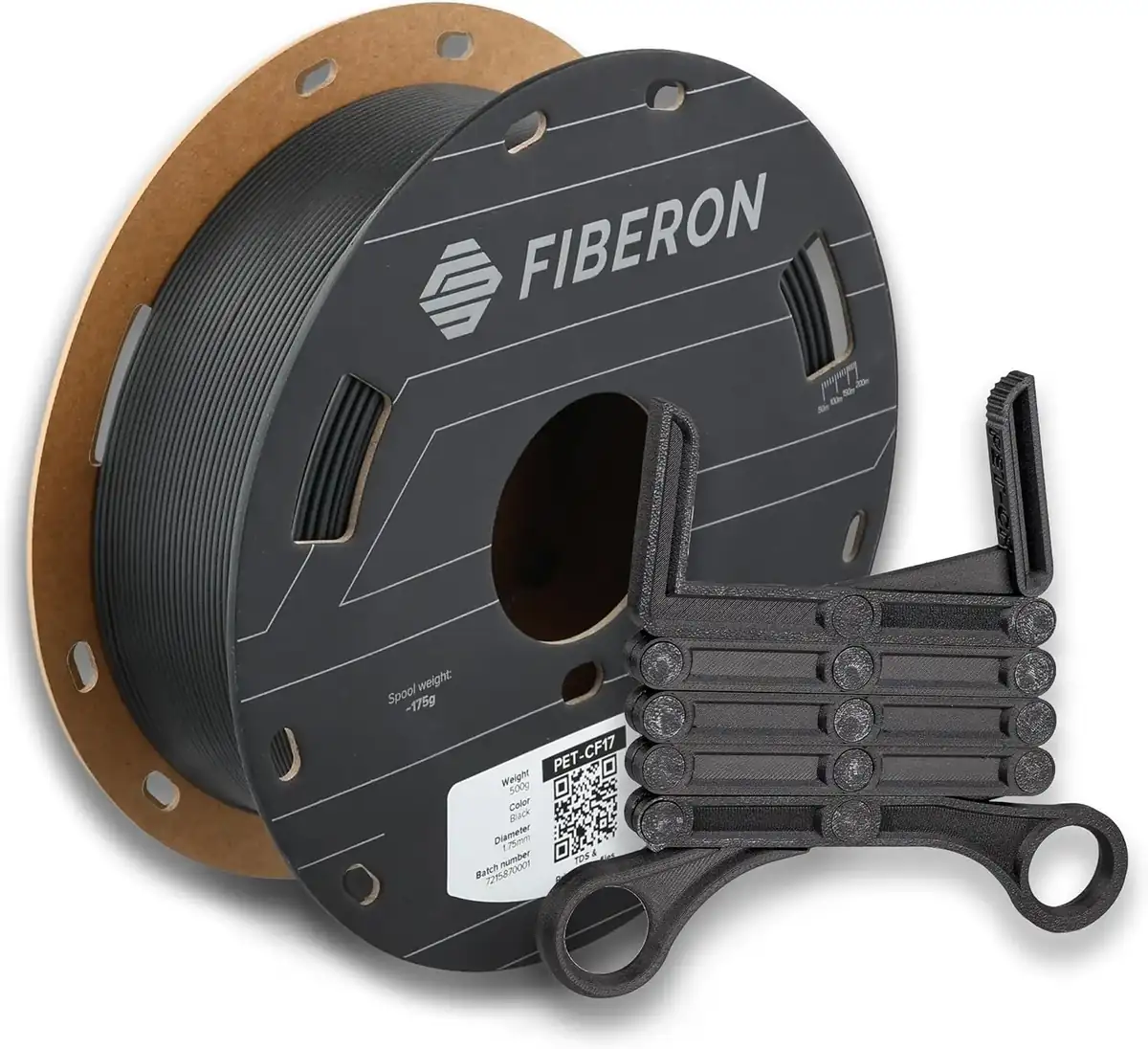
Polymaker PET-CF17 3D Printer Filament
By Polymaker · Filament & Resin · 3D Printing · More from Polymaker
- Printing temperature 270-300°C
- Bed temperature 70-80°C
- Max print speed 300mm/s
- HDT 147.5°C (0.45MPa)
- Bending modulus 5481 MPa (dry)
Price not listed
- PolymakerView at Polymaker
- eBayView at eBay
- eBay (used) eBay: used, open-box, refurbishedView at eBay (used)
Stores are listed in a fixed order, never by price or commission. Prices are snapshots. Check the current price with the store.
Summary
A 1.75 mm carbon-fiber-reinforced PET filament for stiff functional parts, printed at 270–300°C with the cooling fan off. Check your printer first: it needs an all-metal hotend rated for 270°C or higher and a hardened nozzle, and the published heat resistance depends on annealing.
Strengths
- Published TDS data for annealed specimens: 147.5°C heat deflection at 0.45 MPa and 5481.0 MPa dry bending modulus (X-Y).
- Manufacturer printing window is explicit: 270–300°C nozzle, 70–80°C bed, fan off, speeds up to 300 mm/s.
- One owner reports stiff, warp-free, dimensionally stable parts with good strength.
- Goodprints3D describes it as a stiffer functional option than plain PETG without the moisture-handling burden of many nylon blends.
- No capsule or subscription lock-in; it ships as a standard spool.
Weaknesses
- Filament is brittle and needs a gentle filament path with no sharp bends.
- Surface finish was poor for one owner using a 0.6 mm nozzle at 270°C.
- Abrasive filler increases nozzle wear; the cost is not quantified in the sources read.
- Annealing improves strength and heat resistance but adds brittleness and can deform thin sections.
- The material burns if ignited and does not self-extinguish.
- Cost premium: about twice the price of common filaments by one owner’s account, with the shop listing $24.99 for 0.5 kg.
Verified specifications
| Material | carbon-fiber-reinforced PET, 17% carbon fiber content. |
|---|---|
| Diameter | 1.75 mm. |
| Spool sizes | 500 g and 2 kg on the Fiberon page; 0.5 kg, 1 kg and 3 kg in Black on the shop page. |
| Color | Black only was observed in the shop listing; no color list on the manufacturer pages read. |
| Density | 1.34 g/cm³ at 23°C. |
| Melt index | 30.7 g/10 min at 270°C, 2.16 kg. |
| Flame retardancy | UL 94 HB. |
| Surface resistivity | overload, above 10^12 Ω. |
| Glass transition temperature | 79.3°C. |
| Melting temperature | 241.3°C. |
| Crystallization temperature | 202.9°C. |
| Decomposition temperature | 434.0°C. |
| Vicat softening temperature | 238.4°C. |
| Heat deflection temperature | 105°C at 1.8 MPa and 147.5°C at 0.45 MPa (annealed specimens). |
| Young's modulus (annealed 120°C/10 h) | 5481.0 ± 223.7 MPa (X-Y), 3558.8 ± 260.4 MPa (Z). |
| Tensile strength (annealed 120°C/10 h) | 65.9 ± 1.0 MPa (X-Y), 27.9 ± 1.3 MPa (Z). |
| Elongation at break (annealed 120°C/10 h): 2.4 ± 0.5% (X-Y), 0.8 ± 0.1% (Z). | |
| Bending modulus (annealed 120°C/10 h) | 4744.4 ± 136.3 MPa (X-Y), 2768.2 ± 422.6 MPa (Z). |
| Bending strength (annealed 120°C/10 h) | 109.3 ± 2.0 MPa (X-Y), 43.4 ± 8.8 MPa (Z). |
| Charpy impact strength (annealed 120°C/10 h): 5.1 ± 0.2 kJ/m² notched (X-Y), 25.1 ± 2.8 kJ/m² un-notched (X-Y), 3.1 ± 0.7 kJ/m² un-notched (Z). | |
| Equilibrium moisture absorption | 0.53% at 70% RH, 23°C. |
| Shrinkage | X-Y 40 mm specimen measured 39.94 mm after printing and 39.40 mm after annealing; Z 40 mm specimen measured 40.25 mm after printing and 40.33 mm after annealing; 10 mm diameter specimen measured 9.80 mm after printing and 9.60 mm after annealing. |
| Nozzle temperature | 270–300°C. |
| Bed temperature | 70–80°C. |
| Chamber temperature | room temperature. |
| Cooling fan | off (0%). |
| Printing speed | up to 300 mm/s. |
| Drying | 100°C for 10 h. |
| Annealing | 120°C for 10 h. |
| TDS specimen settings | 300°C nozzle, 70°C bed, 100% infill, 2 shells, 3 top/bottom layers, cooling fan off. |
| Printer requirements | all-metal hotend rated 270°C or higher and a hardened nozzle; a filament dryer may be needed depending on ambient humidity. |
| Printer profiles linked by the manufacturer: Bambu Lab X1C, Qidi Q1 Pro, Raise3D E2CF. | |
| Included | filament and downloadable printer profiles; no physical accessories listed. |
Full research notes and sources
Printing and hardware requirements
The published window is 270–300°C nozzle, 70–80°C bed, room-temperature chamber, cooling fan off, speeds up to 300 mm/s. The TDS specimen data were printed at 300°C nozzle, 70°C bed, 100% infill, 2 shells, 3 top/bottom layers, fan off. The material needs an all-metal hotend rated 270°C or higher and a hardened nozzle; a filament dryer may be needed depending on ambient humidity. The manufacturer links printer profiles for the Bambu Lab X1C, Qidi Q1 Pro and Raise3D E2CF. Treat 300 mm/s as a maximum printing speed, not a validated quality limit for all geometries.
Heat resistance and annealing
The TDS reports 105°C at 1.8 MPa and 147.5°C at 0.45 MPa for annealed specimens (120°C for 10 h), with a glass transition of 79.3°C and Vicat softening of 238.4°C. The wiki says annealing raises heat deflection from around 70°C to over 100°C. Annealing increases strength and heat resistance but adds brittleness, and can deform thin sections; gradual heating, lower-temperature longer annealing, or retaining supports are suggested. The manufacturer’s moisture-insensitive claim conflicts with the TDS: 0.53% equilibrium moisture absorption at 70% RH and 23°C, with drying at 100°C for 10 h. Dry before printing if ambient humidity is high.
Owner experience
One TeamFDM owner printed at 270°C with a 0.6 mm nozzle and reported brittle filament needing a gentle filament path, no warping, dimensional stability, strong parts and poor surface finish with that nozzle. The same owner reported annealing improved strength and heat resistance while increasing brittleness, and that the material burns if ignited and does not self-extinguish. No instrumented independent test of PET-CF17 was found; the TDS data are manufacturer specimen data with a disclaimer that values are for reference and comparison only.
Cost and ownership
Observed Polymaker shop prices: $24.99 for 0.5 kg, $44.99 for 1 kg and $109.99 for 3 kg in Black, with free economy shipping on orders over $49. Derived unit costs: $49.98 per kg for 0.5 kg, $44.99 per kg for 1 kg and $36.66 per kg for 3 kg; the 3 kg variant has the lowest observed unit cost. An owner price note from April 2025 of about $25 for 500 g is consistent with the observed 0.5 kg shop price. Ownership costs beyond the spool include a hardened nozzle, an all-metal hotend capable of 270°C or higher, possible filament drying and electricity for drying and annealing. There is no capsule or subscription lock-in. No additional price points beyond those two were found.
Which model this is
This page covers Polymaker Fiberon PET-CF17, a carbon-fiber-reinforced PET filament with 17% carbon fiber, 1.75 mm diameter, sold in Black. The Fiberon page lists 500 g and 2 kg spools, while the shop lists 0.5 kg, 1 kg and 3 kg in Black. The 0.5 kg Black variant carries SKU FL01001 and HEX code #302E2F. Do not confuse it with Fiberon PET-GF15, PETG-rCF08, PA6-CF20, PPS-CF10, PLA-CF or other Fiberon composites. No diameter tolerance, spool dimensions or gross weight specification was found.
Sources
Manufacturer:
- Fiberon PET-CF17 – Fiberon 3D Printing Filament by Polymaker
- Fiberon PET-CF17 - Polymaker
- TDS_FIBERON PET-CF17_V1.0_EN (PDF)
- Fiberon™ PET-CF17 | Polymaker Wiki
- Fiberon PET-CF17 1.75mm 3D printer filament - Polymaker shop
Independent reviews:
Owner reports: