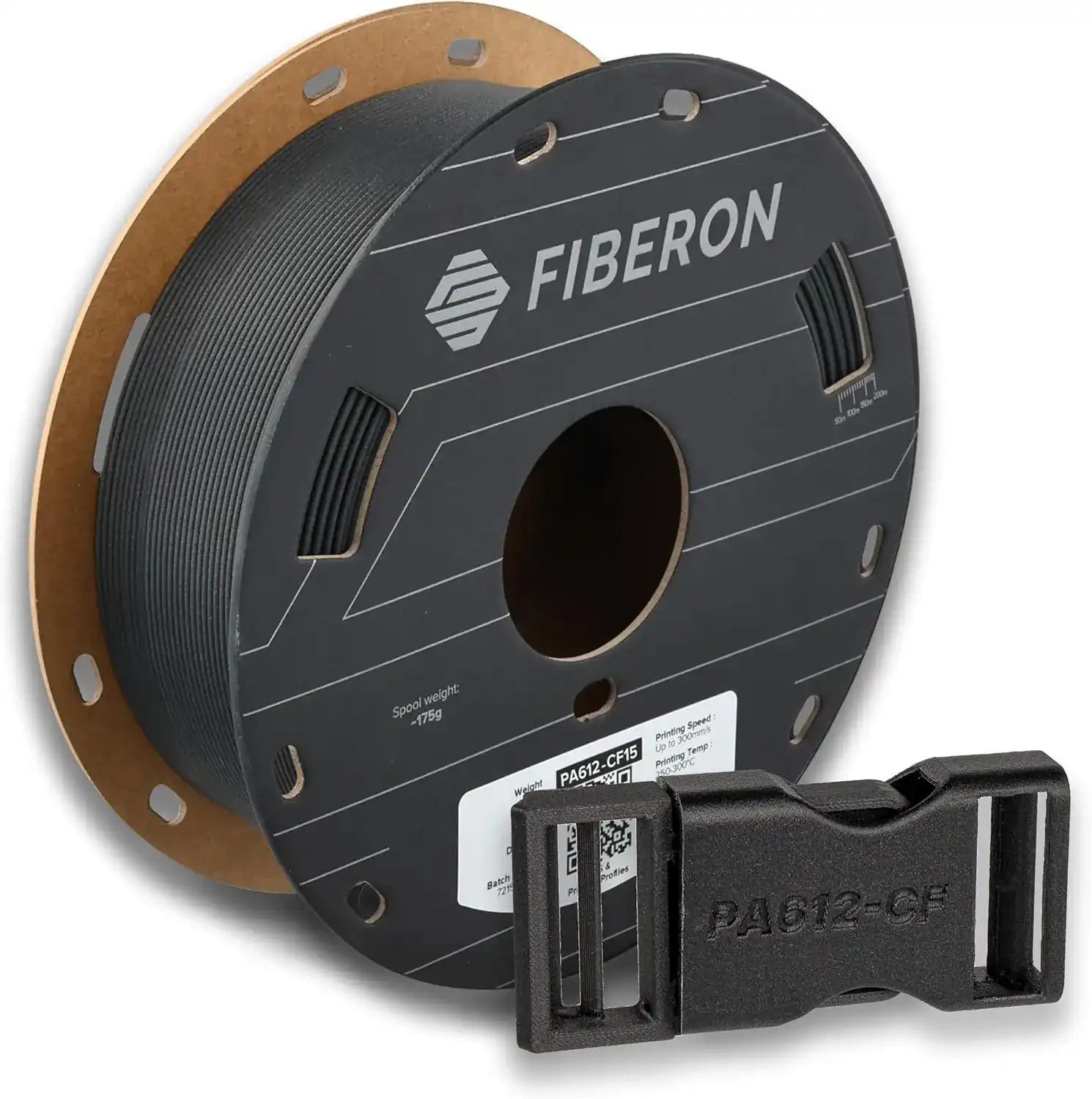
Polymaker PA612-CF15 3D Printer Filament
By Polymaker · Filament & Resin · 3D Printing · More from Polymaker
- 1.75mm diameter
- 15% carbon fiber reinforced PA612
- printing temp 250-300°C
- bed temp 25-50°C
- HDT 175.1°C at 0.45MPa
Price not listed
- PolymakerView at Polymaker
- eBayView at eBay
- AmazonView at Amazon (paid link)
- eBay (used) eBay: used, open-box, refurbishedView at eBay (used)
Stores are listed in a fixed order, never by price or commission. Prices are snapshots. Check the current price with the store.
Summary
A 15% carbon-fiber-reinforced PA612 (long-chain nylon) filament for functional and engineering parts, with lower moisture sensitivity than PA6/PA66 and a 175 °C heat-deflection temperature. Check your printer before buying: it needs a 250–300 °C hotend, a hardened nozzle, drying at 100 °C for 10 hours, and annealing at 100 °C for 16 hours to reach its rated strength.
Strengths
- Strong, stiff parts: 91.9 MPa dry XY tensile strength and 175 °C HDT at 0.45 MPa.
- Lower moisture sensitivity than many nylons, with 2.2% equilibrium water absorption at 70% RH.
- Good printability with strong bed adhesion and reduced warping; AMS compatible.
- Matte professional finish with dimensional stability.
- Accessible price for an engineering filament on the Polymaker shop: $34.99 for 0.5 kg and $49.99 for 1 kg (2026-10-25).
Weaknesses
- Needs a 250–300 °C hotend and a hardened nozzle; brass nozzles wear in about 9 hours.
- Drying is effectively required despite lower-moisture claims, plus annealing for maximum strength.
- Print quality drops at high speeds; slower speeds are preferred for strength.
- Cardboard spool can pinch filament after 25–30% use, with breakage reported on some rolls.
- Filled nylon is more brittle than PA6, so impact strength is lower.
- No independent instrumented test of this exact filament exists; mechanical data comes from the manufacturer TDS.
Verified specifications
| Material | carbon-fiber-reinforced PA612 (long-chain copolyamide), 15% carbon fiber. |
|---|---|
| Diameter | 1.75 mm. |
| Color | black, HEX #302E2F. |
| Nozzle temperature | 250–300 °C. |
| Build plate temperature | 40–50 °C recommended (shop technical block lists 25–50 °C). |
| Chamber | room temperature; enclosure recommended, heated chamber not required. |
| Maximum printing speed | up to 300 mm/s (shop technical block lists 60 mm/s). |
| Cooling fan | off. |
| Drying | 100 °C for 10 h in a regular oven, or PolyDryer level 3 for 18 h. |
| Annealing | 100 °C for 16 h. |
| Moisture conditioning after annealing | 48 h in a humid environment, or water at 60 °C. |
| Nozzle | hardened/wear-resistant, 0.4 mm or larger. |
| Density | 1.03 g/cm³ at 23 °C. |
| Melt index | 9.9 g/10 min at 260 °C, 2.16 kg. |
| Flame retardancy | UL 94 HB at 1.5 mm. |
| Surface resistivity | greater than 10^12 Ω. |
| Melting temperature | 210 °C. |
| Crystallization temperature | 180 °C. |
| Decomposition temperature | 448.4 °C. |
| Vicat softening temperature | 206.2 °C (TDS V1.1). |
| Heat-deflection temperature | 175 °C at 0.45 MPa; 114 °C at 1.8 MPa. |
| Equilibrium water absorption | 2.2% at 70% RH, 23 °C. |
| Tensile strength, dry | 91.9 ±2.0 MPa XY, 48.3 ±3.9 MPa Z; wet: 83.1 ±2.2 / 35.6 ±3.0 MPa. |
| Young's modulus, dry | 5136.7 ±192.2 MPa XY, 2786.4 ±78.4 MPa Z; wet: 3990.8 ±136.5 / 2386.8 ±150.2 MPa. |
| Elongation at break, dry | 2.6 ±0.2% XY, 2.1 ±0.2% Z; wet: 4.1 ±0.3% / 1.7 ±0.2%. |
| Bending strength, dry | 138.0 ±2.2 MPa XY, 73.5 ±3.9 MPa Z; wet: 118.1 ±1.6 MPa XY. |
| Bending modulus, dry | 4583.5 ±62.7 MPa XY, 2264.8 ±203.8 MPa Z; wet: 3888.3 ±56.3 MPa XY. |
| Charpy impact, dry | 8.1 ±0.8 kJ/m² notched, 29.9 ±1.6 kJ/m² unnotched XY; wet: 7.7 ±0.5 kJ/m² notched. |
| Shrinkage | 40.05/39.92/9.84 mm after printing; 40.04/39.66/9.78 mm after annealing, from a 40/40/10 mm model. |
| Spool net weights | 0.5 kg, 1 kg, 3 kg (3 kg marked sold out on the shop page). |
| AMS compatible | yes. |
| SKU | FG07001. |
| Spool | cardboard spool with reinforced hard edge and resealable vacuum bag. |
| Brass nozzle life | approximately 9 h. |
Full research notes and sources
Print settings and hardware
Print settings are a 250–300 °C nozzle, 40–50 °C bed, fan off, and a hardened 0.4 mm or larger nozzle. The shop’s technical-specifications block lists a 25–50 °C bed and 60 mm/s maximum speed, while the print settings and TDS say 40–50 °C and up to 300 mm/s; owner reports indicate quality loss near 300 mm/s. An enclosure is recommended but a heated chamber is not required, and room-temperature chamber printing is supported. Drying at 100 °C for 10 h (or PolyDryer level 3 for 18 h) and annealing at 100 °C for 16 h are part of the process, followed by 48 h of moisture conditioning in a humid environment or water at 60 °C. Store and print under dry conditions, below 20% RH.
Mechanical properties and moisture
The TDS reports dry XY tensile strength of 91.9 ±2.0 MPa, wet 83.1 ±2.2 MPa, and HDT of 175 °C at 0.45 MPa (114 °C at 1.8 MPa), with equilibrium moisture absorption of 2.2% at 70% RH and 23 °C. The material-comparison page quotes the wet-state figures (83.1 MPa tensile, 3990.8 MPa modulus), consistent with the TDS. The TDS V1.0 lists Vicat softening as N/A while V1.1 lists 206.2 °C. No credible instrumented third-party test of this exact filament was found; mechanical numbers come from the manufacturer TDS and shop page.
Ownership costs, spools and upkeep
At $34.99 for 0.5 kg and $49.99 for 1 kg on the Polymaker shop, the cost per kilogram is about $70.00 for the small spool and about $50.00 for the large one. Ownership costs include a hardened nozzle, a filament dryer, glue stick or Magigoo PA, annealing-oven time and electricity; there is no subscription or lock-in. The material is abrasive: brass nozzle life is approximately 9 h. Cardboard spool issues include filament pinching against the inner wall after 25–30% use and breakage on about 7–8 of 20-plus 0.5 kg rolls. Store under dry conditions below 20% RH. No warranty or quality-guarantee terms for the filament were found in the sources checked.
Is it worth it?
At $34.99 for 0.5 kg and $49.99 for 1 kg, the filament is positioned as an accessible engineering material next to alternatives priced above $100 per spool. Value is strongest for users who already own a 250–300 °C hotend and a dryer; users needing hardware upgrades should weigh those costs. Owner feedback aggregated from AValidReview describes strong, stiff, dimensionally stable parts with a matte finish, good bed adhesion and AMS compatibility, printable on common desktop machines with upgrades. No independent instrumented test was found, so mechanical claims rest on manufacturer data.
Which model this is
This page covers Polymaker Fiberon PA612-CF15, formerly PolyMide PA612-CF, a 15% carbon-fiber-reinforced PA612 filament in 1.75 mm, black (HEX #302E2F), SKU FG07001. Manufacturer states it is the same formula as the earlier PolyMide PA612-CF, printing slightly darker black. Available spool sizes are 0.5 kg, 1 kg and 3 kg, with the 3 kg size marked sold out on the shop page. Do not confuse it with PA6-CF20, PA12-CF10, PET-CF17 or other Fiberon grades. The Amazon listing for identity is ASIN B0D4QF5QVL. No Amazon prices are cited.
Sources
Manufacturer:
- Fiberon PA612-CF15 1.75mm 3D printer filament — Polymaker shop
- Fiberon PA612-CF15 — Polymaker Wiki
- TDS Fiberon PA612-CF15 V1.1 (PDF)
- Material Comparison Guide — Fiberon by Polymaker
Independent reviews:
Owner reports: