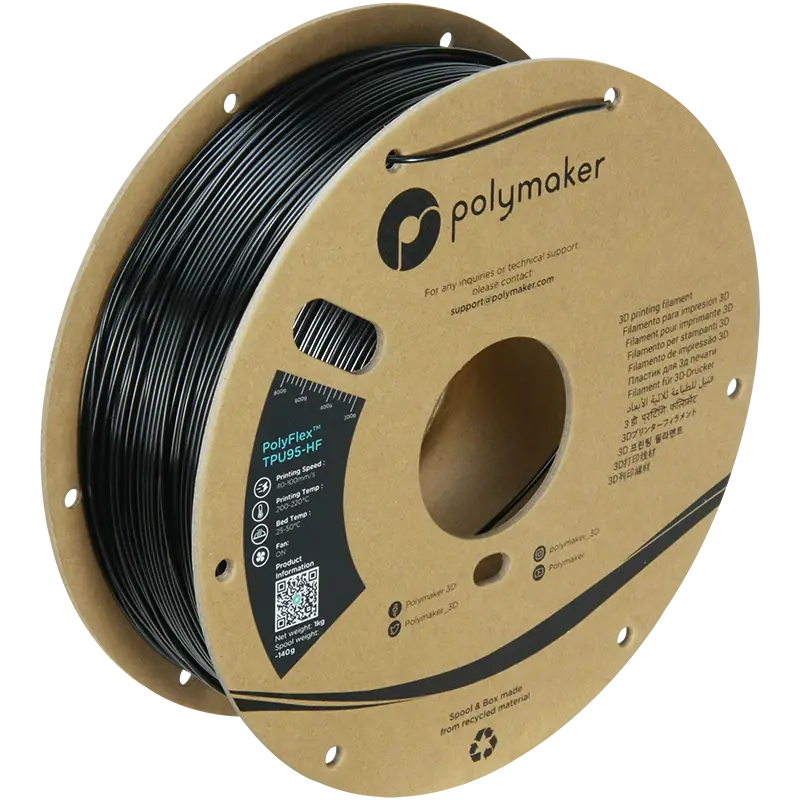
Polymaker High Flow TPU
By Polymaker · Filament & Resin · 3D Printing · More from Polymaker
- 1.75mm diameter
- Shore 95A (closer to 98A)
- Nozzle 200-230°C
- Bed 25-50°C
- Print speed 30-100 mm/s
Price not listed
- PolymakerView at Polymaker
- eBayView at eBay
- AmazonView at Amazon (paid link)
- eBay (used) eBay: used, open-box, refurbishedView at eBay (used)
Stores are listed in a fixed order, never by price or commission. Prices are snapshots. Check the current price with the store.
Summary
A high-flow TPU filament (Shore 95A, closer to 98A) rated for a 200-230 C nozzle, 25-50 C bed and 30-100 mm/s, aimed at faster flexible parts on a direct-drive printer. Check your printer’s feed path and drying setup before buying: real-world throughput lands well below the headline unless the filament is thoroughly dried and spool drag is controlled.
Strengths
- Manufacturer TDS gives full mechanical data: density 1.16 g/cm3, tensile strength 26.6 MPa, elongation 495.8 %.
- High-flow rating targets faster flexible parts than standard TPU on a direct-drive printer.
- Cooling fan stays on and no heated chamber is required, so setup is simple.
- Drying is a single 70 C for 8 h cycle per the manufacturer.
- Owners report clean parts at roughly half the print time of standard TPU when dried and fed properly.
- Adhesion reported fine on PEI with glue stick or a Lightyear G10 Pro plate.
Weaknesses
- Real throughput is far below the 100 mm/s headline: owners see 6-12 mm3/s for clean prints.
- Moisture absorption causes blobs, stringing and weak layer bonds; drying discipline is mandatory.
- Spool drag can starve the extruder and cause skipped steps.
- Diameter consistency can be poor on a given roll; one owner measured about 1.6 mm instead of 1.75 mm.
- TPU95-HF is firmer than the 95A name implies (closer to 98A), so standard TPU95 settings do not transfer.
Verified specifications
| Product | PolyFlex TPU95-HF, TPU, high-flow finish. |
|---|---|
| Diameter | 1.75 mm (also listed in 2.85 mm). |
| Shore hardness | 95A nominal, closer to 98A. |
| Nozzle temperature | 200-230 C. |
| Bed temperature | 25-50 C. |
| Printing speed | 30-100 mm/s. |
| Retraction distance | 3-6 mm; retraction speed 40-60 mm/s. |
| Cooling fan | ON. |
| Chamber | not required. |
| Support material | PolySupport and PolyDissolve S1. |
| Drying | 70 C for 8 h. |
| Density | 1.16 g/cm3 at 23 C. |
| Melt index | 9.3 g/10 min (185 C, 1.2 kg). |
| Tensile strength (X-Y) | 26.6 +/- 0.6 MPa. |
| Elongation at break (X-Y) | 495.8 +/- 16.2 %. |
| Stress at 100/200/300/400 % strain (X-Y) | 15.5/19.9/23.0/24.2 MPa. |
| Chemical resistance | weak acids fair, strong acids poor, weak alkalis fair, strong alkalis poor, oils/grease good. |
| UV resistance | stated by listing copy. |
| Spool format | cardboard spool; filament dried and vacuum-sealed with desiccant. |
| Colors | black, clear, white (and others per manufacturer). |
| Manufacturer product code | PD03001. |
Full research notes and sources
Print settings and drying
Manufacturer data lists a 200-230 C nozzle, 25-50 C bed, 30-100 mm/s print speed, 3-6 mm retraction at 40-60 mm/s, cooling fan on, no chamber, and drying at 70 C for 8 h. Standard PolyFlex TPU95 settings (210-230 C, 25-60 C, 20-40/30-50 mm/s, 65 C drying) do not transfer to TPU95-HF, so do not reuse an old TPU95 profile. Drying temperature itself conflicts by source: the manufacturer specifies 70 C for 8 h for HF, while standard TPU95 sources say 65 C for 8 h if wet. Follow the spool and dryer limits and use 70 C for 8 h for HF.
Real-world throughput
The high-flow claim is conditional. One Bambu X1C owner achieved a passable Benchy in about 50 minutes at 6 mm3/s only after switching from a defective, stretched red roll to a black roll. Another A1 mini Benchy was “a total booger” at 12 mm3/s before drying and tuning. Prusa XL owners also report trouble pooling HF material, with moisture suspected. Flow calibration on the X1C set flow rate to 0.946 versus the 1.0 default. Treat the 100 mm/s headline as a maximum under ideal direct-drive conditions, not a default.
Moisture, diameter and spool drag
TPU absorbs moisture, which causes rough surfaces and weak layer bonds. Drying 8 h or more improved results for owners reporting blobs and clumped stringing. Diameter inconsistency is a documented failure mode: one owner measured red TPU95-HF at about 1.6 mm instead of 1.75 mm, causing persistent failures until trimmed. Spool drag can starve the extruder; bearing turntables and low-drag holders were suggested by owners. Extruder grip failed on an A1 mini, requiring manual feeding. Clean the nozzle and use cold pulls to clear feeding issues.
Compatibility and handling
TPU cannot be fed through Bambu AMS tubing due to flexibility; external spool feeding is required. Printer compatibility depends on the feed path, and value depends on having direct drive with a controlled feed path. Without that, HF speed claims are not realized. Colors include black, clear and white, with others per the manufacturer.
Is it worth it?
At up to $30/kg, strong value for a high-flow 95A TPU with documented TDS data and broad community use. At $31-40/kg, fair; that matches typical PolyFlex pricing. Above $40/kg, compare against eSUN, Overture, Bambu TPU and standard PolyFlex TPU95 unless speed is the deciding factor. Manufacturer TDS values are stated as typical and for reference only, with no warranty of fitness for use unless announced separately. No formal warranty term was found in the sources.
Which model this is
This page covers PolyFlex TPU95-HF, the high-flow member of Polymaker’s PolyFlex TPU line, manufacturer product code PD03001, sold under the “Polymaker High Flow TPU” listing name. It is distinct from standard PolyFlex TPU95 (softer, different settings) and from PolyFlex TPU90 and TPU80. The Amazon listing for the clear 1.75 mm, 1 kg variant is ASIN B09MTCBSNF. Confirm the exact spool weight and color at purchase, since listings differ between 750 g and 1 kg.
Sources
Manufacturer:
- PolyFlex TPU95-HF product page
- PolyFlex TPU95-HF technical data sheet (wiki)
- PolyFlex TPU95-HF product/wiki page
- PolyFlex TPU95-HF TDS PDF V5.4
Independent reviews:
- PolyFlex filament review (Filament Cheat Sheet)
- PolyFlex TPU95-HF data sheet (SpoolScout)
- PolyFlex TPU95-HF print settings (SpoolBites)
- Polymaker PolyFlex TPU95 print settings (FilamentSettings)
- PolyFlex TPU95-HF material page (SliceHub)
Owner reports: