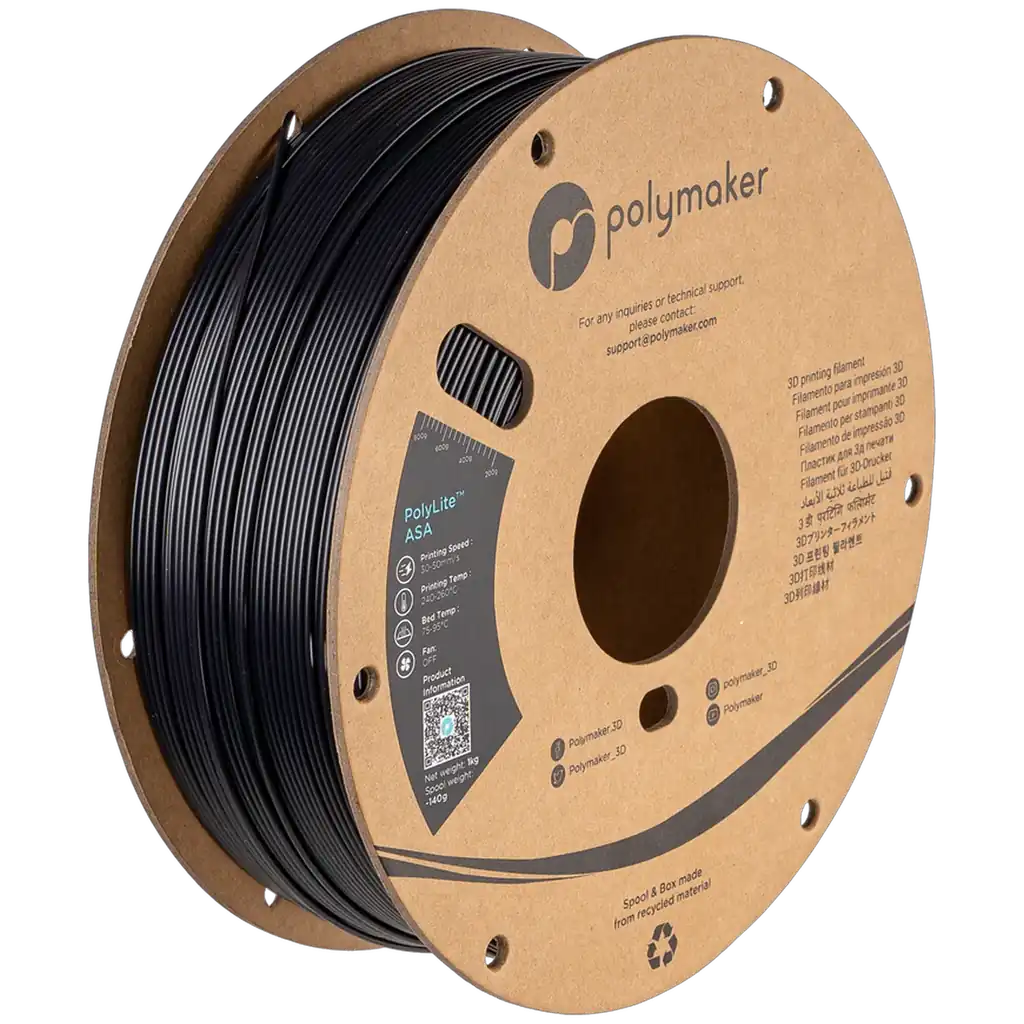
Polymaker ASA 3D Printer Filament
By Polymaker · Filament & Resin · 3D Printing · More from Polymaker
- 1.75 mm diameter
- 1 kg net weight
- Nozzle 230-260°C
- Bed 75-95°C
- Max speed 200 mm/s
Price not listed
- PolymakerView at Polymaker
- eBayView at eBay
- AmazonView at Amazon (paid link)
- eBay (used) eBay: used, open-box, refurbishedView at eBay (used)
Stores are listed in a fixed order, never by price or commission. Prices are snapshots. Check the current price with the store.
Summary
Polymaker ASA is a mainstream unfilled ASA filament for UV- and weather-exposed rigid parts such as enclosures, brackets and automotive trim, sold as the renamed PolyLite ASA. Check your printer before you buy: it needs an enclosure and ventilation, and bed adhesion is the weakest spec.
Strengths
- UV and weather resistance with color retention under sunlight, backed by two-year aging data.
- Heat tolerance around 100 °C HDT, suited to sun-exposed covers and hot car interiors.
- Affordable versus premium ASAs, with print quality and mechanical properties competitive with higher-priced brands.
- Wide US availability, unlike European boutique brands.
- AMS-compatible spool edges.
- Strong layer adhesion in a warm chamber; prints sand and machine well; acetone smoothing possible.
Weaknesses
- Bed adhesion is the weakest spec and often needs glue or slurry.
- Large flat parts warp and lift corners even in an enclosure.
- Part-cooling fan must stay off, softening overhangs.
- Styrene and VOC fumes during printing; ventilation required separate from the enclosure.
- Drying needed after humid storage; popping or rough extrusion possible.
- Color range limited to about eight options.
Verified specifications
| Material | ASA (acrylonitrile styrene acrylate), standard unfilled; PolyLite ASA was renamed Polymaker ASA, the same product. |
|---|---|
| Diameter | 1.75 mm. |
| Spool weight | 1 kg (1000 g). |
| Nozzle temperature | 230–260 °C (older pages specify 240–260 °C). |
| Build plate temperature | 75–95 °C. |
| Build surface | PC and textured PEI; glue when needed. |
| Cooling fan | off. |
| Printing speed | 50–200 mm/s. |
| Max volumetric speed | up to 16 mm³/s. |
| Retraction | 1–3 mm distance at 20–40 mm/s. |
| Enclosure | required (ambient temperature). |
| Drying | 70 °C for 7 h. |
| Annealing | not listed. |
| Glass transition temperature | 98 °C (DSC, 10 °C/min). |
| Vicat softening temperature | 105 °C (ISO 306). |
| Heat deflection temperature | 100 °C at 1.8 MPa; 103 °C at 0.45 MPa (ISO 75). |
| Density | 1.13 g/cm³ at 23 °C (ISO 1183). |
| Melt index | 25 g/10 min at 220 °C, 10 kg. |
| Young's modulus | 2379 ± 157 MPa (X-Y); 1965 ± 136 MPa (Z) (ISO 527). |
| Tensile strength | 43.8 ± 0.8 MPa (X-Y); 32 ± 1.8 MPa (Z) (ISO 527). |
| Elongation at break | 6.7 ± 0.6 % (X-Y); 1.65 ± 0.2 % (Z) (ISO 527). |
| Bending modulus | 3206 ± 108 MPa (X-Y) (ISO 178). |
| Bending strength | 73.4 ± 2.1 MPa (X-Y) (ISO 178). |
| Notched Charpy impact | 10.3 ± 0.4 kJ/m² (X-Y); 6.7 ± 1.4 kJ/m² (Z) (ISO 179). |
| Chemical resistance | weak acids good; strong acids poor; weak alkalis good; strong alkalis fair; oils and grease good. |
| UV and weather | two-year natural aging showed color change ΔE below 2.5; accelerated aging showed ΔE below 5 and minimal tensile strength loss after 8000 kJ/m² irradiation; components maintain integrity outdoors for a minimum of two years. |
| Post-processing | can be smoothed or welded with acetone. |
| AMS compatibility | yes (spool edges redesigned for AMS). |
| Food safety | no data; the manufacturer states no 3D printing material on the market is FDA food-safe certified. |
| Diameter tolerance | ±0.02 mm, reported by an independent swatch site; not stated on the manufacturer pages read. |
| Spool | modern spools use recycled cardboard. |
| Color range | about eight options in the PolyLite/Polymaker ASA line; natural and black most common. |
Full research notes and sources
Print settings and enclosure
Polymaker’s current exact-product guidance is a 230–260 °C nozzle, 75–95 °C bed, 50–200 mm/s, part-cooling fan off, an enclosure, and drying at 70 °C for 7 h when symptoms or exposure history justify it. The enclosure is required by the manufacturer, not optional, and reviewers advise against choosing a first spool on the open-printer exception. Source conflicts exist: Filament Oracle suggests a 90–100 °C bed and 80 °C for 4 h drying, and Makers101 suggests a 90–110 °C bed and around 80 °C for 8 h. Use the manufacturer’s 70 °C for 7 h and 75–95 °C bed as the exact-product guidance. The published 50–200 mm/s range is a material ceiling, not a promise that every shape prints at the upper limit; volumetric flow and corner quality limit real speeds.
Strength, heat and UV
The technical data sheet gives a glass transition of 98 °C, Vicat softening of 105 °C, and HDT of 100 °C at 1.8 MPa (103 °C at 0.45 MPa). Tensile strength is 43.8 MPa in X-Y and 32 MPa in Z, elongation 6.7 % in X-Y, bending strength 73.4 MPa, and notched Charpy impact 10.3 kJ/m² in X-Y. UV aging data report color change ΔE below 2.5 after two years of natural aging and minimal tensile strength loss after 8000 kJ/m² of accelerated irradiation, with components maintaining integrity outdoors for a minimum of two years. The material can be acetone-smoothed or welded. AMS compatibility comes from redesigned spool edges.
Bed adhesion and warping
Bed adhesion is the weakest spec on the Filament Swatch subjective scores (6/10) and owners report glue or slurry is often needed. Large flat parts warp and lift corners even inside an enclosure. In the 10-brand comparative test cited by Makers101, Sunlu and Bambu Lab spools warped and failed before halfway on an open-frame printer, while Polymaker ASA was the balanced all-rounder that never topped a category but never failed one. Design chamfers instead of steep unsupported angles, because overhangs soften with the fan off.
Fumes and ventilation
Styrene and VOC fumes are emitted during printing. An enclosure retains heat but does not neutralize fumes; ventilation is a separate requirement. No measured VOC emission levels or required ventilation rates were found. Drying helps after humid storage but does not fix warped geometry, weak enclosure, or an unsuitable profile.
Running costs and value
Ownership costs beyond the spool include an enclosure, ventilation or filtration, a temperature-capable dryer, build-surface adhesive, tuning filament and time, and storage containers with desiccant. There is no capsule or material lock-in; the spool is consumable with no recurring proprietary consumable. At the $30 level it is described as competitive value, with print quality and mechanical properties close to premium brands.
Is it worth it?
Buy Polymaker ASA for rigid sun- or weather-exposed parts on an enclosed, ventilated printer. Skip it for indoor-only parts already served by PLA or PETG, or when the printer cannot control ASA warp and fumes. 3D Printer World finds no demonstrated reason to switch from another standard ASA that already prints your parts.
Which model this is
This page covers the standard unfilled Polymaker ASA, formerly PolyLite ASA, 1.75 mm, 1 kg spool. Match material, diameter, color, and seller rather than assuming a formulation change; older listings, profiles, reviews, and spool photos may still say PolyLite. It is not the carbon-filled Fiberon ASA-CF08 or the decorative Galaxy ASA, which are separate products with different nozzle wear, flow, stiffness, and qualification needs. The Amazon listing for this spool is ASIN B0B1DF9273. Do not confuse it with 2.85 mm filament, which is not interchangeable.
Sources
Manufacturer:
Independent reviews:
- Polymaker PolyLite ASA — Filament Swatch
- Polymaker PolyLite ASA — Specs, Print Settings, Reviews (Filament Oracle)
- Best ASA Filament 2026: 6 Brands Tested For Strength & UV (makers101.com)
Owner reports: