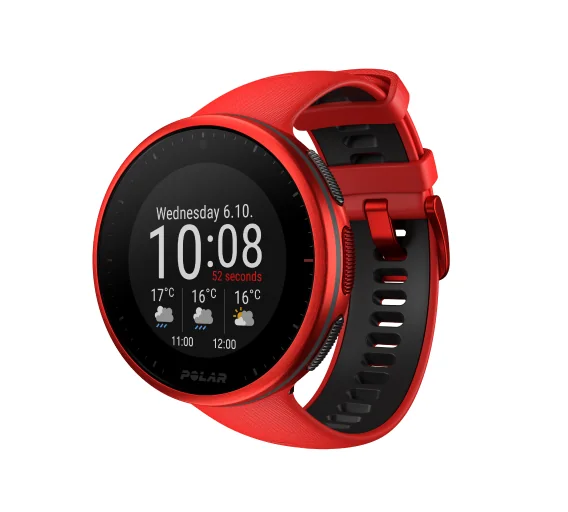
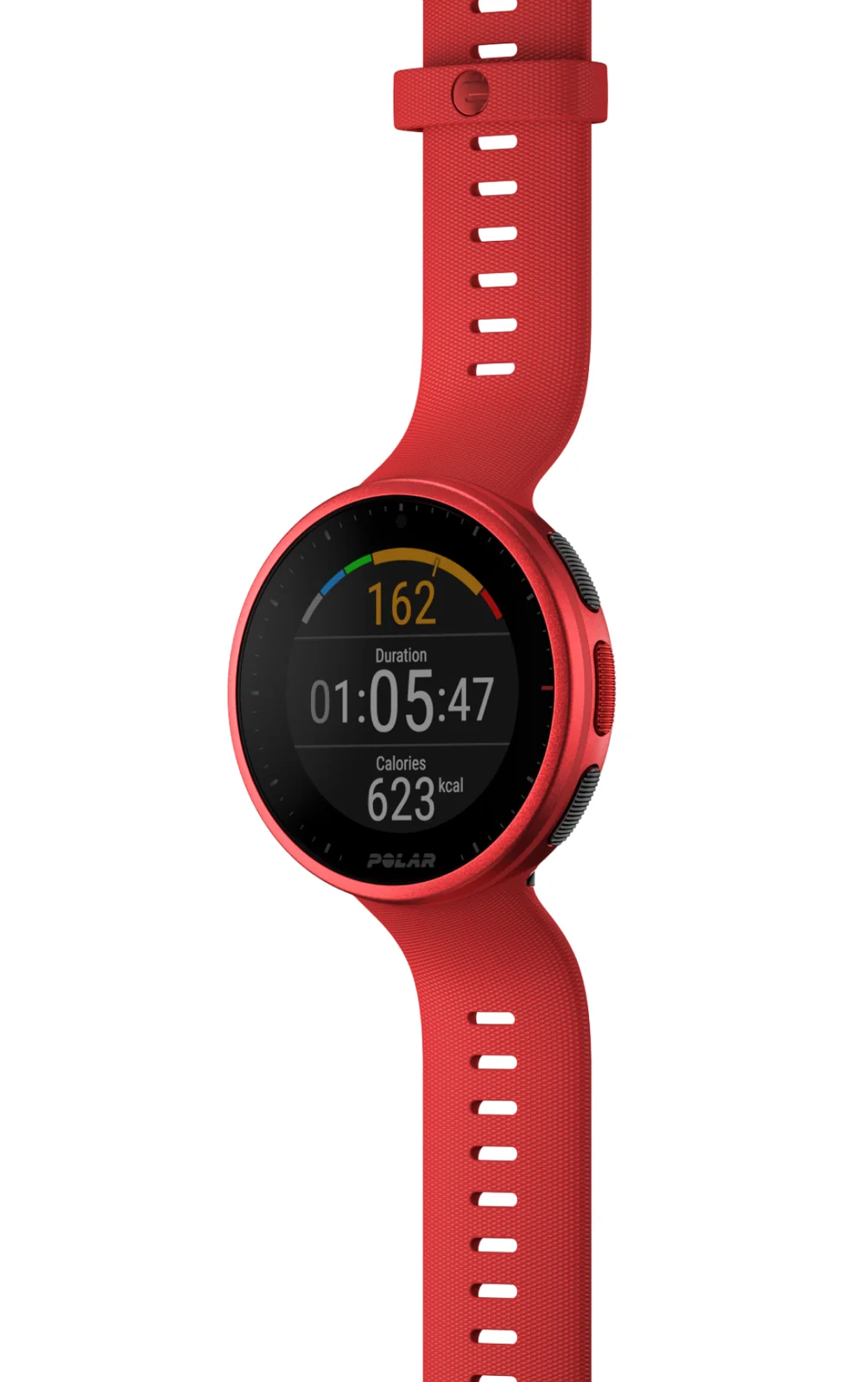
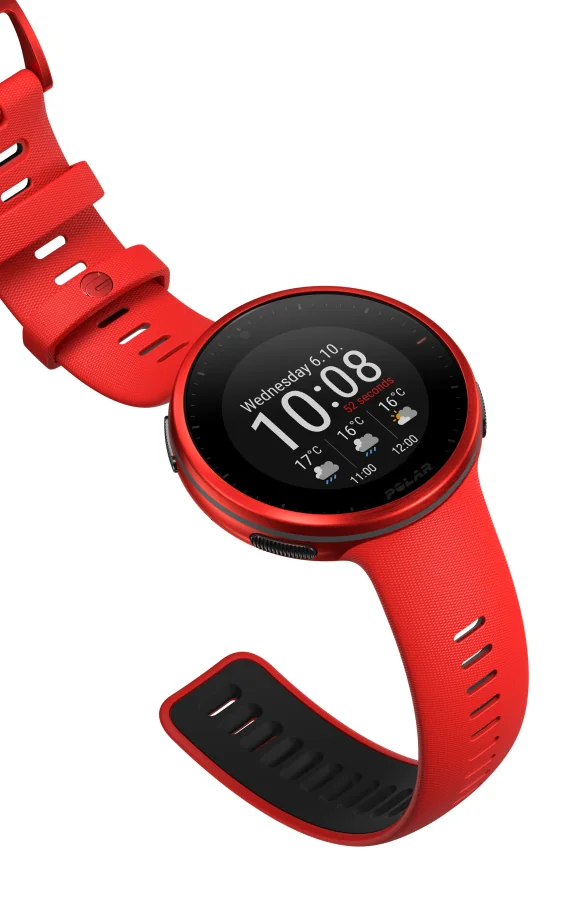
Polar Vantage V2 Shift Edition
By Polar · Fitness Trackers · Phones & Computers
- 1.2 inch display, 240 x 240 resolution
- 346 mAh battery, 40 h training / 7 days watch mode
- GPS with multi-satellite support
- Weight 52 g, aluminum body
- Water resistant to 100 m
Price not listed
- PolarView at Polar
- eBay (used) eBay: used, open-box, refurbishedView at eBay (used)
- eBayView at eBay
- AmazonView at Amazon (paid link)
Stores are listed in a fixed order, never by price or commission. Prices are snapshots. Check the current price with the store.
Summary
A 2020-era premium multisport GPS watch sold as a bundle — standard Vantage V2 hardware plus an aluminum adapter and two 22 mm bands — for runners and triathletes who value battery life and training depth over smartwatch features. Check the wrist heart rate before you buy: three independent reviews found it lags and spikes on fast intervals, and a chest strap is required for serious interval work.
Strengths
- Light for a multisport watch: 52 g with a band, 34 g bare, in an aerospace-aluminum case.
- Deep training stack: barometric altimeter, wrist-based running power, Training Load Pro, Energy Sources, FitSpark and Komoot turn-by-turn.
- Physical buttons plus a touchscreen that works with gloves and wet hands.
- Two-year warranty on the device for US and Canada purchases, with global central service.
- Open-sky GPS drew “no complaints” and “spot-on” from independent testers.
Weaknesses
- Wrist heart rate lags and spikes on fast intervals in three independent reviews; DC Rainmaker calls the sensor a regression versus earlier Polar watches.
- GPS gets patchy under tree cover, and initial locks occasionally fail.
- No maps, no music storage, no ECG, no SpO2 and no skin-temperature sensor; storage is 32 MB.
- Charging uses a proprietary USB-A cable, not USB-C, and the cable is a loss point.
- The adapter’s pins are not interchangeable with the stock strap’s, and a replacement adapter costs $29.99.
- The leather band in the bundle has no warranty at all, and battery wear-out is excluded too.
Verified specifications
| Display | 1.2 in, 240 × 240, always-on transflective color touchscreen with an ambient light sensor. |
|---|---|
| Battery | 346 mAh lithium-polymer, internal, replaced only at a Polar Central Service. |
| Claimed battery life | up to 40 h training with GPS and wrist HR, up to 7 days watch mode with continuous HR, up to 100 h with power-save options. |
| Dimensions | 47 × 47 × 13 mm; 52 g with a wristband, 34 g bare. |
| Case and bezel | aerospace aluminium; Corning Gorilla Glass 2320 screen. |
| GNSS | GPS, GLONASS, Galileo and QZSS, plus assisted GPS. |
| Sensors | Precision Prime optical HR (GEN 3.5), barometric altimeter, magnetometer compass, accelerometer, gyroscope, ambient light. |
| Water resistance | 100 m (WR100), tested to MIL-STD-810G. |
| Training history | up to 90 hours with GPS and heart rate. |
| Route accuracy | average 5 m; distance within ±2%. |
| Heart-rate range | 15–240 bpm; watch accuracy better than ±0.5 s/day at 25 °C. |
| Connectivity | Bluetooth LE only (2.402–2.480 GHz, 5 mW max); proprietary USB-A cable for charge and sync. |
| CPU and storage | 120 MHz CPU, 0.64 MB memory, 32 MB storage. |
| No ECG, no SpO2, no skin-temperature sensor. | |
| Recovery Pro | requires a Polar H9 or H10 chest strap. |
| Wristband sizing | S fits 120–190 mm wrists; M/L fits 145–215 mm. |
| In the box | watch, SHIFT adapter, FKM sport band, perforated leather band. |
Full research notes and sources
Battery life
Polar’s manual claims up to 40 hours in training mode with GPS and wrist HR, up to 7 days in watch mode with continuous HR, and up to 100 hours with power-save options. Polar’s own product-page table disagrees, listing 31 h performance, 132 h eco and 6 d smartwatch — an unresolved first-party conflict with no published reconciliation.
Cycling Weekly wore the V2 next to a Garmin Forerunner 945 for weeks, with at least one activity a day plus normal notification use: the V2 ran 126 hours before the 10% warning and died 7 hours later, while the Garmin lasted 66 hours more. The measured figure sits far closer to the product-page table than to the manual’s 40 h. For a multi-day event or a week away from a charger, this watch remains genuinely strong.
Cold and age cut into it. An owner of the older Vantage V reported charging every ~4 days with 24/7 HR, then watching battery life drop to around 2 days as the watch aged.
Heart rate and GPS accuracy
This is where the independent record turns negative, consistently across three outlets that tested the watch hands-on. TechRadar found responses to sudden HR change during HIIT “weren’t instantaneous and sometimes resulted in spikes”. Cycling Weekly, using a chest strap as reference, found HR lagged in warm-up and that on starting an interval “the Polar took some time to register a change in heart rate”, so “time spent in a higher zone is not being recorded”. Believe in the Run saw the watch “spike and dip” on one fast transition — “not on par with the Polar H10”. DC Rainmaker’s verdict is the harshest: “a regression in accuracy with both the Vantage V2 and Grit X sensors compared to past Polar sensors”.
The plausible reconciliation — steady-state HR is fine, fast transitions are not — has not been tested directly. If you do intervals, assume the watch will under-report time in zone and treat a chest strap as required, not optional.
GPS is better. DC Rainmaker found track and loop accuracy “no complaints” and “spot-on”, with “some slight differences” on a route starting in trees; Cycling Weekly found signal “patchy” under tree cover; Believe in the Run reported “no issues” apart from a couple of failed initial locks, fixed by returning to the main screen. Foliage is the problem, not open sky.
Warranty and running costs
Polar’s limited international guarantee gives two years from purchase for US and Canada products, one year for silicone or plastic wristbands, and nothing for the leather band in this bundle — the terms explicitly exclude “textile or leather wristband”. Normal battery wear-out is excluded, and second-hand purchases are not covered. Repairs go through Polar Central Service regardless of country of purchase, so keep the receipt.
The battery is internal and service-center only. A community data point on the older Vantage V puts a UK battery replacement at £15 battery plus £9.50 labour plus £3.95 postage — £28.45 all-in — which is indicative of Polar’s service model, not a current US quote. A replacement 22 mm wristband runs about $39.95, and the SHIFT adapter itself is $29.99 from Polar’s US store, more than a standard strap. A Polar H9 or H10 chest strap, roughly $40–90, is optional but unlocks Recovery Pro and is what reviewers recommend over the wrist sensor. No subscription is required; Polar Flow is free.
Battery care is simple: rinse the charging contacts with lukewarm tap water after sessions, keep the charge between 10 and 90%, and never charge below 0 °C or when the watch is wet.
Is it worth it?
The Shift Edition is effectively end-of-life: Polar’s US store lists only the standard Vantage V2 at $499.95, a long-standing authorized dealer had it at $249.98 but marked sold out, and a Czech retailer says the V2 is “no longer in the manufacturer’s offer”. No US price for the Shift bundle specifically is published.
At $499.95 — still Polar’s US list price — this is a hard sell in 2026: the Vantage V3 sells at $699.99 with AMOLED, dual-frequency GPS, maps, ECG, SpO2 and 32 GB of storage. Around $250, the level the authorized dealer recently listed, the calculus changes: you get a triathlon-grade tool with a barometric altimeter, 100 m water resistance and top-of-class battery for half the launch price. Above $400 it is a legacy premium product that no longer justifies its price.
Owners who upgraded from the Vantage V are lukewarm: the screen and buttons are “slightly better”, but only noticeable side-by-side, and one advises that if your watch is working fine there is “almost no difference” between the two. A 2024 V2 owner considering the V3 describes themselves as “quite satisfied”. Satisfaction, not excitement — which matches the hardware.
Which model this is
The Shift Edition is a bundle, not different hardware: Polar’s manual lists the Shift colorways — Black & Black-Red and Silver & Gray-Orange — with the same device material stack as every other Vantage V2, changing only the adapter and the bands. The adapter fits all Vantage V2 models and accepts any 22 mm wristband with quick-release spring bars, but Polar’s own instruction says to use the pins that came with the adapter, because regular wristband pins “will not fit properly” — the main setup trap for a used bundle with missing pins. The US listing for this bundle is ASIN B09SQ64XBK. Do not confuse it with the Vantage V, Vantage M2, Grit X or Vantage V3.
Sources
Manufacturer:
- Polar Vantage V2 product page
- Vantage V2 user manual — technical specifications
- Vantage V2 user manual — battery
- Polar Vantage V2 SHIFT Edition blog post
- Polar Vantage V2 FAQ
- Attaching the Shift Edition adapter — Polar Support
- Polar warranty
- Polar USA — Vantage V2
- Polar USA — Vantage V2 SHIFT Adapter
- Polar Vantage V3 vs Vantage V2
- Vantage V2 support hub
Independent reviews:
Owner reports:
- Shift from Vantage V2 to V3? (r/Polarfitness)
- Vantage V battery life after 4 years (r/Polarfitness)
- Vantage V Titan vs V2 (r/Polarfitness)
- Worth the upgrade? Vantage M to V2 (r/Polarfitness)
- Polar Vantage V1 to V2 (r/Polarfitness)
Parts and stores: