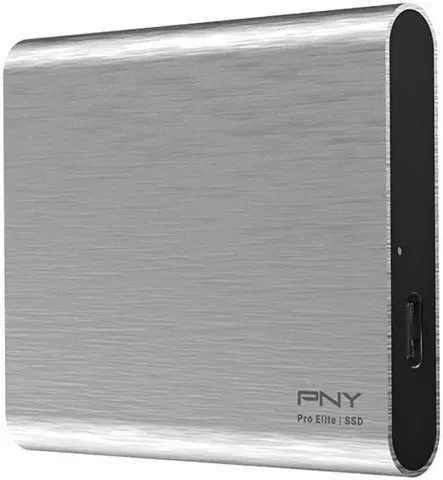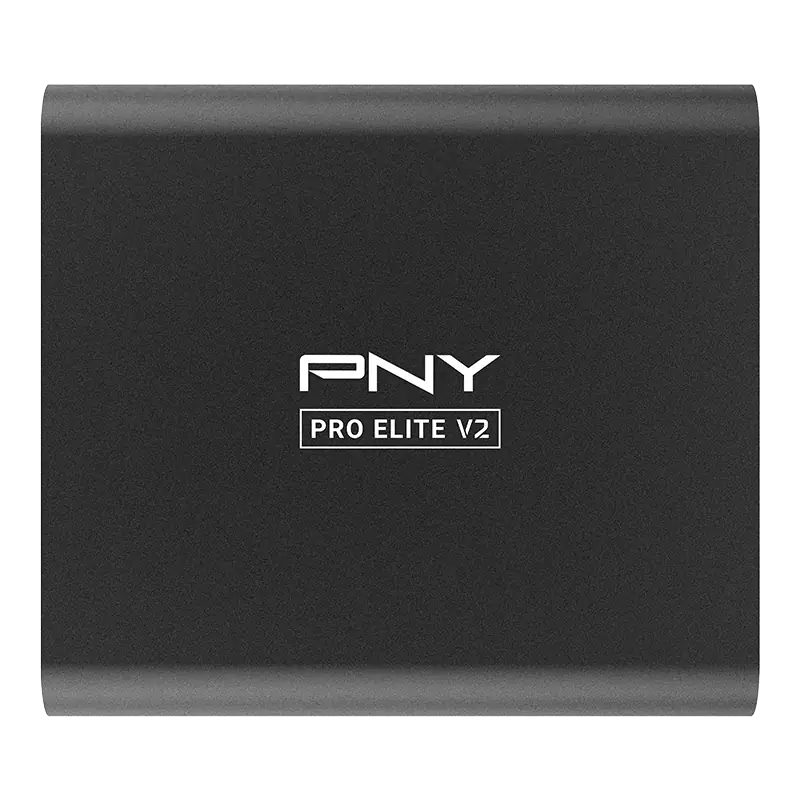
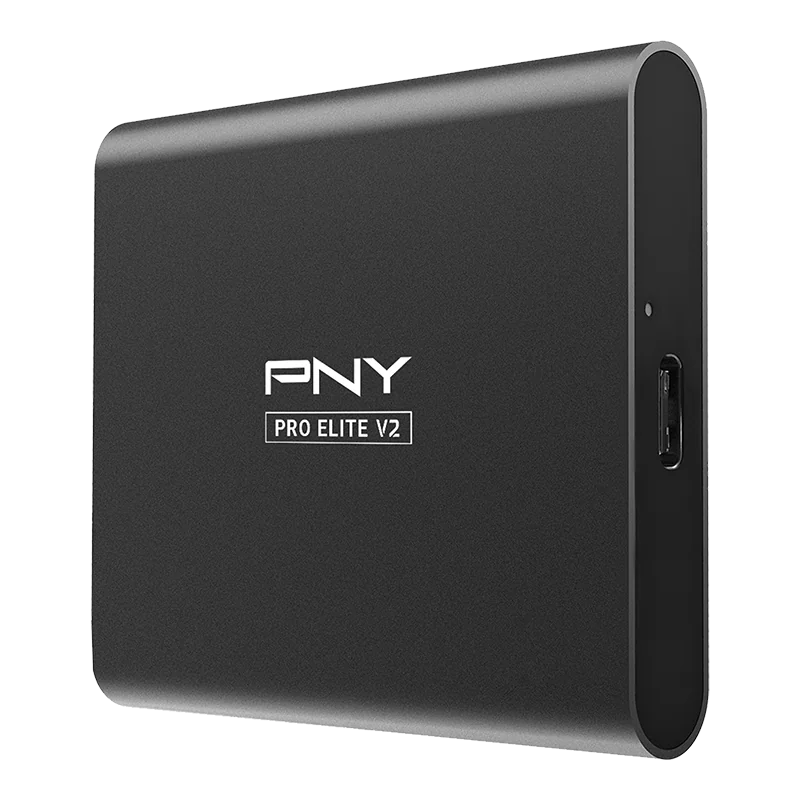
PNY Pro Elite V2 1TB Portable SSD
By PNY · External Ssds · Desk & Streaming Setup
Compare all External Ssds side by side →
- 1TB capacity
- USB 3.2 Gen 2x1 Type-C interface
- Max sequential read 1,100 MB/s
- Max sequential write 1,000 MB/s
- Dimensions 2.50" x 2.25" x 0.43"
Price not listed
- PNYView at PNY
- eBayView at eBay
- B&H Photo30-day returns · store policyView at B&H Photo
- Best Buy15-day returns · store policyView at Best Buy
- NeweggView at Newegg
- Staples14-day returns · free shipping $35+ · price match · store policyView at Staples
- AmazonView at Amazon (paid link)
- eBay (used) eBay: used, open-box, refurbishedView at eBay (used)
Stores with a price are sorted lowest first; commission never changes the order. Prices are snapshots. Check the current price with the store.
Summary
A pocket-sized aluminum USB-C portable SSD rated at 1,100 MB/s read and 1,000 MB/s write, built for photographers and editors who want near full USB 3.2 Gen 2 speed in the smallest package. Check the price before you buy: the same drive was listed at $141.86 by one March 2026 review and at $205.99 by PNY’s own store at the time of that check, and there is no hardware encryption at any price.
Size in context

6.3 cm · 2.5 in (W) × 5.7 cm · 2.2 in (D) × 1.1 cm · 0.4 in (H) · Drawn to scale from the maker's stated dimensions, next to everyday objects.
Strengths
- Measured large-file throughput lands close to the rated numbers: 1,087 MB/s writing a 50GB file and 1,000 MB/s reading it back.
- The body is 2.50 × 2.25 × 0.43 in, so it disappears into a pocket or a camera bag.
- Both USB-C-to-C and USB-C-to-A cables ship in the box.
- The aluminum shell keeps large transfers from throttling; SSD Buddy saw only mild warming in a 200GB write.
- Plug-and-play on Windows and macOS with no drivers, plus a 3-year warranty.
Weaknesses
- No hardware encryption, so data at rest depends entirely on host-side encryption.
- Small-file throughput drops to about 400 MB/s on a 10,000-JPEG transfer, far below the headline speed.
- It ships NTFS-formatted, so Mac and console users must reformat before use.
- No published endurance rating, IP rating, drop rating or operating temperature range.
- The brushed finish shows fingerprints, and the body is small enough to lose.
- Top throughput is well below NVMe portable SSDs for high-bitrate multi-camera editing.
Verified specifications
| Model | Pro Elite V2 USB 3.2 Gen 2x1 Type-C Portable SSD, 1TB. |
|---|---|
| Part number | PSD0CS2160-1TB-RB. |
| Interface | USB 3.2 Gen 2x1, single USB Type-C port; works on USB 3.2 Gen 1, USB 2.0 and USB 1.1 hosts. |
| Max sequential read | 1,100 MB/s. |
| Dimensions | 2.50 × 2.25 × 0.43 in (63.5 × 57.15 × 10.92 mm); 0.075 lb (about 34 g). |
| Housing | textured brushed aluminum, dark finish, acting as a heat sink. |
| Power | bus-powered over USB, no external adapter needed. |
| Format out of the box | NTFS for Windows; reformat to exFAT for a PlayStation 5 or to APFS for Mac. |
| Controller and NAND type | not disclosed by PNY. |
| Hardware encryption | none. |
| In the box | the drive, a USB-C 3.2 to USB-C 3.2 cable and a USB-C 3.2 to USB-A 3.2 cable, plus an Acronis True Image code claimed by registering the drive. |
| Warranty | 3-year limited warranty. |
Full research notes and sources
Speed in real use
The headline numbers are large-file sequential numbers, and independent testing supports them on big files. SSD Buddy’s March 2026 test on a 1TB unit wrote a 50GB 4K file in 46 seconds at an average 1,087 MB/s, read it back in 50 seconds at 1,000 MB/s, moved a 20GB mixed-media folder in 19 seconds at 1,052 MB/s, and kept speed steady across repeated large transfers. My Tech Grid copied a 60GB card dump of RAW and video in under a minute on a USB 3.2 Gen 2 system and edited 4K clips straight off the drive with no timeline stutters. A PlayStation 5 game installed and launched from the drive after an exFAT reformat, with load times comparable to the console’s own storage.
Older testing from How-To Geek on a 500GB sample moved hi-res photos and 4K video in about five seconds on a 2021 MacBook Pro and played 4K video from the drive on a Samsung TV over the USB-A port with no visible quality loss; a 30-minute 4K file took roughly two seconds longer over USB-A than over USB-C.
The gap between those numbers and the advertised speed is file size, not hardware. A folder of 10,000 JPEGs (15GB) moved at about 400 MB/s, so photo-basket workflows feel far slower than a spreadsheet of sequential figures suggests. Reviews Inside, which published no benchmark numbers, still names fast transfers as the main strength and the tiny body as a risk of being misplaced.
Formating, ports and everyday use
The drive ships NTFS for Windows. Mac users and console owners need to reformat before the drive will play nicely, and exFAT is required for the PlayStation 5. It also works on Android devices and gaming consoles, and access from iPhone and iPad is limited to the Files app.
The aluminum housing is the cooling solution, and it worked: no notable slowdown appeared across repeated large transfers in SSD Buddy’s testing, and only mild warming showed up on a thermal camera. The connector is a single USB-C port. How-To Geek reports a white LED that flashes while the drive is in use; SSD Buddy lists the absence of an LED as a con, so confirm on the unit you receive. One How-To Geek test hit a “Disk Not Ejected” warning in macOS after unplugging, with no data lost and normal behaviour afterwards, so eject it properly rather than pulling it free.
Encryption, software and upkeep
There is no hardware encryption on this drive, and no bundled management or backup utility that runs without a code. The Acronis True Image Data Protection code inside the box activates only after you register the drive, so the software is not preinstalled. If you carry client footage or personal records, plan on host-side encryption or pick a different drive.
Nothing needs maintaining in the sense of periodic servicing: there is no firmware update path and no health-monitoring tool for this model. The practical rules are the ordinary ones — eject cleanly, and back up anything you cannot replace. The unit is sealed, with no published parts list and no teardown option, so a failed drive is a replaced drive. No failure-rate or defect-rate data was found for this exact 1TB model.
Is it worth it?
The decision is mostly about price and encryption. Below roughly $120 this is a strong buy for photographers and editors who want near the maximum USB 3.2 Gen 2 speed in the smallest package. Between $120 and $150 it is fair to good, matching the $141.86 quoted by SSD Buddy in March 2026 against a Samsung T7 1TB at about $159 and a SanDisk Extreme 1TB at about $149 in the same comparison. Between $150 and $180 the case weakens, because the missing hardware encryption and the thin independent test record stop paying for themselves. Above $180, and certainly at the $205.99 PNY listed on its own store at the time of the check, an encrypted and better-tested drive is the better purchase.
Which model this is
This is the PNY Pro Elite V2 USB 3.2 Gen 2x1 Type-C Portable SSD, 1TB, part number PSD0CS2160-1TB-RB, sold in a 500GB and 1TB pair. The ASIN for this listing is B0CW8VT9N2. Do not confuse it with the PNY Pro Elite V2 USB-A flash drive, part numbers like P-FD1TBPROV2-GE, or with the older Pro Elite USB 3.1 Gen 2 portable SSD; both are separate products with different connectors and speeds.
Sources
Manufacturer:
Independent reviews:
Owner reports:
- No owner forum threads could be read for this model, so no owner failure reports are cited here.