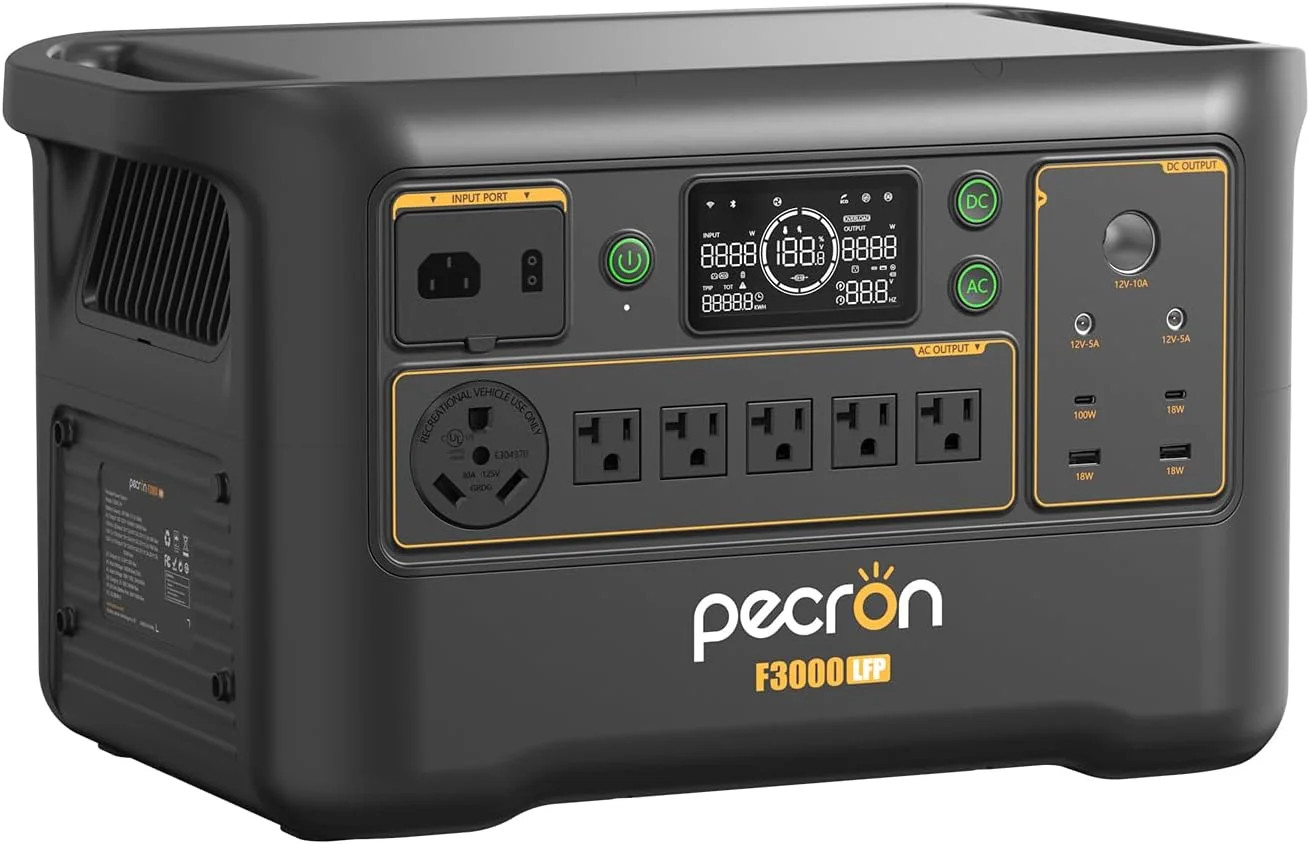
PECRON Portable Power Station F3000LFP
By PECRON · Portable Power Stations · Audio & Electronics
- 3,072Wh LiFePO4 battery (expandable to 9,000Wh+)
- 3,600W pure sine wave AC output, 4,500W surge (5s)
- 1,800W AC fast charge (0-100% in ~2h)
- 1,600W max solar input (XT60, 25-120V)
- 63.3 lbs, 19.3 x 11.6 x 11.1 in
Lowest price seen
$899.00
from $899.00 at Outbound Power · Checked Oct 20, 2026
- Outbound Power $899.00View at Outbound Power
- PECRONView at PECRON
- eBayView at eBay
- AmazonView at Amazon (paid link)
- eBay (used) eBay: used, open-box, refurbishedView at eBay (used)
Stores are listed in a fixed order, never by price or commission. Prices are snapshots. Check the current price with the store.
Summary
A budget ~3 kWh LiFePO4 power station with a 3,600 W inverter that held up under independent testing, aimed at whole-house backup and job sites. Check idle draw before you buy: about 37 W with the inverter on drains the pack faster during intermittent standby than some rivals.
Strengths
- Held a full 3,600 W continuous load in hands-on testing and delivered its claimed 4,500 W surge for about 10 seconds before tripping.
- Charged at the advertised 1,800 W AC rate and took the full 1,600 W solar input in The Solar Lab’s test.
- Averaged 83% efficiency running a sustained 3,600 W output from full to empty.
- A 3-hour whole-house outage ran fridges, lights and house loads at a 300-400 W idle on about 40% of the battery.
- Capacity per dollar is the pitch, and expansion packs lift total capacity to 9,216 Wh or 10,752 Wh.
- The inverter rode through breaker-flip inrush currents from a laser printer that an EcoFlow Delta 2 could not.
Weaknesses
- Idle draw with the inverter on measures about 37 W, so intermittent standby drains the pack faster than some rivals.
- There is no charge cutoff or state-of-charge limit on the F3000; you can only adjust charge speed.
- Plugged into AC, output is capped to the input, and exceeding it trips an “E20 — Inverter Overload” error.
- The interface is app-only with no touchscreen, and owners report pairing friction including a dead Bluetooth icon.
- There is no built-in light, and the AC sockets sit close enough that bulky plugs can block neighbors.
- Owners report BMS/state-of-charge miscalibration: one unit read 70% then dropped to 1% with nothing plugged in.
Verified specifications
| Battery | 3,072 Wh (51.2 V, 60 Ah) LiFePO4, rated to retain 80% capacity after 3,500 cycles. |
|---|---|
| Inverter | 100-120 V pure sine wave, 3,600 W continuous and 4,500 W peak for 5 s. |
| AC charging | 1,800 W at 120 V, full in about 2 hours. |
| Solar input | XT60, 25-120 Vdc, 1,600 W max, 25 A, one built-in MPPT controller. |
| AC outlets | 6 receptacles on the US unit (5 × 120 V plus 1 × 30 A RV outlet). |
| DC and USB | 2 × USB-A 18 W, 2 × USB-C (one 18 W, one 100 W PD), 1 × 12 V/10 A cigar port, 2 × DC 5525 12 V/5 A. |
| Expansion | XT120 port cascades up to 2 battery packs, 44-58 V at up to 40 A. |
| UPS | 8-20 ms switchover; the manual limits UPS loads under 1,800 W (120 V). |
| Warranty | 2+3 years (5 total) advertised in the US. |
| Weight | 28.7 kg / 63.3 lb. |
| Dimensions | 19.3 × 11.6 × 11.1 in (489 × 295 × 282 mm). |
| In the box | F3000LFP, AC charging cable, single-port XT60-to-MC4 solar cable, accessory bag, user instruction and quick start guide. |
Full research notes and sources
Output and charging under test
The Solar Lab’s hands-on test found the F3000LFP sustained a full 3,600 W load for extended periods, delivered its 4,500 W surge for about 10 seconds before tripping, and charged at the advertised 1,800 W AC input, reaching full in just over 2 hours. With a ~2,000 W solar array on a sunny day it took the full 1,600 W solar input easily, and it averaged 83% efficiency from full to empty.
Backup power and idle draw
A DIY Solar Forum owner ran a 3-hour home outage on the F3000LFP, powering fridges, lights and house loads at a 300-400 W idle and using about 40% of the battery. The same owner said the inverter rode through breaker-flip inrush currents from a laser printer that an EcoFlow Delta 2 could not. The clearest measured drawback is idle draw: about 37 W with the inverter on, and a forum post cites 40.4 W. At a 300-400 W house idle that baseline matters less, but if you leave the inverter running for intermittent loads it shortens runtime.
App, outlets and upkeep
The F3000LFP is app-only with no touchscreen, and owners report pairing friction: one had to unplug the unit to enter pairing mode and found the Bluetooth icon never turned on, while another solved connection problems with a dedicated 2.4 GHz Wi-Fi channel. There is no built-in light, and the AC sockets are spaced closely enough that bulky plugs can block adjacent outlets. The manual documents charge 0-45 °C and discharge -10 to 45 °C, warns the unit is not waterproof, and says a deeply over-discharged battery may not restart and should then be disposed of.
Reliability and warranty
The strongest owner caution is BMS/state-of-charge miscalibration: an r/Pecron owner reported a unit reading 70%+ then dropping to 1% in under 12 hours with nothing plugged in, fixed by leaving it on AC to top-balance. A sibling E1500LFP failed within a year and was repaired under warranty in about 3 weeks, a data point on the brand’s service rather than this model.
Is it worth it?
At about $799 it is strong value for high-capacity backup and job-site use where fast charging and honest surge matter more than app polish or low standby drain. PECRON’s own storefront banner advertises the F3000LFP at $899, The Solar Lab cites a typical $849 street price, and AGB lists $799 at $0.26 per Wh. Reddit deal threads reference $799 and, more recently, $719.20. Above $1,000 the value case weakens for a budget-branded unit; compare mature-app rivals. Expansion batteries add cost: The Solar Lab cites about $699 for an EP3000-48V pack, which brings total capacity to 9,216 Wh, or 10,752 Wh with two EP3800-48V packs.
Which model this is
This page covers the US F3000LFP, a 100-120 V unit with 6 AC receptacles including a 30 A RV outlet, 3,072 Wh and 3,600 W continuous output. Its radio module is certified under FCC ID 2BKWI-F3000LFP, applicant Shenzhen Pecron New Energy, and the US manual on file is revision F3000 LFP-EN-V1.4. Do not confuse it with the similarly named PECRON E3600LFP, the Anker SOLIX F3000, or the newer F5000LFP. The Amazon listing for the US variant is ASIN B0F6YCRKTJ.
Sources
Manufacturer:
- PECRON F3000 LFP User Manual (EN V1.4)
- PECRON F3000LFP Portable Power Station (US product page)
- PECRON F3000LFP Solar Generator (US product page)
- F3000LFP portable power station Test Report — FCC ID 2BKWI-F3000LFP
Independent reviews:
Owner reports:
- Pecron F3000LFP - initial impressions — DIY Solar Forum
- Pecron F3000LFP issues — r/Pecron
- Issues with Pecron F3000LFP — r/PortableBatteryPacks
- Pecron Portable Power Station F3000LFP — r/VanLife
- Pecron F3000lfp feedback — r/SolarDIY
Parts and stores: