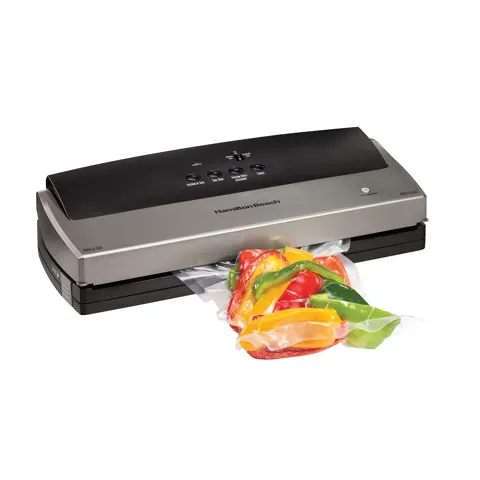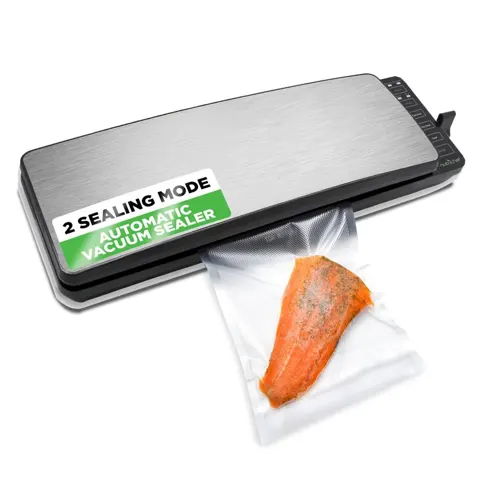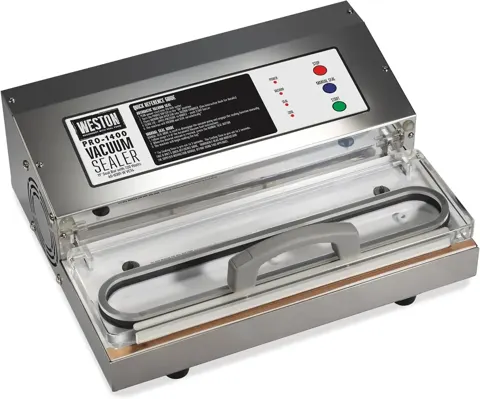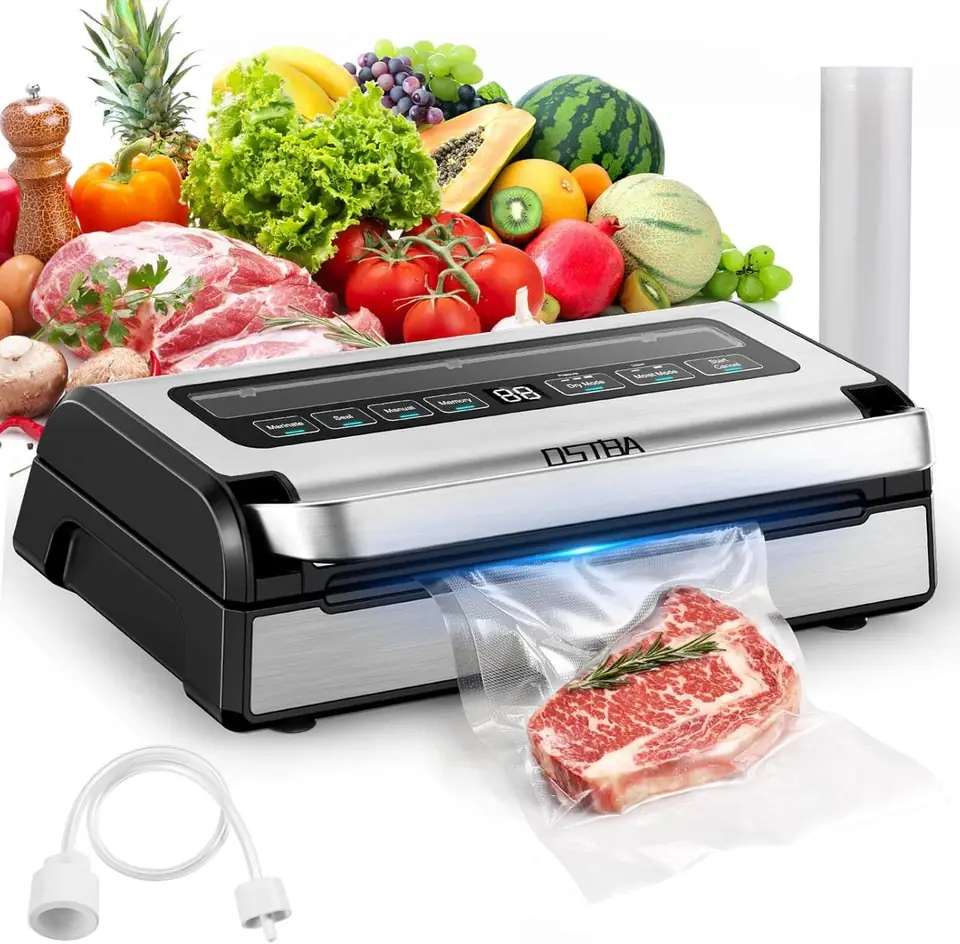
OSTBA VS2037 95 kPa Dual-Pump Vacuum Sealer
By OSTBA · Vacuum Sealers · Kitchen & Cooking
Compare all Vacuum Sealers side by side →
The short version
✓ Why people buy it: Dual-pump, double-seal and 180 W hardware claims offer substantial features for its observed budget-market pricing.
✗ Watch out for: No credible independent exact-model measurement verifies 95 kPa, 8–18-second cycles, motor noise or sustained batch capacity.
Prices at 4 stores ↓ · Will it fit? Size check ↓ · All 6 catches ↓
- Claimed 95 kPa suction, 180W dual-pump system
- True double heat seal with easy-lock handle
- Dry/Moist, Pulse, Marinate and external canister support
- Built-in cutter and roll storage
- Official warranty is 12 months
Price not listed
- The Home Depotprice match · store policyView at The Home Depot
- AmazonView at Amazon (paid link)
More on eBay (1)
- eBayView at eBay
- eBay (used) eBay: used, open-box, refurbishedView at eBay (used)
Stores with a price are sorted lowest first; commission never changes the order. Prices are snapshots. Check the current price with the store.
Summary
The OSTBA VS2037 packs a claimed high-vacuum dual-pump system, two heat seals, an onboard cutter and a removable drip tray into a home countertop machine. Its biggest purchasing caveats are the unverified pressure and speed claims, a reported failure of the plastic lid locks and a 12-month manufacturer warranty—not the “five-year support” that some listings advertise.
Size in context

40.6 cm · 16.0 in (W) × 21.6 cm · 8.5 in (D) × 11.4 cm · 4.5 in (H) · Drawn to scale from the maker's stated dimensions, next to everyday objects.
Strengths
- Dual-pump, double-seal and 180 W hardware claims offer substantial features for its observed budget-market pricing.
- A removable drip tray simplifies cleaning compared with fixed-trough external vacuum sealers.
- Dry, Moist, Manual, Marinate and Memory controls allow more adjustments than a one-button machine.
- Roll storage and the onboard manual cutter keep common bag-preparation tasks together.
- The included hose provides an option for compatible rigid vacuum containers.
- Several short-term verified owners describe good suction and effective sealing.
Weaknesses
- No credible independent exact-model measurement verifies 95 kPa, 8–18-second cycles, motor noise or sustained batch capacity.
- One verified buyer reports failed plastic lid locks and unanswered manufacturer support requests; prevalence is unknown.
- Other verified buyers report unclear instructions and a trial-and-error learning curve.
- Official warranty coverage is 12 months, despite “five-year support” wording elsewhere.
- No verified OSTBA VS2037 spare-parts catalog makes repairs after a failed latch, heater or pump uncertain.
- Short, partly incentivized ownership reports do not establish long-term durability.
Verified specifications
| Product identity | OSTBA VS2037, also syndicated as SJ-VS2037 or SJ-VS2037-N; retailer SKU 11445093. |
|---|---|
| Power | 180 W, according to OSTBA’s retailer listings. |
| Vacuum | manufacturer/seller claim up to −95 kPa; no independent exact-model gauge test found. |
| Pump configuration | seller-advertised dual pump; independent airflow and pump count inspection unavailable. |
| Sealing | advertised true double heat seal; exact finished weld-line widths not independently measured. |
| Timing | seller-advertised vacuum/sealing time of 8–18 seconds; no controlled bag-size-specific benchmark found. |
| Controls | Marinate, Seal, Manual and Memory functions, with three Dry levels and two Moist settings. |
| Accessories | external suction hose for compatible canisters or wine-bottle accessories; connector interchangeability not established. |
| Bag handling | built-in bag-roll bay, sliding manual cutter, progress display and lid-locking handle. |
| Cleanup | removable drip tray, useful after liquid reaches the vacuum channel. |
| Supplied kit | machine, one 20 cm × 300 cm textured bag roll, external hose and user manual in the exact Best Buy listing. |
| Materials | syndicated SJ-VS2037-N copy describes stainless steel and ABS; independent chassis inspection unavailable. |
| Dimensions | retailer data conflict; one syndicated listing gives 16 × 8.5 × 4.5 in and 6.6 lb, but Lowe’s lists an incompatible width field of 10.24 in. |
| Warranty | OSTBA’s published policy is 12 months; some retailers separately advertise five years of “support.” |
| Servicing | no verified retail listing for exact-model foam gaskets, heater parts, latch parts or a replacement pump. |
Full research notes and sources
How the controls, rolls and double seal work
The OSTBA VS2037 is a conventional external-suction bag sealer, not a chamber vacuum machine. Put food in a compatible textured bag, position the open edge in the vacuum channel, lock the lid and select a vacuum-and-seal mode. As the pumps draw air out through the bag’s internal channels, the heater seals the mouth. The basic method is familiar, but the VS2037 has more settings than a simple start-and-stop unit. The seller groups its functions under a “12-in-1” claim; that is a marketing count of settings and combinations, not evidence of twelve separate mechanisms.
The Dry choices let users select among three levels, while Moist has two settings. OSTBA lists Manual, Seal, Marinate and Memory controls as well. Manual control is useful when you want to stop before fragile food is crushed or before meat juices rise toward the suction channel. Seal-only operation serves the other half of the routine: making the closed end of a new pouch from a roll. Memory is advertised as a convenience feature for repeat settings, but no independently confirmed exact-model manual describes which selections it remembers across a power cycle. Do not assume it saves a custom timed recipe without first checking the supplied instructions.
The machine advertises two heat seals, not merely one unusually wide seam. That distinction is useful for shoppers planning freezer storage or sous-vide preparation. Two separate heat lines can leave a second barrier if a small wrinkle affects one line, but they do not turn badly positioned plastic into an airtight seal. The exact line spacing, individual welded widths and maximum usable bag width were not measured in reliable independent testing of the OSTBA-branded VS2037. Product photos and retailer copy support the double-seal configuration; they do not supply a quantitative leak-rate result.
The built-in roll compartment and manual sliding cutter are straightforward conveniences. The box listing specifies one 20 cm by 300 cm roll, which is adequate for experimenting with the machine but not evidence that a year’s supply is included. To make a pouch, cut enough material for the food and a clean sealing margin, use Seal mode on one end, fill it and then vacuum-seal the remaining opening. A sliding cutter still requires you to pull out and portion the roll yourself; it is not an automatic feed-and-trim system. A verified buyer specifically says that deciding how much bag to cut takes practice.
This category normally uses embossed or channel-style vacuum bags. Smooth pouches for chamber sealers are not a safe assumption because the external machine must have air channels beneath its clamped lid. OSTBA’s listings refer to ordinary vacuum rolls, and early owners describe sealing store-bought bags successfully. That supports a non-proprietary approach to consumables, but it does not prove a specific FoodSaver-branded roll or every generic material will operate correctly. The exact Best Buy question asking whether FoodSaver bags fit did not have a credible manufacturer answer in the reviewed record. Test a few bags from a new roll before buying a large case.
The external hose is a separate workflow. OSTBA advertises vacuum support for canisters and wine bottles, which means a correctly matched connector can move air from a rigid container. The included kit lists a hose, not a collection of compatible canisters or wine stoppers. There is no verified list of all third-party lid fittings, and no trustworthy independent timing for evacuating a one- or two-liter canister. A connection that looks similar to another sealer’s port is not a guarantee of fit. Check the accessory interface rather than paying for several containers in advance.
The removable drip tray is the most useful physical detail for wet foods. It makes the channel easier to wipe after a little meat juice escapes. It does not stop a pump from ingesting unrestricted soup or sauce, and the Moist settings are about managing the sealing workflow rather than converting this into a liquid-safe chamber machine. For juicy food, chill it first, keep the bag opening dry and stop suction if liquid approaches the channel. Freeze freely flowing liquid before attempting external bag sealing. Remove and clean the tray afterward, then dry the seal area and gaskets before the next bag.
Pump power, speed and noise
OSTBA’s seller listings describe a 180 W motor arrangement, two vacuum pumps and suction up to minus 95 kPa. These are plausible product specifications, but they are claimed specifications, not independent test results. Input wattage does not tell you how fast a particular bag empties. Peak pressure does not give you airflow in liters per minute. Two pumps do not automatically mean twice the ultimate vacuum or twice the useful throughput of a named competitor. A useful comparison would measure the same bags, fillings, pressures and ambient conditions across machines; no credible matched exact-model test was found here.
The advertised 8–18-second figure has the same limitation. It is not clear whether the seller timed evacuation, sealing or a combined cycle using a specific small bag. A pouch containing a large piece of food has less free air than the same-size empty pouch, while rigid containers have their own volumes and hose restrictions. Different test conditions could give different apparent speeds without showing a defect. Verified owners say the machine pulls air well for their food portions, but an owner comment cannot validate a precise 95 kPa or a set number of seconds.
Retail descriptions also promote “continuous sealing” through a built-in cooling system. That phrase should not be confused with a certified commercial-duty cycle. There is no independent OSTBA VS2037 test documenting how many successive bags can be sealed before heat protection engages, how hot the bar becomes or the exact rest interval. Use the supplied instructions and stop if the heater behaves abnormally, instead of assuming that a cooling-system claim means indefinite operation.
The noise evidence is thin. One verified buyer describes the motor as loud, but that is a subjective report from a single household. No reliable calibrated decibel measurement for the exact OSTBA VS2037 was found, and sound from video demonstrations is sensitive to recording gain and distance. It is therefore unsupported to describe this model as quieter or louder than a measured rival. The same applies to motor pitch: the size of a pump or its input wattage cannot reliably predict how shrill it will sound in your kitchen.
The smart way to evaluate the advertised power is to separate four issues: whether the device starts vacuuming consistently, whether it gets enough air out of your normal bags, whether the heated lines close the plastic reliably and whether the same process remains practical for your typical batch. Short-term customer feedback offers some support for the first three. It does not settle precise pump performance or batch endurance. The VS2037 is promising on paper, but its impressive numbers should be treated as provisional until an independent exact-model tester publishes a repeatable procedure.
Handle reliability, cleaning and warranty
The locking handle deserves closer inspection than its simple appearance suggests. On an external vacuum sealer, closing the lid presses foam gaskets around the suction channel. That compression is part of how the machine forms an airtight chamber at the bag mouth. A handle that fails to hold the lid shut is therefore not merely a cosmetic nuisance; it may make vacuum operation impossible. OSTBA advertises a convenient one-handed locking mechanism, and many users may have no trouble with it. Nevertheless, this particular part is a meaningful purchase risk because of a documented owner complaint.
A verified Best Buy purchaser says the plastic pieces holding the lid down broke within 60 days of ownership. The same review states that repeated attempts to obtain a warranty solution from the manufacturer went unanswered. That is one person’s account, not a verified manufacturer admission or an independently proven design fault. It is also not enough evidence to estimate a failure percentage, predict lifespan or claim that OSTBA never provides customer service. Still, the consequence described is severe enough to deserve mention: once the handle cannot compress the chamber seals, a strong motor specification is of little use.
Other owners raise a different problem. Two verified Best Buy buyers report that the included documentation does a poor job of explaining the operating sequence, and both describe learning it by experimenting. A Lowe’s owner likewise says it took some time to work out the settings. These complaints do not mean that the vacuum system itself fails, and those reviewers also describe usable suction and seals. They do mean that a shopper who expects an immediately obvious, one-touch experience may need to devote time to bag length, mode selection and lid positioning.
Some of the Best Buy reviews are marked both verified purchase and incentivized, and syndicated retailer reviews may come from the brand’s own collection program. A verified purchaser label supports the claimed transaction; it does not make every assertion a controlled test. A promotional incentive does not automatically make a review dishonest, but it limits how confidently a tiny sample can establish long-term reliability. There is no sufficiently deep independent exact-model owner history or instrumented endurance study to turn these anecdotes into defect statistics.
Day-to-day care is fairly uncomplicated. Remove the drip tray after wet food and wash or wipe it as appropriate for its material, clear residue from the vacuum channel and keep the heating strips free of crumbs. Examine the foam gaskets for flattened sections, cuts or dirt before assuming the pumps have become weak. Wrinkled or greasy plastic along the sealing area can prevent a good heat weld even when the lid stays locked. Do not scrape the heater with metal tools, and let hot components cool before cleaning. The supplied manual, if available, should govern the exact cleaning procedure rather than instructions for an unrelated VS2037-branded appliance.
The lack of exact-model spare parts is a bigger concern than the bag consumables. No reliable public factory catalog was found for replacement OSTBA VS2037 gaskets, latches, sealing tape, heating bars or motor parts. That does not establish that the manufacturer can never supply them on request, but it does mean a shopper cannot readily check prices, availability or service methods in advance. Finding a generic seal or a machine with a similar model number is not proof that the part will fit. For a device whose lid lock is crucial to operation, unverified latch interchangeability is particularly risky.
The warranty language is another area where precision matters. OSTBA’s own warranty page promises 12 months. A Lowe’s advertisement mentions five-year support, while retailer feature text elsewhere repeats a one-year warranty. Support can mean access to questions or troubleshooting without guaranteeing replacement parts, shipping coverage or five years of repairs. The official customer-help page primarily describes contacting OSTBA through Amazon seller messaging. That process is straightforward for an Amazon order but less clear for a purchase made through Best Buy, Walmart or Lowe’s. Before buying, confirm which marketplace seller is responsible for a failed product and how written warranty claims are submitted.
For the first few uses, try more than a single easy bag. Check that the handle closes normally, that both heat seals look continuous and that the vacuum holds in a suitably textured pouch. Try Moist and Manual settings with a controlled amount of damp food, while keeping liquids out of the air intake. Also test the accessory hose if it is an important reason for your purchase. Save the receipt and any written exchanges with the seller. If the handle cracks, stop relying on it to hold pressure and request a warranty remedy rather than trying to force it shut.
Is it worth it?
The strongest argument for the OSTBA VS2037 is its feature set at a discounted price. In September 2026, Walmart listed a unit around $71.99, Best Buy around $79.99 and Lowe’s around $89.99; older marketplace snapshots showed considerably higher comparison prices. These are observations from particular dates and retailers, not guaranteed offers today. The better question is what you receive for the actual checkout price: advertised dual pumps, a true double heat seal, several control modes, roll storage and cutter, a removable drip tray and an external hose. Those are tangible conveniences even if the 95 kPa and cycle-speed figures remain untested.
At roughly $70 or below, the hardware looks appealing for an occasional home user willing to accept uncertainty. In the $70–85 range, the convenience features are still competitive if a trustworthy seller provides straightforward returns. Around $85–100, weaker evidence on pump performance and spare-part availability matters more, especially if the shopper needs a machine for frequent large batches. Above $100, consider a sealer with deeper independent testing, an established repair-parts channel or more informative documentation. These are editorial value thresholds, not a measured price-performance league table.
The main recurring consumable is textured vacuum-bag material. Ordinary channel rolls are the relevant type of bag, so shoppers do not need to assume the starter roll is their only future supply. Check the usable length and width of a bag roll, not just the number of rolls in a package. A longer roll stored outside the housing may save money even though the internal compartment is tidier for shorter spools. A built-in cutter saves a pair of scissors; it does not create bags automatically. No reliable exact-model gasket replacement price or service interval was found, so a precise annual maintenance-cost estimate would be invented.
For occasional dry foods, freezer meal portions and similar work, the VS2037 can be a reasonable budget choice when discounted. The removable drip tray is helpful if small amounts of meat juice collect during sealing. Buyers mainly packaging soups and sauces should be cautious: an external vacuum machine is not the same thing as a chamber sealer. People who seal many bags without stopping also need actual thermal-duty information, not the sales phrase “continuous sealing.” The missing test data matters more when a purchase is for repetitive or demanding use rather than a few bags on weekends.
The reported broken lid lock changes the purchase calculation. A failed latch is not a minor accessory problem, and the owner’s account of unsuccessful support requests makes the seller’s return and claim process important. There is not enough evidence to call this a widespread defect, but it is enough to advise checking how the seller handles a failure and using the return period to exercise the mechanism repeatedly. Do not pay a premium for “five-year support” as though it were five years of parts-and-labor coverage. OSTBA’s published warranty says 12 months.
If your priority is documented maximum suction, calibrated noise, known seal endurance or readily ordered replacement parts, the evidence for this model remains insufficient. Keep the two types of judgment separate: an attractive feature list is established by the sales materials, while demonstrated performance and lifetime reliability require testing and longer ownership evidence.
Which model this is
Syndicated product data sometimes call it SJ-VS2037 or SJ-VS2037-N. The target is the external-suction OSTBA model with an advertised 180 W dual pump, double heat seal, locking handle, internal cutter and removable drip tray. One Best Buy specification field incorrectly calls it a chamber sealer; the machine’s bag channel and accessory-hose layout establish that it is not a chamber unit.
Do not confuse it with ROUUO VS2037 or AAOBOSI VS2037. Those brands use the same numerical identifier on separate marketplace products. Their manuals, service parts and owner reviews cannot be transferred to OSTBA without evidence that the hardware and revision are truly identical. Even identical-looking housings would not establish gasket geometry, lid-lock fit or warranty coverage. Likewise, a listed width of 10.24 inches on Lowe’s conflicts with the syndicated 16-inch chassis length; the exact physical dimensions have not been independently confirmed. Measure the available storage space conservatively and confirm the dimensions with the seller if they are critical.
The VS2037 name alone is not proof of a unique factory design. It is a useful search term, but the brand, retailer SKU and actual labeled specification should all match when obtaining advice or searching for parts.
Sources
Manufacturer:
Product pages:
- OSTBA 12-in-1 vacuum sealer product page (Best Buy)
- OSTBA 180 W listing and width field (Lowe’s)
- OSTBA 180 W listing (Walmart)
- OSTBA feature and package copy (TikTok Shop)
- SJ-VS2037-N syndicated listing: dimensions and weight (MercadoLibre)
Owner reports:
Cross-brand identifier: