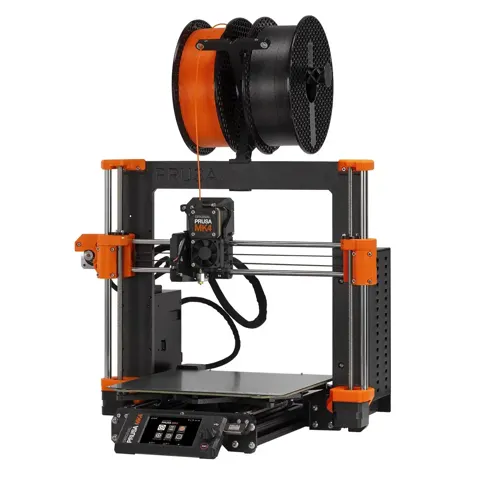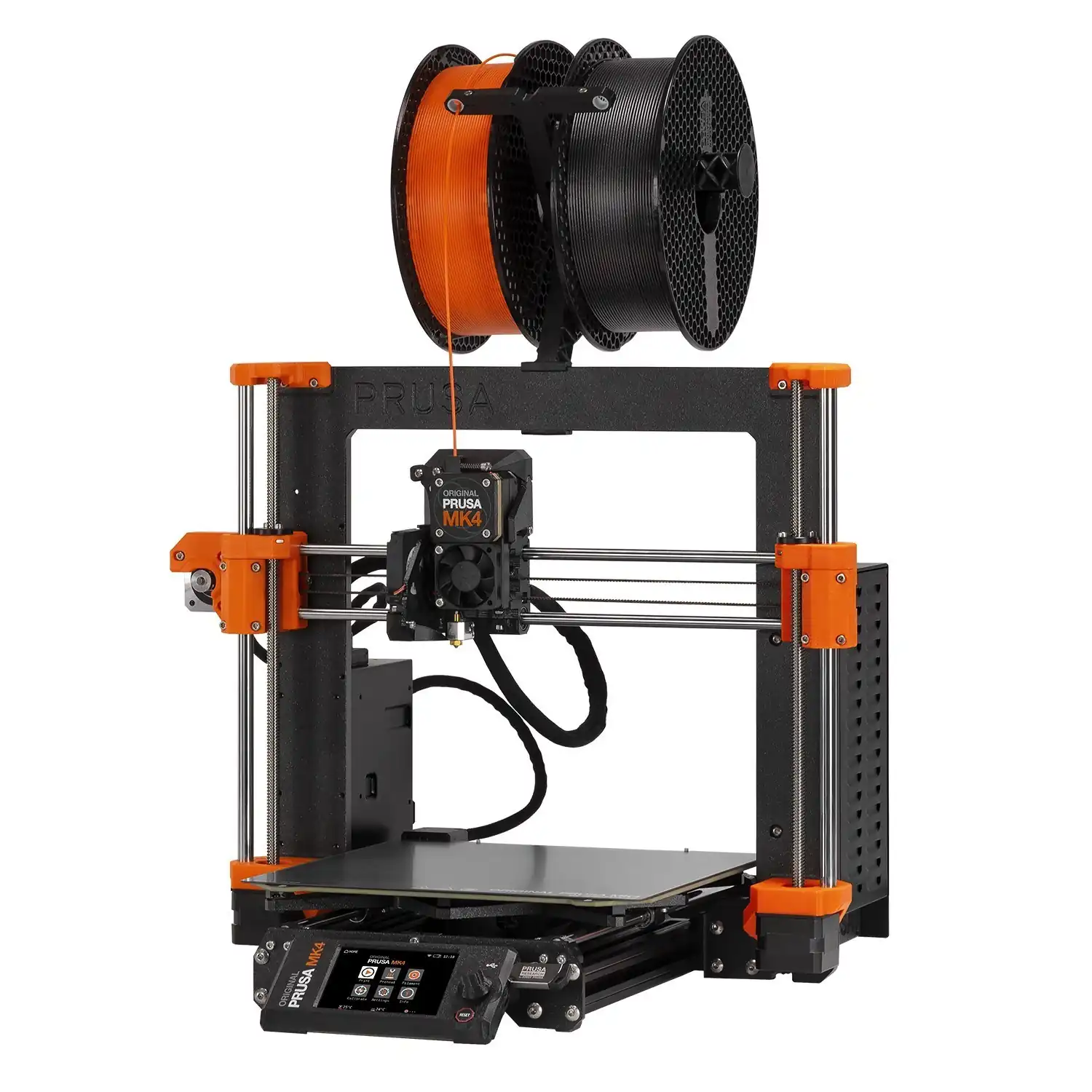
Original Prusa MK4 3D Printer
By Original Prusa · 3D Printers · 3D Printing · More from Original Prusa
Compare all 3D Printers side by side →
- Build volume 250 x 210 x 220 mm
- Layer height 0.05-0.30 mm
- Max nozzle temperature 300 °C
- Max bed temperature 120 °C
- Direct-drive Nextruder with 0.4 mm nozzle
Price not listed
- eBay (used) eBay: used, open-box, refurbishedView at eBay (used)
Stores with a price are sorted lowest first; commission never changes the order. Prices are snapshots. Check the current price with the store.
Summary
A premium open-frame FFF 3D printer with a 250 × 210 × 220 mm build volume, direct-drive Nextruder, and load-cell first-layer calibration that delivers consistent first layers without manual adjustment. The bedslinger motion system caps practical speed around 200 mm/s, and no enclosure is included for ABS/ASA printing; consider the newer MK4S for improved cooling and speed.
Size in context

50.0 cm · 19.7 in (W) × 55.0 cm · 21.7 in (D) × 40.0 cm · 15.7 in (H) · Drawn to scale from the maker's stated dimensions, next to everyday objects.
Strengths
- Load-cell first-layer calibration gives consistent first layers without manual Z adjustment.
- Print quality at or above average; dimensional accuracy of 0.08–0.12 mm on test cubes.
- Excellent documentation (3D Printing Handbook) and Prusa support (24/7 chat, email, phone).
- Open-source firmware; community mods including Klipper are possible.
- Long-term parts availability for legacy printers; machine designed to be maintained and upgraded.
- Wide filament compatibility; upgradable with enclosure and MMU3 multi-material unit.
Weaknesses
- Price at launch ($1,099 assembled, $799 kit) is higher than faster enclosed competitors like the Bambu Lab P1S.
- Bedslinger motion caps practical speed at ~200 mm/s before ringing appears.
- No enclosure included; printing ABS, ASA, or PC requires an aftermarket enclosure.
- MMU3 multi-material upgrade is fiddly compared with Bambu’s AMS and can jam.
- Kit assembly takes 8–10 hours and has an “industrial” feel not ideal for beginners.
- Open frame exposes prints to drafts, dust, and temperature swings.
Verified specifications
| Build volume | 250 × 210 × 220 mm (9.84 × 8.3 × 8.6 in). |
|---|---|
| Layer height | 0.05–0.30 mm. |
| Nozzle | 0.4 mm direct-drive Nextruder with 10:1 planetary gearbox, all-metal hotend; max nozzle temperature 290–300 °C. |
| Max bed temperature | 120 °C. |
| Motion system | Cartesian “bed-slinger” with dual Z axis. |
| Mainboard | custom 32-bit xBuddy with STM32, Trinamic 2130 drivers, 0.9° X/Y stepper motors. |
| Extruder | Nextruder direct drive with filament sensor and load-cell sensor for bed leveling/Z-height. |
| Bed | magnetic heatbed with removable PEI spring steel sheets; automatic mesh bed leveling on print area. |
| Connectivity | USB drive, LAN, optional Wi-Fi (ESP module), Prusa Connect. |
| Interface | 3.5 in color LCD (240x320) with knob/touch. |
| Materials | PLA, PETG, TPU/Flex, ABS, ASA, Nylon/PA, PC, PVA, HIPS, composites (enclosure recommended for ABS/ASA/PC). |
| Max print speed | rated up to 600 mm/s; practical useful speed ~200 mm/s before ringing. |
| Power consumption | 80 W (PLA settings) / 120 W (ABS settings); 240 W PSU. |
| Sensors | filament sensor, load-cell sensor, power panic, 4 thermistors, fan RPM monitoring. |
| Dimensions | 500 × 550 × 400 mm (19.6 × 21.6 × 15.7 in); weight 7 kg (15.4 lb). |
| Warranty | 12 months parts and labor. |
| In the box (assembled) | printer, full tool kit, 1 kg Prusament PLA spool, USB stick with sample models, 3D Printing Handbook, stickers, Haribo gummy bears, factory test print on bed. |
Full research notes and sources
First layer and calibration
The headline daily-use feature is the load-cell sensor that measures nozzle-to-bed force for automatic mesh bed leveling and Z-height calibration. Assembled units are effectively plug-and-print: owners report usable first layers across 80+ prints without manual adjustment. The Tested Hub found 20 mm calibration cubes held within 0.12 mm over eleven months. The system works on the print area only, not the full bed.
Print quality and speed
TechRadar scored the MK4 26.5/30 on the Autodesk Kickstarter test, scoring 5 on dimensional accuracy, fine negative features, and bridging, with an average X/Y error of 0.08 mm. PCMag found above-average quality across ten test objects with one misprint (a file flagged as problematic) and no operational problems. Input Shaper and Pressure Advance were added via firmware update in September 2023.
Enclosure and materials
No enclosure ships with the printer. ABS, ASA, PC, and other warp-prone materials need the Prusa Enclosure or an equivalent aftermarket solution. The open frame is fine for PLA, PETG, and TPU but exposes prints to ambient drafts and dust. Prusa sells the enclosure as a separate accessory; adding it increases footprint and cost.
Kit vs assembled and repairability
The kit takes a focused weekend to build — TechGearLab measured 10 hours. Assembled units cost more but arrive tested with a factory print on the bed. The open design uses Allen keys throughout; no welded or glued parts. Prusa sells individual replacement parts for years, including nozzles, heatbeds, sensors, and mainboards for legacy printers. Factory repair service is available. The claim rate is reported under 1% by Prusa and repeated by TechGearLab and The Tested Hub, though this is company-reported, not independently verified.
Running costs and upgrades
Filament is the main recurring cost (PLA, PETG, TPU are common). Optional upgrades: Prusa Enclosure, MMU3 multi-material upgrade, extra PEI spring steel build plates, nozzle combo packs ($27.90), V6 hotend adapter ($29.99). The MK4S successor adds 360-degree cooling, a high-flow nozzle, native mobile app, and improved speed/quality at lower prices ($925 assembled, $657.40 kit as of 2026-11-08 at Prusa3D).
Is it worth it?
At launch pricing (~$1,099 assembled), the MK4 competes on reliability, serviceability, and support rather than speed or enclosure; buyers prioritizing throughput should prefer the Bambu Lab P1S or X1 Carbon. The kit ($799) rewards buyers willing to spend a weekend assembling. The MK4 is now succeeded by the MK4S at lower prices; a new buyer should generally choose the MK4S unless a specific MK4 deal is found used. For long-term “buy it for life” ownership, the MK4/MK4S remain strong due to parts availability and open firmware.
Which model this is
This page covers the Original Prusa MK4 (also called Original Prusa i3 MK4), the fourth-generation open-frame FFF printer from Prusa Research, hardware introduced in 2023. It is distinct from the MK3S+, Mini+, XL, CORE One, and the newer MK4S. The Amazon listing for the assembled unit is ASIN B0CKSW74GX. Prusa no longer sells the MK4 new; the current product line is the MK4S.
Sources
Manufacturer:
Independent reviews:
Owner reports: