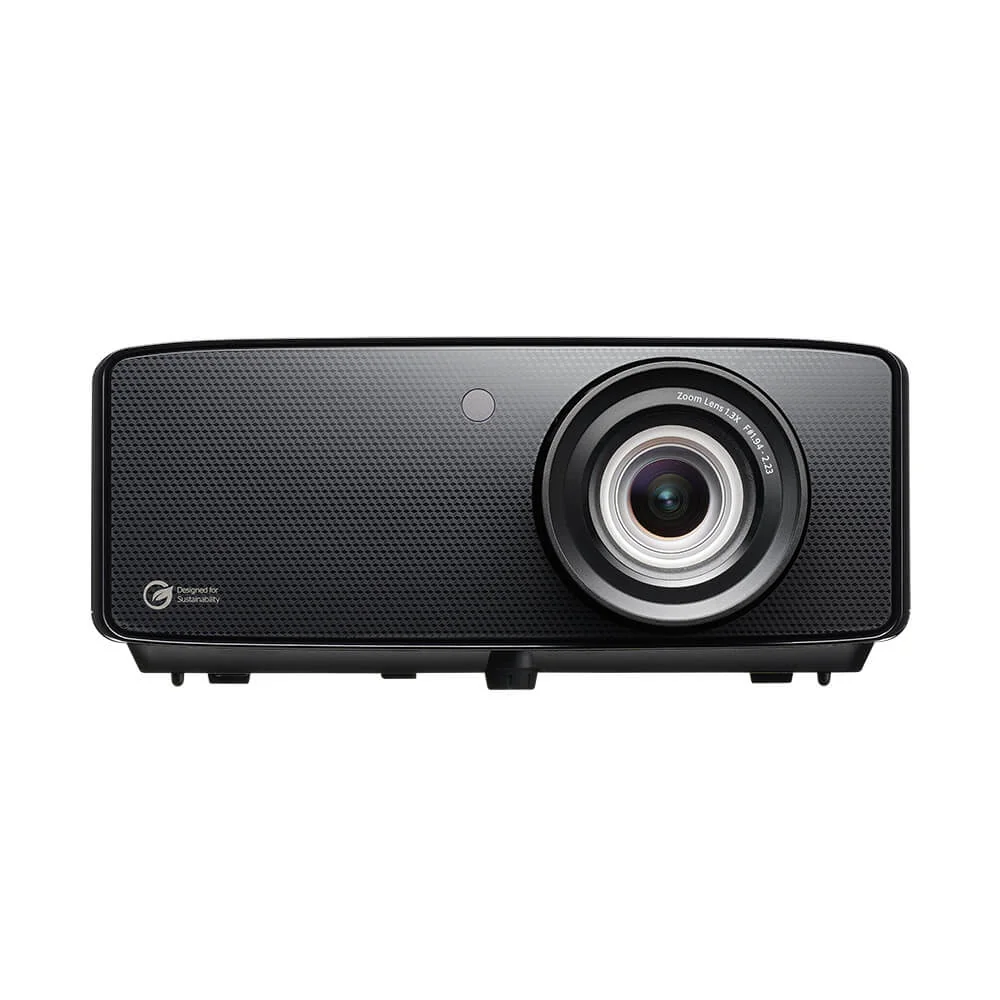
Optoma UHZ36 Smart Projector
By Optoma · Smart Projectors · Audio & Electronics · More from Optoma
- Native 4K UHD 3840x2160 DLP resolution
- Brightness 3,500 ISO lumens
- Laser phosphor light source life 30,000 hours (Eco mode)
- Contrast ratio 1,000,000:1
- Throw ratio 1.21-1.59:1 with 1.3x manual zoom, image size 28"-300"
Price not listed
- OptomaView at Optoma
- eBayView at eBay
- Audio General Inc.View at Audio General Inc.
- AmazonView at Amazon (paid link)
- eBay (used) eBay: used, open-box, refurbishedView at eBay (used)
- Focused TechnologyView at Focused Technology
Stores are listed in a fixed order, never by price or commission. Prices are snapshots. Check the current price with the store.
Summary
A 3,500-ISO-lumen laser home-entertainment projector for a fixed 100–150 inch screen in a darkened room, with a 1.3x manual optical zoom and no built-in streaming apps. Check the throw distance and the ARC-versus-eARC labeling before you buy: independent testing found washed-out colors, high input lag and frames skipped at 120 Hz.
Strengths
- Brighter than the portable projectors it competes with; independent testing calls it decent once room lighting is reduced.
- Laser light source rated up to 30,000 hours in Eco, so there is no lamp-replacement cycle.
- A real 1.3x optical zoom gives placement latitude that fixed-lens designs lack.
- RS-232 and a 12 V trigger let it live inside a controlled AV installation.
- Dual HDMI, ARC and a powered USB port let you keep a streaming box or AVR you already own.
- Moving-image detail is good and contrast in mixed scenes came out decent in independent testing.
Weaknesses
- Colors came out muted and washed out with factory calibration inaccurate, and calibration only partly fixed it.
- Input lag was high and 1080p at 120 Hz input dropped frames; independent testing judged it poor for all but the slowest games.
- Dark scenes had elevated blacks, no tested source format removed judder, and single-chip DLP can flash rainbows at sensitive viewers.
- Contrast figures differ between Optoma’s own product page, its PDF datasheet and ProjectorCentral, so there is no verified native contrast number.
- B&H calls the HDMI audio return eARC while Optoma’s datasheet and independent testing call it ARC.
- There is no built-in streaming operating system, so a separate stick, box, console or PC is required.
Verified specifications
| Projection | single-chip DLP with a laser-phosphor light source and pixel-shifted 3840 × 2160 on-screen UHD, not a native 3840 × 2160 imager. |
|---|---|
| Brightness | 3,500 ISO lumens, Optoma’s own figure measured under ISO 21118. |
| Contrast | the documents disagree — Optoma’s product page lists 1,000,000:1, Optoma’s own PDF datasheet says 1,500,000:1 and ProjectorCentral lists 2,000,000:1 — so none of them is a verified native contrast figure. |
| Throw | 1.21–1.59:1, which puts a 100-inch 16:9 image about 8.8–11.6 feet from the lens and a 120-inch image about 10.5–13.9 feet. |
| Zoom and focus | 1.3x manual optical zoom, manual focus, no lens shift. |
| Keystone | automatic vertical keystone plus digital horizontal and vertical correction up to ±30°. |
| Screen size | roughly 28–300 inches diagonal, with front, rear and ceiling mounting supported. |
| Inputs | two HDMI 2.0 with ARC on HDMI 1, 3.5 mm audio out, USB-A 5 V/1.5 A, RS-232 and 12 V trigger. |
| Refresh | accepts 1080p at 120 Hz and UHD at up to 60 Hz; independent testing saw frames skipped at 120 Hz input. |
| Audio | a single 15 W mono speaker, not stereo. |
| Power | AC 100–240 V, 50/60 Hz; 85 W typical and 98 W max in Eco, 150 W typical and 173 W max in Bright, 0.5 W standby. |
| Dimensions | 10.8 × 8.5 × 4.0 in, 4.5 in high with feet; net weight about 7.5 lb (3.4 kg). |
| In the box | AC mains cord, backlit remote, two AAA batteries and a quick-start manual. |
| Light source | laser-phosphor rated up to 30,000 hours in Eco mode. |
| Warranty | one year of standard U.S. parts-and-labor coverage; a separate Optoma warranty text lists 5 years or 12,000 hours for the light source in that class, so confirm coverage for your serial number. |
| Release | February 2026, sold as the UHZ36 4K UHD laser home-entertainment model. |
Full research notes and sources
Picture quality and color
Optoma rates the UHZ36 at 3,500 ISO lumens, which is a manufacturer figure measured under ISO 21118, not an independent reading of calibrated output. Independent testing found it decently bright after dimming the lights and noticeably brighter than the Hisense M2 Pro and the XGIMI Elfin Flip 4K, but not usable in ordinary daylight without controlling the room.
Color is the weak side. Independent testing found the colors muted and washed out, factory calibration quite inaccurate, and only partial improvement after calibration. Dark scenes show elevated blacks, no tested source format eliminated judder, and single-chip DLP can throw rainbow flashes at viewers sensitive to them. Contrast is a documentation problem as much as a picture problem: three official-looking figures exist for the same projector, and all of them are marketing or dynamic numbers.
Nobody has published a failure rate for this model, and the forum warning that turns up about Optoma’s other 0.47-inch 4K projectors is not evidence of a defect in the UHZ36. Treat the color findings as measured limitations of the picture, not as a known hardware fault.
Gaming and motion
Optoma accepts 1080p input at 120 Hz and UHD at up to 60 Hz, but accepting a signal is not the same as showing it. Independent testing observed frame skipping at 1080p at 120 Hz and measured high input lag, judging the projector poor for all but the slowest games. The absolute lag figures in that test sit behind a membership wall, so the 4.4 ms and 240 Hz numbers you see in family-level sales descriptions are not supported by testing of this exact projector.
No validated firmware fix for the frame skipping was found in the sources. If gaming decides the purchase, the Hisense M2 Pro and the XGIMI Elfin Flip 4K both test better on response, and the Elfin Flip adds 120 Hz and VRR support.
Placement and setup
The lens throw is 1.21–1.59:1, which for a 100-inch 16:9 image puts the lens about 8.8–11.6 feet from the screen, and about 10.5–13.9 feet for a 120-inch image. Measure before you buy. There is a genuine 1.3x manual optical zoom, but focus is manual and there is no lens shift, so table height or the ceiling mount position decides whether the image lands square. Vertical keystone is automatic and digital horizontal and vertical correction goes to ±30°, but aggressive keystone resamples the image, so mechanical alignment is the better fix.
Optoma lists roughly 28–300 inches of image. That top figure is geometry, not quality: brightness per unit of area falls away fast on a big screen, and independent testing found the black floor too high for critical viewing of dark films.
Audio is one 15 W mono speaker, so a soundbar or AVR is the sensible addition. Moving the unit to another room means manual refocus and zoom again, and there is no carry handle, no battery and no lens cover.
Running costs, parts and warranty
Running the projector three hours a day works out to about 1,095 active hours a year. At Optoma’s rated 85 W typical in Eco that is 93.1 kWh of active use, plus 3.8 kWh in standby at 0.5 W across 7,665 standby hours, or 96.9 kWh a year. At an illustrative $0.20/kWh tariff that is about $19.40 a year in Eco and about $33.60 a year in Bright mode, where the typical draw is 150 W. These are estimates built on the manufacturer’s watt ratings rather than a utility bill quotation, and they leave out your streaming box, screen and audio gear.
Consumables are thin. The remote takes two standard AAA cells; Target listed an Energizer MAX AAA four-pack at $5.49 in October 2026, so a two-cell change costs about $2.75 when you need it, and Optoma states no change interval. There is no projection lamp to buy: the laser-phosphor source is rated up to 30,000 hours in Eco and is not a user-replaced part. No UHZ36-specific air filter or replacement remote was confirmed, so ask Optoma before buying either.
Warranty is one year of parts and labor on the projector in the U.S. A separate Optoma warranty text lists 5 years or 12,000 hours for the light source in its class, but coverage depends on serial number and purchase channel, so get a written determination before you rely on it. Optoma asks for proof of purchase, the serial number and an RMA before a unit ships, and it pays two-way shipping on qualifying claims within 30 days of purchase. No owner reports document UHZ36 claim outcomes, so treat service performance as unknown.
Is it worth it?
Prices for this model swing widely, and the low listings are directory advertisements rather than confirmed checkouts. ProjectorCentral’s certified-store directory showed Audio General at $839, B&H at $1,099 and Focused Technology at $1,299 in October 2026, while B&H’s own product page showed $1,299 in stock. A separately indexed B&H review page sat at $1,199, and ProjectorCentral’s street-price record for the model was about $1,112. A $1,299 Walmart bundle from a marketplace seller adds an HDMI cable and a protection plan, which makes it a different offer from the bare projector.
Under $900 for a new unit with a U.S. warranty and easy returns, the brightness advantage starts to make sense. Between $900 and $1,000 you are choosing: the XGIMI Elfin Flip 4K is $999 with Google TV, RGB triple laser and better color and gaming, at 1,600 ISO lumens, so it is dimmer but far more capable as a display. Above $1,000 the Hisense M2 Pro, seen at roughly $997–1,050 on promotion at B&H, was the substantially better tested unit in the direct comparison, giving up brightness for better color, contrast and response. At the $1,299 B&H lists, value is poor unless your room needs the extra light more than it needs accurate color. The BenQ TK710 was $1,899 at B&H with 3,200 ANSI lumens, and its latency numbers are manufacturer claims rather than independent measurements.
Two things to settle before you order. Confirm whether the HDMI return is ARC or eARC on the unit you are buying, since B&H says eARC and Optoma’s datasheet and independent testing say ARC. And plan the throw distance first, because there is no lens shift to rescue a badly placed lens.
Sources
Manufacturer:
- Optoma UHZ36 product page, specifications and accessories
- Optoma UHZ36 official specification PDF, via ProjectorCentral
- Optoma U.S./Canada limited warranty and RMA requirements
- Optoma warranty registration for projectors in the U.S./Canada
Independent reviews:
Retailers:
- B&H product listing for the Optoma UHZ36
- Walmart bundle listing with HDMI cable and protection plan
- Target Energizer MAX AAA alkaline four-pack listing
- B&H listing for the Hisense M2 Pro
- B&H listing for the BenQ TK710
Owner reports: