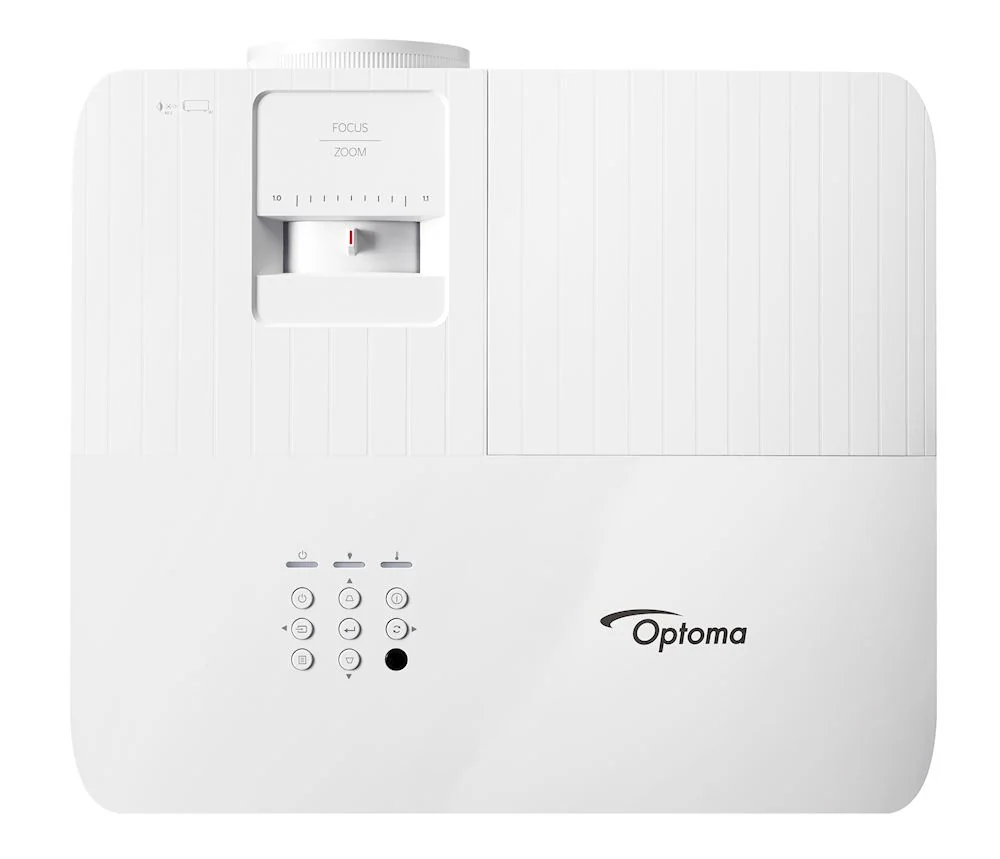
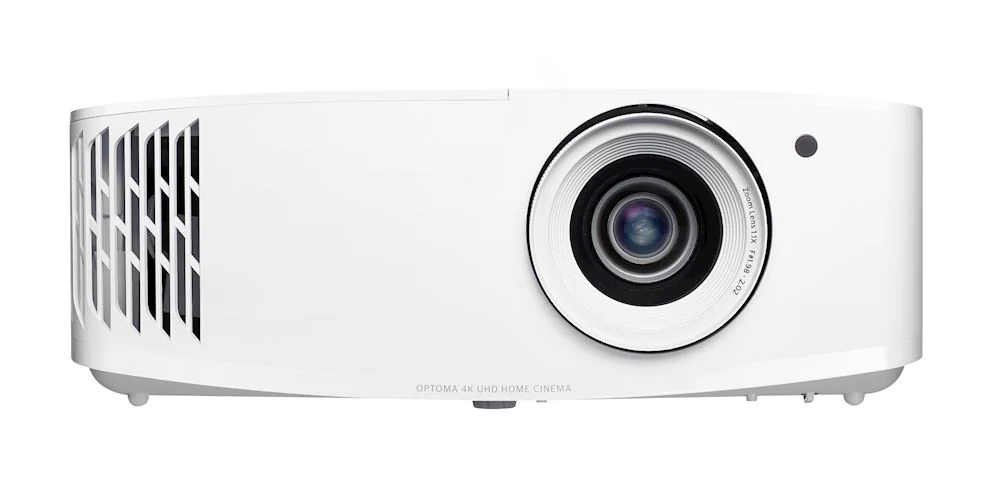
Optoma UHD38 Smart Projector
By Optoma · Smart Projectors · Audio & Electronics
- 4000 ANSI lumens brightness
- 3840x2160 (4K UHD) DLP resolution
- 4.2ms input lag at 1080p/240Hz
- 240Hz refresh rate
- 1,000,000:1 contrast ratio
Price not listed
- OptomaView at Optoma
- eBayView at eBay
- AmazonView at Amazon (paid link)
- eBay (used) eBay: used, open-box, refurbishedView at eBay (used)
Stores are listed in a fixed order, never by price or commission. Prices are snapshots. Check the current price with the store.
Summary
The Optoma UHD38 is a discontinued 4,000-lumen DLP projector built for low-latency gaming, with 4.2 ms input lag at 1080p/240 Hz and a bright image that stays usable in a lit room. Check your room before buying: the short zoom and lack of lens shift mean a 100-inch picture needs roughly 3.3–3.5 m of throw.
Strengths
- 4.2 ms input lag at 1080p/240 Hz is among the lowest measured for a projector.
- Bright 4,000-lumen output stays usable in a lit room, with the curtains open.
- 4K UHD detail looks sharp; testers said buyers would not guess it is pixel-shifted.
- Rich, accurate color on 4K Blu-ray in Cinema mode.
- Large picture for a fraction of the cost of a big TV.
Weaknesses
- Grey, shallow blacks; measured black level was 2.79 cd/m².
- HDR highlights never reach TV levels.
- Bright-mode fan noise measured 41 dB at 50 cm.
- 1.1x zoom and no lens shift make placement tight and unforgiving.
- Bright-mode lamp life is only 4,000 hours, a real cost for heavy viewers.
- The 10 W mono speaker will not carry movie sound.
Verified specifications
| Display technology | 0.47" single-chip DLP with XPR pixel shifting to 4K UHD (3840 × 2160). |
|---|---|
| Brightness | 4,000 lumens, measured per ANSI IT7.228. |
| Contrast | 1,000,000:1 dynamic, full-on/full-off. |
| Light source | 240 W metal-halide lamp, model BL-FU240E. |
| Lamp life | up to 4,000 hours in Bright, 10,000 hours in Eco and 15,000 hours in Dynamic. |
| Input lag | 16.7 ms at 4K/60 and 1080p/60, 8.9 ms at 1080p/120 and 4.2 ms at 1080p/240, all with Enhanced Gaming Mode. |
| Refresh rate | 240 Hz at 1080p only; 4K is limited to 60 Hz over HDMI 2.0. |
| Throw ratio | 1.5:1–1.66:1; 1.1x manual zoom and manual focus, no lens shift. |
| Screen size | 33"–300" diagonal; a 100-inch image needs roughly 3.3–3.5 m of throw. |
| Keystone | horizontal and vertical ±40°, plus four-corner correction. |
| Connections | two HDMI 2.0, VGA (YPbPr/RGB), 3.5 mm audio in, 3.5 mm audio out, S/PDIF out, USB-A (1.5 A power), RS232 and 12 V trigger. |
| Speaker | single 10 W mono. |
| Power | 100–240 V, 50–60 Hz; 0.5 W standby, 220 W minimum and 305 W maximum. |
| 3D | frame packing at 1080p24 and 720p50/60, plus full 3D. |
| Dimensions | 12.4 × 10.63 × 4.65 in (W × D × H); 8.77 lb net, 10.32 lb gross. |
| In the box | AC power cord, backlit remote, 2x AAA batteries and a basic user manual. |
| Warranty | one year. |
Full research notes and sources
Gaming latency
The input-lag ladder is the reason to buy this projector: 16.7 ms at 4K/60, 16.7 ms at 1080p/60, 8.9 ms at 1080p/120 and 4.2 ms at 1080p/240. Optoma, ProjectorCentral, Expert Reviews and Trusted Reviews all report the same mapping. The 240 Hz figure applies to 1080p only; 4K stays at 60 Hz over HDMI 2.0. The lowest numbers need Enhanced Gaming Mode, which switches off keystone, four-corner correction, image shifting and digital zoom and caps the resolution at 1080p.
Picture quality and brightness
The contrast figure is full-on/full-off, not ANSI, and the measurements tell the opposite story. Popzara described average, muted blacks with occasional reddish fringing in high-contrast areas; Son-Vidéo found the color rich and the highlights well handled but the blacks short of what it wanted and the image prone to judder during pans. The 0.47" chip is 1920 × 1080 native and shifts four times per frame, so 4K is pixel-shifted rather than native silicon.
Placement and connections
There is no lens shift and only 1.1x manual zoom, so where the projector sits decides the picture size. A 100-inch image needs roughly 3.3–3.5 m of throw; from 2 m the image is only about 60 inches. Keystone is ±40° in both directions and there is four-corner correction, but the corner-adjustment control is fiddly, and the lowest-lag gaming mode turns all of that off. Inputs are two HDMI 2.0, VGA (YPbPr/RGB) and a 3.5 mm audio jack, with 3.5 mm audio out, S/PDIF out and a USB-A port that supplies 1.5 A of power for a streaming dongle. There is no DisplayPort, no RCA analog audio and no Bluetooth audio, so legacy gear needs a converter or an AV receiver. Son-Vidéo also saw light leaking from the side and front-corner vents, which can pollute the image depending on where you sit.
Lamp, upkeep and running costs
The light source is a 240 W metal-halide lamp (BL-FU240E) rated for 4,000 hours in Bright, 10,000 hours in Eco and 15,000 hours in Dynamic. Bright mode is the one most people will use, and Expert Reviews notes that a five-hours-a-night viewer could burn through a 4,000-hour lamp in two to three years. A third-party replacement bulb was listed at $126.40 (ProjectorLamps.com) with a 180-day warranty, marked out of stock; it is not an Optoma-certified part and its ratings differ from the specification. There is no filter to change, no subscription and no app purchase. Optoma’s US page still publishes the manuals, datasheets and CAD files, but the model has been discontinued since September 2023, so lamp supply and warranty service are the open questions rather than future firmware.
In October 2026, US listings were $899 at B&H Photo Video and $1,199 at Focused Technology, with a $1,049 reference on ProjectorCentral’s spec page. MSRP was $2,499 and the launch price was $1,399.99; UK launch pricing was £1,099. At $899 it is a defensible buy for someone who wants a 100-inch 4K picture and 4.2 ms gaming latency and can live with grey blacks. Above $1,250 it is hard to justify against newer 4K DLP and laser models with longer lamp life and deeper blacks.
Which model this is
This page covers the Optoma UHD38, a 0.47" single-chip DLP projector released in March 2021 and discontinued in September 2023. The Amazon listing for it is ASIN B08WTSV4JY. Do not confuse it with the UHD38x, a December 2022 model with 4,000 ANSI lumens and a different throw ratio, or with the UHD380X, which Optoma lists separately.
Sources
Manufacturer:
Independent reviews:
Parts and stores:
Owner reports:
- No owner threads for the UHD38 turned up, so the impressions above come from professional testers.