NESCO VS-12 Deluxe Vacuum Sealer
By NESCO · Vacuum Sealers · Kitchen & Cooking
Compare all Vacuum Sealers side by side →
The short version
✓ Why people buy it: Two independent test groups report strong vacuum performance, with measurements rather than pump marketing alone.
✗ Watch out for: Some owners report stalls near countdown six or lost vacuum; gasket replacement does not resolve every case.
Prices at 9 stores ↓ · Will it fit? Size check ↓ · All 6 catches ↓
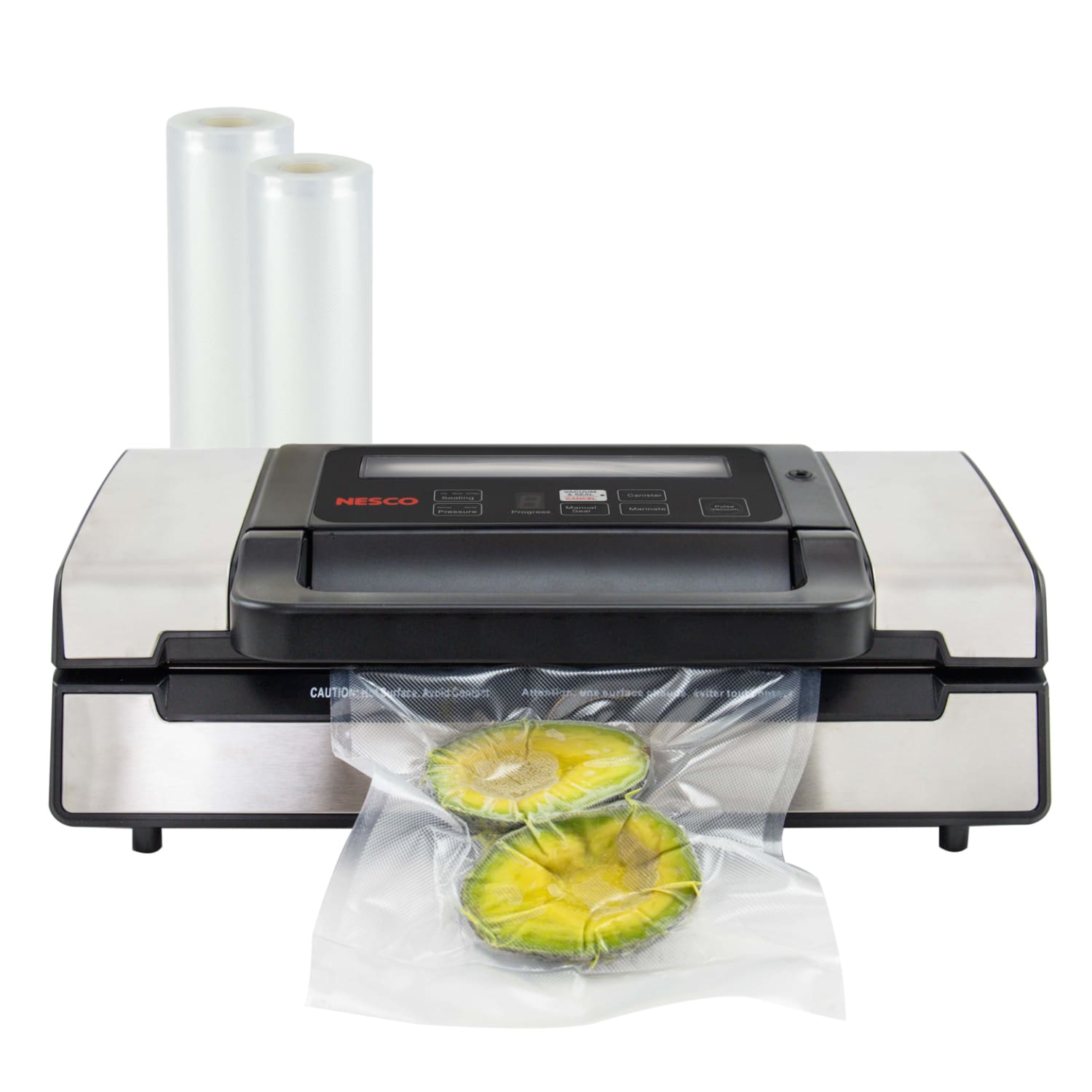
- 130W double vacuum pump
- Optional double heat seal, Dry/Moist, Normal/Gentle and Pulse modes
- Up to 11.8-inch bags with built-in cutter and roll storage
- Compatible with any brand of vacuum-sealer bags
- 1-year limited manufacturer warranty
Lowest price seen
$149.99
from $149.99 at NESCO · Checked Nov 15, 2026
- NESCO $149.99View at NESCO
- pleasanthillgrain $174.99View at pleasanthillgrain
- NeweggView at Newegg
- The Home Depotprice match · store policyView at The Home Depot
- Wayfair30-day returns · free shipping $35+ · store policyView at Wayfair
- Walmartfree shipping $35+ · store policyView at Walmart
- AmazonView at Amazon (paid link)
More on eBay (1)
- eBayView at eBay
- eBay (used) eBay: used, open-box, refurbishedView at eBay (used)
Stores with a price are sorted lowest first; commission never changes the order. Prices are snapshots. Check the current price with the store.
Summary
A substantial external-suction sealer for freezer portions and sous-vide prep, with two vacuum pumps, optional double heat seals, independently tested suction and replaceable factory gaskets. Buy with its operating limits in mind: the manual recommends two minutes between cycles, and some owners report automatic-cycle stalls.
Size in context

39.6 cm · 15.6 in (W) × 19.8 cm · 7.8 in (D) × 11.4 cm · 4.5 in (H) · Drawn to scale from the maker's stated dimensions, next to everyday objects.
Strengths
- Two independent test groups report strong vacuum performance, with measurements rather than pump marketing alone.
- Real double heat seals, Pulse Vacuum and Gentle mode offer useful control for different foods.
- NESCO supports non-proprietary textured bags, including third-party rolls.
- Official foam gaskets are available for purchase individually and replace without dismantling the machine.
- Built-in roll storage, a manual cutter and an easy-lock handle simplify bag preparation.
- The manufacturer publishes current instructions, spare-parts information and warranty terms.
Weaknesses
- Some owners report stalls near countdown six or lost vacuum; gasket replacement does not resolve every case.
- The manual limits operation to one cycle every two minutes even though one independent stress test managed more frequent seals.
- A non-removable vacuum tray complicates cleanup when meat juices or other liquids spill.
- Shouldit’s test measured loud suction at 83.4 dBA and crushed delicate food even in Gentle mode.
- Thin or poorly textured bags can contribute to failed cycles despite the general third-party bag compatibility.
- The bulky chassis costs more than compact alternatives, and repair-parts visibility beyond the gaskets remains thin.
Verified specifications
| Type | NESCO Deluxe VS-12 vacuum sealer, currently marketed as VS-12P, for textured/channel vacuum bags. |
|---|---|
| Pump | manufacturer-rated 130 W double vacuum pump and 25.1 inHg maximum vacuum claim. |
| Independent suction | TechGearLab measured 21.0 inHg at 6,200 ft elevation; Shouldit measured an 80 kPa peak in a separate test. |
| Independent noise | Shouldit recorded a maximum of 83.4 dBA under its test conditions. |
| Sealing | Dry and Moist timings; optional Double mode creates two heat-seal lines. |
| Independent weld measurement | TechGearLab reports two approximately 3 mm seals with a narrow gap; its article gives differing 2 and 3 mm gap descriptions. |
| Vacuum controls | Normal and Gentle modes, manual Pulse Vacuum, automatic Vac & Seal, Manual Seal, Canister and Marinate. |
| Working width | bags up to 11.8 in; internal roll storage, sliding manual cutter and locking front handle. |
| Dimensions | TechGearLab measured 15.6 × 7.8 × 4.5 in and 6 lb; NESCO’s 17 × 15 × 9 in and 10 lb listing may describe packaged dimensions or weight. |
| Included bags | manufacturer lists rolls sized 8.6 in × 9.85 ft and 11.8 in × 9.85 ft. |
| Accessories | external canister functions supported; compatible canisters and attachments sold separately. |
| Warranty | one-year limited warranty for original-purchaser household use, subject to NESCO’s terms. |
| Replaceable gaskets | official NESCO part 67930, sold singly for $6.99; each fits the upper or lower chamber position. |
Full research notes and sources
What the suction measurements actually mean
NESCO calls the VS-12 a 130-watt, double-pump sealer and advertises a maximum vacuum of 25.1 inches of mercury. Those are manufacturer specifications, not proof that every retail unit reaches that figure with a filled bag. Pump wattage is also not the same as airflow: it tells you something about electrical power but not how many liters of air the machine moves per minute. NESCO does not publish a comparable independent airflow or 1-liter and 2-liter canister evacuation benchmark for this model. If speed in large rigid containers is your main goal, do not substitute the pump’s wattage for a missing timed test.
TechGearLab recorded 21.0 inHg during its comparison, using a vacuum gauge at an elevation of 6,200 feet. That was the strongest reading in its particular set of machines. Shouldit used another protocol and reported a peak of 80 kPa during a dry-food cycle that took 27 seconds. A pressure difference expressed in inHg can be converted into kPa, but a converted number does not make readings from two separate experiments directly comparable. Gauge calibration, test elevation, setup and the stage of the cycle matter. Their common conclusion is that this exact sealer can generate substantial suction, not that one reading invalidates the other.
There is a trade-off with that strong vacuum. Shouldit tested delicate, crunchy food using Gentle mode and found 29% of the sample mass broken. That was a measured outcome in its stated test, not evidence that the machine will destroy 29% of every bag of crackers. A loaf of bread, crisp cereal and berries all have different crush resistance. When food starts compacting, use Pulse Vacuum and stop manually before the bag squeezes too hard. The manual also lets you press Manual Seal during an automatic cycle to end suction and begin the heat seal. The Gentle setting helps, but it is not a guarantee of zero damage.
NESCO’s performance on a sous-vide bag was mixed across independent tests. TechGearLab praised the strength and consistency of the finished seals, while Shouldit reported that one sous-vide bag took three attempts to pass its test. Both experiences can be real: pressure strength, bag positioning, moisture and the final heat seam are separate parts of a successful result. A high vacuum number cannot compensate for a wrinkled bag mouth or a seal laid across meat juices. For food headed into a long water bath, inspect the entire seal area after cooling and do not rely on a single visible seam if it looks uneven.
TechGearLab also measured the finished seals. The VS-12 offers a single seam or two distinct approximately 3 mm heat-seal lines. That inconsistency is too minor to justify declaring a new model revision, but it is a reason not to repeat an exact total welded-band width as a factory specification. The important distinction is physical: these are two seal lines, not one wide mark with a decorative stripe. Choose Double mode when you value a second barrier, while remembering that contaminated plastic can defeat both lines.
Its measured noise is not a hidden benefit. Shouldit recorded a maximum of 83.4 dBA while the suction motor operated. That is a substantial level in the setting of the review, although the figure alone does not reveal microphone distance, the room’s reverberation or how the sound would compare at your countertop. A larger dual-pump motor is not automatically quieter or less shrill than a smaller machine. If noise is a deciding factor, give this measured result more weight than product videos with unknown recording gain.
There is also no reliable long-term test establishing that two pumps mean the VS-12 will last twice as long as a single-pump unit. Independent suction and seal tests provide useful performance evidence; durability requires longer observation across many units. The honest reading is a capable, tested home appliance with normal household limitations and accessible basic wear parts.
Bag workflow, batch sealing and wet food
The VS-12 works like a conventional external-suction machine. Make a pouch by cutting a length of embossed roll and sealing one end. Put the food inside, leave room above it, and place the open end into the channel in front of the positioning tabs. Close the front locking handle and select the appropriate combination of Dry or Moist and Normal or Gentle. Vac & Seal then evacuates the bag and activates the heater. The displayed countdown tracks progress; it is not a calibrated pressure gauge.
NESCO includes two starter rolls, one about 8.6 inches wide and another about 11.8 inches wide, each just under ten feet long. The 2024 catalog rounds the sizes to eight and eleven inches and ten feet, so look at the package rather than treating the rounding as a different bag system. The built-in cutter is a sliding blade, not an automatic pouch dispenser. The internal bay stores one roll up to approximately eleven inches wide; you can cut suitable larger bulk rolls outside the compartment. What matters for long-term costs is the price per usable length and width, not whether a roll fits under the lid.
NESCO says the sealer accepts vacuum bags of any brand. In practice, that means compatible textured/channel bags designed for external vacuum machines. Ordinary flat chamber-vacuum pouches do not necessarily let air escape through a clamped lid. Owners have reported that switching from a thin, poorly textured roll to a better channel bag restored reliable vacuuming. That experience is a practical diagnostic clue, not a scientific ranking of bag brands. If you buy a large box of third-party bags, test several portions and check the vacuum and heat seal before relying on the rest.
Liquids are another limit that the Double and Moist settings do not remove. The built-in vacuum trough catches overflow, but TechGearLab notes that this tray cannot be removed for easy washing. An external-suction unit can pull meat juice or sauce toward the pump before the seam has formed. Pat the bag opening dry, keep wet food well below the lip and chill or pre-freeze soups and other freely flowing foods. A chamber machine is a different type of appliance for frequently packaging liquids. Double sealing can make a seam more forgiving, but it does not keep liquid out of the intake.
The accessory Canister mode uses a separate hose connection and compatible lid or container. The manual describes attaching the hose firmly, selecting Normal pressure, briefly pressing down on the canister lid during startup and removing the hose after the cycle ends. It also warns that moisture can collect inside the hose after using moist foods, so dry it before storage. Canisters, jar attachments, bottle stoppers and similar accessories are sold separately. Do not assume a third-party adapter fits merely because it looks like another brand’s connector. NESCO’s Marinate function uses the canister system to alternate vacuum conditions, not to vacuum-pack a liquid-filled bag.
Batch throughput needs unusually careful wording here. The manufacturer’s current manual says the appliance is not designed for continuous use and approves one operating cycle every two minutes. In the instructions, it separately notes that Manual Seal will not activate within fifteen seconds of the previous command and recommends cooling the appliance for two minutes between uses. That short electronic lockout is not permission to run a complete vacuum-and-seal cycle every fifteen seconds. The conservative instruction is the manufacturer’s recommended duty cycle for owners.
There is competing evidence about when the hardware actually overheats. Some owners describe having to pause after roughly six to ten back-to-back bags. TechGearLab, by contrast, reported handling more than thirty bags consecutively without observing a cooling shutdown. Neither observation proves that all VS-12 units have the same automatic thermal cutoff after a fixed number of bags. The reviews may involve different bags, modes, room temperatures and pacing. Follow the manual’s two-minute guidance for routine use, and treat unusually early shutoffs as a possible troubleshooting issue rather than a universal characteristic of the model.
Speed also depends on the stage being timed. TechGearLab reports an average seal operation of sixteen seconds in its test protocol; Shouldit measured twenty-seven seconds to reach the dry-cycle vacuum figure. Those numbers describe different things and cannot be added or compared as if they both measured the same full bag-preparation process. Pulling roll material, cutting it, sealing one end, loading food, vacuuming, heating and waiting for the seam to cool takes longer than any single machine-cycle result. For occasional food portions, the easy-lock handle saves work. For dozens of bags at once, preparation and cooling dominate the routine.
After a batch, unplug the machine, wipe the vacuum channel and heat-seal area, and leave the lid unlocked for storage. A closed, latched lid permanently compresses the foam gaskets over time, which can make later suction failures harder to diagnose. This small habit costs nothing and protects one of the model’s few officially replaceable components.
Automatic-cycle stalls and what can be repaired
A recurring complaint in owner discussions is a vacuum-and-seal program that approaches the end of its countdown and then refuses to finish the heat seal. Several owners describe a stall around the number six, while others say their machines lose suction during the transition from evacuation to sealing. This pattern appears in more than one discussion, including posts in r/sousvide and comments on NESCO’s retail page. It is a credible troubleshooting signal, not a calculated failure rate. Nobody has supplied an independently verified population of affected units, and there is no basis to say that most VS-12 machines develop the fault.
Start with the simplest causes before assuming an electronic defect. The open end of the bag needs to lie flat inside the correct vacuum channel, with the intake unobstructed. A folded corner can create a leak path while the pump is running. If the machine starts vacuuming but never reaches its internal threshold for switching to heat, reseat the bag and test a fresh piece of known-compatible channel material. Owners have attributed some apparently weak or unreliable vacuuming to poor bag texture. Also confirm the front handle is fully latched: inconsistent pressure on the upper and lower gaskets can let air back into the channel.
The foam gaskets are another common first check. Look for crumbs, oil, tears or flattened sections around the entire upper and lower channel. NESCO sells a VS-12 replacement foam gasket under part number 67930. NESCO lists the part at $6.99 per single gasket, not per two-piece kit, and says the same part fits the lid or the lower chamber. If both positions need replacing, you need two pieces. The gaskets sit in accessible channels and can be lifted and reseated without opening the electrical housing.
Owner reports are mixed about gasket fixes. Some say flipping or replacing a compressed gasket restored vacuum; others still encountered the countdown stall after changing both seals. That difference matters. A fresh gasket can solve an air-leak fault, but it is not evidence that every timer, microswitch or valve problem is a gasket problem. Likewise, pressing down hard on the lid may temporarily help a leak, but it should not become the normal way of operating a machine with a handle designed to lock it shut. If suction remains inconsistent after you have confirmed bag position, cleanliness, suitable material and sound gaskets, use the warranty channel while coverage remains in force.
Another limitation is access to service parts beyond the chamber seals. NESCO’s replacement gasket has a clear manufacturer SKU, but no similarly dependable retail catalog was established for the VS-12 heating element, control board, internal valve or sealing-bar tape. A home repair could require parts and instructions the manufacturer has not made generally available. Do not treat generic high-temperature tape or look-alike heaters as proven drop-in replacements. Internal electrical work is a different risk from lifting a foam gasket out of a groove.
There is a practical benefit to NESCO’s documented spare-part offering even if the machine is not fully modular. Low-cost gaskets may extend useful life when the defect is simply a chamber leak. By contrast, a sealer without a published gasket profile or replacement SKU can become unusable because a small piece of foam has worn out. The VS-12 is therefore relatively serviceable for that wear item, not a machine whose every component is guaranteed repairable.
NESCO’s written one-year limited warranty covers the original purchaser using the product for personal or household purposes, subject to the policy. The warranty page describes replacement of eligible defective parts or an eligible appliance at the manufacturer’s discretion and requires purchase evidence. It excludes commercial use, is not transferable, and warns that unauthorized disassembly or misuse can void coverage. Keep your order confirmation. If a new machine repeatedly stalls or cannot achieve a vacuum with compatible material, document the symptoms and contact the manufacturer rather than immediately opening its housing.
Several owners also report reliable service over multiple years. Other threads describe failures after much less use. Both sorts of account can be useful, but neither substitutes for an independently measured lifespan distribution. The right buying question is how simple routine upkeep is, whether spare gaskets are available and what the seller will do for a genuine defect within the return or warranty period. Those are more concrete than predicting the exact year a pump will fail.
Which model this is
NESCO’s current direct-store listing names the Deluxe Vacuum Sealer as VS-12P, while both its current 2025 care guide and older manuals identify the device as VS-12. Neither the manuals nor the direct-store page establish which internal components, if any, changed with the retail SKU suffix. A replacement part advertised for the VS-12 is better supported by NESCO’s own compatibility list than by a guess based on the outer case.
Those models may have different sealing widths, housings, duty cycles and replacement parts. The direct-store size listing of 17 × 15 × 9 inches at 10 pounds also does not match TechGearLab’s measured 15.6 × 7.8 × 4.5 inches at six pounds; shoppers planning cabinet clearance should favor the measured appliance dimensions while allowing additional room for the open lid and cord.
Is it worth it?
The VS-12P is easy to justify for someone who wants an established external-suction design with documented real-world performance, a double heat seal and a source for replacement foam gaskets. Independent testers recorded good evacuation of dry bags, and the large handle, roll compartment and cutter make it easier to work through ordinary portions. It is not a specialist wet-food machine, not particularly quiet in Shouldit’s test, and not a model with proven unlimited batch throughput. The two-minute operating interval is a meaningful instruction for a shopper planning to freeze a large quantity of meat at once.
The manufacturer listed this VS-12P at $149.99 when rechecked in October 2026; research in September found a Walmart offer around $133.99. Those figures are dated store observations, not a promise about your next checkout. At $100 or less, a unit in good condition from a retailer with sensible returns presents a strong price-to-performance case. From $100 to $120, the independently tested suction and available gasket still help justify the purchase. Compare the actual checkout total, return terms and documented features instead of treating a nominal discount as a result.
The gasket is a useful example of ownership cost. NESCO lists an exact replacement part for $6.99 each, so wear at the channel seal does not automatically end the machine’s life. Embossed rolls are the other ongoing expense; buying appropriate bulk material rather than branded short rolls can reduce spending, provided the particular bag material seals reliably. There is no documented annual replacement schedule for the foam, and no good evidence from which to invent a yearly gasket expense. Buy spares when the seals show wear or when a known-compatible replacement is otherwise hard to obtain.
The question for a freezer-focused household is whether the working routine suits the volume. A few bags a week, or several bags with adequate cooling between cycles, play to the model’s strengths. Frequent sessions with many dozens of bags require respecting the duty-cycle guidance and making room for the bulky lid. For large volumes of soup or sauce, a chamber machine avoids the basic external-suction constraint, but it is a different price and size class. The VS-12P’s strengths are real and measurable; so are its noise, bag-handling limitations and uneven owner reports about stalls.
Sources
Manufacturer:
- NESCO Deluxe Vacuum Sealer product page
- NESCO current VS-12 care and use guide (2025)
- NESCO older VS-12 care and use guide (2023)
- NESCO 2024 catalog
- NESCO warranty page
- NESCO black foam gaskets, part 67930
Independent reviews:
Owner reports:
- Countdown stall and return discussion (r/sousvide)
- Seal failure and the non-removable tray (r/sousvide)
- Moist sealing and auto-seal behavior (r/sousvide)
- Bag quality and vacuum loss (r/sousvide)
- Bag compatibility questions (r/sousvide)
- Upper gasket replacement (r/sousvide)
- Long-term durability thread (r/BuyItForLife)