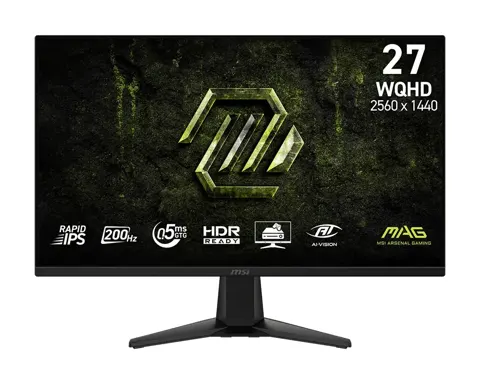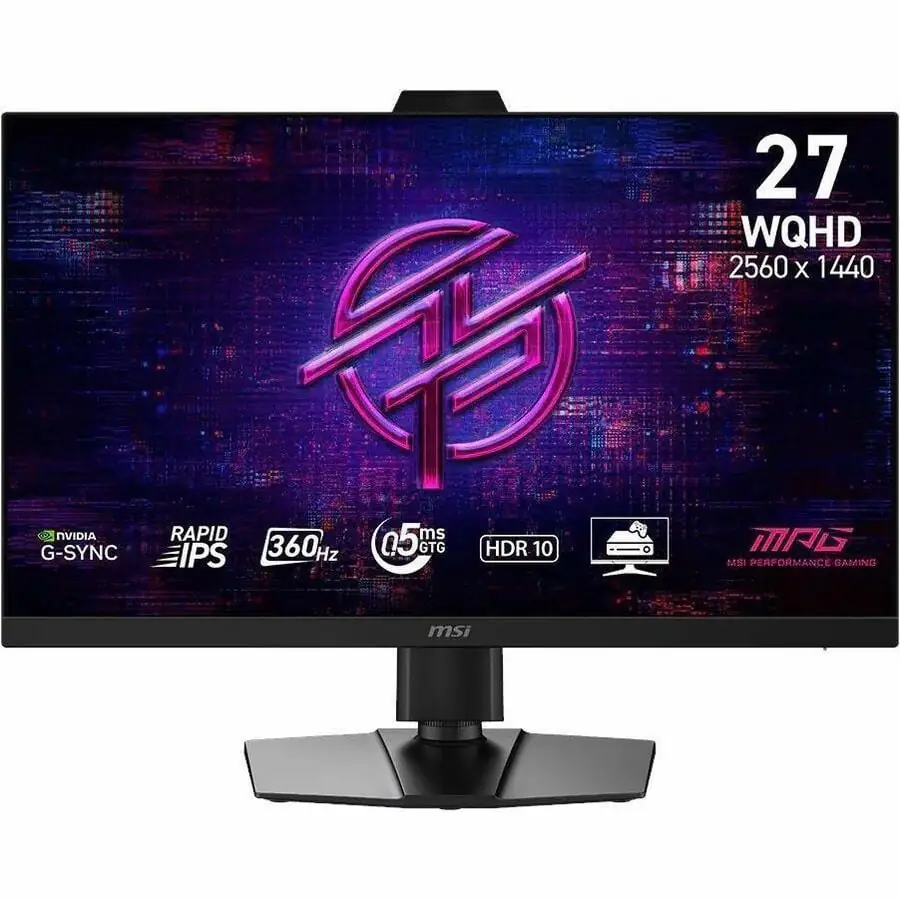
MSI MPG 272QRF X36 27' QHD Gaming Monitor
By MSI · Gaming Monitors · Audio & Electronics · More from MSI
Compare all Gaming Monitors side by side →
- 27-inch Rapid IPS panel
- 2560 x 1440 (WQHD) resolution
- 360Hz refresh rate
- 0.5ms (GtG, Min.) response time
- NVIDIA G-SYNC Pulsar with variable refresh rate
Check today's price at the stores
- eBay (used) eBay: used, open-box, refurbishedView at eBay (used)
Stores with a price are sorted lowest first; commission never changes the order. Prices are snapshots. Check the current price with the store.
Summary
The MSI MPG 272QRF X36 is a 27-inch 1440p 360 Hz gaming monitor built around NVIDIA’s G-SYNC Pulsar, aimed at competitive FPS players running an RTX graphics card. Check two things before buying: Pulsar needs an RTX 30-series or newer card over DisplayPort 1.4a, and the IPS panel’s roughly 1000:1 contrast looks grey in dark scenes.
Size in context

61.4 cm · 24.2 in (W) × 22.8 cm · 9.0 in (D) × 42.2 cm · 16.6 in (H) · Drawn to scale from the maker's stated dimensions, next to everyday objects.
Strengths
- Motion clarity. G-SYNC Pulsar combines VRR with rolling-scan strobing for CRT-like clarity with no tearing across roughly 80–360 FPS.
- Fast response and low lag. Measured 2.35 ms GtG and 2.15–2.75 ms input lag at 360 Hz SDR.
- Bright, accurate color. 520–536 nits peak and Delta E 0.79–1.3 in sRGB out of the box.
- High peak brightness combats glare; measured up to 656 nits in Pulsar mode.
- Ergonomic stand with 130 mm height, tilt, swivel and pivot adjustments.
- Firmware updates improved Pulsar clarity and added ULMB2 at 60 Hz and 120 Hz.
Weaknesses
- IPS contrast around 1000:1 leaves dark scenes grey, especially in dim rooms.
- HDMI ports capped at 120 Hz; native 360 Hz and Pulsar require DisplayPort 1.4a.
- Pulsar requires an NVIDIA RTX 30-series or newer GPU; AMD and Intel Arc fall back to standard VRR or ULMB2.
- Cabinet runs hot and deep: 47.5 °C rear panel and about 3 inches of depth for G-SYNC cooling.
- No USB-C video or charging, no internal speakers, no KVM.
- Backlight strobing can cause eye strain or headaches in sensitive users.
Verified specifications
| 27-inch Rapid IPS panel, flat, 2560 × 1440 (WQHD), ~109 PPI, 16:9 | |
| 360 Hz native refresh over DisplayPort 1.4a with DSC | |
| 0.5 ms GtG minimum claim; measured 2.35 ms average GtG in Normal overdrive with 5 ms remanence | |
| NVIDIA G-SYNC Pulsar | VRR plus rolling-scan backlight strobing across roughly 80–360 FPS |
|---|---|
| HDMI 2.1 VRR supported; HDMI ports capped at 120 Hz at 1440p | |
| 10-bit (8-bit + FRC); rated 90% DCI-P3 and 119% sRGB; measured 100% sRGB, 88–90% DCI-P3, 82–91% Adobe RGB | |
| 400 nits typical and 500 nits HDR claim; measured 520–536 nits SDR/HDR peak, up to 656 nits in Pulsar mode, 18 nits minimum in Eco | |
| 1000 | 1 rated contrast; measured 990:1 to 1046:1 |
| Factory sRGB Delta E 0.79–1.3, below the 1.5 perception threshold | |
| Ports | 1× DisplayPort 1.4a, 2× HDMI 2.1, 3× USB 3.0 Type-A, 1× USB Type-B, 1× Micro-USB for firmware updates, 3.5 mm headphone jack; no internal speakers, no USB-C, no KVM |
| Dimensions with stand | 614 × 228 × 422–552 mm; 6.4 kg panel only, 9.9 kg with stand |
| Stand | toolless assembly, 130 mm height, -5°/+20° tilt, ±30° swivel, ±90° pivot, VESA 100×100 mm |
| Chassis | matte black textured plastic with brushed grey rear plate, top ambient light sensor, rear RGB strip; cabinet about 3 inches (7.6 cm) deep at the cooling vents |
| Power | external adapter; 27–38.5 W SDR, 56–63 W HDR/Pulsar active, 0.5 W standby |
| Included | DisplayPort 1.4 cable, HDMI 2.1 cable, USB Type-A to Type-B cable, USB Type-A to Micro-USB firmware cable, power brick and cords, factory calibration report, quick start guide |
| Firmware upgradable via Micro-USB; tested versions include FW.035 (v1.0.6), FW.038 (v1.1.4), FW.045 (v1.1.10) | |
| Warranty | 3 years (36 months) per European and Ukrainian documentation; US retailer cards sometimes list 1–2 years |
Full research notes and sources
Motion clarity and G-SYNC Pulsar
G-SYNC Pulsar pairs VRR with 10-zone rolling-scan backlight strobing, and independent testers report motion clarity equivalent to over 1000 Hz with MPRT below 1.0 ms. Measured average GtG response is 2.35 ms in Normal overdrive with minimal 1.83% overshoot and 83.3% refresh rate compliance. Input lag measures 2.15–2.75 ms at 360 Hz SDR, rising to 4.42–4.74 ms with Pulsar active; at 120 Hz it is 5.14–6.5 ms and at 60 Hz 9.01–11.9 ms. Pulsar disengages below about 75–80 FPS, which can cause brief blackouts unless frame generation keeps frame rates up. Firmware FW 1.1.10 lowered 240 Hz strobing latency from about 5.9 ms to about 3.8 ms and added ULMB2 support at 60 Hz and 120 Hz.
Color, brightness and contrast
Factory calibration in sRGB mode averages Delta E 0.79–1.3, under the 1.5 perception threshold, with gamma tracking 2.05–2.1 that can be corrected via the OSD gamma 2.4 preset or an ICC profile. Gamut measures 100% sRGB, 88–90% DCI-P3 and 82–91% Adobe RGB. SDR peak brightness reaches 520–530 nits, up to 656 nits in Pulsar mode, with an 18 nit Eco minimum. HDR10 peaks at 536 nits with accurate EOTF tracking, but the lack of local dimming leaves blacks greyish in dark scenes. The static contrast of 990:1 to 1046:1 is typical for IPS and remains the main image-quality trade-off.
Ports, heat and ergonomics
The cabinet is nearly 3 inches thick to ventilate the dedicated G-SYNC processor, and the rear panel reaches 47.5 °C under load while drawing 27–38.5 W in SDR and 56–63 W with HDR or Pulsar active. The stand offers 130 mm height, -5°/+20° tilt, ±30° swivel and ±90° pivot, with VESA 100×100 mm mounting. There is no USB-C video input, Power Delivery, internal speakers or KVM. Minor uniformity variance puts the top-right corner 10–18% dimmer than center on white patterns.
Is it worth it?
MSRP is $649–$650, with Newegg listing at $649, Walmart at $628 and open-box units near $400. European pricing runs £599 in the UK and roughly €495–€550 on sale against an ~€800 MSRP. Value is strong below $550 for competitive FPS players with an RTX GPU who prioritize motion sharpness over dark-room contrast. Between $551 and $650 it matches rival G-SYNC Pulsar monitors such as the ASUS ROG Strix XG27AQNGV, AOC AGON AG276QSG2 and Acer Predator XB273U F5, though buyers who play mixed story and cinematic games may prefer 240 Hz or 360 Hz QD-OLED panels in the $550–$700 range for infinite contrast. Above $650 it is weak value unless G-SYNC Pulsar motion clarity on IPS is specifically required.
Which model this is
This is the MSI MPG 272QRF X36, a 27-inch 1440p 360 Hz Rapid IPS monitor with NVIDIA G-SYNC Pulsar. It should not be confused with MSI’s other 27-inch panels or with QD-OLED 360 Hz monitors. No hardware revisions are documented; firmware revisions FW.035, FW.038 and FW.045 exist and are user-upgradable through the dedicated Micro-USB port.
Sources
Independent reviews: