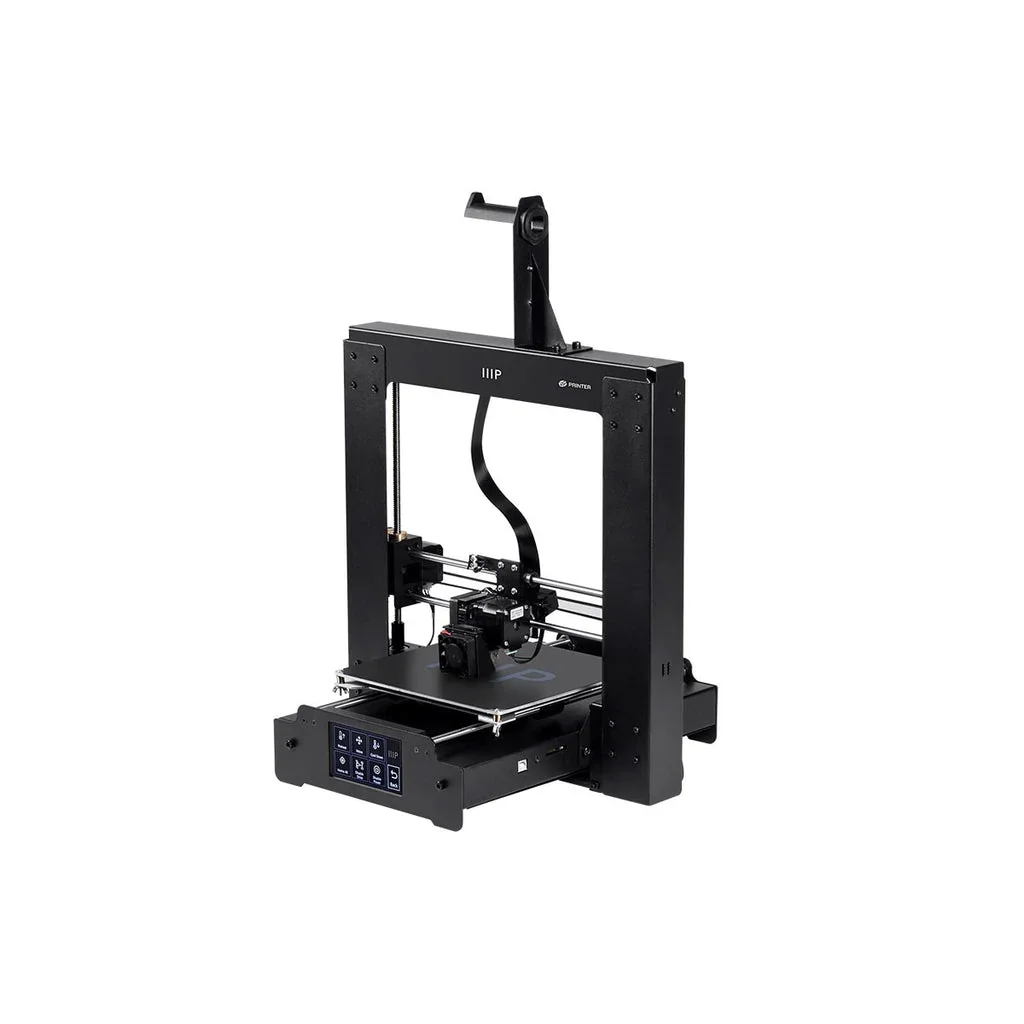
Monoprice Maker Select Plus
By Monoprice · 3D Printers · 3D Printing
- Build area 200 x 200 x 180mm (7.9 x 7.9 x 7.1in)
- Layer resolution 0.1-0.4mm
- 0.4mm nozzle, single MK10 extruder
- Print speed 10-70mm/s
- Heated bed 30-70C
Lowest price seen
$499.99
from $499.99 at 3D Printer Universe · Checked Oct 17, 2026
- 3D Printer Universe $499.99View at 3D Printer Universe
- MonopriceView at Monoprice
- eBayView at eBay
- AmazonView at Amazon (paid link)
- eBay (used) eBay: used, open-box, refurbishedView at eBay (used)
Stores are listed in a fixed order, never by price or commission. Prices are snapshots. Check the current price with the store.
Summary
A 2016-era Cartesian FDM printer, a rebadged Wanhao Duplicator i3 Plus, aimed at a hobbyist who wants an inexpensive used machine to tinker with and repair. Before you buy, have the seller show a heat and print test, and check the heated-bed connector and bed wiring for the faults owners report.
Strengths
- Period testing found small features, bridges and overhangs clean for the price; Digital Trends gave it Editors’ Choice.
- Quiet for an FDM printer, quiet enough for a den or home office.
- The touchscreen is easier than the rotary-knob panels on older machines.
- Electronics sit in the base, so it uses less floor space than the V2’s separate control box.
- Repair access is straightforward, and the box includes wear parts like the PTFE tube.
- A large Wanhao i3 Plus community supplies guides, mods and parts.
Weaknesses
- No automatic bed leveling; you set four corners by hand with a sheet of paper.
- The advertised 150 mm/s speed is not reachable with good print quality.
- Discontinued: Monoprice’s product page says it is no longer available, and replacement beds and harnesses are hard to source.
- Owners report melted heated-bed connectors and fractured bed thermistor wires from the moving-bed cable.
- Owners who fitted a 12 V heater to this 24 V machine saw shutdowns during heat-up.
- The stock sticky bed mat grips hard, and the included scraper can gouge the surface.
Verified specifications
| Technology | Cartesian, open-frame FDM with one direct-drive extruder and a heated bed that moves on Y. |
|---|---|
| Build volume | 200 × 200 × 180 mm (7.9 × 7.9 × 7.1 in). |
| Dimensions | 400 × 410 × 400 mm; 22 lb (10 kg). |
| Nozzle | 0.4 mm brass, MK10-type. |
| Filament | 1.75 mm, non-proprietary. |
| Layer height | 0.1–0.4 mm selectable, 0.4 mm standard. |
| Positioning resolution | 0.012 mm X/Y and 0.004 mm Z, published step sizes rather than measured tolerances. |
| Print and travel speed | 10–70 mm/s per the manual; the 150 mm/s figure is a marketing maximum. |
| Nozzle temperature | 170–240 °C operational; PLA preset 185 °C, ABS preset 210 °C. |
| Bed temperature | 30–70 °C operational; PLA preset 50 °C, ABS preset 70 °C. |
| Power | 100–120 VAC, 60 Hz, 3.5 A input, about 420 VA nameplate. |
| Interface | 3.25-inch color touchscreen, SD card and USB, no Wi-Fi or camera. |
| Slicers | Cura Wanhao Edition 16.01 included; Repetier-Host, ReplicatorG and Simplify3D also work. |
| Leveling | manual four-corner adjustment; no automatic bed sensor. |
| In the box | two-piece printer, spool holder, two bed mats, spare PTFE tube, hex keys, scraper, 4 GB SD card, sample 10 m of PLA, USB and power cables. |
Full research notes and sources
Which model this is
It is not the Maker Select V2, the MP Select Mini, the Maker Select Ultimate, or the later Wanhao Duplicator i3 Plus Mark 2.
The listing is ASIN B075BBJZB5.
What owners report going wrong
Owner reports on the exact model cluster around the heated bed and its wiring. In May 2020 an owner found a partly melted, loose heated-bed connector; replacing the connector and wiring did not immediately restore heating even though voltage and thermistor tests looked reasonable. In the same period an owner of the exact Plus described a bed thermistor conductor that fractured invisibly under its insulation and was fixed by replacing the bed wiring. Treat a browned connector, charred contacts or brittle cable as a stop: power off, unplug and get it repaired or reject the unit.
In January 2020 an owner fitted a 12 V heater cartridge and the printer shut off during heat-up; a respondent identified the Plus as a 24 V system, unlike the 12 V Maker Select V2. Check the controller and the replacement part before buying any heater.
A February 2021 owner said the bed had once reached 110 °C during ABS printing, then faulted while heating and later struggled to reach 100 °C; another owner pointed out the stated operational bed range is only up to 70 °C, and the first owner also could not find an original heated bed in stock. Running a legacy bed past its rated range is not a manufacturer endorsement.
A writer who bought two Maker Select Plus units saw a failed pair of cooling fans after about a month on the first, and a broken Z endstop wire plus a worn filament-feeder part after eight days on the second; he also saw uneven bed heating away from the center. Two units are not enough to infer a defect rate, so check the specific machine.
Other owners describe inconsistent thermistor readings after several hours, and destroyed thermistors after a failed print wrapped the hotend, sometimes followed by reboots or board damage; some of these followed accidental tool damage during cleaning or mods, so they are not spontaneous failures of untouched hardware.
Leveling, speed and day-to-day use
Leveling is manual and corner-by-corner: the manual calls for a sheet of ordinary printer paper, light resistance at several bed positions, and adjustment of four under-bed nuts. There is no stock automatic bed sensor, and you will re-level after moving the printer or changing the surface.
Speeds are modest. The manual specifies 10–70 mm/s for print and travel, and some owners print slower for acceptable quality; the 150 mm/s figure is a maximum, not a production pace.
No removable magnetic PEI plate came in the box. The included sticky mat and scraper make delicate parts hard to remove and can scar the surface; let parts cool and keep the tool off the mat. Filament loading is manual as well: poor tension, a blocked hotend or a mis-seated PTFE liner can stop extrusion or cause heat creep.
The open frame limits ABS and engineering plastics. The bed’s stated range is 30–70 °C and the enclosure is open, so expect warping, drafts and fumes; a higher number on the touchscreen is not evidence the hardware reaches it safely. The manufacturer says not to leave the printer unattended while operating and to use ventilation and a grounded connection.
Connectivity is SD card and USB only — no Wi-Fi, camera or timelapse without third-party add-ons. The bundled 4 GB card can corrupt with age, and old Cura profiles may need rebuilding for current slicers. There is no confirmed power-loss recovery or filament runout sensor in the original spec.
Parts, filament and running costs
There is no subscription, app or brand-locked filament. Filament is ordinary 1.75 mm material: MatterHackers lists its MH Build PLA at $19.99 for a 1 kg spool, with bulk pricing from $14.99 per spool across twelve. A hobbyist printing 100 g a week would use about 5.2 kg a year, roughly $103.95 in filament at that one-off price; failed prints and supports add to it.
Power is the small part. At an assumed 100 W average over 312 hours a year, the printer would draw about 31.2 kWh, roughly $6.24 at $0.20/kWh, for about $110.19 a year combined. Those are illustrative numbers: there is no watt-meter measurement of an exact unit, and the 420 VA input rating is apparent nameplate power, not a constant draw.
Wear parts come from the Wanhao ecosystem rather than Monoprice. Micro Swiss sells an MK10 wear-resistant nozzle for PTFE-lined hotends at $14.99, an all-metal hotend with a slotted cooling block at $49.99, a nozzle for that all-metal kit at $14.99 or a plated hardened-steel version at $19.75, CNC extruder levers and plates from $13.00 to $28.00, and an all-metal thermal tube at $23.50. Note the all-metal-kit nozzle does not fit the stock PTFE-lined MK10, and the thermal tube is not a replacement for the original PTFE tube.
For the heated bed, thermistor and harness there is no verified current OEM part number or reliable delivered price; an owner’s old $12 harness figure is historical. A worn or damaged bed harness needs a competent repairer, not a guess.
Is it worth it?
Used prices for the exact model are the whole question. eBay listings reviewed in October 2026 showed $84 with $162.96 shipping (about $246.96 before tax) and $100 with $162.96 shipping (about $262.96), plus a parts-only unit at $120 with free shipping. At that kind of landed cost, a modern machine is the better buy.
A new Creality Ender-3 V3 SE lists at $186 US-direct against a regular $219, with automatic bed leveling and a 220 × 220 × 250 mm build; a Sovol SV06 ACE is $239 with auto leveling, Klipper controls and the same 220 × 220 × 250 mm volume; and a Bambu Lab A1 mini last listed at $249 with automated calibration and a smaller 180 × 180 × 180 mm build.
Treat the Plus as a local-pickup project. Pay $0–50 for a unit that demonstrates working hotend and bed heat, working axes and a completed print; $51–80 is acceptable for a complete working machine if you want legacy hardware and can repair it; $81–100 is borderline and needs live test prints and visible bed wiring. Above $100 delivered, skip it unless you specifically want the Wanhao platform.
It launched in 2016 at $399.99, and the PowerSpec-badged version at Micro Center sold for $350 in 2018, occasionally $250 on sale; that era’s value was the package, not the 150 mm/s claim.
Sources
Manufacturer:
Independent reviews:
Owner reports:
- Melted heated-bed connector (r/3Dprinting)
- Fractured bed thermistor wire (r/MPSelectMiniOwners)
- Bed heating loss above 100°C (r/3Dprinting)
- 12 V heater cartridge in a 24 V machine (r/3Dprinting)
- Two-year owner, electrical irregularities (r/3Dprinting)
- Thermistor and controller trouble (r/3DprintingHelp)
Parts and stores: