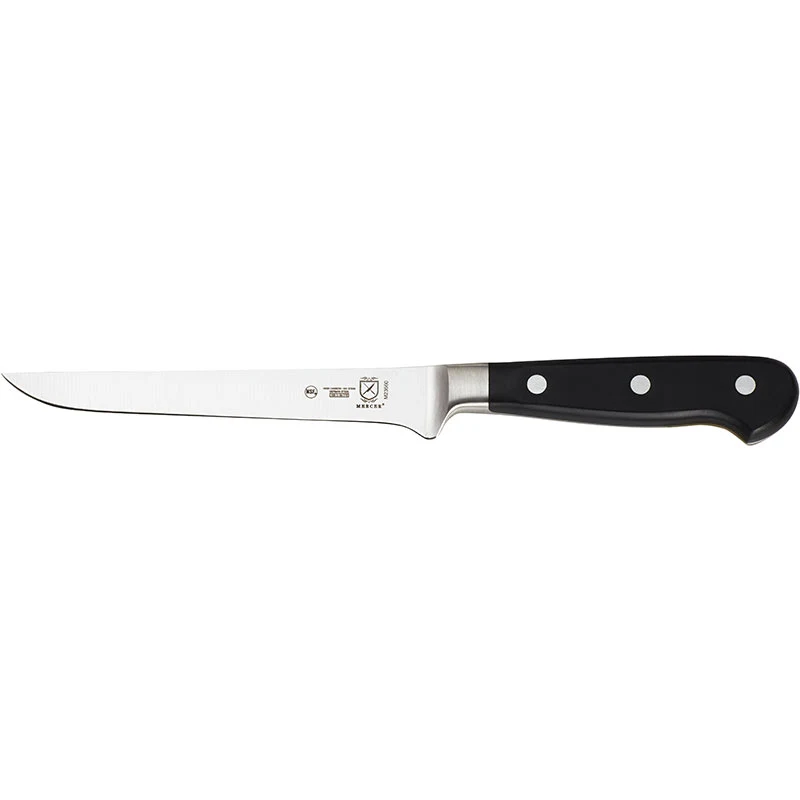
Mercer Culinary M23560 Renaissance
By Mercer · Kitchen Knives · Kitchen & Cooking · More from Mercer
Compare all Kitchen Knives side by side →
The short version
✓ Why people buy it: Flexible construction suits poultry, meat and fish, and one owner uses it as a fillet knife.
✗ Watch out for: It costs more than stamped 6-inch flexible boning knives at the same retailer.
- 6" (15.2 cm) blade
- High-carbon German steel
- Delrin® handle
- Precision forged construction
- NSF certified
Lowest price seen
$42.99
from $42.99 at Webstaurantstore · Checked Nov 25, 2026
- Webstaurantstore $42.99View at Webstaurantstore
- MercerView at Mercer
- AmazonView at Amazon (paid link)
- KnifemerchantView at Knifemerchant
- eBayView at eBay
- eBay (used) eBay: used, open-box, refurbishedView at eBay (used)
Stores with a price are sorted lowest first; commission never changes the order. Prices are snapshots. Check the current price with the store.
Summary
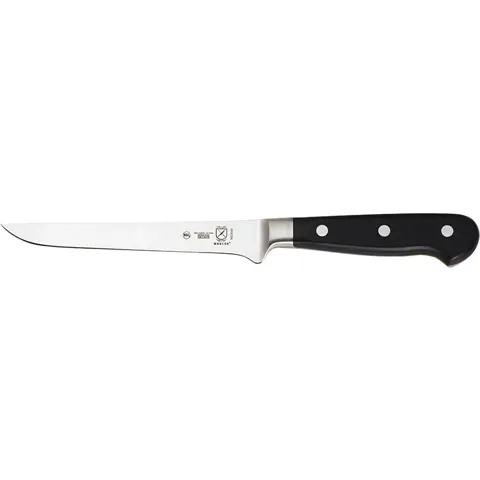
The Mercer Culinary Renaissance M23560 is a 6-inch flexible boning knife with forged construction, a full tang and a riveted Delrin handle. It suits cooks who want a premium-style handle and NSF certification; check that you are comfortable honing its 15-degree edge on softer 56 +/-1 HRC steel.
Strengths
- Flexible construction suits poultry, meat and fish, and one owner uses it as a fillet knife.
- Forged full-tang construction gives it a more substantial feel than stamped alternatives.
- Owners report a sharp factory edge, good edge retention and comfortable handles.
- The shortened bolster leaves the heel accessible for sharpening.
- NSF certification and a limited lifetime warranty fit professional kitchens.
Weaknesses
- It costs more than stamped 6-inch flexible boning knives at the same retailer.
- The 56 +/-1 HRC steel is relatively soft, so the edge needs regular honing.
- No instrumented test of this exact model was found, so its cutting performance is not independently measured.
- The exposed heel is thinner stock and needs gentle handling on sharpening stones.
- Overall weight and balance are not published.
Verified specifications
| Blade length | 6 in (15.2 cm) |
|---|---|
| Blade material | high-carbon German stainless steel |
| Construction | one-piece precision forged |
| Tang | full tang through the entire handle |
| Handle | black Delrin, triple riveted, ergonomic with a rounded spine |
| Bolster | shortened, exposing the full blade edge for sharpening |
| Edge | taper ground at a manufacturer-stated 15 degrees per side |
| Hardness | 56 +/-1 HRC |
| Certification | NSF |
| Country of origin | Taiwan |
| Blade shape | straight with a pointed tip and medium width |
| Packaging | Mercer Pak; no sheath or guard included by default |
| Recommended guard | Mercer M33111P 6-1/2 x 1 in polypropylene blade guard |
| Shipping weight | 0.38 lb |
| Warranty | limited lifetime; 25 years for corporate users |
Full research notes and sources
Forged construction and handle
Mercer specifies one-piece forged construction, a full tang and a triple-riveted black Delrin handle. The handle extends the tang through its full length. This is the main reason to choose the M23560 over the stamped knives that dominate commercial kitchens. One owner comparing it with 10-year-old Wusthof Classic knives described similar steel and handle materials and comparable fit and finish, while finding the Mercer handle thicker and more rounded.
The general Renaissance line review from The Edge Bench praises the value of forged, full-tang construction.
Flexibility and edge angle
The blade is classified as flexible and is marketed for removing bones from poultry, meat and fish. Exact-model owners call its flexibility unusual for a forged knife. One owner says it works as a fish fillet knife too. No controlled measurement of flexibility or edge retention was found.
Mercer states a factory edge angle of 15 degrees per side and hardness of 56 +/-1 HRC. Forum guidance for comparable commercial boning knives says 15-degree edges need consistent honing. The softer steel tends to roll rather than chip, so plan for more frequent honing than with harder Japanese blades.
Sharpening and upkeep
Hand wash with warm water and mild soap, rinse and dry immediately. Do not put it in the dishwasher, soak it, or let it contact chlorine or bleach. Long contact with aluminum cookware or stainless sinks can cause galvanic pitting, according to the care guidance cited in the research.
The shortened bolster exposes the full edge and avoids the heel-sharpening restriction of Renaissance chef’s knives with full bolsters. Keep pressure gentle around the thinner heel. Use a honing rod or sharpening stones to maintain the 15-degree geometry. The knife has no service parts; maintenance is limited to re-edging and storage.
WebstaurantStore listed the knife at $42.99 when checked on 2026-11-16. At the same retailer, a stamped Victorinox 6-inch flexible Fibrox boning knife was $35.00 and a stamped Dexter-Russell V-Lo 6-inch narrow boning knife was $28.99. The Mercer therefore carries an $8–14 premium over those alternatives.
That premium buys forged construction, the riveted handle and NSF certification. It does not buy demonstrated cutting superiority, because no independent test of this exact knife was found. The matching M33111P blade guard was $2.29 at WebstaurantStore when checked on 2026-11-16. There are no consumables beyond normal knife care.
Is it worth it?
Buy the M23560 if you want forged construction, a riveted Western handle or a matching Renaissance set. The evidence supports the Mercer’s construction and owner reports, but not a claim that it cuts better.
Sources
Manufacturer:
Independent reviews:
Owner reports: