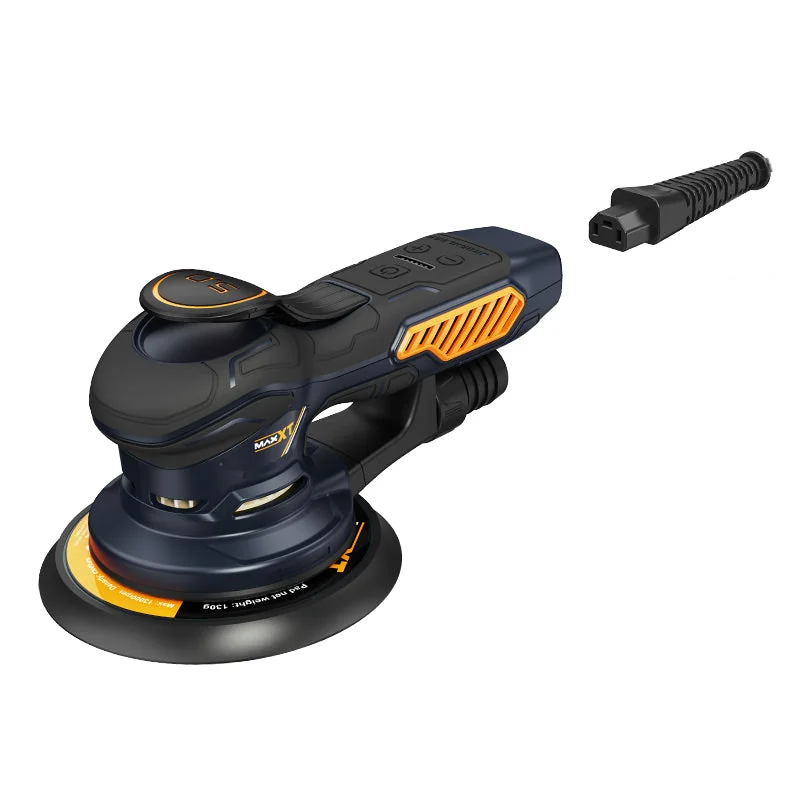
MAXXT Ramdon Orbital Sanders 6inch
By MAXXT · Orbital Sanders · Power Tools
- 350W brushless EC motor
- 4000-10000 RPM six-speed
- 5mm orbit
- 6 in (150 mm) hook-and-loop pad
- Includes 10 sanding discs
Price not listed
- MAXXTView at MAXXT
- eBayView at eBay
- AmazonView at Amazon (paid link)
- eBay (used) eBay: used, open-box, refurbishedView at eBay (used)
Stores are listed in a fixed order, never by price or commission. Prices are snapshots. Check the current price with the store.
Summary
A corded 6-inch brushless random-orbit sander for woodworkers who sand broad panels and want variable speed without battery downtime. Check the warranty before you buy: MAXXT’s product page and FAQ disagree on coverage years, and dust extraction needs a real vacuum.
Strengths
- A Fine Woodworking area comparison puts the 6-inch pad at 28.3 sq in versus 19.6 sq in for 5 inches, about 44% more coverage.
- Six speed presets plus a proportional lever cover coarse sanding and restrained finishing without a second machine.
- Corded power means no battery packs and no charge downtime; there is no subscription and no proprietary consumable.
- The 28 mm port and included dust hose connect to a shop vacuum, the setup OSHA’s woodworking guidance points to.
- MAXXT hosts the official manual and sells backing pads and disc kits, so parts are at least findable.
- At 1.27 kg net it is light for a 6-inch corded sander, on paper at least.
Weaknesses
- Extraction needs a real vacuum; no standalone dust bag is specified, and the 28/35 mm adaptor fit is on you to verify.
- A December 2024 r/woodworking report describes a MAXXT orbital that stopped cutting with an 80-grit disc at full speed; the model was not identified, so read it as a brand-level caution.
- An April 2026 r/woodworking report describes a sander that died within its first year, with a months-long warranty replacement.
- The manual’s troubleshooting table lists low- and high-voltage, overcurrent, IGBT-overheat and overload shutdowns; normal LEDs plus a stop means ease off the pressure.
- Vibration is real: the manual lists 8.15 m/s², and no independent lab has measured this model against its rivals.
- The 6-inch pad is awkward on narrow trim and corners, and no 5-inch pad is guaranteed in the box.
Verified specifications
| Model | R7308, confirmed on the manufacturer’s product-page comparison panel and in the original owner’s manual. |
|---|---|
| Motor | brushless EC motor marketed at 350W, with electronic soft start, constant-speed control and a brake that stops the backing pad. |
| Electrical | 110–120 VAC, 60 Hz, 3 A for the North American version; the manual also lists a 220–240 VAC variant. |
| Speed | 4,000–10,000 rpm no-load — six presets in 1,200 rpm steps, or proportional lever control. |
| Pad | 150 mm (6 in) round hook-and-loop backing disc, perforated for dust extraction. |
| Orbit | 2.5 mm (3/32 in) eccentric offset per the manual, a 5 mm full orbit diameter. |
| Dust extraction | 28 mm sander-side port with a 35 mm vacuum-end adaptor; dust hose and rubber ring in the box. |
| Cord | 5 m (about 16.4 ft) per the manufacturer’s model chart; mains-powered, no battery or charger. |
| Weight | 1.27 kg (2.79 lb) net per the manual; the product page shows 2.4 kg and a French listing a 2.36 kg parcel, an unresolved gross-versus-net discrepancy. |
| Vibration and sound | the manual lists hand-arm vibration of 8.15 m/s² (K 1.5 m/s²); its 86/78 dB(A) power and pressure figures appear reversed. |
| Safety | Class II double-insulated, dry sanding only, no water-based coolant, unplug before maintenance. |
| In the box | sander, dust hose, rubber ring, 10 sanding sheets, hex wrench and the installed round pad; no carry case is documented. |
| Warranty | the product-page badge says 2 years; the official FAQ says one year for products sold on the MAXXT website. |
Full research notes and sources
Dust extraction and running costs
The 28 mm port and included dust hose are the right idea: OSHA’s woodworking dust guide identifies vacuum collection through a perforated pad as the relevant control for random orbital sanders, and the box even includes the hose and rubber ring. But there is no standalone dust bag, so a shop vacuum or extractor is not optional, and the 35 mm vacuum-end adaptor is on you to match to your hose. A Walmart bundle from August 2026 — a different MAXXT kit, not this one — arrived with a kinked hose that restricted flow, which is the kind of fitting problem to check on day one.
Running costs are simple. There are no batteries, no subscriptions and no cloud service: $0 a year before consumables. Electricity is the nameplate 350W figure at most, and that is a marketing rating, not a measured draw; the illustrative arithmetic is 100 active sanding hours at 0.350 kW, or 35 kWh, which at a hypothetical $0.20 per kWh is $7.00. Abrasives are the real recurring cost. MAXXT sells a 6-inch backing pad with 30 sanding discs for $32.99, a nominal $1.10 per disc if you allocate the whole kit to paper — and that overstates paper cost, since the kit also contains the pad. A replacement backing pad lists at $19.99, replaced when the hook-and-loop grip wears out or the foam cracks. Add vacuum filters and bags for the extractor, and note that no replacement interval or per-job cost has been measured for this model.
Speed, orbit and pad
The manual describes two speed-control modes, not two speeds: a proportional lever, or six preset maximums in 1,200 rpm steps from 4,000 to 10,000 rpm no-load, with the +/- buttons pressed together to switch modes. MAXXT’s own product copy muddles this by saying “two speed settings” in places, so read the manual before you blame the machine. The orbit is a 2.5 mm eccentric offset, which describes a 5 mm full orbit diameter; retailer listings that say “5 mm stroke” mean that diameter, not a 5 mm radius or a 10 mm orbit. Nobody has published a dial-indicator measurement of the current production unit. The pad-area math comes from a Fine Woodworking category article that predates the R7308 and does not test it.
Technique matters more than the spec sheet. The manual’s troubleshooting table says that if the LEDs look normal but the sander stops, you are pressing too hard — reduce the grinding pressure, because overload protection cuts power and pushing harder reduces cut instead of increasing it. Match the grit and perforations to the pad, keep the disc balanced, and expect the 6-inch circle to feel clumsy on narrow trim and corners; the interchangeable 5- and 6-inch pad set belongs to the separate MOS350C kit, and this box does not claim it.
Warranty, service and parts
The warranty paperwork does not agree with itself. The R7308 product page carries a prominent “2-year Warranty” badge and the company homepage markets 24 months, while the official FAQ says one-year coverage for products sold on the MAXXT website. Email service@maxxt-tools.com before you buy and get the coverage for your seller in writing. Returns are another maze: the FAQ allows contact within 30 days for eligible returns “if the product can be returned for free,” with refunds 2–14 business days after warehouse receipt, while the homepage advertises 15-day returns.
Owner reports cut both ways. In an April 2026 r/woodworking thread, an owner of two MAXXT sanders said one died within its first year and the warranty replacement took several months; others in the same thread reported a two-pad sander working well after over a year and a pair of sanders they praise. A June 2026 r/Tools thread has a corner-sander owner who got replacement screws sent free after stripping them. Treat these as anecdotes about variance, not a failure rate — nobody has published one.
Parts exist but are not model-precise. MAXXT sells a generic 6-inch DA backing pad for $19.99 (5/16-24 thread, 13,000 rpm rating) and a pad-plus-30-disc kit for $32.99, but neither page expressly names the R7308, so confirm the mounting screw, offset and hole pattern with support first. The manual routes North American parts through Hyperfit Tools and accessories ship from China in 2–3 weeks when not held domestically. No spare hose, ring, control board or motor SKU with a US price could be found for this model, and one owner’s months-long wait for a replacement on another MAXXT orbital means there is no supportable annual repair reserve.
Is it worth it?
MAXXT lists the R7308 at $159.99 on its own site, in stock with a free-shipping claim (October 2026). The most compelling checked new listing is a MAXXT-TECH eBay offer at $113.99 with free standard shipping for a new R7308-style 150 mm sander, though its seller and warranty terms may differ from MAXXT’s own store. Against that, MAXXT’s own separate 350W brushless is listed at $119.99 and its 5-plus-6-inch set at $154.99, so the official R7308 price sits above comparable hardware from the same brand.
Above $170, compare the $179.99 dual-pad kit with case and the established names: Home Depot lists the DEWALT DWE6423, a 5-inch 3A orbital running 8,000–12,000 OPM, at $99.00 with 90-day retailer returns, and Makita’s BO6030 at $299.00 with the BO6050J at $459.00. If you sand mostly broad panels, already own a vacuum, and confirm the warranty in writing, the R7308 does the job; if you want a 5-inch option, a case, or an established repair ecosystem, the same money has options.
Which model this is
The product sold as “MAXXT Ramdon Orbital Sanders 6inch” is the MAXXT R7308, a corded US 110–120V, 3A, 150 mm palm sander. MAXXT’s own page is titled “MAXXT Brushless Orbital Sanders, 6 Variable Speed,” but its comparison table and box illustration identify the R7308, and the 59-page multilingual manual (English pages 3–12) is the original document. Do not confuse it with the MOS350C dual 5/6-inch-pad model, the R7303 listing, the offline industrial MOS600R, or the R7310 triangular sander; the manual and the comparison panel are the identity checks.
Sources
Manufacturer:
- MAXXT R7308 user manual (PDF)
- MAXXT R7308 product page
- MAXXT random orbital sander collection
- MAXXT FAQ: warranty, returns and support
- MAXXT 350W brushless random orbital sander (separate model)
- MAXXT 6-inch DA backing pad
- MAXXT 6-inch backing pad and 30-disc kit
Independent reviews:
Owner reports:
- MAXXT sander recommendations and reliability reports (r/woodworking)
- MAXXT sander loses cutting ability (r/woodworking)
- Which MAXXT sander would you grab (r/Tools)
Parts and stores: