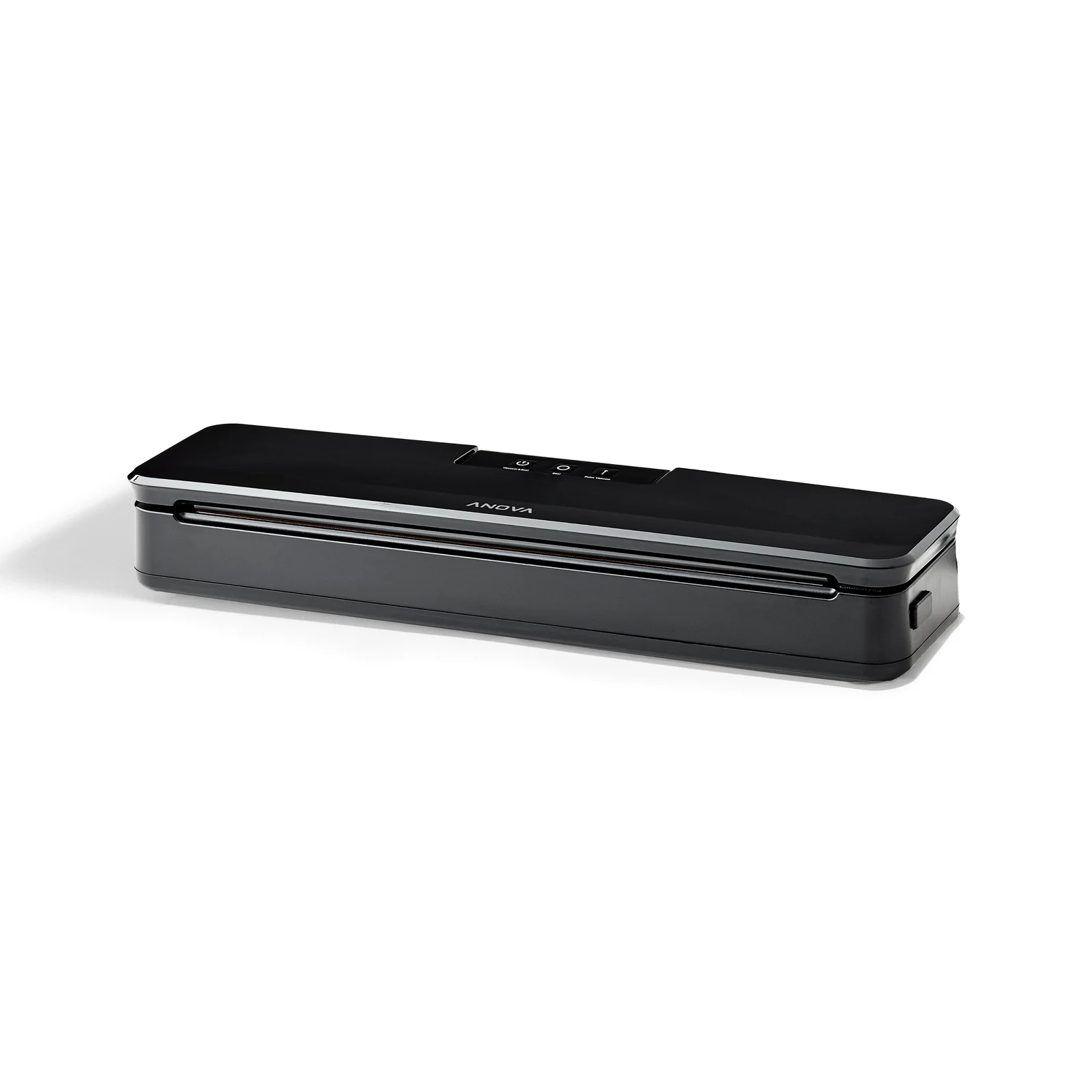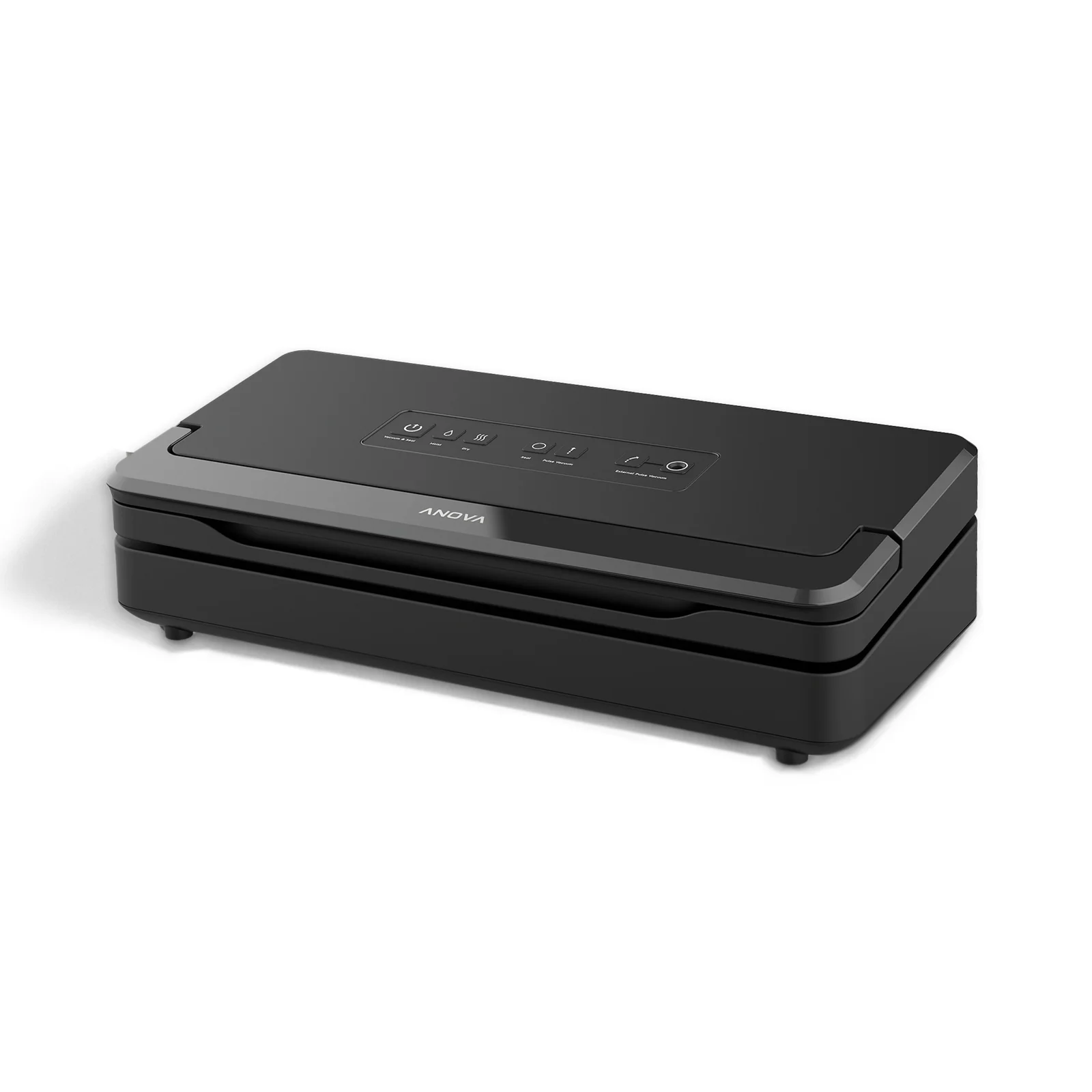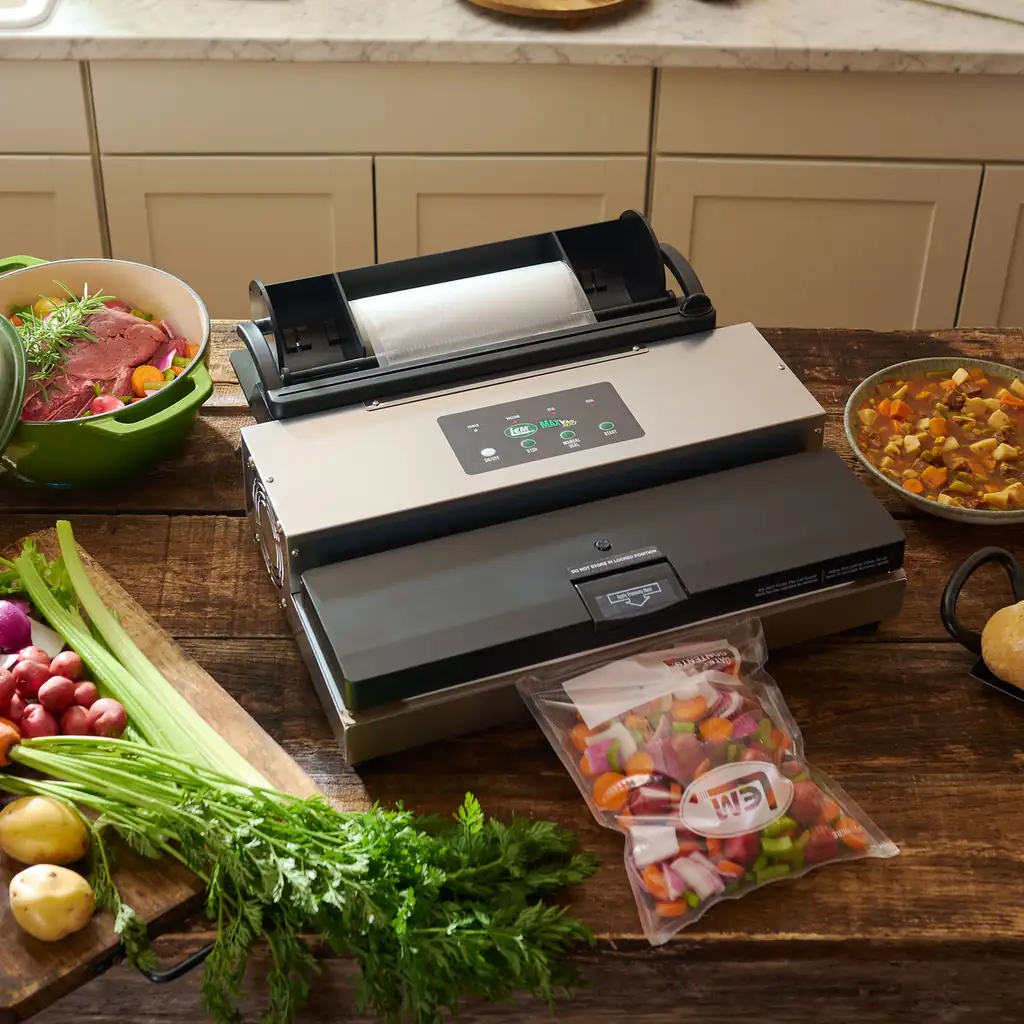
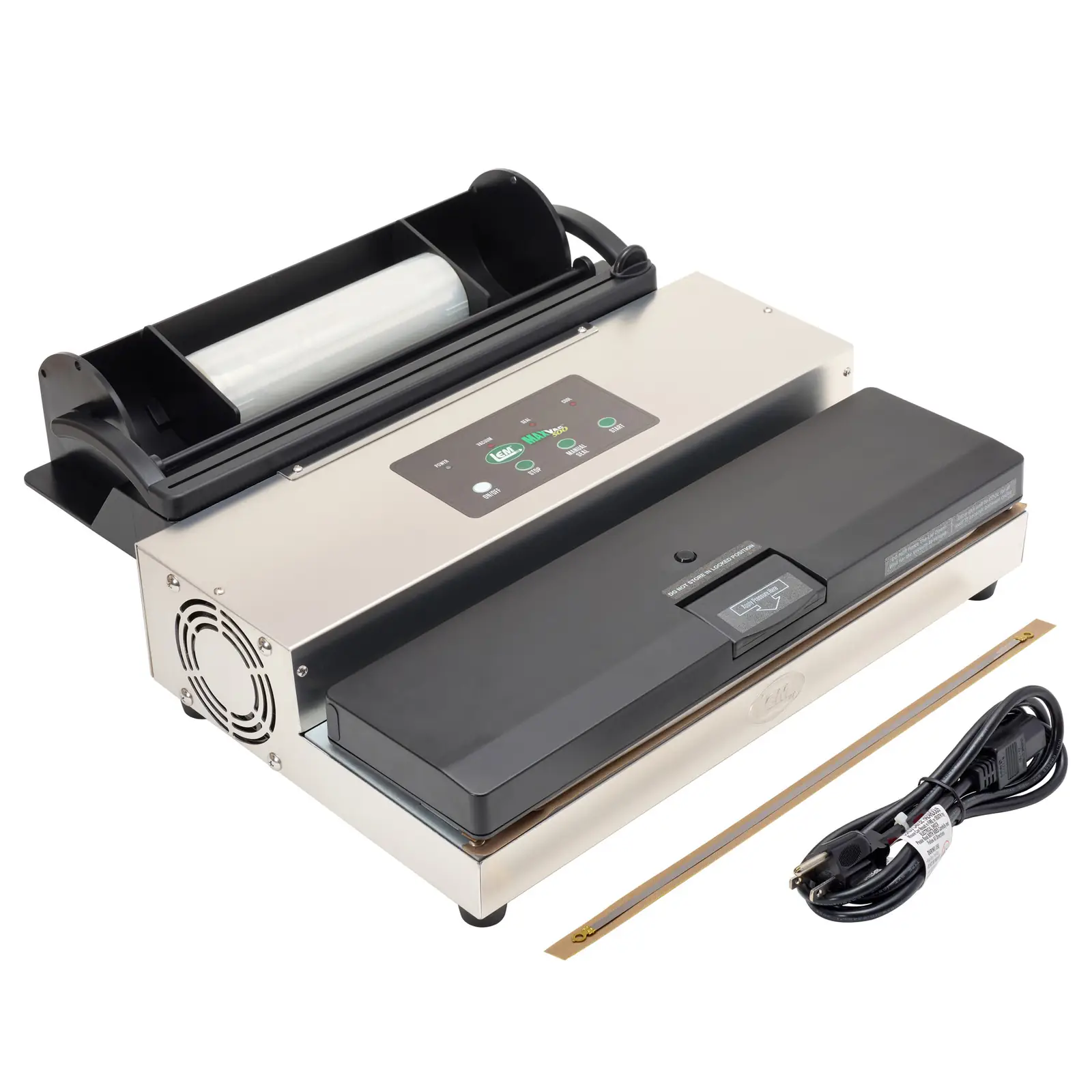
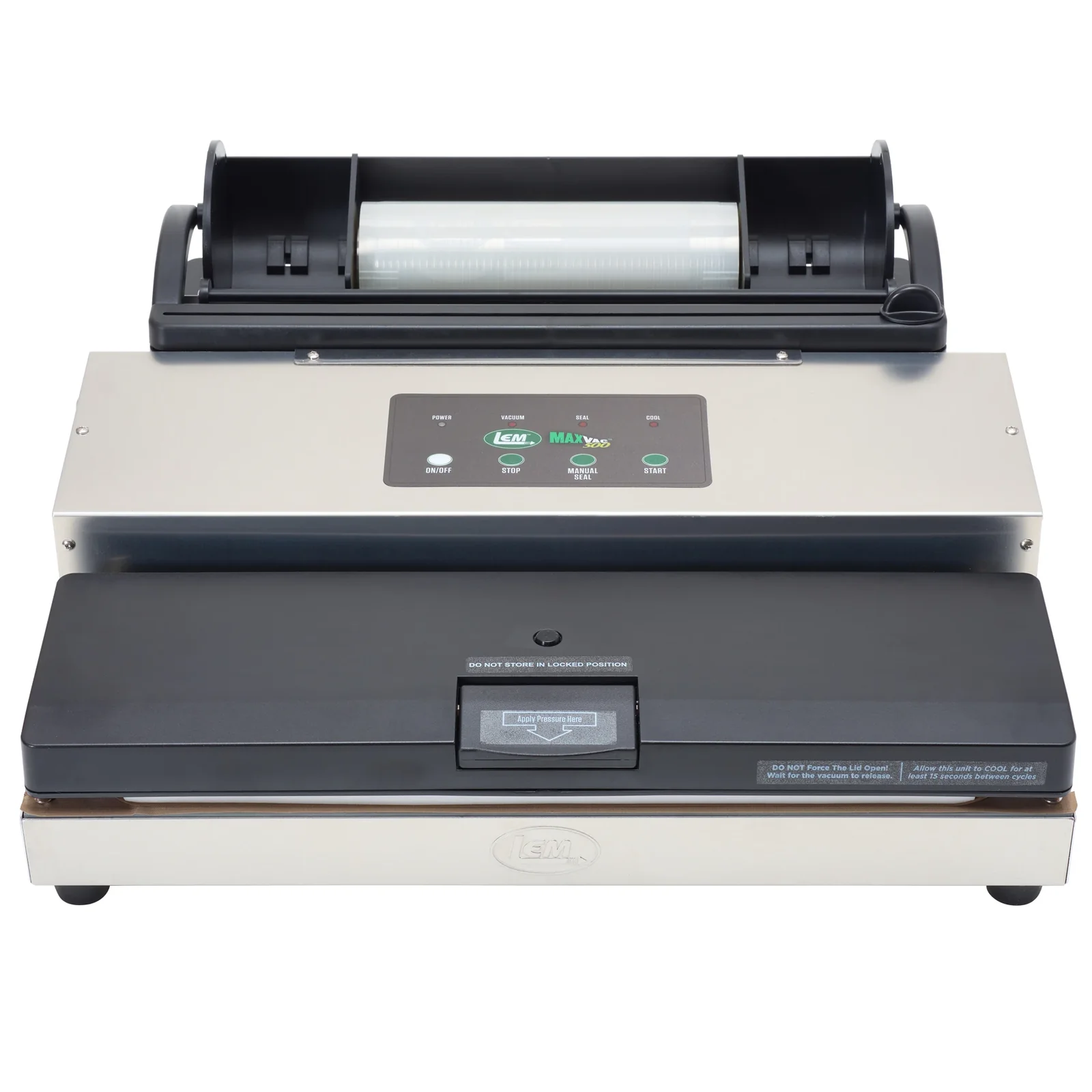
LEM MaxVac 500 Vacuum Sealer (1253)
By LEM · Vacuum Sealers · Kitchen & Cooking
- External-suction bag sealer with a 14-inch heat bar for embossed bags up to 14 inches wide
- Manufacturer-rated 462 W and advertised 21 Hg vacuum
- Aluminum body, 18.55 x 11.46 x 4.77 in and 17.22 lb
- Detachable roll holder and sliding cutter
Lowest price seen
$429.99
from $429.99 at LEM Products (D2C) · Checked Oct 19, 2026
- LEM Products (D2C) $429.99View at LEM Products (D2C)
- eBay (used) eBay: used, open-box, refurbishedView at eBay (used)
- eBayView at eBay
Stores are listed in a fixed order, never by price or commission. Prices are snapshots. Check the current price with the store.
Summary
The LEM MaxVac 500 is a large aluminum-bodied external vacuum sealer designed for frequent bulk food packaging, with a 14-inch bar, detachable roll holder and unusually good replacement-parts availability. Before choosing it, consider its weight, single wide seam rather than two separate welds, and the registration and service conditions behind its advertised two-year warranty.
Strengths
- A 14-inch heat bar fits larger external-suction bags than many compact household models.
- Fan and removable roll holder/cutter help organize sustained meat and game packaging sessions.
- LEM sells an exact heater, both protective tape types, oval gaskets, maintenance kit and motor.
- The manufacturer offers a two-year new-unit warranty and publishes an exact-model manual.
- Manual Seal enables early suction cutoff for delicate portions, along with straightforward automatic operation.
- A 25-foot roll provides meaningful starter material for custom-sized bags.
Weaknesses
- The advertised 4.8 mm seam is a wide single weld, not documented as two independent heat-seal lines.
- 500 consecutive seals is a manufacturer specification, not independent proof of uninterrupted production.
- Its 17.22-lb weight and broad footprint make storage less convenient in small kitchens.
- No credible independent exact-model pressure, airflow, noise or cycle-time benchmark was identified.
- The manual restricts use to domestic settings and specifies cooldown procedures despite heavy-duty marketing.
- Warranty registration and return-shipping responsibilities in the older manual need confirmation for a new purchase.
Verified specifications
| Model identity | LEM Products MaxVac 500, SKU 1253; retailer/manufacturer UPC 734494012538. |
|---|---|
| Type | countertop external-suction bag sealer, not a chamber-style vacuum machine. |
| Manufacturer-rated power | 462 W, a rated electrical input and not a measured pumping speed. |
| Advertised vacuum | 21 Hg in LEM’s specification, without an independent exact-model instrumented pressure result or explicit test methodology. |
| Seal bar | 14 in, accommodating manufacturer-stated embossed bags up to 14 in wide. |
| Seal type | 4.8 mm wide heat seam per manufacturer, using one documented heating strip; no verified pair of independently separated welds. |
| Claimed capacity | approximately 500 consecutive seals, up to 5 hours of operation with its continuous-run cooling fan; independently measured endurance not located. |
| Size | 18.55 × 11.46 × 4.77 in, manufacturer-listed exterior dimensions. |
| Weight | 17.22 lb, manufacturer-listed appliance weight. |
| Case | aluminum housing; the manual describes lid, gasket and replaceable heater assembly. |
| Electrical connection | grounded, manufacturer manual states 110 V and a 6-ft detachable power cord is listed. |
| Controls | On/Off, Start automatic vacuum/seal, Manual Seal for roll ends or early finish, Stop and progress indicator lights. |
| Thermal safety | motor fan, circuit breaker and thermal overload switch; cooling may still be required during heavy use. |
| Roll accessory | removable holder and manually operated sliding cutter, rather than a fixed automatic feed system. |
| Included film | 8-in × 25-ft starter roll per manufacturer; additional rolls and bags bought separately. |
| Bag compatibility | suitable textured/embossed food-grade vacuum film, not ordinary smooth sandwich bags. |
| Canister support | external vacuum hose port on lid; hose is not included with the new-item listing. |
| Exact replacement gasket | oval foam 10114001, sold singly by LEM, listed $9.49 each. |
| Exact heater element | 10059001, listed $3.99 in LEM’s online replacement-parts catalog. |
| Protective tape | model-compatible 10118006 for lid/under heater and 10118004 over heater; each listed $3.99. |
| Maintenance kit | 10152002, includes one heater, three tape pieces and two oval foams; listed $29.49. |
| Pump motor service item | LEM’s parts catalog lists an exact 1253 replacement motor for $33.99. |
| Manufacturer direct offer | new #1253 displayed $429.99 and in stock at the checked retailer visit. |
| Warranty | new product advertised as two-year, while refurbished #1253 is separately advertised with one-year coverage; old manual has registration conditions. |
| Intended use | the actual manual says domestic use, not commercial, despite high-volume marketing language. |
Full research notes and sources
Who needs this much capacity?
The MaxVac 500 is designed around bulk food processing, not the occasional snack bag. The case is aluminum, the heat bar stretches across 14 inches and a fan helps keep the motor running through repeated cycles. For someone who processes game, portions large fish catches or packs a season’s worth of frozen meals, those design choices can be valuable. A household sealing only a handful of bags each week could find the extra size and cost unnecessary.
LEM markets the machine with 500 consecutive seals and up to 5 hours of use. Those numbers are much more specific than vague promises of “continuous operation.” They are still manufacturer’s approximations: no independent timed exact-model test documents the bag sizes, film thickness, pause between cycles, ambient temperature and success criteria behind that figure. The refurbished model’s marketing even refers to 450+ seals while repeating the higher table figure, another reason not to interpret 500 as a rigid minimum. The promise is about the intended class of workload, not a guaranteed personal production rate.
One of the less obvious contradictions is in LEM’s own literature. The 1253 instruction manual, still offered on the company’s site, says the unit is for domestic rather than commercial use. The storefront positions it as a heavy-duty choice for hunters, processing crews and other frequent users. Both statements can describe a high-volume home machine, but a buyer should not treat the marketing as proof that a commercial processing business is covered under warranty. A shop planning to run it for paid food packaging needs written confirmation from LEM before assuming it is authorized for that duty.
Thermal protection also constrains how the marketing numbers should be read. The manual has a circuit breaker and an overload switch, and gives specific recovery steps if either interrupts operation. In its troubleshooting instructions, LEM advises letting a heat strip cool 30–60 seconds when bags melt, or leaving the lid open for 1–2 minutes. After a thermal shutdown, the manual directs users to turn the machine off, raise the lid and allow around 10 minutes for cooling. That is inconsistent with interpreting five hours as permission to press Start repeatedly without checking the quality of the seals.
For practical meal preparation, it is better to stage bags, fill portions and cut new roll pieces while the machine naturally cools. A fan does not prevent every film from melting and does not override the thermal cutoff. An owner can be entirely satisfied after packaging a large catch of fish without ever approaching the theoretical maximum session duration. The relevant question is how the machine behaves for the number of pouches you actually use, not whether a sales claim advertises a remarkably large total.
The scale of the machine affects daily convenience. At 18.55 × 11.46 × 4.77 inches and 17.22 lb, it occupies a substantial countertop area and is not a lightweight item to carry up and down from a high cabinet. Its aluminum shell is useful for frequent handling and gives a different feel from lightweight plastic sealers, but it is still a countertop external-suction design with a lid, heater and gasket that require care. The separate holder may also need its own space when detached. Plan where the machine and film will live before ordering it for a small kitchen.
How vacuum and sealing actually compare
The first figure is a vacuum specification with ambiguous shorthand, normally understood as inches of mercury in this product class, but there is no controlled exact-model test to verify the achieved bag vacuum. The second figure is electrical power consumption under rated conditions. Neither number specifies airflow in liters per minute or time required to remove air from a known bag volume. A machine can draw substantial power without being the fastest in a calibrated evacuation trial.
There is no credible independently instrumented exact 1253 pressure reading, pump air-flow trace, matched 1-liter or 2-liter canister time, or verified dBA microphone measurement in the checked sources. Therefore a chart comparing its advertised value with a competing product’s advertised pressure rating would mix unlike methods. Even translating the unit correctly would not correct for gauge placement or whether the vacuum is measured at the pump inlet or inside the finished bag. The manufacturer can advertise its intended pump pressure; it is not a independently measured performance ranking.
The seal itself is described with useful precision: 4.8 mm. The 1253 instruction manual shows one heating bar under protective Teflon tape, and the official parts catalog offers one compatible heating element. That supports describing a single broad heat-weld band. It does not establish a pair of separate 4.8-mm seams, nor a second independently controlled heater. A two-line seam can provide redundancy when one narrow defect affects only one line, whereas a single wide seam spreads heat over a larger band. Neither structure proves leak-free storage when the bag mouth is dirty or wrinkled.
This distinction matters because the original vacuum-sealer shortlist prioritized machines advertising two separate heat-seal lines. MaxVac 500 is a useful comparator outside that narrower criterion: buyers may value its service parts and bulk handling even without a true dual-line weld. Anyone requiring physically separate parallel seams should not substitute this model without evidence of that specific construction. The manufacturer’s official 4.8-mm figure is a bar/seam specification, not an independent caliper measurement of the finished weld on different film brands.
The wide heater works only as well as the bag placed on it. A seal can look continuous while a small fold, grain of flour or drop of meat juice creates an air passage through the heat-softened plastic. The manual recommends leaving clear material around the opening and ensuring the bag lies flat before the lid locks. Sharp bones and stiff corners can also puncture a properly sealed pouch later. A good-looking seam immediately after sealing is not proof that a package will remain airtight through every movement in storage.
LEM’s 1253 manual provides a simple interface. Use Start for automatic vacuuming until the pressure-triggered cutoff engages sealing. Manual Seal closes an end of cut roll film or ends suction earlier when the contents have reached the desired compression. Stop interrupts the cycle. There is no documented sophisticated sensor that can safely recognize soup entering the vacuum channel or a measured soft-food vacuum level on every run. Users need to watch delicate food rather than assuming the machine’s high-power marketing means it will protect it automatically.
Noise is a practical issue in kitchens and shared food-processing spaces, but it cannot be rated numerically here. No exact-model calibrated dBA measurement under a defined microphone distance surfaced in the reviewed sources. A continuous cooling fan adds its own sound along with the pump, but there is no basis to claim the MaxVac 500 is quieter or louder than another tested model using incompatible impressions. Someone with strict noise limits should inspect a genuine sound measurement or test a unit under return terms.
Bags, moisture and canister work
LEM includes an 8-inch-wide, 25-foot starter roll with the new MaxVac 500. Its removable roll holder and cutting tool let you make bags to the exact length needed for a roast or stacked fish fillets. This is not a self-feeding, motorized bag dispenser. Take a length of compatible embossed film, cut it straight, seal one open end with Manual Seal, then insert and evacuate the other end after adding food. The removable holder can be convenient when working in a large preparation area because film need not occupy the space directly behind the motor.
The manual recommends cutting a pouch longer than the food and leaving at least 2–3 inches of clear material between the contents and the open mouth, plus clearance at the sides. This gives the plastic somewhere to move as vacuum builds and keeps residue out of the heater. With a very full bag, the open end can be pulled sideways or crumpled as the food shifts. Center it across the heat bar and check for folds before starting. The stated 14-inch bar and 14-inch compatible-bag limit should not be mistaken for a promise that a full 14-inch loaded mouth always lies perfectly flat without alignment.
Standard channel-style vacuum rolls are the sensible consumable. LEM says bags from other national vacuum-sealer brands can work, but they must be made specifically for this kind of sealer. The manufacturer’s care guide says its own bags are approximately 3 mil thick and warns that thinner films can burn while thicker films may not weld completely under the machine’s normal timing. This is not a requirement to buy only LEM film, but it explains why changing bag brands without a test seam may produce inconsistent results. Ordinary smooth sandwich bags are not suitable, and smooth chamber-machine film is not a safe drop-in replacement for embossed rolls.
Dry staples such as cereal or coffee should be packed without fine particles entering the vacuum inlet. The manual specifically warns about flour and baking powder, recommending that powdery contents remain wrapped or contained before being placed inside the outer vacuum pouch. A little dust entering the pump can shorten its life or contaminate a sealing surface. For fragile foods, use the manual button to stop vacuuming before crackers, berries or baked items are crushed. Better still, pre-freeze delicate pieces when compatible with the intended food use.
Wet food is a more serious limitation. MaxVac 500 evacuates through the opening of the flexible pouch. It does not change the entire pressure environment around the bag as a chamber machine does. Soup or a marinade can be pulled toward the vacuum channel when suction increases, carrying fluid into the pump. LEM’s manual recommends freezing liquid-rich contents before bagging, and placing a clean absorbent pad or folded paper towel below the seal area for modest moisture from fish or meat. The pad should not cover the intended heat-weld line.
The fact that the seller calls it a tool for marinating does not mean it can draw a loose container of liquid through the bag channel safely. It has a separate canister-vacuum port beneath the lid. The official product page makes clear that the connecting hose is not included, even though an accessory port is provided. A buyer needs an appropriate food-grade canister and the exact matching hose or adapter; third-party jars are not confirmed compatible just because their lids look similar. The instruction manual describes leaving space inside a canister and waiting for suction to release before detaching the hose.
A small problem with a wet bag can look like pump failure. When an open end sticks together from juice or grease, the suction may not remove much air even though the appliance is functioning normally. Unfold the film, dry the mouth and test with a fresh embossed bag. A loose foam gasket around the suction channel can have a similar effect. The manual says gently pressing the lid for 3–4 seconds can help the upper and lower gasket form the initial seal. That is a troubleshooting technique, not proof that every machine requires a person to lean on the lid for an entire run.
Vacuum sealing is not sterilization. LEM’s manual states that foods requiring refrigeration or freezing still need it, and warns about handling certain produce and soft cheeses. The precise shelf-life examples on a seller’s chart are guidelines, not guaranteed food-safety dates. Food preparation, rapid cooling, correct cold storage and the recipe’s sous-vide time/temperature should remain the primary safety controls. Packaging meat in plastic does not make room-temperature storage safe.
Replacement parts and the true ownership cost
The most compelling reason to include MaxVac 500 alongside less expensive sealers is documented exact-model service parts. LEM does more than offer a vague support email. Its own store sells the oval chamber foam, heater element, both protective tape types and a preassembled maintenance assortment under stock numbers naming SKU 1253. It even lists a replacement electric pump motor and replacement roll holder/cutter in the broader parts catalog. This is unusual transparency compared with generic brands that advertise strong suction yet cannot supply a worn gasket by part number.
The oval gasket 10114001 is listed for $9.49 each. LEM recommends replacing both upper and lower chamber foams together. Therefore a pair costs twice the single-piece listing before tax or shipping; the price displayed is not a two-pack. These gaskets are shaped to sit in the vacuum lid and body grooves. If they are stretched, twisted or compressed unevenly, the machine can lose suction even while the pump runs. The manual gives removal and installation steps and cautions against stretching the foam during cleaning.
The 10059001 heater element was listed for $3.99. Protective tape is not a cosmetic trim piece: it prevents heated components from adhering directly to the bag material and covers the working heat strip. Two differently placed tapes have distinct part numbers. LEM identifies 10118004 as tape above the heating element and 10118006 for the lid and under the heater; each was listed at $3.99. Choosing the wrong tape location or leaving wrinkles can spoil seals, so the exact compatible part is preferable to a generic roll selected only by appearance.
The 10152002 maintenance kit lists for $29.49 and includes one heater, one heater-cover tape, two pieces for the lid and under-bar positions, and two oval foams. The bundled combination is practical for a heavy user whose unit has both a worn sealing surface and aging gaskets. It does not guarantee the pump or circuit board is faultless, and a worn heat strip need not imply an equally worn gasket. A buyer should compare the components actually needed before purchasing the entire kit.
The LEM replacement-parts catalog also contains a motor explicitly described for MaxVac 500 #1253, listed at $33.99, and a roll holder/cutter at $43.99. The motor is a powered internal component, not a bag-consumable. Its price is evidence that the manufacturer supports this part, not a recommendation for untrained users to repair mains-connected equipment themselves. Disconnect the appliance, follow the exact manual, and use the maker’s service support for electrical faults. Finding spare parts today is helpful, but cannot guarantee their availability for the next decade.
Replacement supplies also clarify the difference between repairability and warranty coverage. The 1253 manual treats oval foam, PTFE tape and heating bar as consumable wear parts, generally outside its defects warranty. That means a buyer can keep a machine working after the original cover starts to discolor or a gasket stops sealing, but routine upkeep may require spending money. With a device intended for repeated meat processing, this is a normal ownership consideration, not by itself proof of poor quality.
For bags, compare the real cost per usable foot and actual compatible pouch width. The included roll is enough to experiment with different lengths, but a large seasonal job will require more film. There is no proprietary cartridge subscription. The expense of a failed seal on costly meat can exceed small differences between film brands.
Warranty, returns and owner experience
LEM’s current new-model product description advertises a two-year warranty and lifetime customer support. The separate factory-refurbished MaxVac 500 listing describes a one-year warranty. Those are different offers and should not be combined when comparing a new purchase with a refurbished deal. A restored machine can have a new heater and still have different legal service terms, so verify condition and warranty in the seller’s exact listing.
The dated 2017 manufacturer manual includes a particularly important provision. It tells the original purchaser to send a completed warranty card with the receipt promptly. It states that failure to return the warranty card will limit coverage to 90 days with proof of purchase. Another introduction section of the same manual refers to warranty registration through the company’s website. These pages are old enough that the practical procedure may have changed, but the registration language is specific enough not to ignore.
Before purchase, request LEM’s current written policy for a new #1253 and ask whether online registration satisfies all conditions, or whether registration is still required at all. Do not assume that the product-page phrase “two-year warranty” eliminates every condition. The old document also describes prepaid shipment for warranty repair, possible return-shipping charges and a $50 cleaning fee for a dirty machine. It distinguishes original manufacturing defects from damage caused by misuse or unauthorized service. These may not be the present standard for every transaction, but their presence makes written confirmation important.
The older manual explicitly instructs customers to obtain return authorization before sending the machine to LEM and says the product should be cleaned of food particles. An appliance that has packed fresh fish or meat could carry a sanitation problem during shipping. Keep the receipt and serial or model details; preserve email confirmation of any modern registration and retain the terms displayed when buying. A public replacement-parts shop is valuable, yet it does not automatically provide a no-cost service path for each consumable.
Independent customer ownership evidence is limited but useful. In an April 2026 discussion on r/homestead, one MaxVac 500 owner said years of demanding use had not caused a breakdown. That commenter was advising someone processing many chickens and also suggested heat-shrink bags for whole birds. The statement supports the possibility of long service in a demanding household, but there is no inspection record or independent log of completed sealing cycles.
Another 2024 r/Hunting participant described using the machine for small routine amounts and sometimes several dozen bags at once, reporting generally satisfactory results while acknowledging that some bags are finicky to seal. That specific criticism is relevant: a large heater does not remove the need for carefully positioned, dry, compatible film. It does not establish a failure rate and should not be turned into a claim that a fixed percentage of MaxVac 500 units have sealing problems.
A February 2025 r/FishingWashington discussion recommends the unit for fish processing and says it is faster and less prone to overheating than a typical lower-cost FoodSaver. This is a user’s comparative impression, not an instrumented speed test with matched bag sizes. Other posts from 2020 and 2022 report positive early impressions after purchase. None proves that every unit will meet the advertised multi-hour duty level or last a specific number of years.
There is no reliable exact #1253 controlled laboratory evaluation in the gathered sources reporting calibrated vacuum pressure, liters per minute, sound level, cycle time, weld strength and multi-year durability. Video summaries that reuse manufacturer claims should not be counted as laboratory corroboration. The documented service components and actual manual are the stronger evidence; owner reports can add context about workflow and possible annoyances without filling the measurement gaps.
Which model this is
This article covers LEM MaxVac 500 vacuum sealer, SKU #1253, identifiable on LEM’s own current product page and in its exact model manual. The MaxVac 1000 is another more expensive member of the line, while MaxVac 250 has a different construction and duty specification. The MaxVac Pro products are chamber sealers and should not be mistaken for the MaxVac 500 external-suction platform. The refurbished #1253 is the same model family but a different purchase condition and warranty offer.
No verified exact-model ASIN is assigned here. The manufacturer’s SKU, UPC and direct part-numbered listings provide enough identity to avoid importing other models’ bag dimensions or service policies. When buying through an outside marketplace, compare the physical product label and seller terms rather than accepting a title that merely says “LEM MaxVac.”
Is it worth it?
LEM’s own storefront showed a $429.99 new-unit offer and marked it in stock at the research check. That is far above the entry-price category of simple household sealers. The cost makes sense only if its capacity, bag width, replaceable hardware and ease of bulk preparation are going to be used. For a person sealing two sandwiches each weekend, the extra mass and claimed multi-hour duty capability are unlikely to justify the premium.
The main advantages are unusually concrete: real stock from the manufacturer, a long starter roll, a detachable cutter/holder, a 14-inch bar and part-numbered spares all the way down to the motor. Few lower-cost competitors combine those features with a direct two-year advertised new-unit warranty. The limitations are equally concrete: only one documented broad seam, no independent exact-model performance testing, no hose in the new kit, relatively high weight and a warranty document that merits careful confirmation.
Anyone whose top requirement is two separately welded heat-seal lines should keep looking rather than assume a 4.8-mm wide band meets that requirement. Someone who frequently handles free-flowing liquids may find a chamber sealer more appropriate even if the MaxVac’s wider bags appear convenient. This model is a stronger fit for large amounts of solids and moderately moist food which can be pre-frozen or bagged without juice reaching the air inlet.
Before ordering, verify the exact new versus refurbished condition, the applicable registration procedure, whether the canister hose and film are included, and the current availability of matching wear parts. No numerical “buy below this price” rule can substitute for those practical differences. The MaxVac 500 offers credible serviceability and a compelling duty specification, but it remains an external-suction machine with cooling, bag-compatibility and operator-workflow limits.
Sources
Manufacturer and exact-model documentation:
- LEM MaxVac 500 #1253 product description, specifications and new warranty
- LEM MaxVac 500 #1253 full instruction manual and warranty provisions
- LEM vacuum-sealer workshop and manual links
- LEM refurbished MaxVac 500, separate warranty terms
- LEM factory replacement-parts selection for vacuum sealers
- LEM warranty and service workshop
Model-compatible repair parts:
- LEM 1253 oval chamber foam #10114001
- LEM 1253 heating element #10059001
- LEM PTFE tape for lid and under heater #10118006
- LEM heater-surface PTFE tape #10118004
- LEM 1253 maintenance assortment #10152002
Owner reports, not laboratory tests: