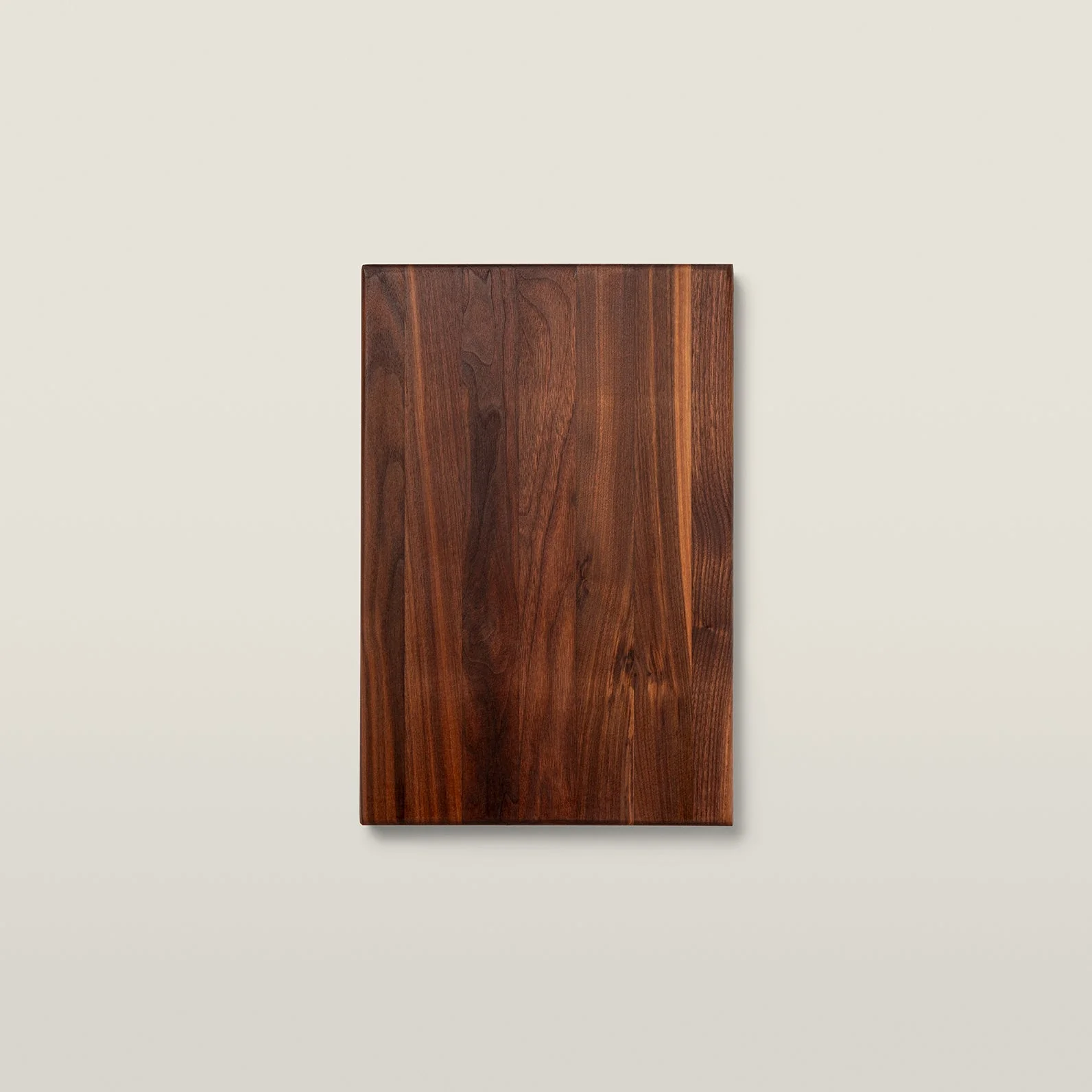
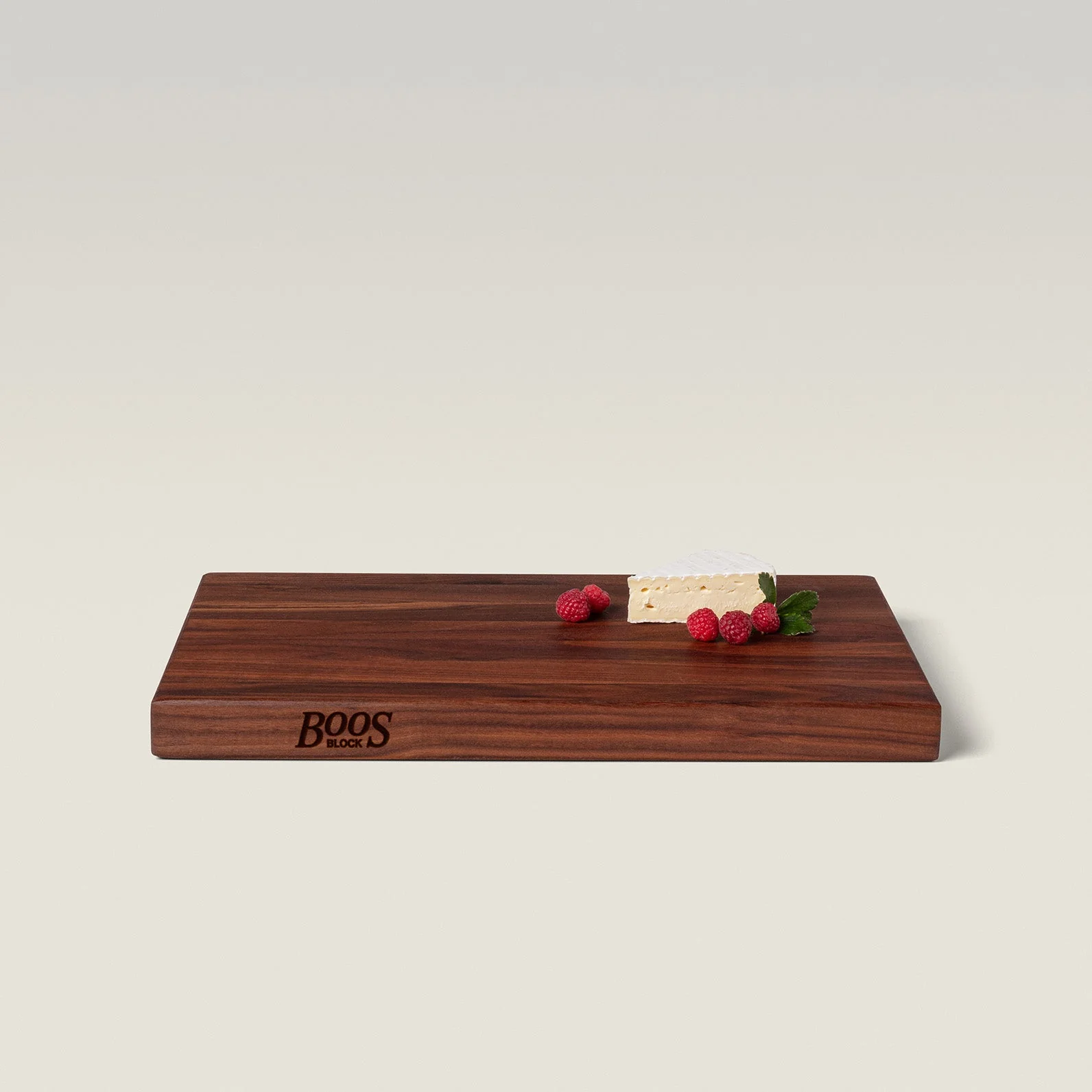
John Boos R-Board Series Rectangular Wooden Walnut Cutting Board 18”x12”
By John · Cutting Boards · Kitchen & Cooking
- 18" x 12" x 1.5" thick
- 9 lb weight
- American Black Walnut, edge-grain construction
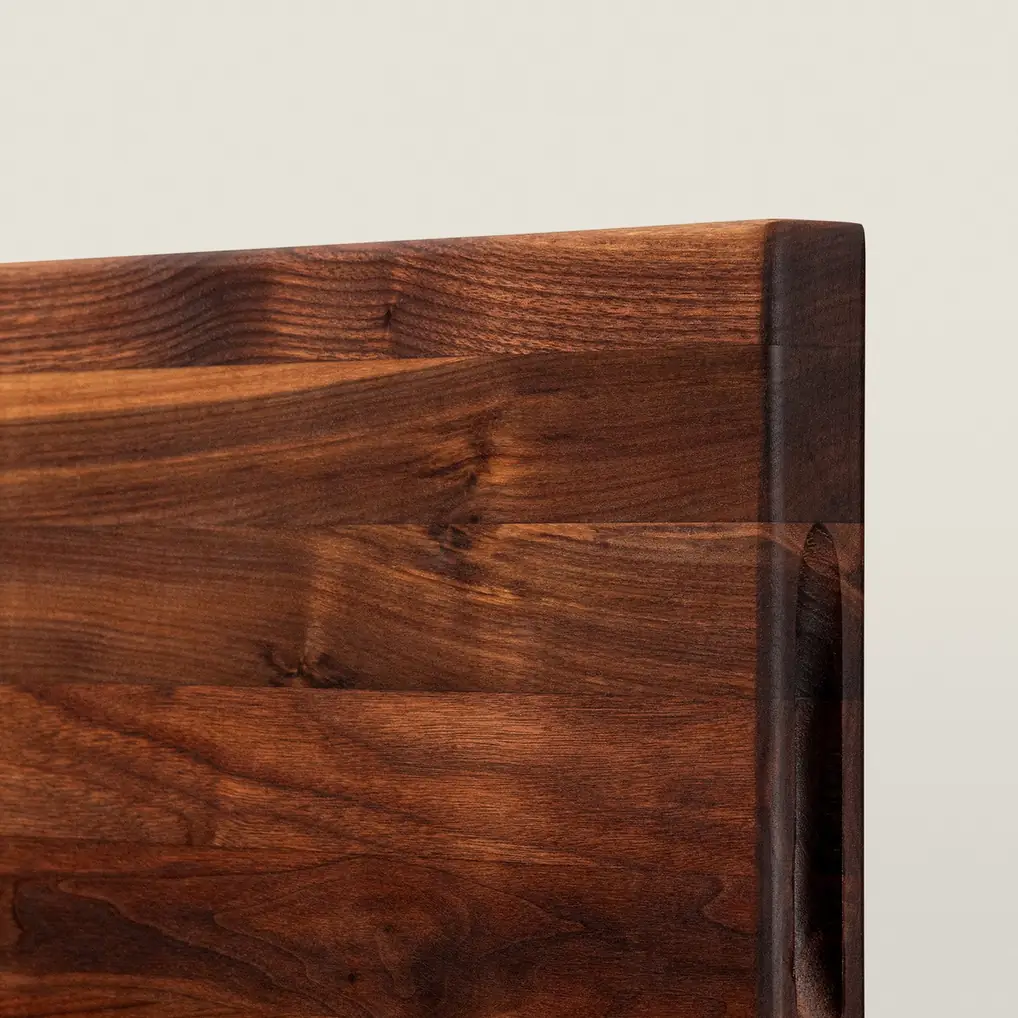
- Reversible with recessed finger grips
- Oil finish
Price not listed
- JohnView at John
- eBayView at eBay
- Crate & BarrelView at Crate & Barrel
- Everything KitchensView at Everything Kitchens
- AmazonView at Amazon (paid link)
- eBay (used) eBay: used, open-box, refurbishedView at eBay (used)
Stores are listed in a fixed order, never by price or commission. Prices are snapshots. Check the current price with the store.
Summary
A 1.5-inch-thick edge-grain American black walnut board, reversible with recessed finger grips, for cooks who want a dark, substantial surface. The catch is upkeep: the one-year warranty excludes the splitting and warping that follow skipped oiling.
Strengths
- Two usable faces and recessed grips let you separate raw and ready-to-eat tasks and spread wear.
- A thick 9 lb slab stays put better than a thin flexible mat under normal chopping.
- Food & Wine chose the walnut R-Board as its favorite among 55 boards tested in 2026.
- Walnut stained less than maple in Wirecutter’s tests.
- Light scratches sand out with 200-grit paper and fresh oil, so cosmetic wear is restorable.
- Stocked at a consistent price across several well-known retailers.
Weaknesses
- Edge-grain is harder on knives, cuts do not self-heal, and Wirecutter does not recommend edge-grain boards generally.
- The one-year warranty excludes splitting, checking and cracking from inadequate oiling, plus damage from damp storage.
- Owners report warping and glue-joint splitting after oiling lapses.
- Hand wash only: no dishwasher, no soaking, no cooking oils.
- It arrives pre-finished, but conditioning varies and one tested Boos edge-grain board arrived extremely dry.
- No juice groove, and no NSF certification on the walnut version.
Verified specifications
| Model | WAL-R01 (18), R-Board Series. |
|---|---|
| Dimensions | 18 x 12 x 1.5 in. |
| Usable face | about 216 sq in before the bevel. |
| Weight | 9 lb. |
| Wood | American black walnut, edge-grain build with strips glued side by side and lengthwise grain on the faces. |
| Finish | factory oil finish; the FAQ says boards ship with a Boos Cream finish containing beeswax. |
| Handling | reversible with recessed finger grips; no feet and no juice groove. |
| Certification | an NHLA icon on the product page; no NSF claim on the walnut R-Board (the maple R-Boards are the NSF-certified line). |
| Origin | made in the USA with domestic and imported materials. |
| In the box | the board only; no oil, cream, applicator, feet or stand. |
| Warranty | one year from purchase or delivery against manufacturing defects. |
Full research notes and sources
Maintenance and running costs
Oiling is the condition of ownership, not a suggestion. John Boos asks for food-grade mineral oil on all faces and edges at least monthly, more often with heavy washing, then an optional beeswax cream over the top. The branded consumables are Mystery Oil at $14.95 for 16 fl oz and Board Cream at $13.95 for 5 oz direct from John Boos (2026); a care pack with both plus a foam applicator is $49.95. Esquire calls the branded oils overpriced and notes any food-grade mineral oil works. For a rough sense of scale, one bottle of oil and one cream a year would run about $28.90 before shipping, but nobody publishes how much a board actually drinks.
There is no parts economy. The rails are glued hardwood with no manufacturer-specified replacement components. Minor stains and scratches come out with 200-grit sandpaper along the grain, fresh oil and a wipedown, and split glue joints have been repaired by owners with Titebond 3 and sanding. The board is not dishwasher-safe and should not be soaked, so the running cost is mostly your time.
Warping, splitting and the warranty
The failure modes are consistent and predictable. Wirecutter’s own 2015 wood pick, a Boos Block maple edge-grain reversible, arrived extremely dry and cracked at the handle within a year. In r/Cuttingboards and r/chefknives threads, owners describe warping and glue-joint separation after oiling lapses, and one commenter explains that a dry, unfinished face absorbs moisture differently from a finished one, which cups the board and breaks the seams. A 2023 owner of an unspecified Boos edge-grain board flagged a joined seam after three months of regular oiling, with no open crack yet. None of these establish a failure rate for the exact walnut 18 x 12 board.
The warranty covers manufacturing defects for one year and excludes neglect, normal wear, misuse, temperature and humidity extremes, and unauthorized repair. A reseller’s warranty page spells out the exclusions that matter here: splitting, checking and cracking from inadequate oiling, dishwasher damage, and warping from excessively damp storage. Those are the exact problems owners report, so a cracked board may need proof of careful maintenance before any resolution, and the factory can repair or replace rather than refund. A separate law-firm investigation into John Boos’s countertop line, not cutting boards, alleges glue-line splitting and warranty denials blamed on humidity or user maintenance.
Edge grain versus end grain
Edge grain means wide strips glued side by side with the grain running horizontally across the cutting face. Wirecutter’s position is blunt: it does not recommend edge-grain boards, citing knife wear, poor self-healing and more cracking in its long testing history. Food & Wine and Esquire, working with the same family of boards, rate them highly. Both things can be true: the construction trades knife-edge gentleness and wear-hiding for a lower price and a flatter, denser-looking surface. If preserving an expensive knife edge matters more than walnut’s color, an end-grain board is the better tool.
Is it worth it?
John Boos sells the exact 18 x 12 walnut R-Board for $193.95 direct (October 2026), and Target, Crate & Barrel, Williams Sonoma and Best Buy list a matching board at the same figure. The same-brand maple R01 is $94.95 direct, so at this price walnut is largely a species and color choice rather than a durability upgrade. If you want end grain instead, Jones sells a 16 x 12 maple end-grain board for $120 and The Boardsmith’s collection starts at $245. Around $140 or less the walnut board is a strong buy; from $141 to $165 it is worth considering for walnut lovers who will maintain it; at the full $193.95 you are paying for looks, and above that compare a verified alternate seller or an end-grain option.
Which model this is
This page covers the R-Board Series walnut board, model WAL-R01 with the 18 x 12 x 1.5 in size selected. The Amazon listing uses ASIN B003EI91C8. Do not confuse it with the end-grain CCB “Chopping Block” series, the 1-inch-thick 4-Cooks walnut boards, the Rustic-Edge (Boos 1887) one-piece boards, or the maple and cherry R-Board variants. Larger R-Boards in the same series are 20 x 15 and 24 x 18 in; their weight and shipping figures do not apply to this board.
Sources
Manufacturer:
- Solid walnut R-Board cutting board, 18 x 12 in (John Boos)
- Walnut and edge-grain board collection (John Boos)
- Warranty policy (John Boos)
- FAQs (John Boos)
- Cutting board care and maintenance (John Boos)
- Care and maintenance guide PDF (WebstaurantStore mirror)
Independent reviews:
- The best cutting boards, according to our tests (Food & Wine)
- Best wooden cutting boards 2024 (Forbes Vetted)
Owner reports:
- John Boos cutting board (r/Cooking)
- Advice on John Boos cutting boards (r/chefknives)
- Cracked Boos board (r/Cuttingboards)
- Edge cracking after about four months (r/Cuttingboards)
- Glue-seam concern on an edge-grain Boos board (r/Cuttingboards)
- Repair a John Boos cutting board (BobIsTheOilGuy)
- Boos end grain splitting after 2 weeks (r/Cuttingboards)
Parts and stores:
- Reversible walnut board (CuttingBoard.com)
- John Boos 18 x 12 reversible walnut board (Crate & Barrel)
- Boos walnut edge-grain rectangular board, 18 x 12 (Williams Sonoma)
- Mystery Oil, 16 fl oz (John Boos)
- Board Cream, 5 oz (John Boos)
- 16 x 12 maple end-grain board (Jones Cutting Boards)
- End-grain board collection (The Boardsmith)
- Boos Block countertop investigation (Migliaccio & Rathod)