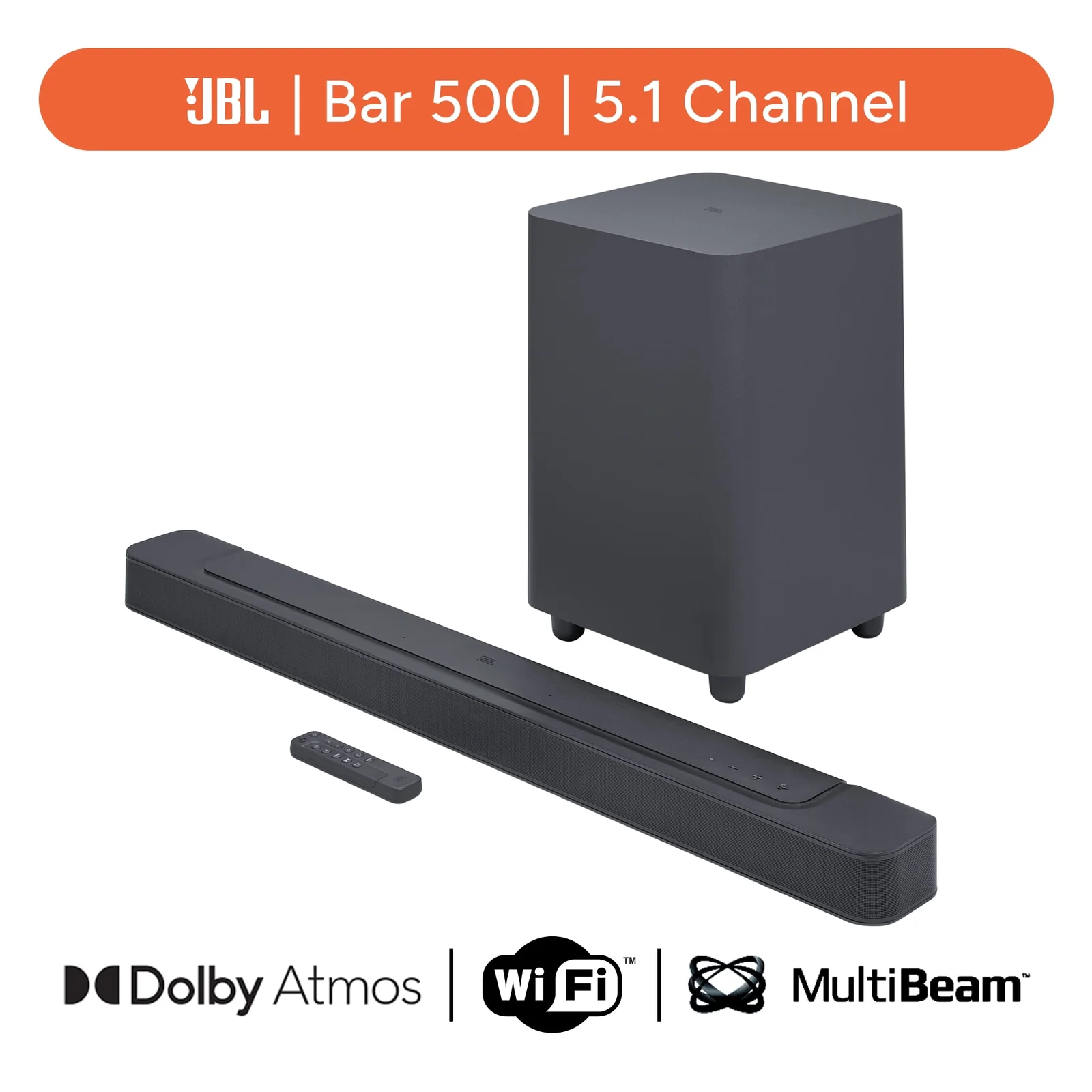
JBL Bar 5.1 Soundbar
By JBL · Soundbars · Desk & Streaming Setup · More from JBL
- 550W total system power
- 40Hz-20kHz frequency response
- 10-inch wireless subwoofer
- Bluetooth 4.2
- HDMI 4K pass-through
Price not listed
- JBLView at JBL
- WalmartView at Walmart
- eBayView at eBay
- AmazonView at Amazon (paid link)
- eBay (used) eBay: used, open-box, refurbishedView at eBay (used)
Stores are listed in a fixed order, never by price or commission. Prices are snapshots. Check the current price with the store.
Summary
A 2019/2020 40.1-inch soundbar with JBL MultiBeam virtual surround and a separate 10-inch wireless subwoofer, HDMI ARC, one HDMI input, Wi-Fi, AirPlay 2, Chromecast and Ethernet. This is the BAR51SURROUND model with no detachable rear speakers, but published peak amplifier output is 550W at 1% THD.
Strengths
- Convincing virtual enveloping sound without rear speakers: Tom’s Guide (Dec 2020) found motion around the room surprisingly convincing for this class while still below proper 5.1 separation. RTINGS finds room calibration, center-channel speech clarity, and balanced music, with a more modest description of virtual surround. TechAdvisor found MultiBeam effective.
- Real center driver and legible voices: RTINGS explicitly credits a discrete center-channel speaker for clearer dialogue; Tom’s Guide praised speech clarity across movies and musical theater.
- Network and video flexibility: AirPlay 2, Chromecast, Ethernet, Wi-Fi, and Bluetooth, plus HDMI IN, HDMI ARC, and optical offer more choices than cheap HDMI-ARC-only sets.
- Auto calibration built into bar: no separate external measurement mic to lose. Unlike earlier JBL BAR 5.1, the remote initiates calibration through the bar’s own mic. Accounts for some seating/room differences in the front/side virtual image; cannot substitute for actual rear drivers or install Atmos.
Weaknesses
- Subwoofer pairing and wireless dropouts: bar and sub are factory paired; manual documents explicit re-pairing for lost link (hold sub rear pairing until rapid white flash; on remote hold BASS >5 seconds, press minus, wait for “PAIRING” then “CONNECTED”; if sub times out after 3 minutes, retry closer). Manual specifies distinct 5 GHz wireless sub link. January 2025 Reddit owner describing “bar 5.1” wireless fail-pairing after 4 years did not prove the SURROUND subtype; 2023 posts explicitly identified the older detachable model. Pairing test is essential because an unmatched SUB may cost more than the used set.
- 5 GHz wireless congestion/crackles: both home Wi-Fi and sub links operate in 5 GHz-related bands by maker spec. Reddit users report crackling and re-sync with “JBL 5.1”; one 2023 thread explicitly reveals the poster owns the detachable-satellite version, so do not attribute that case to this Surround model. Quantified exact-model interference frequency and guaranteed best router channel: no reports found.
- HDMI ARC handshake compatibility: JBL published firmware 20-43-51-00 explicitly to improve HDMI ARC compatibility with TVs. Credible first-party evidence of previous firmware-related incompatibility class, but does not prove all individual HDR or audio dropouts are solved or current firmware version. Test TV native app, HDMI IN source, optical as control, and HDCP/CEC toggles.
- Wi-Fi/Chromecast/AirPlay discovery issues: JBL manual troubleshooting lists Wi-Fi not joining, Google Home app failing to find bar, AirPlay device not appearing when Wi-Fi network or smartphone differs. Checklist: network enabled, correct SSID, same Wi-Fi LAN, router within range, compatible OS streaming version. Documented support troubleshooting, not measured defect incidence. Hardwired Ethernet can remove one network variable.
- Too much bass or harsh/closed treble, limited EQ: TechRadar’s initial hands-on warned sub can overpower mids/voices; LBTech found overtones recessed and too little air; Tom’s Guide heard harsh upper frequencies in some material. RTINGS specifically says no bass and treble EQ (sub-volume control is not a bass-shelf equalizer). Move the sub, reduce sub level, use room calibration; DSP cannot repair every tonal preference.
Verified specifications
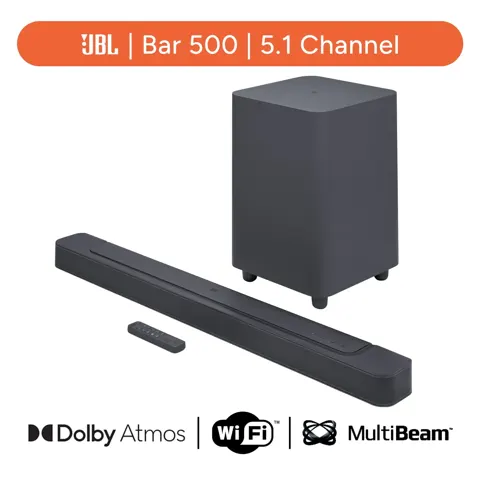
| Driver architecture | soundbar has 5 racetrack speakers + 2 side-firing 1.25-inch tweeters; separate powered 10-inch subwoofer. Published peaks: 5×50W bar, 300W sub, 550W total at 1% THD. No separate rear speakers, battery-powered satellites, or ceiling-firing Atmos height drivers. |
|---|---|
| Maximum SPL | 103 dB maker claim; 2019/2020 brochure frequency response 40 Hz–20 kHz; 2024+ manual specifies 34 Hz–20 kHz. These are incompatible first-party versions with no measurement tolerance or evidence a buyer’s US unit reliably meets the lower 34 Hz limit. |
| Dimensions | soundbar 1018×58×100 mm (40.1×2.3×3.9 in); subwoofer 305×440×305 mm (12×17.3×12 in). Weight conflict: 2020 US spec sheet says 3.06 kg bar, 10.62 kg sub; earlier JBL sheet says 2.85 kg bar. Treat as manufacturer revision conflict, not independently measured. |
| HDMI | one HDMI IN, one HDMI OUT with ARC. US MRM spec sheet lists HDCP 2.2; early global sheet/manual says HDCP 2.3. No official full-bandwidth HDMI 2.1/4K120/VRR/ALLM pass-through. JBL advertises 4K UHD HDR/Dolby Vision pass-through; source and TV format support must be checked. Output labeled ARC, not eARC. |
| Other inputs | one TOSLINK optical, Bluetooth 4.2 (A2DP/AVRCP), USB Type A, one Ethernet LAN jack, dual-band Wi-Fi 802.11a/b/g/n/ac (2.4 and 5 GHz). No analog 3.5 mm AUX. US version supports MP3 playback via USB (80–320 kbps, 16–48 kHz); international variants commonly designate USB for service only. No reliable proof USB works as PC DAC or plays FLAC. |
| Streaming | Chromecast built-in, Apple AirPlay 2, Alexa Multi-Room Music (MRM) per US manual. This is audio receiving capability, not a microphone-equipped voice assistant. |
| Automatic Multibeam Calibration (AMC) | built-in microphone on top of soundbar. Place bar in final position, hold HDMI on remote ~5 seconds, follow loud countdown tones, check “DONE” not “FAILED”. RTINGS and Tom’s Guide confirm the feature. |
| DSP | 5.1-channel Dolby Digital listening with JBL MultiBeam virtual surround and Smart Mode. No Dolby Atmos object decoding. Limited DSP controls—no conventional multi-band EQ, separate bass/treble sliders, or dedicated dialogue enhancement in RTINGS’ tested unit. |
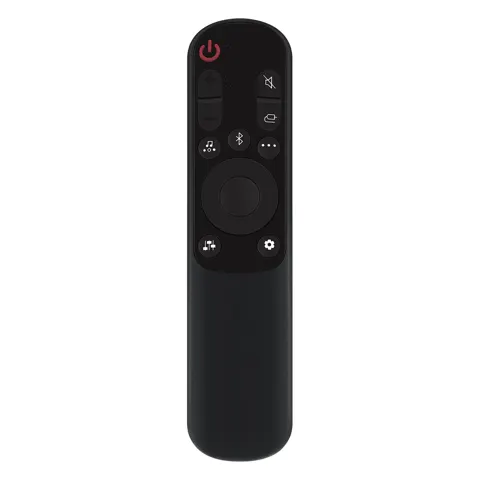
| Remote | original infrared handheld requiring 2×AAA; USA replacement JBLBAR51BLKRC ($19.95 reference, SOLD OUT). Distinguish from remotes for original detachable Bar 5.1. |
| Original box | bar, matched wireless sub, remote with AAA cells, two AC power cords (region varies), HDMI cable, wall-mount bracket kit/screws, template, paper manuals/warranty card. No rear speakers, powered satellite receivers, or microphone stand. |
| Network standby | <2.0W network standby, <0.5W regular standby, <10 min to standby. 550W is maximum audio output, not wall input power. Rated 100–240V AC, 50/60 Hz; recommended ambient 0–45°C. |
| Warranty | US official terms: 1-year limited manufacturer’s warranty from original retail delivery, only for products from authorized US reseller, used in US. Parts have separate 90-day warranty. A used 2019–2020 JBL in 2026 normally has no remaining original term; third-party Allstate 1-year $24.99 policy is not a fresh JBL factory warranty. |
Full research notes and sources
HDMI ARC and wireless subwoofer behavior
The ARC handshake and 5 GHz subwoofer link are the two main technical variables. Firmware 20-43-51-00 (Dec 2020) targeted ARC compatibility; verify actual installed version and use maker updates only. For the subwoofer, keep it away from densely packed router and metal obstruction, power-cycle, move closer, re-pair with official sequence, and test heavy bass over a long scene. No quantified exact-model interference frequency or guaranteed best router channel found. An unmatched SUB may cost more than the used set; pairing test before purchase is essential.
Sound quality: bass, dialogue, and virtual surround
RTINGS credits a discrete center-channel speaker for clearer dialogue; Tom’s Guide praised speech clarity across movies and musical theater. MultiBeam virtual surround is convincing for the class but below proper 5.1 speaker separation (Tom’s Guide); RTINGS finds surround illusion inferior to discrete rear systems. TechRadar’s 2019 hands-on found the 10-inch sub “overwhelming” in demos, masking voices; LBTech found overtones recessed and too little air; Tom’s Guide heard harsh upper frequencies in some material. No conventional bass/treble EQ or graphic EQ; sub-volume control and Smart Mode processing are the only tonal adjustments.
Parts and consumables
No mandated filters, proprietary rechargeable rear-speaker battery replacements, amplifier fluid, or paid firmware subscription. The older detachable Bar 5.1 has satellite battery replacements; the Surround has no such satellites/batteries.
- Genuine IR remote — JBL item JBLBAR51BLKRC: JBL listed $19.95, SOLD OUT; correct name “Remote control for Bar 5.1 Surround.” Original remote powered by two AAA batteries (included in new box, separate for replacements). No lifetime or battery-change interval published.
- Aftermarket model-specific remote — Remotes.net RT06SB510URC0S: $34.90 with 90-day return policy; seller claims full original-function compatibility with “JBL BAR 5.1 SURROUND.” NOT genuine JBL; verify remote has HDMI/calibration and bass functions for this model. Replace only if remote lost/broken, not yearly.
- Soundbar CNTR, side tweeters, five racetrack drivers, AMC microphone: exact original spare assembly numbers, US service parts inventory, installed repair labor, and regular replacement intervals not found. Power/electronics enclosure requires qualified service.
- Wall brackets, screws, printed template: included originally. Specific OEM separate spare part number/US offer not found. Use wall fasteners appropriate to actual wall material and load; do not mount above a TV without safe hardware.
- USB storage device for MP3/official firmware: optional, not original required consumable. Only use JBL’s official exact-model files and checksum; generic flash media is sufficient when supported, no paid firmware license.
- Streaming services: Chromecast/AirPlay don’t require a direct JBL subscription, although commercial music providers might.
Running costs
Power consumption: JBL rates maximum audio amplifier output 550W, which is not actual AC draw. US technical sheet reports <2.0W network standby, <0.5W regular standby, <10 min until standby; no verified active watts across normal movies or high subwoofer volumes. Annual bill cannot be asserted as a manufacturer-measured single figure.
Explicit hypothetical illustration: if both units together average 60W from the wall for 3 h/day (assumed, not measured), active energy 0.06 kW × 1,095 h = 65.7 kWh/year. At assumed $0.20/kWh this is $13.14. If remaining 21 h/day at maximum published network standby <2W were continuously approached, standby would be <15.33 kWh/year (<$3.07); combined under these assumptions about <$16.21/year. A non-network standby could be less. These are illustrative usage/rate inputs, not an exact JBL user’s annual energy measurement.
Regular service: no disposable consumables; 2×AAA remote batteries vary with use. Remote replacement at $34.90 if lost and/or unplanned sub/board repair should not be presented as a recurring annual fee without incidence data. A complete older set failing outside warranty may be uneconomical to repair versus new $149–200 alternatives. No reliable exact-model mean annual repair spending.
Is it worth it?
$90–125 local for a COMPLETE functioning matched BAR51SURROUND is strong given the 10-inch sub, Wi-Fi, and HDMI IN, assuming successful pairing and return window. $125–175 delivered can be reasonable if bass output, network streaming, and lack of rear wires are priorities. $175–225 is conditional on extraordinary condition, confirmed remote and original sub, since entirely new VIZIO/Insignia with actual surrounds are competitively priced. $249 delivered eBay offer is hard to favor except for JBL-specific bass preference and confirmed reliability/returns. Above $300 used, poor general value; $599.95 original MSRP makes no sense in 2026. These are buyer-value judgments, not inferred national market statistics.
Which model this is
It is NOT the earlier 2017 JBL Bar 5.1 with two detachable battery-powered rear speakers, three HDMI inputs, and 510W. The Bar 5.1 Surround has NO detached or actual rear loudspeakers, one HDMI input, and 550W published peak amplifier output. The bar is labeled Bar 5.1 CNTR and the sub Bar 5.1 SUB in official documentation. Both the product title and numerous online listings omit “Surround,” causing severe review/parts/price confusion. ASIN not confirmed in sources.
Sources
Manufacturer:
- JBL USA exact BAR51SURROUND official product page, $599.95 sold out
- JBL 2020 USA BAR 5.1 SURROUND manufacturer spec sheet, PDF; 40Hz, HDCP2.2, 3.06kg, standby
- JBL official BAR 5.1 SURROUND owner’s manual V7 EN PDF, 21 pages, wiring, calibration, setup and troubleshooting
- JBL early global 2019 Bar 5.1 Surround spec sheet, HDCP 2.3 / 40Hz / 2.85kg variant
- JBL global product specs: LAN/Wi-Fi, USA MP3 playback, Bluetooth 4.2, no analog AUX
- Harman official US exact BAR 5.1 SURROUND USB update instructions, read firmware and reset
- JBL manufacturer BAR 5.1 Surround troubleshooting PDF: Wi-Fi, AirPlay, Google Home, Bluetooth
- JBL United States official one-year powered Home Audio warranty eligibility and conditions
- JBL USA original Bar 5.1 Surround remote JBLBAR51BLKRC, $19.95 SOLD OUT
Independent reviews:
Owner reports:
- Reddit r/Soundbars Aug 2025–Mar 2026 exact NON-DETACHABLE Bar 5.1 Surround no-power after ~3 years
- Reddit r/JBL broad Bar 5.1 subwoofer reconnection reports, variant uncertain
- Reddit r/Soundbars 2023 subwoofer interference thread confirmed DIFFERENT detachable-speaker model
- Reddit Jan 2025 “JBL 5.1 sub disconnected” 4+ year owner, version not reliably identified
Parts and stores:
- Walmart exact 640473892 JBL Bar 5.1 Surround, $599.95 out of stock and owner comments
- eBay exact used Bar 5.1 Surround with sub and remote, $219 plus $30 shipping
- Remotes.net aftermarket exact JBL Bar 5.1 Surround RT06SB510URC0S remote, $34.90
- Walmart VIZIO SV510X-0806 new 5.1 $149 and stock/region caveats
- Best Buy Insignia NS-SB512 new 5.1.2 Dolby Atmos $179.99 promotional offer
- Best Buy JBL BAR 500 MK2 newer Atmos soundbar with 10-inch sub, $649.95 reference
- ManualsLib older JBL Bar 5.1 detachable speaker SERVICE manual firmware unify.bin instructions, DIFFERENT firmware