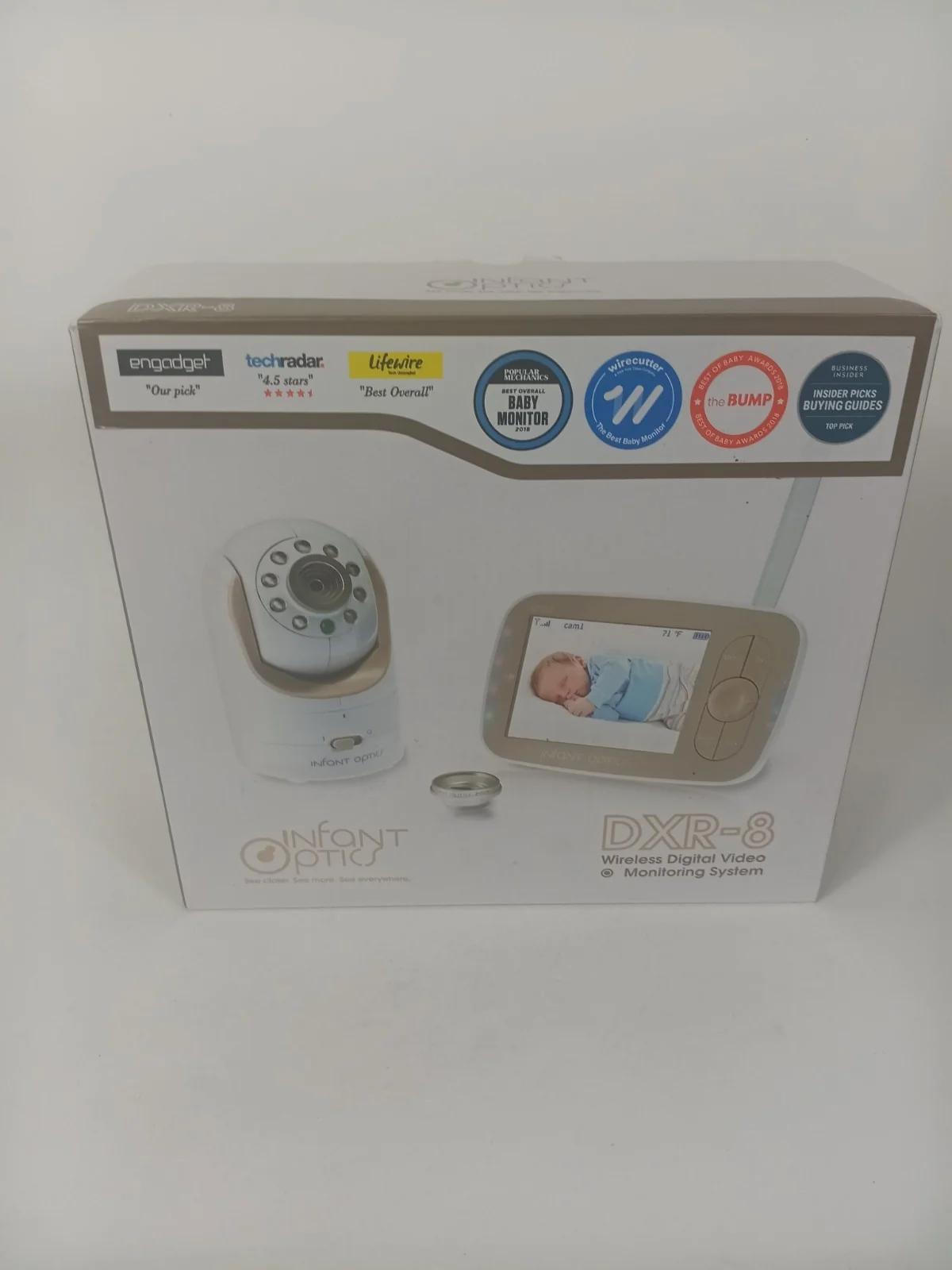
Infant Optics DXR-8 Baby Monitor
By Infant Optics · Baby Monitors · Cleaning & Smart Home · More from Infant Optics
- 3.5-inch QVGA display
- FHSS 2.4GHz connectivity
- Up to 700 ft signal range
- Remote pan/tilt/zoom camera
- Supports up to 4 cameras
Price not listed
- Infant OpticsView at Infant Optics
- TargetView at Target
- WalmartView at Walmart
- eBayView at eBay
- AmazonView at Amazon (paid link)
- eBay (used) eBay: used, open-box, refurbishedView at eBay (used)
Stores are listed in a fixed order, never by price or commission. Prices are snapshots. Check the current price with the store.
Summary
A closed, non-WiFi baby monitor for parents who want no app, cloud account or subscription, with a 3.5-inch screen, remote pan/tilt/zoom and interchangeable lenses. Check your floors before you buy: measured indoor range is four walls and 65 ft, and a two-year owner lost the connection between floors.
Strengths
- No app, cloud account or subscription; the link needs no router and cannot drop when home WiFi goes down.
- Interchangeable screw-in lenses, with an optical zoom lens in the box, a rare feature in baby monitors.
- Easy setup and automatic pairing; BabyGearLab rated it first in its group for ease of use at 7.0.
- Long runtime on a new unit: BabyGearLab measured 11.5 hours and PCMag saw no low-battery warning for 12 hours.
- Sturdy hardware; TechRadar’s camera survived repeated falls off the crib rail.
- The sound-activated LED bar works with the screen off, so you can see crying without audio.
Weaknesses
- Measured indoor range is four walls and 65 ft; open-field signal broke up around 650 ft and was gone at 750 ft.
- PCMag’s unit threw spurious “out of signal” alerts indoors and out and cut its feed three times at about 200 ft.
- No sound activation and no sensitivity control, so the volume has to sit low and a sound sleeper can miss a cry.
- Narrow pan/tilt travel: the camera loses the baby standing at one side of the crib with the standard lens.
- The temperature sensor read 73.4 °F in a nursery that was actually 75 °F.
- Testers reported choppy camera pan and image/navigation desync after a few weeks, fixed by a power cycle.
Verified specifications
| Display | 3.5-inch QVGA; PCMag’s spec table gives 640 by 480. |
|---|---|
| Link | private FHSS on 2.4 GHz, encrypted; no app, cloud or subscription. |
| Range | up to 700 ft claimed, qualified by Infant Optics as line of sight. |
| Camera | remote pan/tilt plus digital zoom; BabyGearLab measures pan 270° and tilt 120°. |
| Cameras | up to 4 cameras supported. |
| Audio | two-way talk and a sound-activated LED bar; BabyGearLab measured a maximum sound level of 86 dBa. |
| Night vision | automatic infrared with no visible red glow; PCMag counted eight LED sensors. |
| Temperature | built-in remote readout shown on the parent unit. |
| Battery | user-replaceable lithium-ion cell; PCMag measured a 1,200 mAh pack. Infant Optics claims 10 hours standby and about 6.5 hours with the screen on. |
| Dimensions | 4.88 × 3.13 × 0.88 in; 5.38 oz. |
| Warranty | 1 year. |
| In the box | parent monitor, camera unit, optical zoom lens, power adapters for both units, USB power cable, wall screw and anchor. |
Full research notes and sources
Range and signal
The headline figure needs the manufacturer’s own qualification: the spec table says “up to 700 feet (line of sight)”. BabyGearLab measured an indoor range of four walls and 65 ft; in open field the signal held to 600 ft, began breaking up around 650 ft and was gone by 750 ft. PCMag’s unit threw spurious “out of signal” alerts indoors and outdoors and cut its feed three times during a slow walk at roughly 200 ft. The 2.4 GHz link also interferes with home WiFi: PCMag measured slightly more interference than a Motorola MBP36 produced. If the nursery is more than one floor from where you sit, this is the wrong monitor.
Video, sound and temperature
Maximum sound measured 86 dBa, and because the monitor has no sound activation and no sensitivity control you keep the volume low to mask background noise, which risks sleeping through a cry. Daytime video is average with slightly darker colors, night video is darker than average and fuzzy at the edges, and there is no movement detection. The temperature sensor read 73.4 °F in a nursery that was actually 75 °F, which matters if you read it to judge sleep temperature. EMF from the camera measured 1.89 V/m at 6 ft, one of the highest in that test group, which argues for mounting it as far from the crib as the optics allow.
Battery and long-term use
On a new unit the battery is genuinely good: BabyGearLab measured 11.5 hours, and PCMag’s unit gave no low-battery warning for 12 hours, against a manufacturer claim of 10 hours screen-off and about 6.5 hours with the screen on. The current product page states the parent-unit cell is user-replaceable, so a worn battery need not end the monitor. The one long-horizon owner report found the opposite: her display unit’s battery drained faster and faster over about two years of daily use until it had to stay plugged into a wall. The same account adds two complaints the lab tests miss: there is no clock on the screen, and her range failed in a house where the display unit sat in the first-floor kitchen and the camera in the second-floor bedroom.
Features and warranty
There is no app and no remote viewing away from the house; PCMag notes the only way to share the feed is to point a webcam at the parent unit’s screen. There are no prerecorded lullabies, no motion sensor, no nightlight, no out-of-range temperature alerts and no belt clip, and the screen sleeps automatically but does not wake automatically. Warranty is one year from the date of retail purchase, only for the original purchaser; Infant Optics may replace the unit rather than repair it, return shipping is not covered, and coverage applies only to products bought and used in the USA, with liability capped at the purchase price. Support is phone-based, 1-800-291-0195, seven days a week, 9AM-5PM PST, with an email response promised within 24 hours. Manuals, a quick-start guide and an add-on camera guide are published.
Is it worth it?
The manufacturer’s own page publishes $165.99 USD for the DXR-8 Full Kit (Infant Optics, 2026), but the same page carried an out-of-stock flag when checked, so the price a shopper would actually pay was not established. Against the measured performance, the DXR-8 earns its money below the $166 list price BabyGearLab used in 2022 for a buyer who values the lens system and the app-free, subscription-free design. At PCMag’s recorded $239.99 launch MSRP it is not competitive: WiFi monitors with movement detection, phone access and better night vision are the better buy. A PCMag price module showed $119 at Best Buy and $157 at Walmart on 2026-10-20. A 170-degree wide-angle lens was a separate $11.99 purchase (PCMag, 2014). BabyGearLab’s own alternatives for that money were the Babysense MaxView and the HelloBaby HB6550.
Which model this is
This page covers the DXR-8 Full Kit, a 3.5-inch QVGA parent unit with a pan/tilt/zoom camera on a private 2.4 GHz FHSS link. Do not confuse it with the DXR-8 PRO or DXR-8 PRO SS, the current HD models with split-screen, or the older DXR-6. The Amazon listing for the DXR-8 is ASIN B00ECHYTBI.
Sources
Manufacturer:
- Infant Optics DXR-8 user manual (PDF)
- Infant Optics DXR-8 Full Kit product page
- Infant Optics support, manuals and troubleshooting
- Infant Optics DXR-8 quick-start guide (PDF)
- Infant Optics DXR-8 add-on camera guide (PDF)
- Infant Optics warranty terms
- Infant Optics homepage
Independent reviews:
Owner reports:
- No Reddit or parent-forum thread was read for this review; the closest owner account is the New York Magazine piece above.