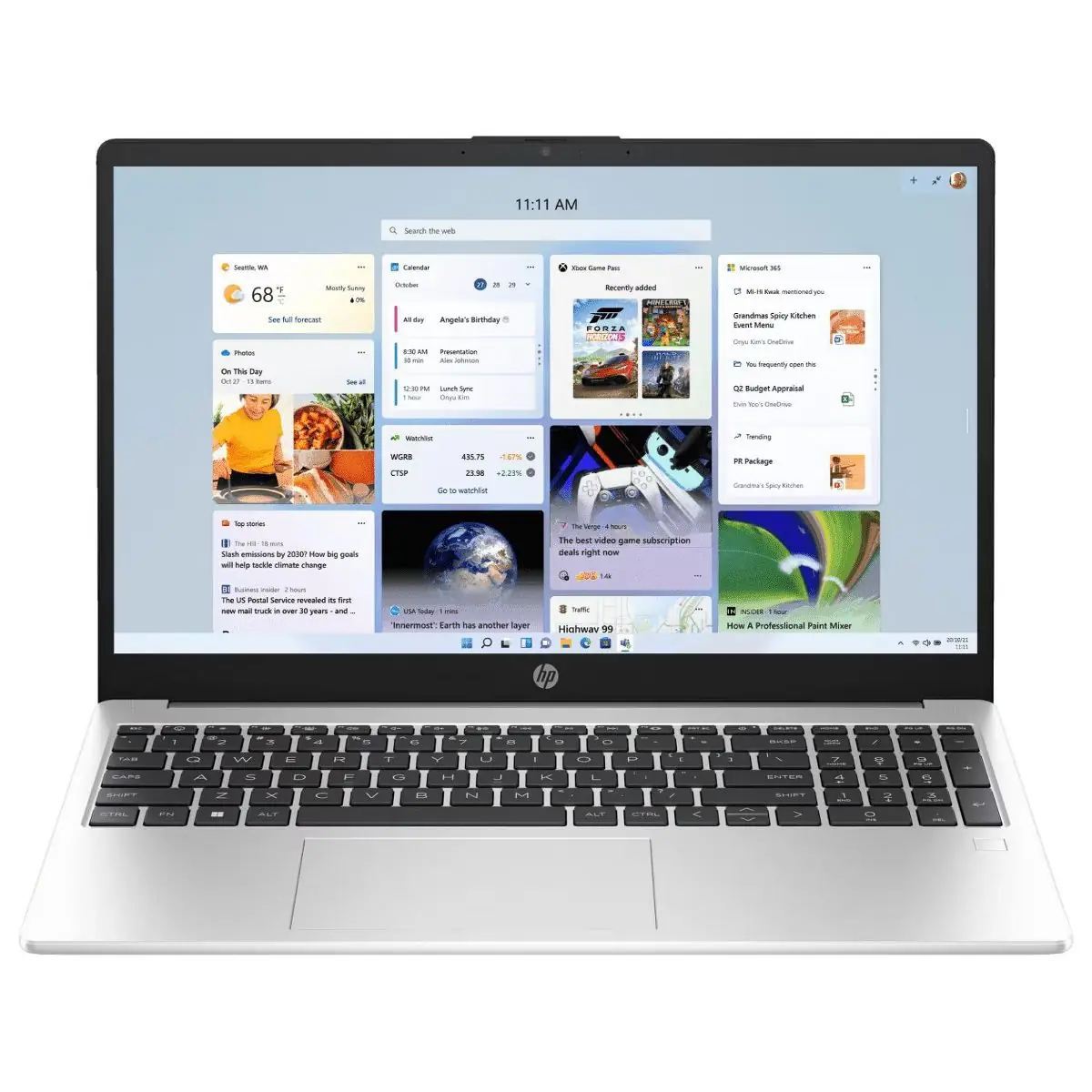
HP 255 G10
By HP · Laptops · Phones & Computers · More from HP
- 15.6" FHD (1920x1080) IPS display, 250 nits
- AMD Ryzen 5 7530U processor
- 16GB DDR4-3200 RAM
- 512GB PCIe NVMe SSD
- Wi-Fi 6, Bluetooth 5.3
Lowest price seen
~$699.99 (approx.)
from $699.99 at Amazon
- Amazon ~$699.99 (approx.)View at Amazon
- HPView at HP
- Best BuyView at Best Buy
- eBay (used) eBay: used, open-box, refurbishedView at eBay (used)
- eBayView at eBay
- WalmartView at Walmart
- TargetView at Target
- StaplesView at Staples
- Macy'sView at Macy's
Prices are snapshots. Check the current price with the store.
Summary
A budget 15.6-inch laptop with a 6-core Ryzen 5 7530U, 16GB of RAM and a 512GB SSD, built for office work, students and business fleets. The one thing to check before you buy is the 250-nit display: it is dim for bright rooms and near windows.
Strengths
- The 6-core, 12-thread Ryzen 5 7530U handles office work, browsing and light creative work with power to spare.
- Notebookcheck’s average Cinebench R23 multi-core score for this chip across 9 laptops is 8,313 points.
- 16GB of RAM and a 512GB NVMe SSD cover everyday productivity out of the box.
- One memory slot is free, so a second 16GB stick upgrades the laptop to dual-channel.
- User-serviceable RAM and SSD plus a service manual with parts diagrams keep upgrades simple.
Weaknesses
- The 250-nit display is the most visible compromise and struggles in bright rooms or near windows.
- The 720p webcam sits below the 1080p standard now common on mid-range laptops.
- A 41Wh battery is small for a 15.6-inch laptop, and competing budget laptops often carry 50Wh or more.
- Single-channel RAM in a 1x16GB layout handicaps the Vega 7 graphics and limits some CPU throughput.
- HDMI 1.4b caps external displays at 4K at 30Hz or 1080p at 120Hz.
- The TPM is firmware-based, which can matter for business buyers who need discrete security hardware.
Verified specifications
| Processor | AMD Ryzen 5 7530U, 6 cores / 12 threads, 2.0 GHz base, up to 4.5 GHz boost, 16 MB L3 cache, 15W default TDP. |
|---|---|
| Graphics | AMD Radeon RX Vega 7 integrated, 7 CUs at up to 2 GHz, shared memory. |
| Memory | 16GB DDR4-3200 (one 16GB SO-DIMM), two slots with one free, up to 64GB maximum. |
| Storage | 512GB PCIe NVMe SSD (M.2). |
| Display | 15.6-inch FHD (1920x1080) IPS, 250 nits, 60Hz, anti-glare, non-touch. |
| Camera | 720p HD webcam with a physical blocker. |
| Connectivity | Wi-Fi 6 (802.11ax) 2x2 and Bluetooth 5.3. |
| Ports | one USB-C 3.2 Gen 1, two USB-A 3.2 Gen 1, HDMI 1.4b and a 3.5mm audio combo. |
| Keyboard | full-size island-style with numeric keypad; no backlight on this configuration. |
| Battery | 3-cell 41Wh Li-ion polymer, with a 45W AC adapter in the box. |
| Operating system | Windows 11 Home. |
| Security | firmware TPM (software-based). |
| Dimensions | 14.17 × 9.29 × 0.73 in (359.92 × 235.97 × 18.50 mm); 3.30 lbs (1.50 kg). |
| Warranty | one year limited parts and labor (Micro Center listing). |
Full research notes and sources
Performance and everyday use
The Ryzen 5 7530U is a 2023 Barcelo refresh of the older Ryzen 5 5625U: six Zen 3 cores, 12 threads and a 200 MHz higher boost clock, at a 15W default TDP that keeps power draw modest. Notebookcheck aggregates Cinebench R23 results for this chip across 9 laptops and averages 8,313 points multi-core (range 6,931 to 9,347) and 1,437 single-core; the spread comes down to each chassis’s thermal design and power limits. In multi-threaded workloads it runs in the same league as the Core i5-1335U and the Ryzen 7 5800U. Feedback across laptops using this chip praises strong multi-threaded performance for the power envelope, good efficiency and competent integrated graphics for casual gaming; the recurring caution is thermal throttling in thin chassis.
No established laptop outlet has published an instrumented test of the exact HP 255 G10. The closest evidence is Notebookcheck’s October 2023 review of the HP ProBook 445 G10, a 14-inch business laptop built around the same processor, rated “good (85%)”. HP ran that chip at 25W sustained and 30W burst with stable long-term performance and no throttling. Its 14-inch panel measured 464 nits average brightness with 1,927:1 contrast, 95.2% sRGB and 68.4% DCI-P3, well ahead of the 250-nit screen on the 255 G10, and its Realtek Wi-Fi 6 card measured 1,375 MBit/s transmit and 1,750 MBit/s receive in iperf3 testing. The ProBook’s keyboard was called “much spongier” than HP’s premium laptops and its touchpad “unspectacular”. Battery and weight are close (42Wh, 1.32 kg), and the review unit carried 16GB of dual-channel DDR4-3200 and a 512GB Kioxia BG5 SSD at 830 EUR (about $880 at the time). Treat the ProBook as context for what this processor can do, not as a test of the 255 G10 itself.
Display, camera and battery
The 250-nit FHD IPS panel is the compromise you notice every day. HP’s own QuickSpecs lists a 300-nit FHD option on other configurations, but this is the 250-nit variant, and it will struggle outdoors or beside a bright window. The 720p camera is the other cost cut that matters for video calls; the related ProBook 445 G10 carries a sharper 5MP camera. The 41Wh battery is small for a 15.6-inch laptop; competing budget laptops often carry 50Wh or more, and the 45W adapter limits fast charging. Nobody has tested whether the USB-C port supports DisplayPort alt-mode or power delivery.
Upgrades, warranty and running costs
Two SO-DIMM slots ship with one free, so a second 16GB stick moves the laptop from single- to dual-channel and lifts the Vega 7 graphics. The SSD is a standard M.2 NVMe drive, and HP publishes service manuals for the 255 G10 series with parts diagrams. Warranty is one year limited parts and labor per the Micro Center listing. Running costs are limited to standard laptop ownership: there are no subscriptions or consumables, and RAM and SSD upgrades are user-serviceable. No exact-model reliability data, failure rates or common service issues have been published, so long-term durability is untested rather than proven.
Is it worth it?
Value depends on street price. At or below $400, the 7530U with 16GB and 512GB is strong value for everyday productivity, students and business deployment. Between $400 and $500, it is fair value: competing laptops may offer brighter displays, 1080p cameras, larger batteries or newer processors. Above $500, value is weak, and buyers should expect Ryzen 7040/8040 or Intel Core Ultra platforms, better displays and more premium construction at that money. The single biggest value limitation is the 250-nit display paired with the 720p camera. Street pricing from other retailers was not captured in the research window, so treat these thresholds as a frame, not a live quote.
Which model this is
This page covers the HP 255 G10 Notebook PC with the Ryzen 5 7530U, 16GB DDR4-3200 (1x16GB), 512GB SSD and 15.6-inch FHD 250-nit display, sold on Amazon US under ASIN B0H6FG31Q2 (Micro Center SKU 899773, part BH0Z7UA#ABA). Do not confuse it with the HP 255R G10, a refreshed model with Ryzen 5 7535U or Ryzen 7 7735U processors, or with the HP 250 G10 and HP ProBook 455 G10.
Sources
Manufacturer:
Independent reviews:
- Notebookcheck: AMD Ryzen 5 7530U benchmarks and specs
- Notebookcheck: HP ProBook 445 G10 review (same processor, context only)
Owner reports:
- No exact-model owner threads were found in this research.
Retailer listings: