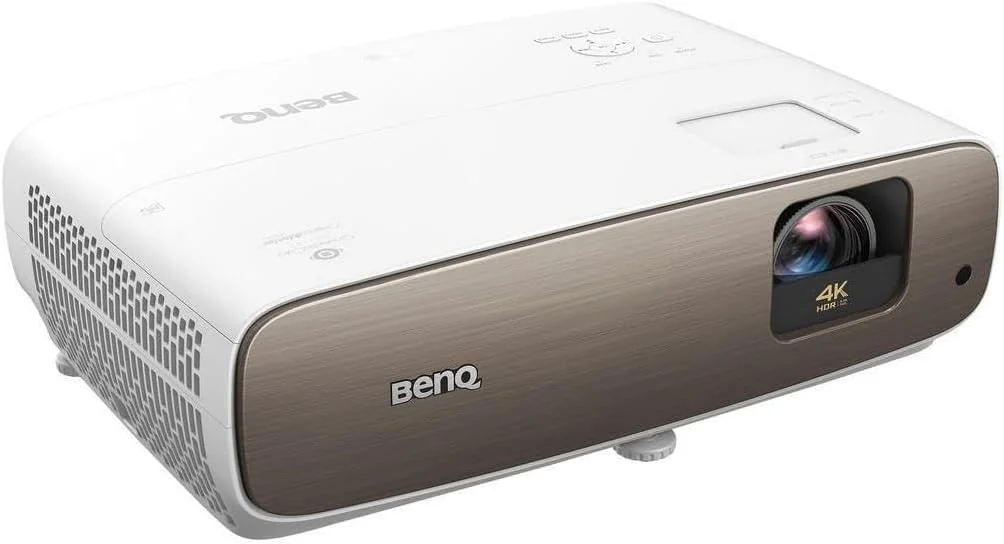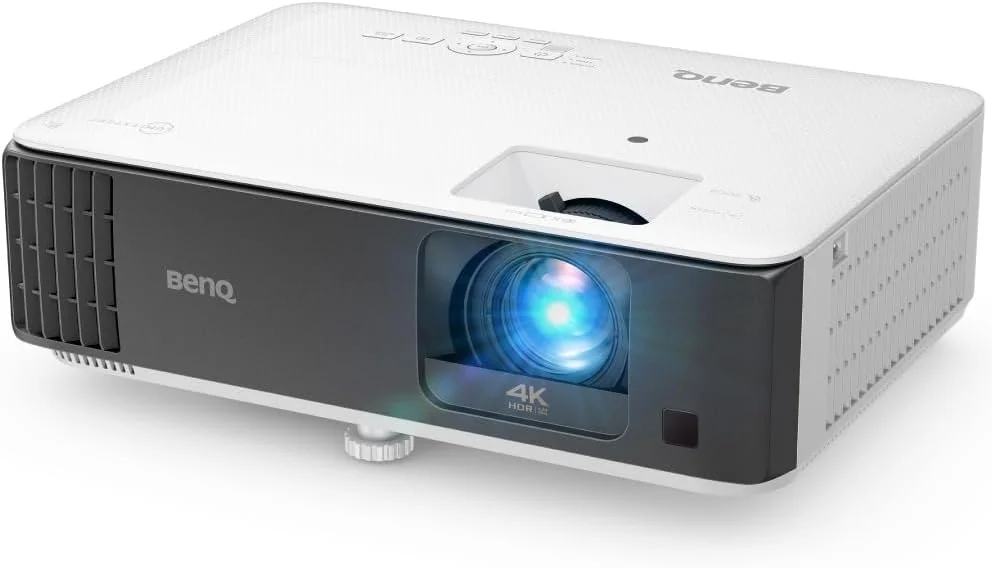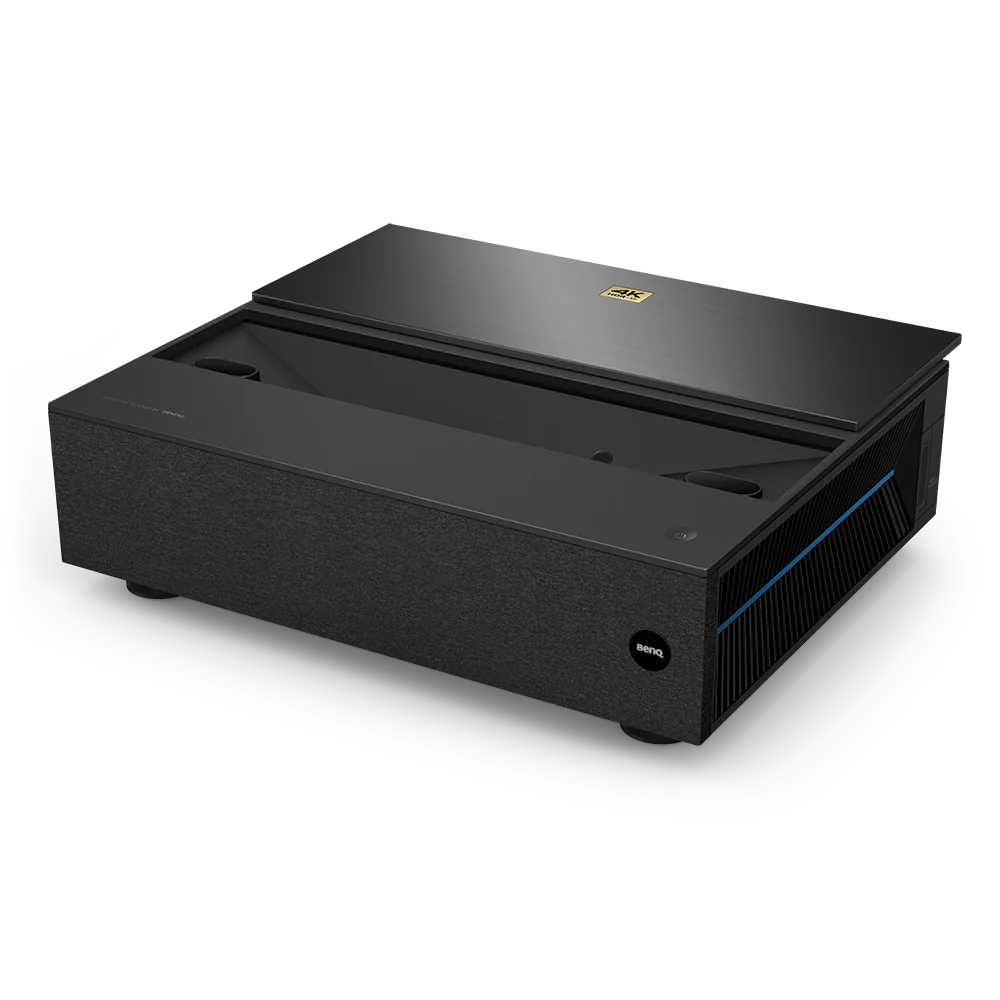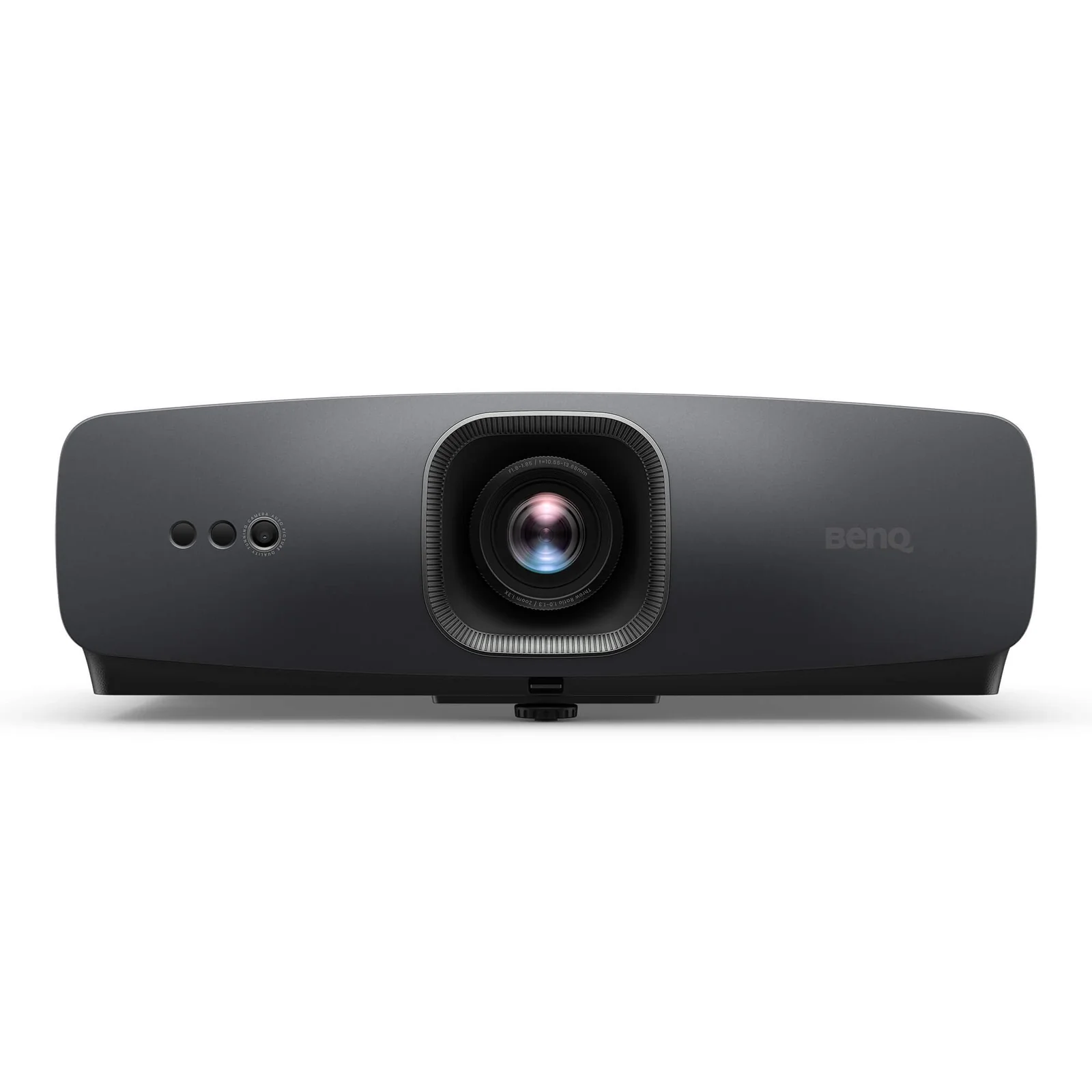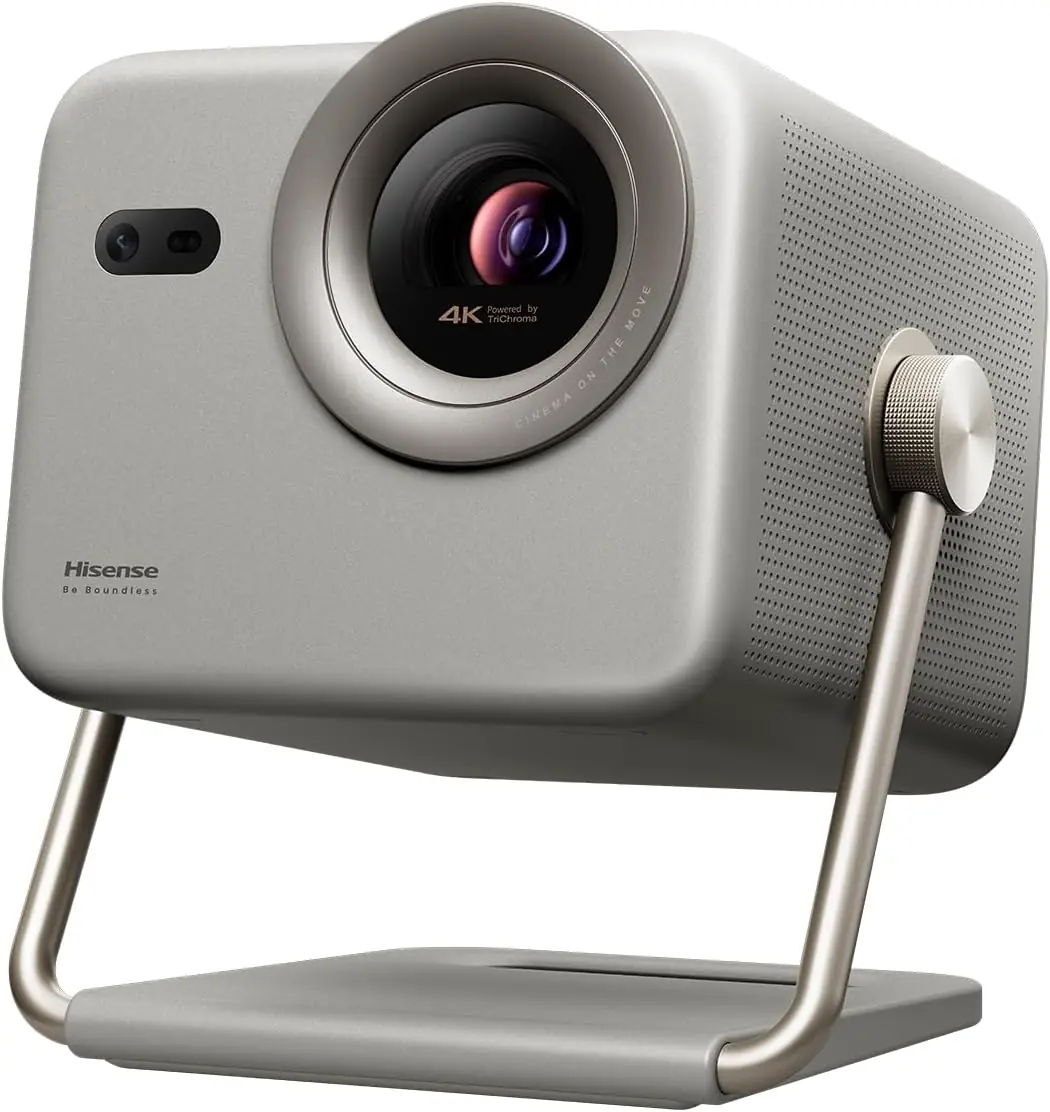
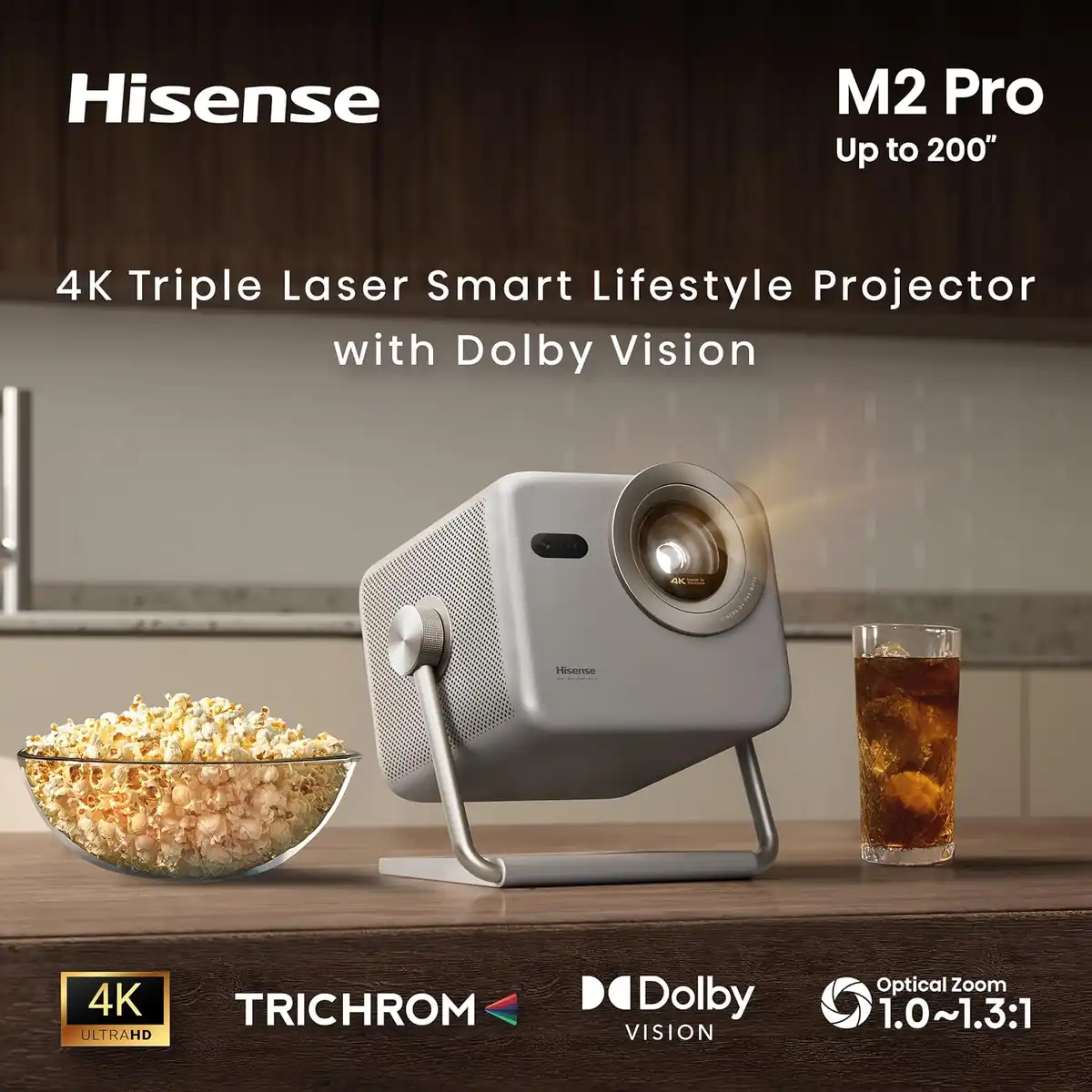
Hisense M2 Pro Smart Projector
By Hisense · Smart Projectors · Audio & Electronics
- 1,300 ANSI lumens brightness
- 4K (3840x2160) with 4K AI upscaling on a 0.47" DMD chip
- R+G+B triple laser light source, 25,000+ hour lifespan
- 65"-200" projection size, optical and digital zoom, 1.0-1.3:1 throw ratio
- 240 Hz high refresh rate, 1,000:1 native contrast, 110% BT.2020 color space
Price not listed
- HisenseView at Hisense
- B&H PhotoView at B&H Photo
- eBayView at eBay
- AmazonView at Amazon (paid link)
- eBay (used) eBay: used, open-box, refurbishedView at eBay (used)
Stores are listed in a fixed order, never by price or commission. Prices are snapshots. Check the current price with the store.
Summary
A compact 4K triple-laser projector with 1,300 ANSI lumens, wide color and a 1.3x optical zoom, built for a dark room and a short throw. Check your room before you buy: 1,300 lumens will not fill a bright living room or a 200-inch screen.
Strengths
- A 1.3x optical zoom is rare in a portable projector, and the stand rotates 360 degrees for ceiling use.
- Setup is largely automatic: autofocus, keystone, screen fit, obstacle avoidance and wall-color correction.
- Portable at 8.6 lb, with the carrying case in the box.
- The 2 × 10 W speakers are louder than portables usually manage, and the unit doubles as a Bluetooth speaker.
- The laser is rated for 25,000+ hours, so there is no lamp in your future.
Weaknesses
- Rainbow artifacts showed up more often than on most DLP projectors when viewing in a dark room.
- One HDMI port and no Ethernet, so one source at a time and no wired network.
- No built-in battery: the power brick has to travel with the projector.
- Auto keystone proved unreliable in one hands-on test, and the manual adjustment range was small.
- One buyer on the Hisense store reports the projector cutting out every ~30 seconds with no reply from the help line.
Verified specifications
| Display | 3840 × 2160 via XPR fast-switch pixel shifting on a 0.47" DMD (native 1920 × 1080). |
|---|---|
| Brightness | 1,300 ANSI lumens. |
| Color | 110% BT.2020. |
| Native contrast | 1,000:1. |
| Light source | R+G+B triple laser, rated for 25,000+ hours. |
| HDR | Dolby Vision, HDR10, HDR10+ and HLG. |
| Throw ratio | 1.0-1.3:1 with a 1.3x optical zoom and powered focus; optical plus digital zoom reaches 2.4x overall. |
| Image size | 65" to 200". |
| Refresh | 240 Hz (HSR240) at reduced resolution, or 4K at 60 Hz; no 4K at 120 Hz. |
| Audio | 2 × 10 W with Dolby Digital and DTS Virtual:X, plus a Bluetooth Music Sharing speaker mode. |
| Smart platform | VIDAA OS with Netflix, Prime Video, YouTube, Disney+ and Apple TV+. |
| Ports and wireless | HDMI 2.1 with eARC and ALLM, USB 3.0, Wi-Fi 802.11a/b/g/n/ac, Bluetooth 5.0, AirPlay 2 and Miracast. No Ethernet port. |
| Auto setup | autofocus, auto keystone in both directions, auto screen fit, auto obstacle avoidance, wall color adaptation and eye protection. |
| 3D | active DLP-Link glasses, with top-bottom, left-right and frame-packing formats; Blu-ray 3D did not play in testing. |
| Power | 100 W, 100-120 V, 19 VDC 5.26 A through a power brick; standby under 0.5 W. |
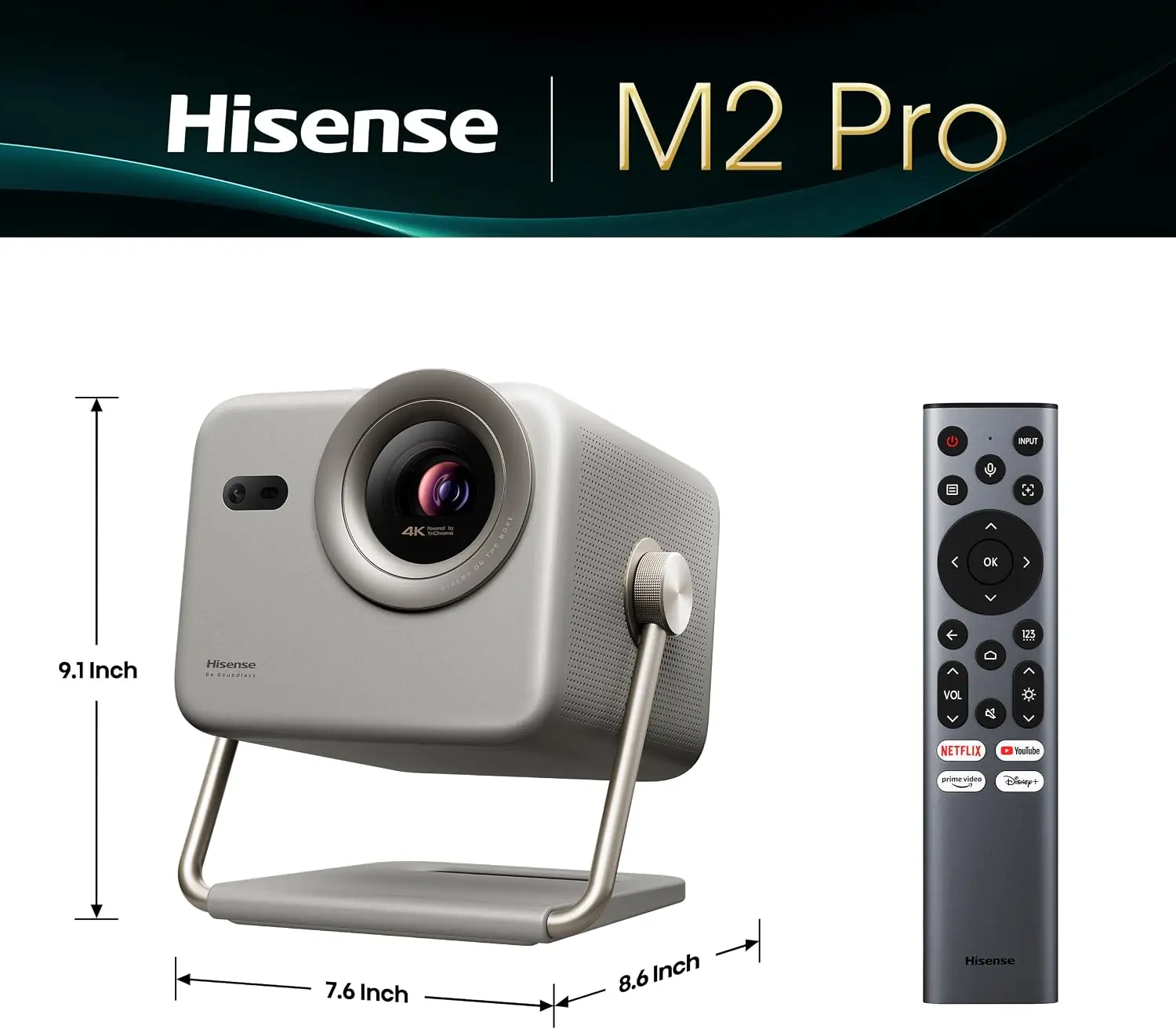
| Dimensions | 7.6 × 8.6 × 9.1 in (193 × 218 × 230 mm); 3.9 kg (8.6 lb). |
| Warranty | one year limited. |
| In the box | voice remote, power cable, quick start guide and a carrying case. No built-in battery. |
Full research notes and sources
Brightness, color and rainbow artifacts
Trusted Reviews says the picture looks brighter than its rating.
Size is where the light runs out. PCMag’s calculation from the ANSI figure puts 1,300 lumens at roughly 140" to 190" on a 1.0-gain screen in a dark room. Mashable ran it as a main display for two months and found daytime viewing acceptable in winter.
Digital geometry costs you brightness. PCMag notes that auto keystone and the other digital adjustments dim the image for a given screen size and can introduce artifacts. If you have a screen, place the projector square to it instead of leaning on the correction.
The triple laser is the reason for the color. The light source is rated for 25,000+ hours.
The catch is what a triple laser does in a dark room. Nobody has published a failure rate for this model, so treat the rainbows as a known trait of the light source rather than a defect.
Gaming and input lag
The refresh rate is the headline number, and it comes with a catch. The projector runs at 240 Hz in HSR240 mode, but only at reduced resolution: the modes are 4K at 60 Hz or 2K at 240 Hz, and no 4K at 120 Hz mode is documented. The HDMI 2.1 port carries eARC and ALLM, so a console can drop into low-latency mode on its own.
Input lag is where the reviews disagree. PCMag could not measure at all, because the unit would not sync with the Bodnar 4K Lag Tester. Plan on 2K at 240 Hz rather than 4K at 120 Hz, and treat the maker’s lag figures as unverified.
Setup, streaming and sound
Setup is mostly automatic. The projector autofocuses, corrects keystone in both directions, fits the image to the screen, avoids obstacles, adapts to wall color and carries eye protection. Man of Many found the auto keystone unreliable and the manual range small, so line it up square to the screen instead. There is no lens shift and no interchangeable lens, but the 1.3x optical zoom is unusual at this size, and the stand rotates 360 degrees horizontally and tilts for ceiling projection.
Streaming runs on VIDAA OS, with Netflix, Prime Video, YouTube, Disney+ and Apple TV+ built in, so a streaming stick is optional. Connectivity is one HDMI 2.1 port, USB 3.0, Wi-Fi 802.11a/b/g/n/ac, Bluetooth 5.0, AirPlay 2 and Miracast.
Sound is 2 × 10 W with Dolby Digital and DTS Virtual:X. PCMag and Trusted Reviews rate it above what portable projectors usually deliver; Man of Many calls it tinny. Hisense’s spec sheet calls the voice remote backlit, while ProjectorReviews says it is not, so check the one in the box.
Owner feedback is thin here. No independent forum threads for this exact model turned up, and the only owner account available is a customer review on the Hisense store.
Is it worth it?
What it costs to run is small. The laser light source is rated for 25,000+ hours, so there is no lamp to replace, and the streaming apps need no subscription. The unit draws 100 W and needs its power brick, because there is no built-in battery; standby is under 0.5 W. Warranty is one year limited. Firmware downloads sit on Hisense’s support page, the manual is online only, and no maintenance schedule or service-part list has been published.
What you pay for the projector decides the value. Hisense’s own store listed the M2 Pro at $1,299.99 and sold out at the October 2026 check. PCMag saw street prices as low as $999 at B&H when it reviewed the unit in October 2025, and Trusted Reviews records a US retail figure of $1,299, £1,099 in the UK and AUD $2,495 in Australia.
On value, PCMag calls the M2 Pro aggressively priced and one of the least-expensive 4K triple-laser projectors, and the value case improves at or below the $999 street price PCMag saw. At list price you are comparing against brighter machines: PCMag points to the Anker Nebula Cosmos 4K SE, which is brighter at the same list price, and to the Hisense C2 Ultra, which is brighter and higher-performing but roughly double the price and heavier. Trusted Reviews and Man of Many both call the value case weak if you need very bright large-screen performance or 4K at 120 Hz.
Which model this is
This page covers the Hisense M2 Pro 4K triple-laser mini projector, model M2 Pro, listed as ASIN B0F6ZV1367. The spec sheet gives UPC 888143023601 and EAN 6942351423036, and ProjectorCentral lists the release as June 2025.
Do not confuse it with the Hisense C1, C2, C3, PX and XR series or with other Hisense projectors. PCMag lists the dimensions as 8.6 × 9.1 × 7.6 in (height, width, depth), which is the same three numbers as the spec sheet in a different order.
Sources
Manufacturer:
- Hisense M2 Pro product page
- Hisense M2 Pro spec sheet (PDF)
- Hisense M2 Pro support and firmware page
- M2 Pro listing on the Hisense store
Independent reviews:
Owner reports: