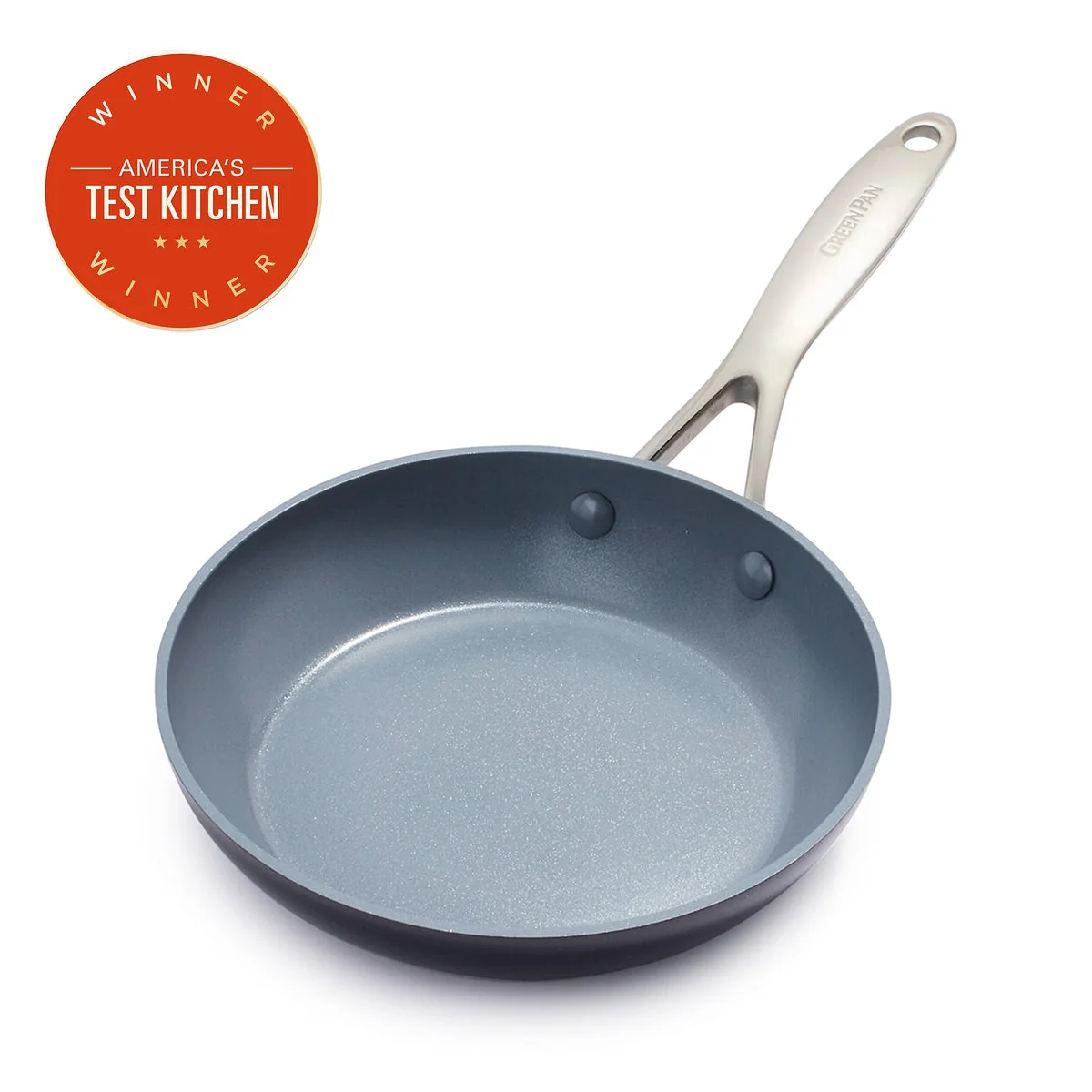
GreenPan Hard Anodized Healthy Ceramic Nonstick
By GreenPan · Frying Pans · Kitchen & Cooking · More from GreenPan
- 10" diameter
- Hard anodized aluminum
- Thermolon Minerals Pro ceramic nonstick
- PFAS-free
- All stovetops including induction
Price not listed
- GreenPanView at GreenPan
- eBay (used) eBay: used, open-box, refurbishedView at eBay (used)
- eBayView at eBay
- AmazonView at Amazon
Prices are snapshots. Check the current price with the store.
Summary
A 10-inch hard-anodized aluminum frypan with GreenPan’s diamond-infused Thermolon Minerals Pro ceramic nonstick — PFAS-free, induction-compatible, oven-safe to 600 F. The one thing to check before buying: ceramic loses its nonstick finish far faster than PTFE, and testers put the lifespan at one to three years.
Strengths
- Even heating: instrumented induction testing measured a 33 F center-to-edge spread at 400 F, tighter than Made In and All-Clad HA1 in the same test.
- It boiled 4 cups of water in 4:45, the fastest in the nonstick subset, and showed no warping after two minutes at 425 F.
- Eggs release easily and tomato-based sauce barely sticks and does not stain, per Good Housekeeping’s lab.
- Lightweight yet sturdy, with long, balanced polished handles.
- PFAS-free ceramic that works on induction and into a 600 F oven.
- A Good Housekeeping tester used one heavily for two to three years, dishwasher included, with it still in good condition.
Weaknesses
- Coating life is the catch: Wirecutter’s testing found ceramic pans lose nonstick properties in about a year, and The Roundup estimates one to three years.
- GreenPan warrants the coating for only two years.
- Rims scratch easily and edges can chip; light interiors stain over time.
- Dishwasher detergents accelerate coating breakdown despite the dishwasher-safe label.
- Heat it too fast or cool it abruptly and the pan can warp; some owners report pans that no longer sit flat.
Verified specifications
| Diameter | 10 inches. |
|---|---|
| Body | hard-anodized aluminum, with GreenPan’s “Duo Forged” pre-treatment before anodizing. |
| Coating | Thermolon Minerals Pro ceramic nonstick, diamond-infused; free of PFAS, PFOA, lead and cadmium per the manufacturer. |
| Stovetops | all, including induction, via GreenPan’s Magneto base. |
| Oven safety | 600 F (316 C); glass lids 425 F (218 C). |
| Handle | stainless steel, riveted to the body. |
| Cleaning | dishwasher safe, though the manufacturer recommends hand washing. |
| Certifications | NSF certified for food contact; Thermolon third-party tested to US FDA, German LFGB, Swiss and KTR standards. |
Full research notes and sources
Cooking performance
Good Housekeeping’s kitchen lab named Valencia Pro its Best Overall ceramic cookware set in 2026: fried eggs released with a spatula nudge, scrambled eggs came out without oil, and simmered marinara barely stuck and did not stain.
Instrumented induction testing reported by The Roundup measured a 33 F center-to-edge temperature spread at 400 F, tighter than Made In (124 F) and All-Clad HA1 (128 F) in the same test. The pan boiled 4 cups of water in 4:45, the fastest in the nonstick subset, and showed no warping after two minutes at 425 F. The Roundup’s hands-on test, running since April 2025, found even heat, no hot spots, fast heating and easy cleanup.
Coating longevity
The coating is the caveat. The Roundup estimates one to three years of coating life with regular use, and its own grill pan declined within six months.
Nobody has published a failure rate for this model, so treat the one-to-three-year figure as a known limitation rather than a defect. The counterpoint: a Good Housekeeping tester put one through heavy daily use for two to three years, dishwasher included, with the set still in good condition.
Care, warranty and support
GreenPan’s care page is blunt: cook on low to medium heat, use silicone or wood utensils, skip spray oils, hand wash with a soft sponge, and let the pan cool before washing to avoid thermal shock. Dishwasher detergents accelerate coating breakdown even though the pan is labeled dishwasher safe. Pan protectors and a melamine restoring sponge are the maintenance kit.
The warranty covers the coating for two years and other materials and workmanship defects for the life of the pan, excluding normal wear; liability is capped at the price paid, and claims need photos and proof of purchase. The return window is inconsistent — GreenPan’s FAQ says 90 days, The Roundup says 60 for unused products. GreenPan also runs a cookware recycling program. A 2019 California class action over “completely toxin free” advertising was dismissed with prejudice in 2020 after a settlement, with no ruling on the claims.
Is it worth it?
GreenPan US listed a 10"/12" Valencia Pro frypan set at $129.99 in December 2025, against a suggested $189.99 — roughly $65 a pan. Against a one-to-three-year coating horizon, that works out to an effective $20 to $65 a year of use. If you want PFAS-free ceramic with induction and a 600 F oven and you accept replacing the pan every few years, that math works. If you cook on high heat or expect a decade of service, the coating penalty is hard to justify: even the best ceramic pan underperformed Wirecutter’s $35 PTFE pick, and stainless steel, cast iron or carbon steel outlasts any ceramic coating. Past about $100 for a single ceramic pan, look elsewhere.
Which model this is
This page covers the Valencia Pro 10" frypan; the US Amazon listing is ASIN B09GH3QTF6. GreenPan does not publish ASIN-level model codes, so treat the mapping as name-based rather than manufacturer-confirmed.
The “Healthy Ceramic Nonstick” name spans several GreenPan lines with different constructions: Chatham is not induction-compatible and is oven-rated to 450 F, Padova Pro to 500 F. Check the line name on the box before you buy.
Sources
Manufacturer:
- GreenPan US — Do GreenPan Products Have Toxins?
- GreenPan US — Warranty (archived)
- GreenPan US — Frypans collection (archived)
- GreenPan US — Care & Use (archived)
Independent reviews:
Retailer listings:
Owner reports:
- No Reddit or forum threads were retrievable during research; owner evidence here is Good Housekeeping’s consumer-tester program (60+ survey respondents) and The Roundup’s hands-on test.