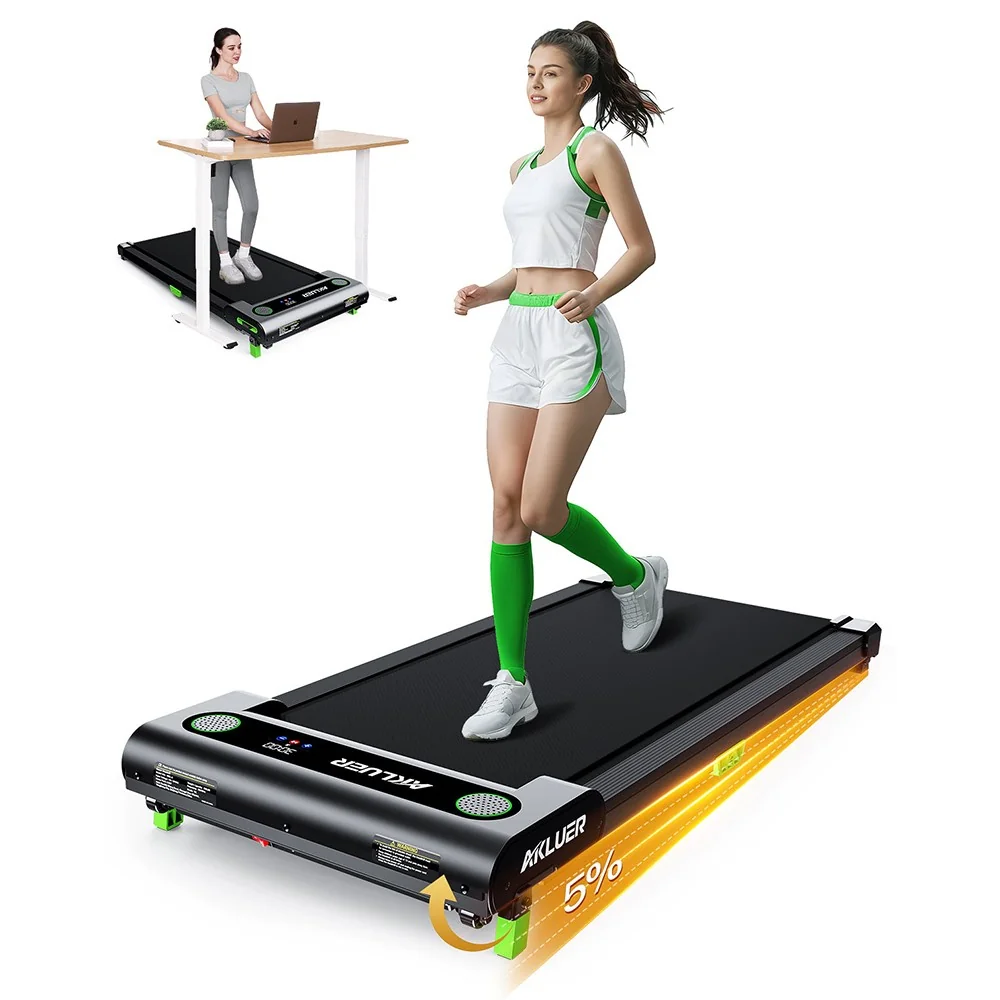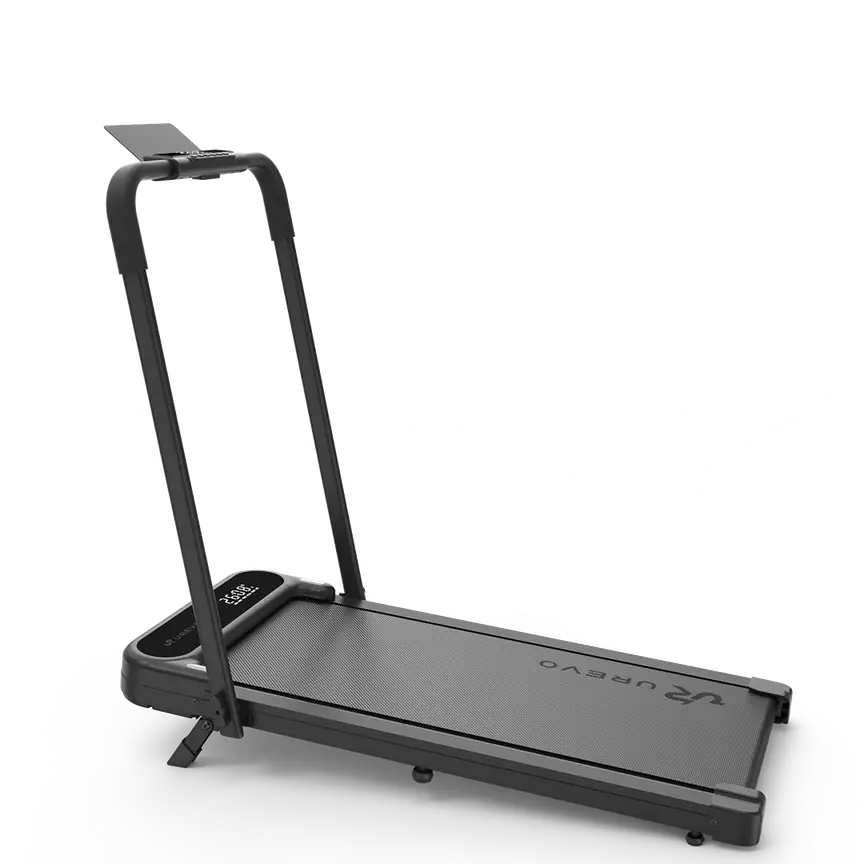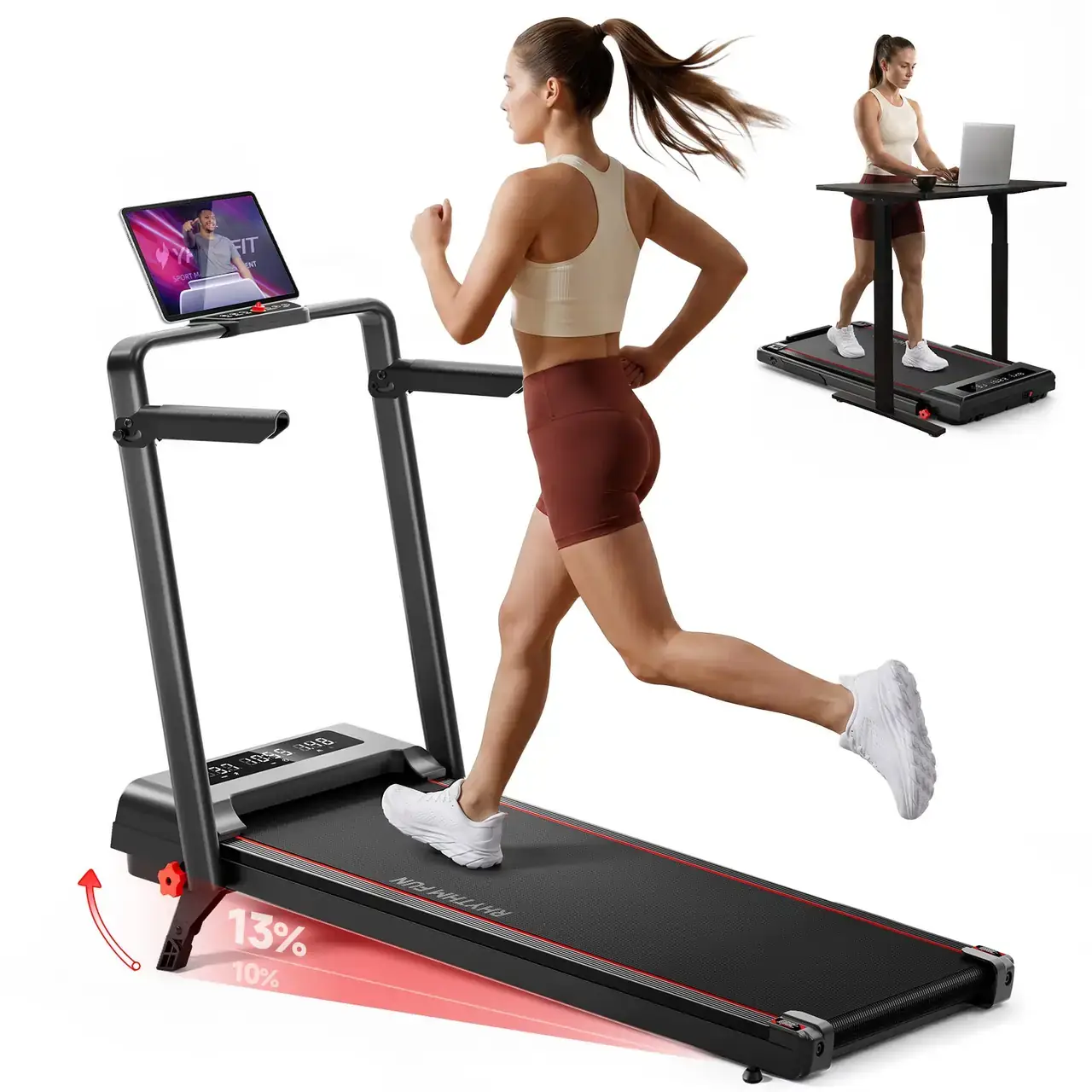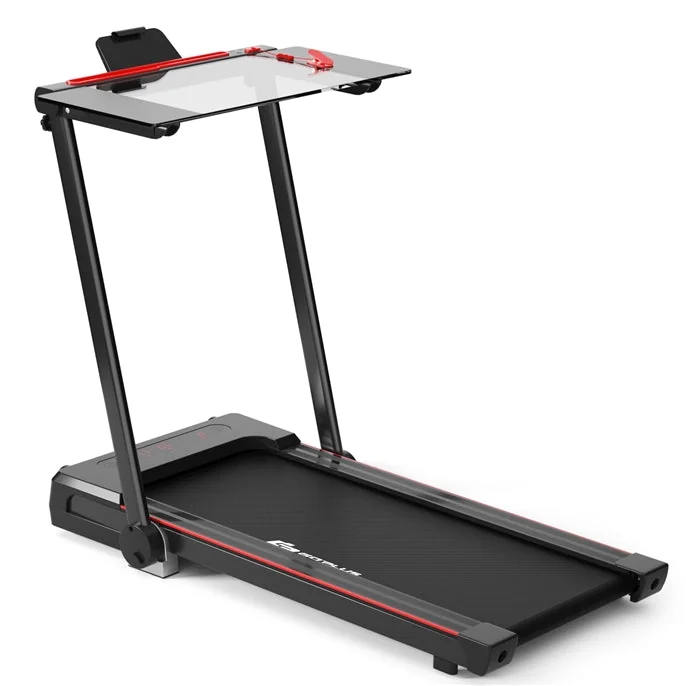
Goplus 3-in-1 Treadmill with Large Desk
By Goplus · Walking Pads · Health & Lifestyle
- 2.25 HP peak motor
- 0.5-7.5 MPH speed range
- 220 lb weight capacity
- 50.5 x 26.5 x 43 in overall dimensions
- 40.5 x 16 in running belt
Price not listed
- GoplusView at Goplus
- eBayView at eBay
- AmazonView at Amazon (paid link)
- eBay (used) eBay: used, open-box, refurbishedView at eBay (used)
Stores are listed in a fixed order, never by price or commission. Prices are snapshots. Check the current price with the store.
Summary
A folding 3-in-1 treadmill with a removable 28.5 × 13.5-inch acrylic worktop, built for walking while you work and jogging once the top comes off. Check your stride against the 40.5 × 16-inch belt and get the warranty in writing: Goplus covers 90 days, while a matching Costway listing shows 365.
Strengths
- The 28.5 × 13.5-inch acrylic top gives you a laptop surface while the belt moves, which is far more than a phone perch.
- Rated 0.5–7.5 mph, a wider range than the 0.6–3.8 mph of most flat walking pads.
- Folds to about 54 × 26 × 6 in on transport wheels, so it can go under a bed or sofa once the top is off.
- Speed, time, steps, distance and calories on one display, plus a Bluetooth speaker for audio from your phone.
- The original KBR-JK31 manual documents lubrication, belt centering and rear-roller adjustment, so small faults have a procedure.
Weaknesses
- The belt is short and narrow for a fast gait: a 40.5 × 16 in deck is far smaller than a 55–60 in running treadmill.
- One buyer reports the speed began surging hard after about six months and says the company did not respond.
- The remote ships without a battery, so a new machine can look dead until you fit a cell, and the cell size is not confirmed.
- Goplus covers 90 days, and its return rules ask for the original packaging and add a $45 repackaging fee (Goplus).
- The worktop has no height adjustment and no published load rating. Do not lean on it while the belt runs.
- No independent test of continuous duty, wall draw or noise has been published for this model.
Verified specifications
| Modes | walking with the acrylic desktop fitted, jogging and running with the desktop removed. “3-in-1” describes use modes, not three motors. |
|---|---|
| Speed | 0.5–7.5 mph rated range, adjustable from the control panel or the handheld remote. |
| Power | AC 110V, 60Hz, corded. No verified full-load consumption, duty cycle or plug specification was published. |
| Running belt | 40.5 × 16 in usable surface, marketed as five-layer construction with shock absorption. |
| Dimensions (folded) | 54 × 26 × 6 in with the acrylic top removed, on transport wheels. |
| Desktop | removable acrylic panel, 28.5 × 13.5 × 0.5 in; detachable phone and tablet holder, 8 × 4.5 × 2.5 in. |
| User capacity | 220 lb; machine weight 73.5 lb. |
| Display | speed, time, steps, distance and estimated calories, plus on-device buttons and a remote. The calorie figure is an estimate. |
| Frame | steel, ABS, PVC, HDF and acrylic, folding upright with two frame lock knobs. No incline and no heart-rate sensor are documented for this model. |
| In the box | machine, acrylic panel, phone holder, remote without a battery, tethered safety key, mains cord and manual. |
| Setup rules | flat solid indoor floor, 2 meters of clear space behind the machine, shoes worn, safety key clipped to clothing. |
Full research notes and sources
Walking at a desk on a short belt
The desktop is the reason to buy this instead of a plain walking pad. The original manual is blunt about what it is not: a work surface, not a handrail.
One owner report is worth reading. That is one person’s routine, not a productivity result.
The belt is what limits you. A Walmart buyer in June 2024 said the running area was too short and narrow for their gait and that slipping started within two days.
Belt tracking is a routine fix rather than a death sentence. A Walmart owner reported the belt drifting to the right, and Goplus replied in August 2026 with a check that the floor is level plus half turns of the right rear screw, slowly, at low speed, letting the belt settle. The original manual describes quarter turns and running the belt unloaded at 0.75–1.2 mph. Follow the procedure printed for your own unit.
Maintenance and running costs
The recurring chore is silicone oil. At an hour per workday that is roughly nine services a year. Unplug the machine before you lift anything, and run it unloaded while the oil spreads.
The consumable is cheap. A 4 fl oz bottle of Action Fitness 100% silicone treadmill lubricant was $9.99 at Walmart in October 2026. The original spare-parts diagram lists one small pack of oil, but the current product list does not, so ask the seller before ordering. The manual never states how much oil to use, so nobody can promise one bottle lasts a year.
Electricity is the larger line, and nobody has measured this machine. At an assumed 500 W average draw while running, one hour per workday for 260 days a year comes to 130 kWh, which at an assumed $0.20 per kWh is about $26 a year. Do not read the 2.25 hp peak rating as a wall-watt figure. One $9.99 bottle of oil on top of that electricity puts the pair at about $35.99 a year.
Optional extras stay small. A Goplus 47 × 24 in PVC floor mat was $22.99 in Walmart’s treadmill-mat category in October 2026, but the machine is 50.5 × 26.5 in, so that mat does not cover the whole footprint. There is no paid app and no subscription for the motor, the controls or the speaker.
Parts are the weak spot.
Safety, faults and warranty
Read the manual before the first session. It asks for a flat, solid indoor floor, 2 meters of clear space behind the machine, shoes, the safety key clipped to clothing, no powering up while it is folded, unplugging before cleaning, and children away from the moving belt and hinge. Start at a low speed.
One owner on Walmart in July 2024 says the speed began surging hard after about six months of use and reports no satisfactory company response. No failure rate has been published for this model, no recall was found and nobody has inspected the cause, so treat uncontrolled acceleration as an instant stop-use trigger: get it to a safe stop, pull the power and contact the seller.
A second owner posted in June 2026 that a treadmill used happily for years began showing E6 when Run was pressed. Goplus suggested lubricating and restarting first, then checking for a drive or motor jam while the machine is unplugged. There is no confirmed fix in that thread, and opening a motor cover without experience puts you close to live wiring. A Costway buyer of the matching 3-in-1 also found an internal right-upright cable connector left unconnected after assembly, which stopped the machine from starting at all.
Warranty and returns are the weakest part of the deal. Goplus’s US policy is a 90-day limited warranty with 30-day returns, and the brand’s own FAQ calls it three months. The refund policy asks for unused, undamaged original packing, excludes sale and clearance items and previously assembled or disassembled goods, and adds a $45 repackaging fee when the original box is missing (Goplus, October 2026). A near-identical Costway listing of the same desk treadmill shows a 365-day warranty and 30-day returns (Costway, October 2026). Get that in writing on the invoice for the exact model you buy. Support answers vary: one E6 owner got a troubleshooting reply roughly 17 days after asking, and another buyer says nobody replied.
Is it worth it?
Asking prices for this configuration sit in a narrow band. Goplus sells the exact 3-in-1 at $269.99 next to a crossed-out $406.99 reference (Goplus, October 2026). Costway lists the white version direct at $259.99, and Target lists the black Costway version at $269.99 (Costway and Target, October 2026). Walmart lists the Goplus black at $269.99 (Walmart, October 2026). No authorized listing below $220 was confirmed.
Below $220 delivered, with a real warranty and return authorization, is a strong deal. The $220–259 band is attractive for moderate desk use, the $260–279 band is the normal asking range, and $280–329 is hard to justify unless a seller adds real coverage. At $330 and up you should look elsewhere.
There are two sensible alternatives. Costway’s own 2-in-1 with a dual display and no detachable desk was $219.99 on Costway’s site in October 2026, and it makes sense if you already own a height-adjustable standing desk. The WalkingPad C2 folds very compactly and walks at about 1–4 mph with no upright rail and no acrylic worktop, listed at $429–449 (WalkingPad, October 2026). For real running, buy a running treadmill, because this belt is not built for it. On price alone the warranty should decide the seller, not the headline horsepower: at Goplus’s own 90-day cover, a $269.99 machine carries more risk than a $259.99 Costway listing with 365 days.
Which model this is
This page covers the Goplus 3-in-1 folding treadmill with the removable acrylic desktop, sold as a 2.25HP machine. The original user manual is catalogued as KBR-JK31. The listing this page tracks is ASIN B08KZNDZBY.
Watch the motor numbers, because the market is muddled. Costway sells a near-identical chassis whose marketing calls it a 2.5HP brushless motor while the same page’s specification table says 2.25HP peak, and its Target listing repeats the 2.5HP brushless claim. Goplus’s own heading and specification both say 2.25HP. No independent test and no joint manufacturer statement proves a motor difference, so judge the unit by its nameplate, its belt and its written warranty rather than by a headline number.
Two details are worth confirming before you check out. Folded height is listed as 6 inches, but a Goplus answer in October 2026 put it at roughly 4.7 inches after the tabletop came off, so measure the gap under your furniture, especially on carpet. And Goplus publishes no MPN, UPC or GTIN for this product, so keep the seller’s written confirmation of what you received. Do not confuse this machine with the Goplus 2-in-1 folding treadmill, which has no detachable desk.
Sources
Manufacturer:
- Goplus 3-in-1 treadmill with large desk, 2.25HP: specifications and product page
- Goplus KBR-JK31 user manual (ManualsLib)
- Goplus 3-in-1 manual text: 30-hour lubrication, controls and safety requirements (Manuals+)
- Goplus guarantee: 90-day limited warranty and 30-day returns
- Goplus FAQ: warranty length, written support and replacement parts
- Goplus refund and return policy, including the repackaging fee
- Goplus treadmill and walking pad category listing
Retailer listings:
- Costway 3-in-1 folding treadmill with large desk, white
- Costway 3-in-1 desk treadmill, second colorway listing
- Target listing for the Costway 3-in-1 with removable desk
- Walmart listing for the Goplus 2.25HP 3-in-1, black
- Costway 2-in-1 folding treadmill with dual display, no detachable desk
- WalkingPad C2 foldable walking machine
Owner reports:
- Owner walking an hour a day during work calls, r/workingmoms (April 2022)
- Owner answers on belt drift, the E6 error and replacement parts, Goplus product Q&A
- Goplus support answer on replacement remotes and parts
- Owner reports of a lost remote and a missing remote battery, Goplus
Parts and stores: