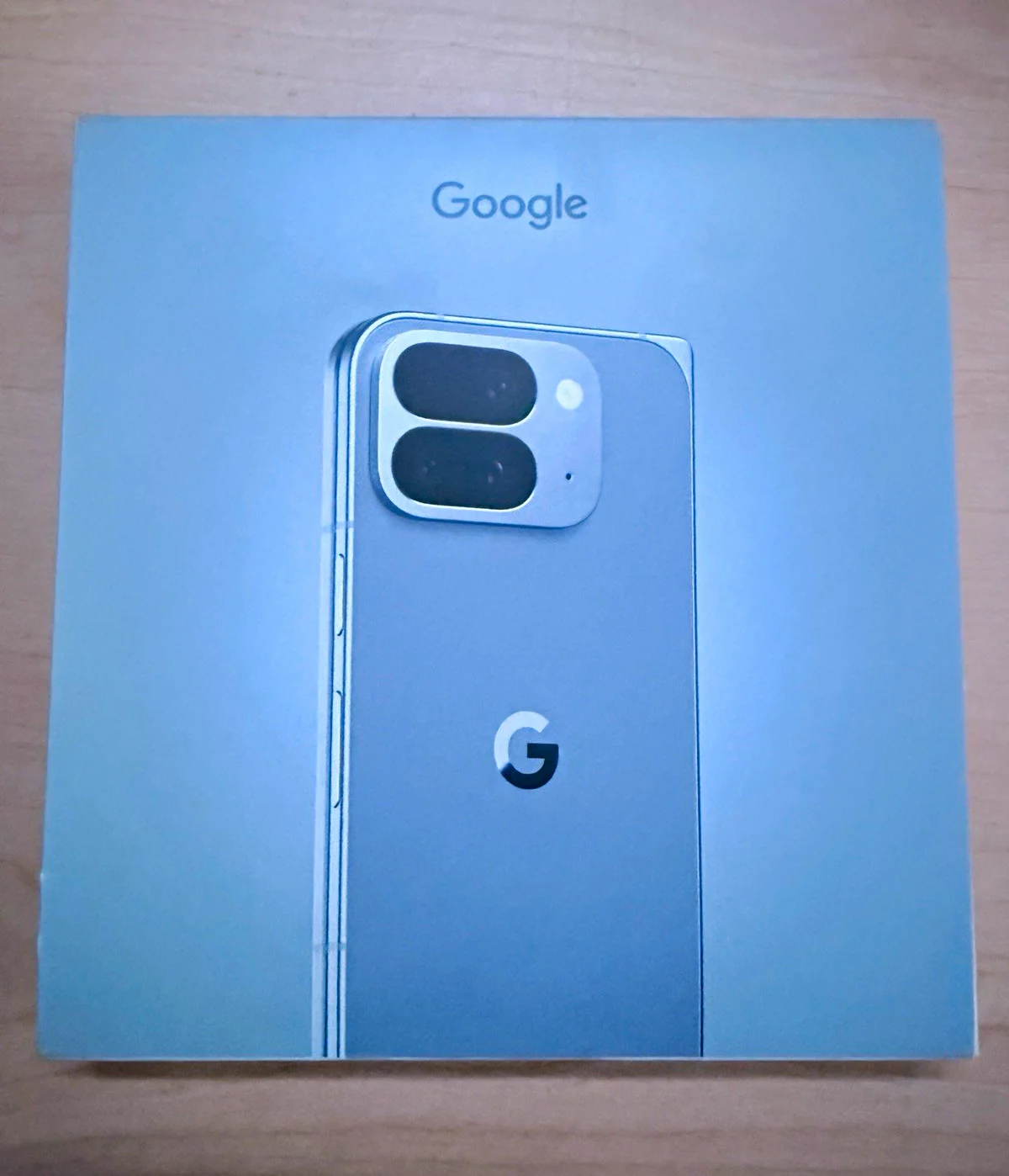
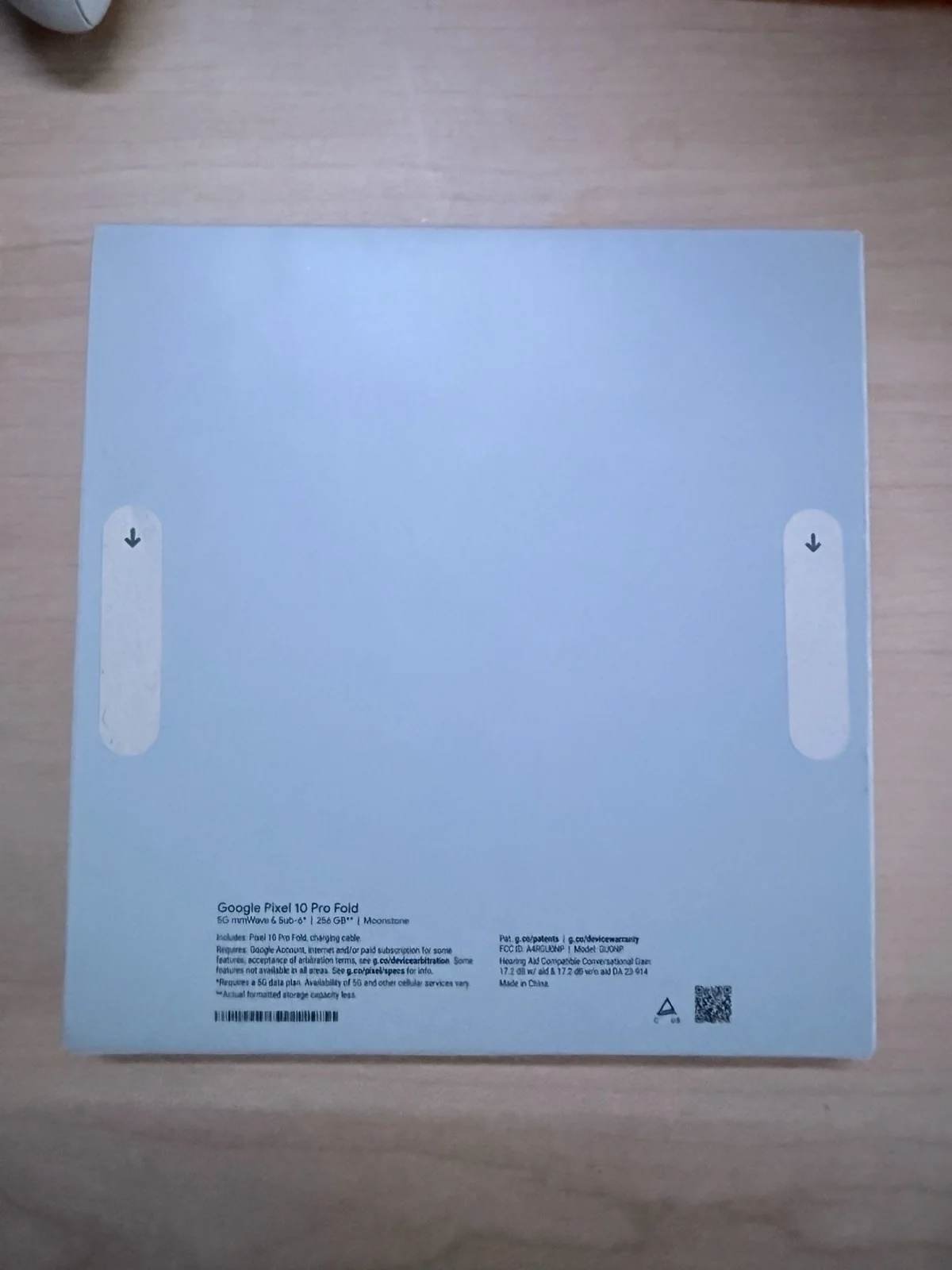
Google Pixel 10 Pro Fold
By Google · Smartphones · Phones & Computers · More from Google
- Google Tensor G5 (3nm, TSMC)
- 6.4-inch outer + 8-inch inner OLED, 120Hz, 3000 nits peak
- 5015 mAh battery, 24+ hour rated life
- 16GB RAM, 256GB/512GB/1TB storage
- 48MP main + 10.5MP ultra-wide + 10.8MP 5X telephoto
Price not listed
- GoogleView at Google
- eBayView at eBay
- Best BuyView at Best Buy
- TargetView at Target
- AmazonView at Amazon (paid link)
- eBay (used) eBay: used, open-box, refurbishedView at eBay (used)
Stores are listed in a fixed order, never by price or commission. Prices are snapshots. Check the current price with the store.
Summary
A book-style foldable with a 6.4-inch cover screen, an 8-inch inner display, IP68 dust and water protection and a Tensor G5, aimed at buyers who want Google’s cameras and seven years of updates in a large, heavy package.
Strengths
- Measured battery life beat the Galaxy Z Fold 7 in three independent tests.
- PCMag called the camera output the best from any folding phone, including the Z Fold 7.
- The inner display measured 2,566 nits against 2,245 nits for the Z Fold 7.
- Qi2 magnetic charging is built in, where the Z Fold 7 needs a separate case.
- Seven years of OS, security and Pixel Drop updates.
Weaknesses
- Heavier and thicker than the Galaxy Z Fold 7: 258 g and 10.8 mm closed against 7.6 oz and 8.9 mm.
- The Tensor G5 trails the Snapdragon 8 Elite on every published benchmark, with Geekbench 6 at 2,344/6,332 against 3,052/9,735.
- Multitasking is limited to two apps side by side, against three on the Z Fold 7.
- No charger ships in the box, and the included cable is USB 2.0.
- The camera hardware is unchanged from the Pixel 9 Pro Fold, and the cameras sit below the Pixel 10 Pro and Pro XL.
- The Google Store still lists the phone at its $1,799 launch figure even though the Pixel 11 Pro Fold replaced it.
Verified specifications
| Model | Google Pixel 10 Pro Fold, US and global model GU0NP; Japan is GM66V. |
|---|---|
| Cover display | 6.4-inch Actua OLED, 1080 × 2364, 408 PPI, 60–120 Hz, up to 2,000 nits HDR and 3,000 nits peak. |
| Inner display | 8-inch Super Actua Flex LTPO OLED, 2076 × 2152, 373 PPI, 1–120 Hz, up to 1,800 nits HDR and 3,000 nits peak. |
| Chipset | Google Tensor G5 with Titan M2, built by TSMC on its 3 nm process. |
| Memory and storage | 16 GB LPDDR5X RAM; 256 GB UFS 4.0, 512 GB and 1 TB Zoned UFS. |
| Battery | 5,015 mAh typical, 4,919 mAh minimum; Google rates 24+ hours of use and up to 84 hours with Extreme Battery Saver. |
| Charging | up to 50% in about 30 minutes with a 30 W USB-C PPS charger or higher, sold separately; Pixelsnap Qi2 magnetic wireless up to 15 W. |
| Rear cameras | 48 MP wide (f/1.70, 82°), 10.5 MP ultrawide (f/2.2, 127°), 10.8 MP telephoto (f/3.1, 23°, 5x optical zoom), Super Zoom up to 20x. |
| Front and inner cameras | 10 MP Dual PD, f/2.2, 87° each. |
| Connectivity | Wi-Fi 7 (802.11be), Bluetooth 6.0, NFC, Thread, USB-C 3.2. |
| SIM | one Nano-SIM and one eSIM; the only Pixel 10 model sold in the US with a physical SIM tray. |
| Durability | IP68, Gorilla Glass Victus 2 cover and back, aerospace-grade aluminum frame. |
| Software | Android 16, 7 years of OS, security and Pixel Drop updates from first US availability. |
| Dimensions | folded 155.2 × 76.3 × 10.8 mm (6.1 × 3.0 × 0.4 in); unfolded 155.2 × 150.4 × 5.2 mm (6.1 × 5.9 × 0.2 in); 258 g (9.1 oz). |
| In the box | 1 m USB-C to USB-C cable (USB 2.0) and a SIM tool; no charger is included. |
| Warranty | 1 year in the US. |
Full research notes and sources
Size, weight and build
Folded, the phone measures 155.2 × 76.3 × 10.8 mm and weighs 258 g (9.1 oz). Unfolded it is 5.2 mm thick, with an 8-inch inner display and a 6.4-inch cover screen. Tom’s Guide calls it a back-pocket phone where the Galaxy Z Fold 7 is slim enough for the front pocket, and PCMag calls it seriously heavy. It is 0.1 mm thicker and 1 g heavier than the Pixel 9 Pro Fold.
The gearless hinge has fewer internal parts than the Pixel 9 Pro Fold, and CNET reports the phone opens and closes without catching.
GSMArena’s EU label lists energy class B, 47:55 hours of battery endurance over 1000 cycles, free-fall class A and repairability class C. That is an EU regulatory label, not a US service commitment.
Displays and battery
The cover display is a 6.4-inch Actua OLED at 1080 × 2364 and 408 PPI, running 60–120 Hz and rated to 2,000 nits HDR and 3,000 nits peak. The inner display is an 8-inch Super Actua Flex LTPO OLED at 2076 × 2152 and 373 PPI, running 1–120 Hz and rated to 1,800 nits HDR and 3,000 nits peak. Google measures the 3,000-nit peak at a 5% on-pixel ratio and HDR brightness separately at 100%, and Tom’s Guide measured the inner panel at 2,566 nits against 2,245 nits for the Z Fold 7.
The battery is 5,015 mAh typical and 4,919 mAh minimum, rated at 24+ hours of use and up to 84 hours with Extreme Battery Saver. Tom’s Guide’s 5G web-surfing test ran 12:16 against 10:44 for the Z Fold 7, and PCMag’s maximum-brightness video streaming test ran 13 hours 42 minutes, about 30 minutes longer than the Z Fold 7 and against 10 hours 15 minutes for the Pixel 9 Pro Fold. CNET’s 45-minute mixed-use test left 96% remaining against 93% for the Z Fold 7, and its 3-hour full-brightness stream left 78% against 84% for the Z Fold 7 and 89% for the Oppo Find N5, which CNET reads as the Tensor G5 not being optimized for video playback. PCMag found Google’s claimed 30 hours of video streaming did not hold up.
Wired charging reaches up to 50% in about 30 minutes with a 30 W USB-C PPS charger, which is sold separately. CNET measured 51% in 30 minutes, Tom’s Guide measured 58% with Google’s 67 W charger against 54% for the Z Fold 7 on a 45 W charger, and PCMag’s 45 W charger took 1 hour 25 minutes for a full charge. Wireless charging is Qi2-certified at 15 W.
Cameras, performance and software
The camera hardware is unchanged from the Pixel 9 Pro Fold: a 48 MP f/1.70 main, a 10.5 MP f/2.2 ultrawide, a 10.8 MP f/3.1 telephoto with 5x optical zoom and OIS, and 10 MP front and inner cameras. PCMag judged the photo output the best from any folding phone, including the Z Fold 7, with clean 20x Super Res Zoom results and on-target color, sharpness and exposure. Tom’s Guide preferred Google’s portraits, low-light shots and 10x zoom against the Samsung’s 3x optical lens, but preferred the Samsung’s 4K video and reported that the Pixel takes about a second to refocus when zooming and shifts exposure while panning. CNET’s reservation is that these cameras are a step down from the Pixel 10 Pro and Pro XL.
The Tensor G5 is built by TSMC on its 3 nm process. Tom’s Guide measured Geekbench 6 at 2,344 and 6,332 against 3,052 and 9,735 for the Z Fold 7, 3DMark Wild Life Extreme Unlimited at 3,383 and 20.2 fps against 4,739 and 28.4 fps, and an Adobe Premiere Rush export of 2:18 against 0:52. PCMag’s GFXBench result was 66 fps against 88 fps. PCMag also found the phone smooth with no stutter and no frame drops in games, which is the counterpoint to the dropped frames Tom’s Guide saw in Destiny: Rising.
The software layer is where Google still leads. Gemini Live, Circle to Search, Live Translate, Add Me, Ask Photos, Auto Best Take, Camera Coach and Instant View are present, with on-device AI handled by the G5’s TPU. Magic Cue is the weak point: Tom’s Guide had it surface flight data from the wrong email, fail to open a requested photo, and not support a corporate account at launch. Multitasking is capped at two apps side by side, against three on the Z Fold 7, though Drag and Drop and a more capable Split Screen mode make the 8-inch canvas more useful than it was.
Is it worth it?
The Google Store lists the phone From $1,799 as of this check, or $49.97 a month on 36-month financing. PCMag lists MSRP $1,799 for 256 GB, $1,919 for 512 GB and $2,149 for 1 TB, and notes the 512 GB tier is still $80 below the 256 GB Galaxy Z Fold 7. The Galaxy Z Fold 7 itself sits at $1,999, and PCMag’s 2026 foldable picks list the Pixel 11 Pro Fold at $1,899. GSMArena’s third-party offers page shows $924.98, £859.99 and €1,772.27, a street listing rather than a manufacturer figure. One year of Google AI Pro, stated as a $239 value, with 5 TB of cloud storage is bundled.
At $1,799 or above this is the worst point to buy it, because a current-generation successor is on sale and the value case rests on IP68, measured battery life and camera output rather than price. At $1,400–1,798 it is still full-price money for a previous-generation device, but a discount makes the IP68 rating, the battery advantage over the Z Fold 7 and the Qi2 magnetic charging defensible. At $1,100–1,399 it is reasonable if you want Google’s camera processing, the 8-inch inner display and seven years of updates below launch cost. Under $1,100, the level of GSMArena’s affiliate listing, the battery, camera and IP68 advantages are the strongest part of the case. Under $1,000 you are against non-folding flagships and used or refurbished foldables, and the size, weight and missing charger start to matter more. Budget for a 30 W or higher USB-C PPS charger, since none is included and the supplied cable is USB 2.0.
Which model this is
This page covers the Pixel 10 Pro Fold announced on 2025-08-20 and released in the US on 2025-10-09, the successor to the Pixel 9 Pro Fold and the predecessor to the Pixel 11 Pro Fold. It was recorded as discontinued on 2026-08-12 when the Pixel 11 Pro Fold replaced it, though the Google Store still lists it. The US and global model is GU0NP and the Japan model is GM66V, sold in Moonstone and Jade. It is not the Pixel 10, Pixel 10 Pro, Pixel 10 Pro XL or Pixel 10a, which use a different chip and different cameras. Its Amazon ASIN is B0FFTNCY4Z.
Sources
Manufacturer:
Independent reviews:
Owner reports:
- No owner-forum thread could be retrieved in this run.