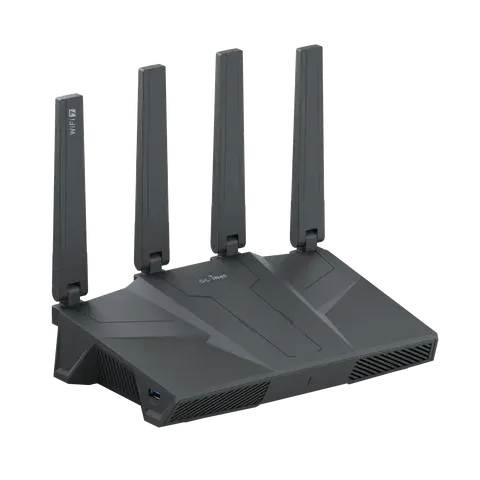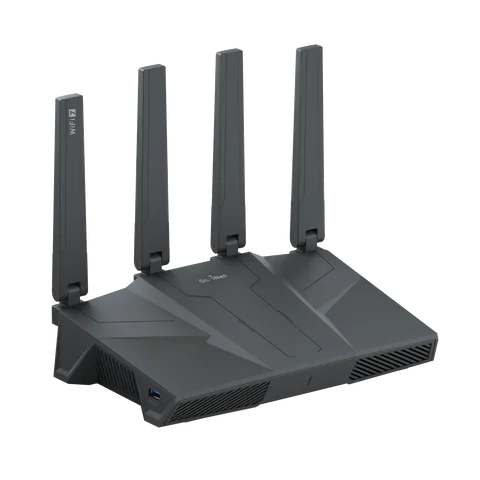
GL.iNet Flint 3 (GL-BE9300) Tri-Band Wi-Fi 7 Router
By GL.iNet · Wifi Routers · Desk & Streaming Setup
- BE9300 tri-band Wi-Fi 7 (688 Mbps @ 2.4 GHz + 2882 Mbps @ 5 GHz + 5765 Mbps @ 6 GHz)
- 5 x 2.5 Gbps Ethernet ports
- Wi-Fi coverage up to 2000 sq ft
- WireGuard/OpenVPN-DCO up to 680 Mbps
Price not listed
- GL.iNetView at GL.iNet
- eBayView at eBay
- AmazonView at Amazon (paid link)
- eBay (used) eBay: used, open-box, refurbishedView at eBay (used)
Stores are listed in a fixed order, never by price or commission. Prices are snapshots. Check the current price with the store.
Summary
A tri-band Wi-Fi 7 router with five 2.5 GbE ports and hardware VPN up to 680 Mbps, running an OpenWrt-based firmware with AdGuard Home, Tailscale and ZeroTier built in. Check the radio and range trade-offs before buying: 2x2 MIMO on every band, no native mesh, and 6 GHz that falls off quickly through walls.
Strengths
- Hardware-accelerated WireGuard and OpenVPN-DCO reach up to 680 Mbps, with 30+ provider templates and Tailscale and ZeroTier built in.
- The OpenWrt-based firmware ships AdGuard Home, parental controls, multi-WAN and dynamic DNS without add-ons.
- Close-range 6 GHz throughput exceeded 1.8 Gbps in independent testing.
- It handled a 2500 Mbps PPPoE connection without bottleneck.
- Idle power draw of 10-12 W keeps running costs low.
Weaknesses
- Radios are 2x2 MIMO on all three bands, a step down from the Flint 2’s 4x4 5 GHz radio.
- There is no native mesh support, and owners report weaker range than the Flint 2.
- 6 GHz range drops quickly through walls and floors.
- MLO is still maturing, with parsing errors and TCP retransmissions reported.
- Standard OpenVPN without DCO is limited to about 142 Mbps.
- An internal cooling fan runs under load and is not mentioned on the manufacturer page.
Verified specifications
| Model | GL-BE9300 (Flint 3), tri-band Wi-Fi 7 (IEEE 802.11a/b/g/n/ac/ax/be). |
|---|---|
| Wi-Fi speeds | 688 Mbps at 2.4 GHz, 2882 Mbps at 5 GHz, 5765 Mbps at 6 GHz (about 9300 Mbps combined marketing figure). |
| Wi-Fi 7 features | MLO, 320 MHz channels, 4K-QAM, preamble puncturing, OFDMA. |
| Ethernet | 5 x 2.5 GbE (1 dedicated WAN, 1 switchable WAN/LAN, 3 LAN), 10/100/1000/2500 Mbps. |
| USB | 1 x USB 3.0 Type-A, rated 5 V / 2 A. |
| CPU | Qualcomm quad-core at 1.5 GHz (IPQ5332). |
| Memory and storage | 1 GB DDR4 RAM, 8 GB eMMC. |
| Antennas | 4 foldable external Wi-Fi antennas; none are removable. |
| LEDs | 1 dual-color indicator. |
| Power input | DC5521, 12 V / 4 A (5.5 x 2.1 mm). |
| Power consumption | under 25 W without USB load; under 37.2 W with USB load. |
| VPN | WireGuard and OpenVPN/OpenVPN-DCO client and server, up to 680 Mbps combined; standard OpenVPN about 142 Mbps; 30+ providers plus Tailscale, ZeroTier and Tor. |
| Software | OpenWrt 23.05-based firmware, kernel 5.4.213; AdGuard Home, parental controls (Bark), multi-WAN failover, load balancing, dynamic DNS, IPv6, VLAN tagging at the LuCI level. |
| Device capacity | up to 124 simultaneous devices. |
| Coverage | up to 2000 sq ft (open layout). |
| MLO uses WPA3 only. | |
| Dimensions | 240 x 157 x 74 mm; 848 g. |
| Power adapter | 48 W (12 V / 4 A). |
| In the box | Flint 3, power adapter, Ethernet cable, user manual, thank-you card, converter (plug varies by country: US/EU/UK/AU). |
Full research notes and sources
Wi-Fi 7 speeds and range
The 9300 Mbps figure is the combined ceiling across all three bands; no single client reaches it. TechRadar measured 1441 Mbps on 6 GHz at short range with MLO off, and with MLO on throughput fluctuated from about 250 Mbps to 5760 Mbps briefly, with parsing errors and TCP retransmissions. WickedYoda’s iperf3 tests showed 291 Mbps on 6 GHz at 160 MHz and 307-310 Mbps with MLO, while 5 GHz managed 167 Mbps and 2.4 GHz 39.6 Mbps in his layout; a Netgear AP passthrough reached 801-812 Mbps, outperforming the Flint 3 at distance. MightyGadget saw over 1.8 Gbps close-range on 6 GHz and 800-900 Mbps on 5 GHz one floor down. Owners in the GL.iNet forum report 600-900 Mbps from a 1 Gbps connection across a small house on the Flint 2 where the Flint 3 was weaker under the same conditions. Coverage of 2000 sq ft assumes an open, low-interference layout, not a multi-floor home with thick walls.
VPN and software
The firmware is an OpenWrt 23.05-based fork tied to the Qualcomm chipset, not flashable with mainline OpenWrt, and ships AdGuard Home, Bark parental controls, Tailscale, ZeroTier and multi-WAN failover. Advanced users rely on LuCI for VLAN tagging, since the GL.iNet GUI does not expose VLAN configuration, and some LuCI packages such as luci-app-ddns are missing for this target. MLO requires WPA3 only. An owner reported the fan staying off in typical home use with CPU at 67-70 C, while another reported high load unless network acceleration is disabled.
Ports, power and cooling
All five Ethernet ports are 2.5 GbE, including one dedicated WAN and one switchable WAN/LAN port, and a 2500 Mbps PPPoE connection was handled without bottleneck. The USB 3.0 port is rated 5 V / 2 A and may not power high-draw storage. Idle draw is 10-12 W and typical use stays under 20 W, with a peak under 25 W without USB load and under 37.2 W with it. The chassis is heavily ventilated matte black plastic with an internal cooling fan that teardowns confirm; the manufacturer page does not mention it. Switching the router into Access Point or WDS mode removes wired web-GUI access.
GL.iNet lists the US-warehouse unit at $209.99. Other recorded prices include $189.90 direct, $199-219 at review time, a $229.90 MSRP, early-bird pricing as low as $119, and a 129 EUR super early bird. At or below about $190 the Flint 3 is strong value for a Wi-Fi 7 router with five 2.5 GbE ports and hardware VPN; between $191 and $220 it is fair; above about $220 it is weak unless Wi-Fi 7 6 GHz and multi-gig ports are specifically needed. For large or multi-floor homes a proper mesh kit is the better buy despite higher cost, and for VPN users needing more than about 680 Mbps the Flint 2 remains the better choice. The manufacturer page advertises a 2-year warranty while one review states a 1-year limited warranty; verify terms at purchase.
Which model this is
This page covers the GL.iNet Flint 3, model GL-BE9300, a tri-band Wi-Fi 7 home router with a Qualcomm IPQ5332 quad Cortex-A53 SoC, a Realtek RTL8372N 10G switch and an RTL8221B 2.5G WAN PHY per a community OpenWrt port. Do not confuse it with the Flint 2 (GL-MT6000, Wi-Fi 6, MediaTek SoC, 4x4 5 GHz) or the Flint 4 (GL-BE14000), nor with Slate or Beryl travel routers or other vendors’ BE9300-class routers. The firmware is an OpenWrt-based fork tied to the Qualcomm chipset and is not flashable with mainline OpenWrt.
Sources
Manufacturer:
Independent reviews:
Owner reports: