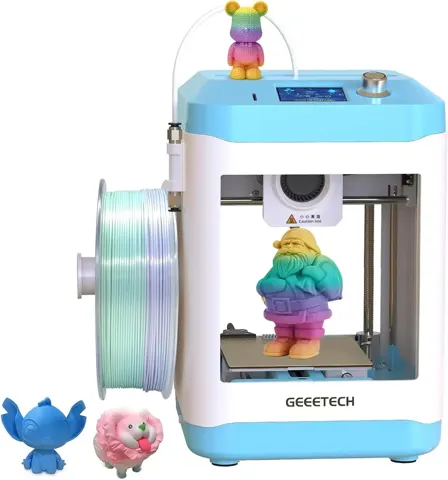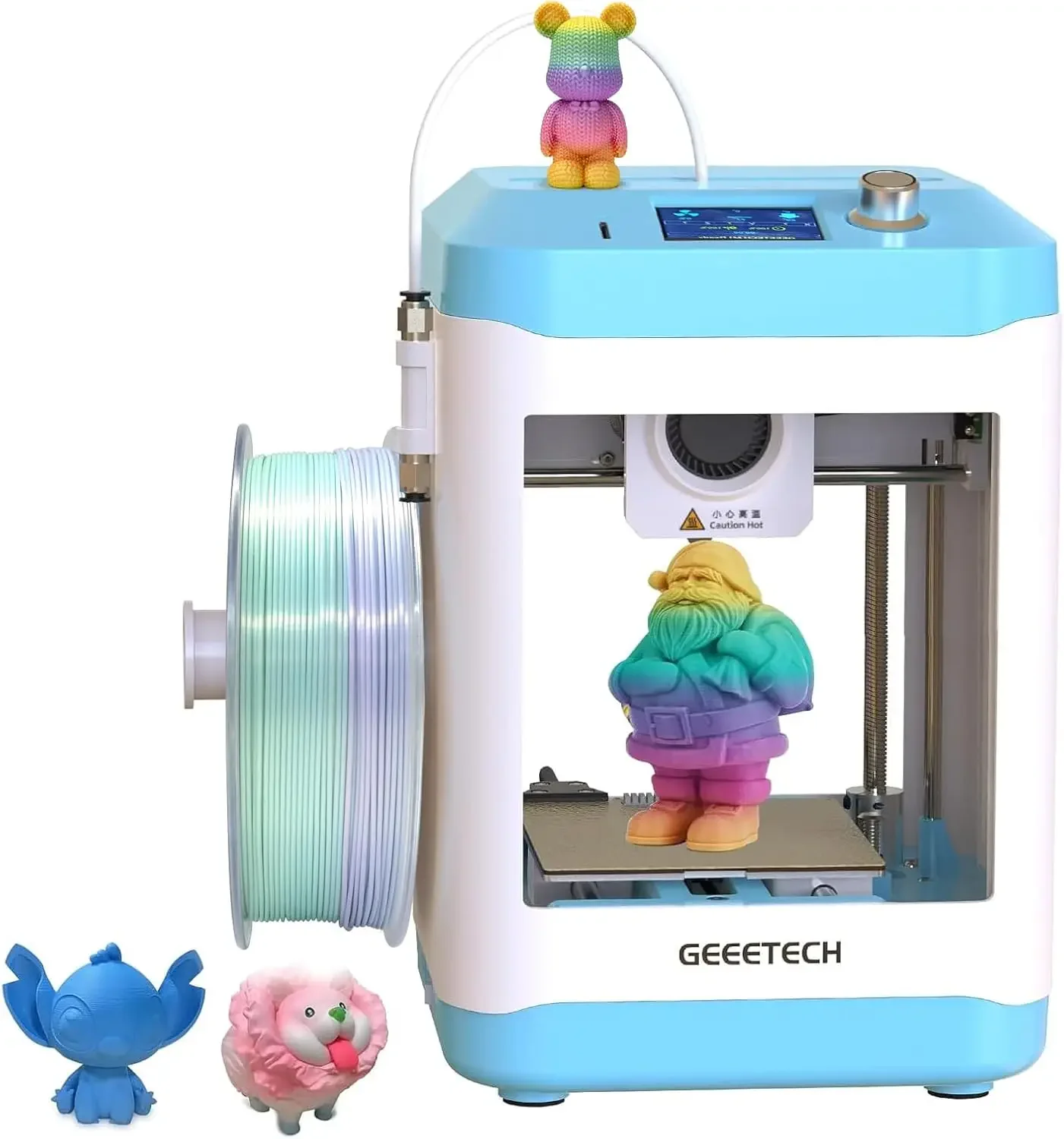
Geeetech M1 3D Printer
By Geeetech · Budget 3D Printers · 3D Printing
- Build volume 100x110x100 mm
- Print speed up to 250 mm/s
- 0.4 mm nozzle, max 230 C
- 1.75 mm filament, PLA/TPU
- Machine size 279x200x298 mm, net weight 3 kg
Price not listed
- GeeetechView at Geeetech
- eBayView at eBay
- AmazonView at Amazon (paid link)
- eBay (used) eBay: used, open-box, refurbishedView at eBay (used)
Stores are listed in a fixed order, never by price or commission. Prices are snapshots. Check the current price with the store.
Summary
A small FDM printer with a 100 × 110 × 100 mm build volume, 16-point auto leveling and direct-drive extrusion. Check whether your parts fit in roughly 10 × 11 × 10 cm and that you can slice and move files by microSD, because the M1 has no advertised Wi-Fi or app workflow.
Strengths
- Unusually small footprint and 3 kg mass make it a credible travel or secondary machine.
- Direct-drive extruder and 16-point leveling lower the barrier to basic small PLA prints when the slicer profile and Z offset are correct.
- Official wiki documents belt adjustment, extrusion clearing, nozzle and hotend replacement, motherboard and screen service, slicer presets and firmware updates.
- OEM parts are listed: PEI sheets, five brass nozzles, hotend assembly and replacement heated bed.
- Owners report useful prints for demonstrations and about 48 hours of printing apart from a card formatting issue.
Weaknesses
- Tiny output envelope: large brackets, helmets and full-size organizers must be split or printed elsewhere.
- No advertised integrated Wi-Fi or app; microSD handoffs matter even with USB, and staff warned the card must stay inserted for their USB/Cura workflow.
- Spool holder fits only 0.5 kg by default; common 1 kg rolls need an external stand or a printed upgrade.
- First-layer Z adjustment may still be needed and belts may need checking straight out of the box.
- 230 C nozzle and 60 C bed ceilings make broad PETG, ABS or ASA claims misleading.
- Top 250 mm/s speed does not equal sustained speed in detailed miniature prints.
Verified specifications
| Model | Geeetech M1 Mini Faster / High-Speed Mini 3D Printer, SKU 800-001-0900. The M1S is a different printer and must not be treated as the same machine. |
|---|---|
| Printing | single-nozzle FDM/FFF, 1.75 mm filament; direct-drive dual metal gear extruder with 5:1 reduction. |
| Build volume | 100 × 110 × 100 mm (about 1.1 L). |
| Layer height and precision | 0.1–0.2 mm stated layer thickness; ±0.1 mm claimed print precision. |
| Speed | 10–250 mm/s range, 200 mm/s recommended. |
| Leveling | 16-point automatic bed leveling with hotend/strain pressure sensing. |
| Temperature | 230 C maximum nozzle, 60 C maximum heated bed. |
| Materials | PLA and TPU are the official primary list; silk PLA and wood-filled polymer are also mentioned. ABS/ASA/PETG are not dependable recommendations at these temperature ceilings. |
| Connectivity | prints .gcode via TF/microSD card; USB cable port listed. Windows, macOS and Linux with Cura and OrcaSlicer. |
| Hardware | 0.4 mm nozzle, 2.4-inch color LCD with physical knob, filament runout sensor, internal LEDs, removable magnetic PEI surface, 0.5 kg spool holder. |
| Power and size | 24 V DC adapter, 96 W electrical figure, about 279 × 200 × 298 mm footprint, 3 kg net mass. |
| Safety | flat, ventilated location away from flammable or explosive materials; no unsupervised child operation. |
Full research notes and sources
Build volume, speed and materials
The 100 × 110 × 100 mm envelope is the real limit: it suits miniatures, replacement clips and desk toys, not full-size parts. The 10–250 mm/s headline is a maximum parameter, with 200 mm/s recommended, and small parts mean frequent acceleration and corner changes. PLA and TPU are the supported materials; the wiki even suggests 240 C for ABS troubleshooting, which exceeds the 230 C hardware ceiling, so that instruction should not be applied to this machine.
Files, slicing and owner reports
The M1 prints .gcode from a TF/microSD card and lists a USB cable port. Cura and OrcaSlicer on Windows, macOS or Linux are the documented tools. A January 2026 first-time owner reported about 20 hours trying to make it work with only a Chromebook and no Wi-Fi, so a supported desktop workflow should be confirmed before purchase. Staff also replied in March 2026 that the card must still be inserted when using the USB/Cura workflow.
Owners report included microSD cards failing and losing files after about 48 printing hours, TPU that would not load, a homing failure after selecting the wrong OrcaSlicer profile, a nozzle tip snapping during removal, and first-layer adhesion or belt-looseness issues. A July 2026 owner on Reddit reported the nozzle tip snapping during removal and commenters suggested replacing the heater block or hotend rather than drilling the remains. Geeetech’s own wiki covers first-layer, nozzle distance, low extrusion and clogged hotend troubleshooting, and maps black screens, negative minimum temperature readings and defective card readers to possible power, motherboard, thermistor or TF-reader faults. These are documented categories and individual incidents, not a measured failure rate.
Parts, running costs and support
Geeetech lists M1 nozzles (SKU 800-001-0919) at $14.99 for five, a hotend kit (SKU 800-001-0950) at $14.99, a PEI plate (SKU 800-001-0910) at $9.90, and a heated bed (SKU 800-001-0918) at $16.99 or $17.99 depending on the store. Basic PLA starts at $12.00 per kg on the maker’s store, but the stock holder cannot hold a 1 kg spool without an upgrade. A transparent example for 100 powered printing hours and 2 kg PLA per year lands around $25.92, excluding shipping, tax, failed prints and wear. No measured annual cost study exists.
The legacy after-sale policy states one year of product quality coverage from receipt, with 7-day DOA and 7-day missing or wrong-item windows; the newer store allows 14 days to request an unused, unopened return. Support contacts are support@geeetech.com and contact@geeetech.com. Public staff replies show responses, not confirmed fixes.
Is it worth it?
At $140 or less delivered, the M1 is attractive for someone who specifically needs a truly tiny, repairable PLA/TPU machine. At $150–175 delivered, it is a conditional purchase if compactness matters more than build area; the $159 plus $12.56 official checkout example lands there. At $180 or more delivered, the Creality Ender-3 V3 SE is listed around $179–$186 with a 220 × 220 × 250 mm build volume, and the Bambu Lab A1 mini is around $219.99 with a 180 mm cube and self-calibration.
Which model this is
The Amazon listing for the single printer is ASIN B0DP9FLZ83. Confirm the SKU on the listing before buying.
Sources
Manufacturer:
- Geeetech newer official shop — M1 High-Speed Mini, SKU 800-001-0900
- Geeetech official M1 wiki — technical specifications, software setup, maintenance, faults and repair procedures
- Geeetech OEM M1 nozzles, 5 pieces, SKU 800-001-0919
- Geeetech OEM M1 series hotend kit, SKU 800-001-0950
- Geeetech OEM PEI plate, SKU 800-001-0910
- Geeetech OEM M1 heated bed, SKU 800-001-0918
- Geeetech legacy store — 1-year quality warranty, 7-day DOA and wrong-item policies
- Geeetech newer store — 14-day unused return policy and US shipping provisions
- Geeetech official M1/M1S accessories catalog
Independent reviews:
- Creality official product — Ender-3 V3 SE, materials, size and auto calibration
- Micro Center — Bambu Lab A1 mini, 180 mm cube and $219.99 US listing
Owner reports:
- Geeetech M1 maker product Q&A — January–March 2026 owner comments and staff replies
- Drucktipps3D forum — Geeetech M1 Mini owner’s January 2026 homing error discussion
- Reddit r/3dprinter — July 27, 2026 M1 owner’s snapped nozzle during service
Parts and stores: