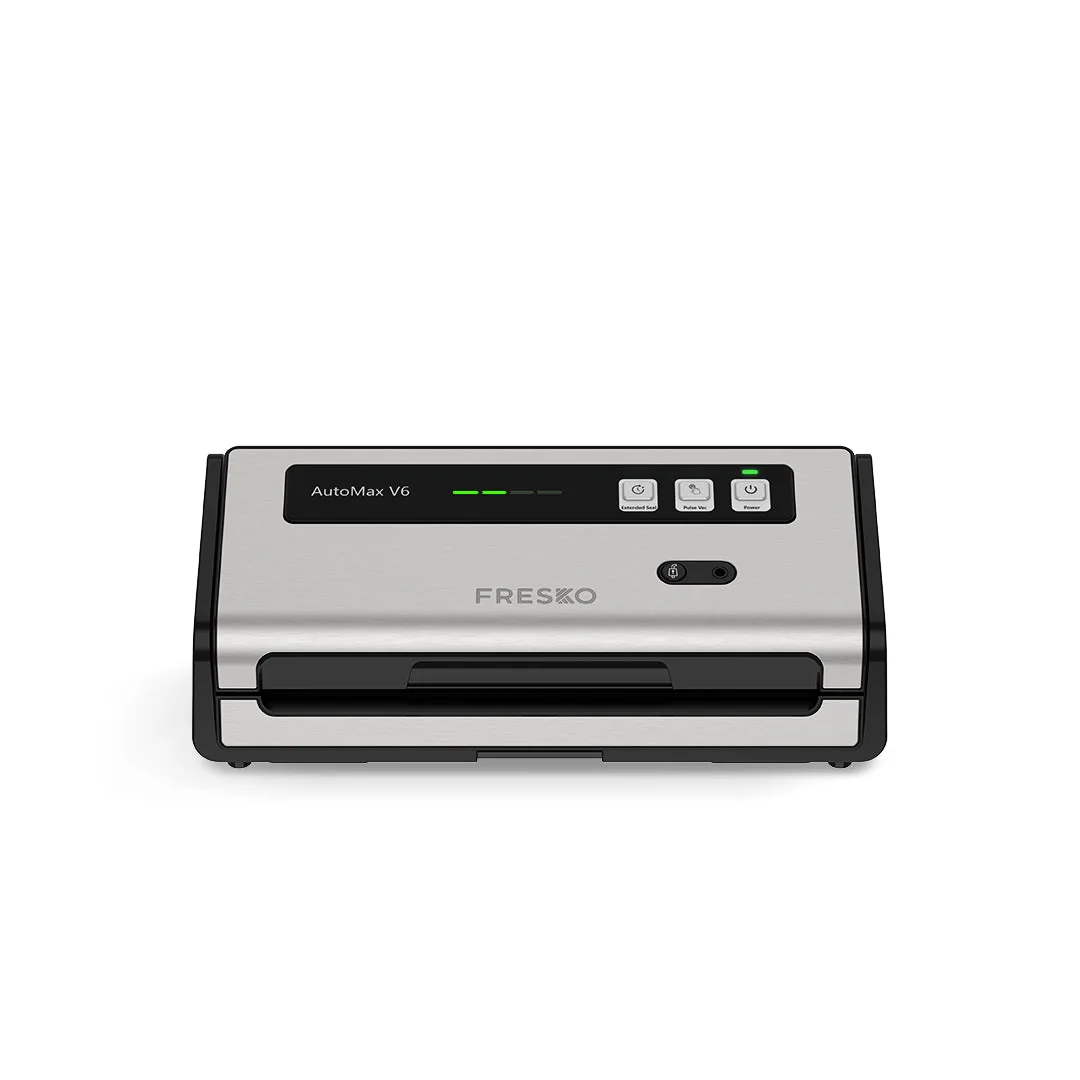
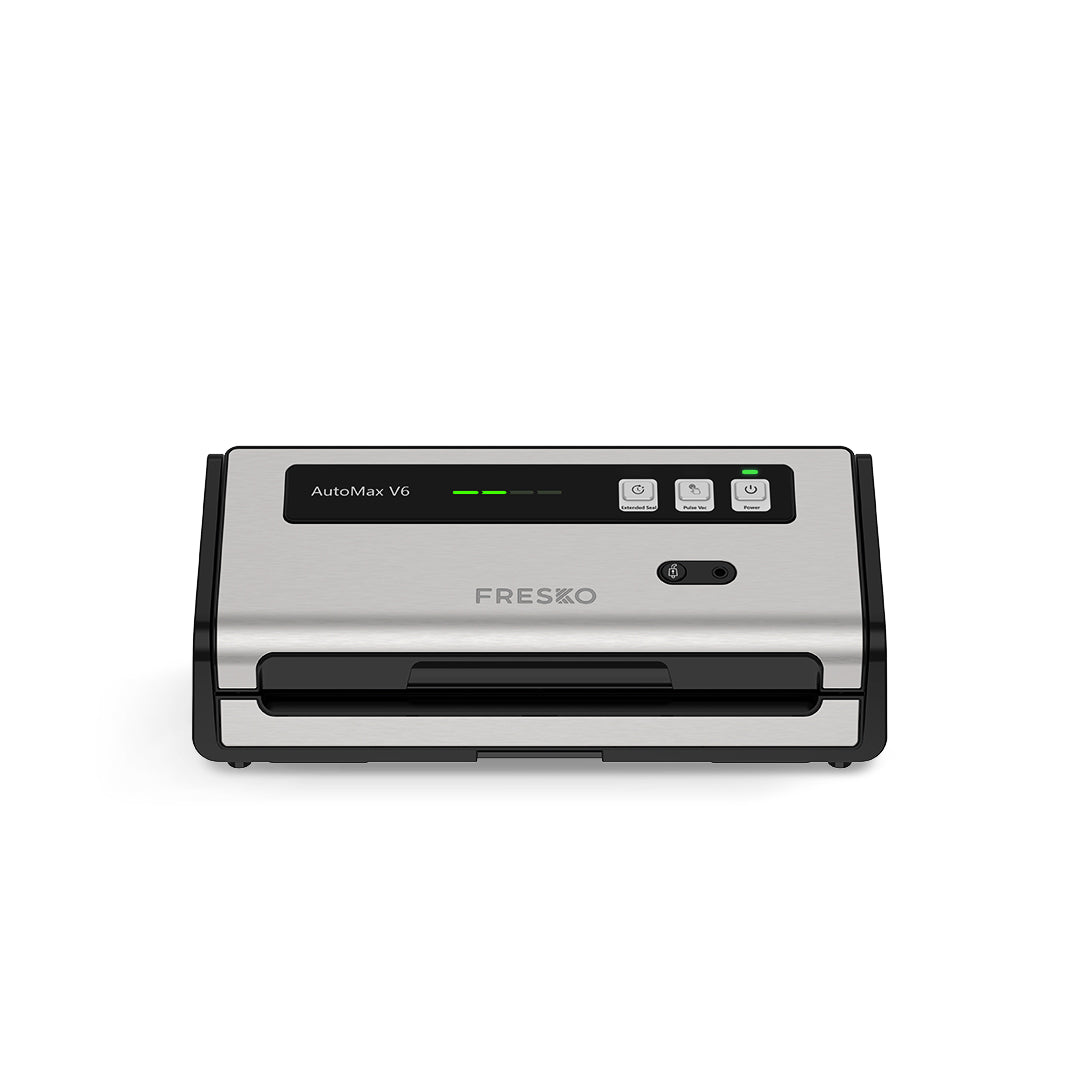
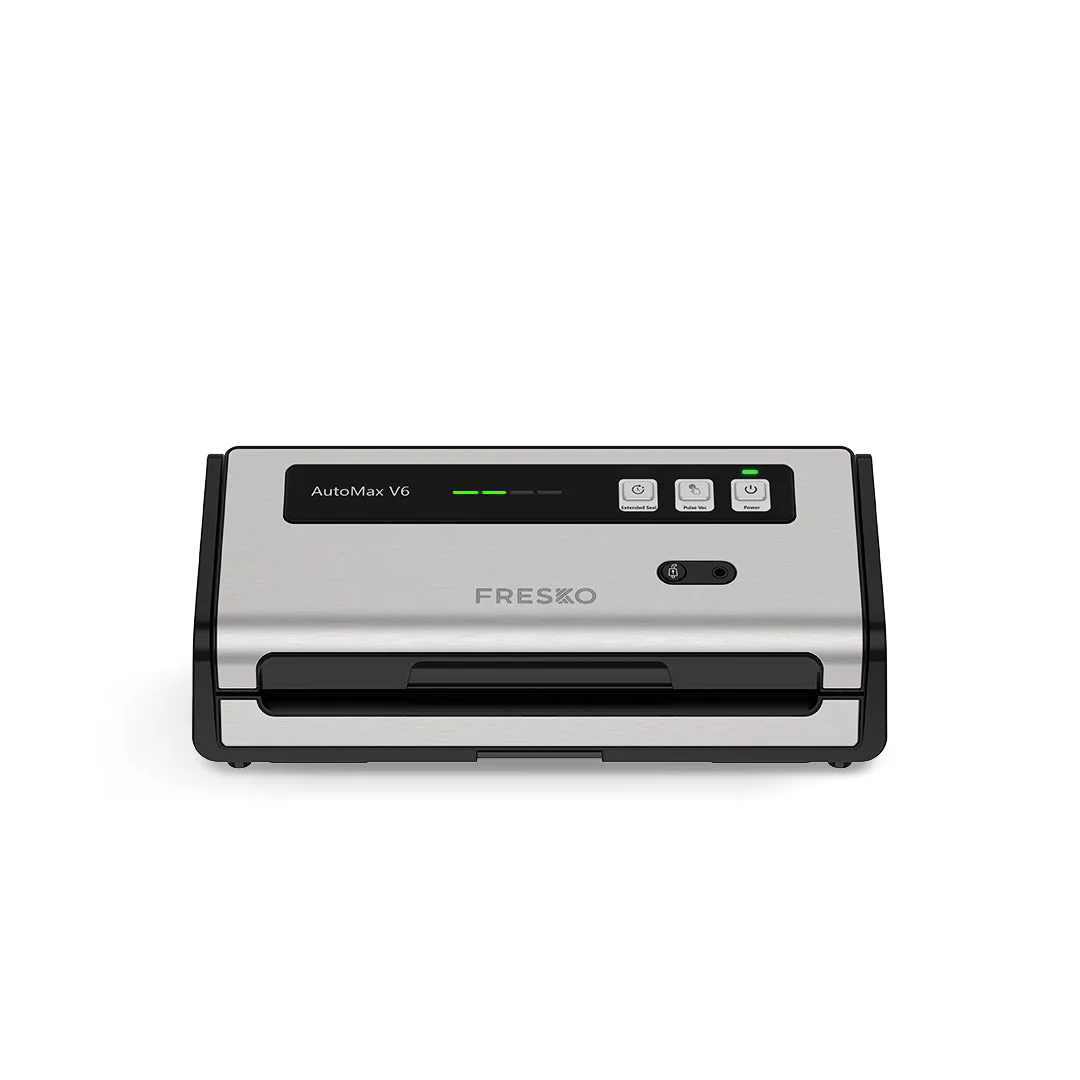
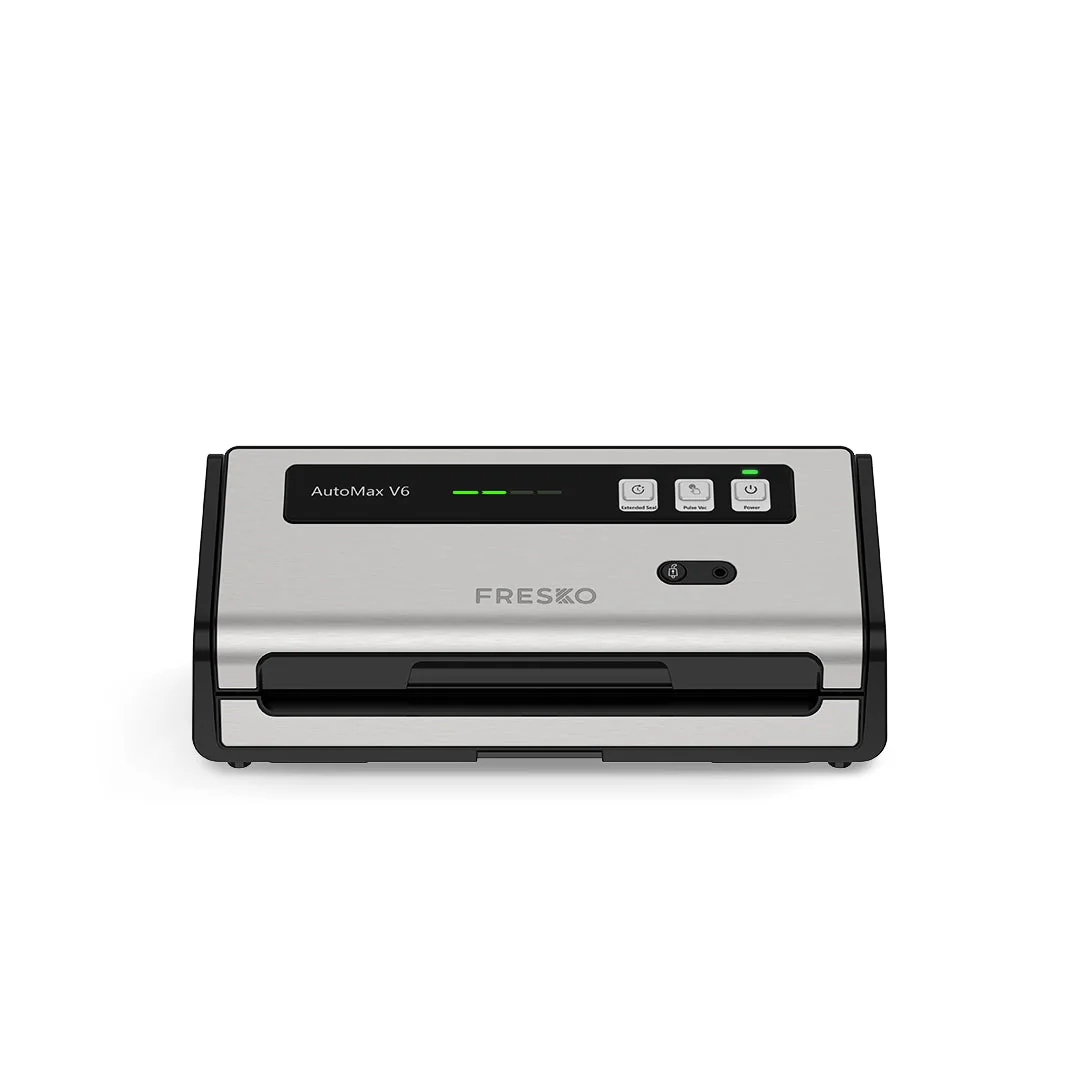
FRESKO AutoMax V6 Vacuum Sealer
By FRESKO · Vacuum Sealers · Kitchen & Cooking
Compare all Vacuum Sealers side by side →
The short version
✓ Why people buy it: Green and red zones distinguish vacuum-and-seal from seal-only work without complicated button sequences.
✗ Watch out for: Pump count, maximum vacuum and airflow remain unpublished for the exact US model.
Prices at 4 stores ↓ · Will it fit? Size check ↓ · All 6 catches ↓
- 145W automatic external vacuum sealer
- Two heating wires with a wide 13 mm double heat seal
- Up to 11-inch bags
- Pulse Vacuum, Extended Seal and external accessory hose
- 3-year manufacturer warranty
Lowest price seen
$99.99
from $99.99 at FRESKO · Checked Nov 13, 2026
- eBay (used) eBay: used, open-box, refurbishedView at eBay (used)
Stores with a price are sorted lowest first; commission never changes the order. Prices are snapshots. Check the current price with the store.
Summary
A convenient automatic vacuum sealer for everyday freezer portions, with separate vacuum-and-seal and seal-only zones, an onboard cutter and a wide double heat seal. Check the trade-offs before buying: FRESKO gives no verified pump pressure or airflow specification for this V6, and a hot machine may need a 15-minute cooling pause.
Size in context

38.5 cm · 15.2 in (W) × 18.3 cm · 7.2 in (D) × 13.2 cm · 5.2 in (H) · Drawn to scale from the maker's stated dimensions, next to everyday objects.
Strengths
- Green and red zones distinguish vacuum-and-seal from seal-only work without complicated button sequences.
- Manufacturer documents two heating wires and a 1.3 cm-wide double-heat-seal region.
- Two starter rolls, an onboard compartment and a sliding manual cutter simplify first-use setup.
- Pulse Vac gives you control for delicate foods, while Extended Seal helps with damp bag mouths.
- An included hose and two interfaces expand the machine to compatible vacuum containers.
- FRESKO advertises a three-year warranty and has a published online troubleshooting guide.
Weaknesses
- Pump count, maximum vacuum and airflow remain unpublished for the exact US model.
- Thermal protection can interrupt a large batch for around 15 minutes.
- Soup and other free-flowing liquids need pre-freezing, not just a longer heating cycle.
- Storage with the lid locked can compress gaskets; dirt and wrinkles still prevent airtight seals.
- Roll storage is limited to 11-inch material, and making a bag from a roll still requires several steps.
- No verified V6 parts catalog was found for replacement gaskets, heaters or pumps.
Verified specifications
| Power | 120 V, 60 Hz, 145 W on FRESKO’s current US product page; older V6 catalog records give 140 W. |
|---|---|
| Zones | automatic green vacuum-and-seal zone and red seal-only zone. |
| Seal | manufacturer-advertised 1.3 cm (13 mm) double-heat-seal region, using two heating wires; individual weld widths are not independently measured. |
| Bag capacity | rolls and bags up to 11 in wide. |
| Functions | Pulse Vac for manual vacuum control; Extended Seal for wetter foods. |
| Hardware | built-in cutter, roll storage, deeper vacuum chamber, pop-up bag support. |
| Containers | accessory hose and two interfaces included; works with suitably connected external canisters, not every third-party jar or lid. |
| Sleep and protection | auto sleep after 10 minutes; overheat protection, standby resumes after about 15 minutes of cooling. |
| Warranty | manufacturer advertises a 30-day trial and 3-year warranty; publicly accessible coverage exclusions and repair commitments remain unclear. |
| Dimensions | 15.16 × 7.20 × 5.20 in (385 × 183 × 132 mm); current FRESKO page does not specify weight or material. |
| In the box | machine, one 8 × 20 ft roll, one 11 × 20 ft roll, accessory hose, two external interfaces/accessories, manual. |
Full research notes and sources
How automatic sealing works
The V6’s appeal is how it separates two jobs that ordinary vacuum sealers often handle with multiple button presses. The green area is for pulling air from a filled bag and then sealing it. The red area is for sealing a bag without first evacuating it. The machine detects where you have placed the opening and starts the corresponding operation when you close the lid. This is convenient if you repeatedly create empty pouches from a roll and then vacuum-pack portions into those pouches. It does not mean the machine measures the food type or checks whether an imperfect seal was made.
The official FRESKO quick-start sheet explains the process more clearly than the promotional photos. Pull enough roll material to cover the food, with spare material at the opening. Slide the built-in cutter across to cut the bag. Put one open end beneath the red baffle and close the lid: the machine seals that end automatically. After filling the new pouch, place its remaining opening under the green baffle and close the lid to start vacuuming and final sealing. FRESKO recommends leaving space between food and the opening; a crowded lip is much harder to position and seal reliably.
For everyday freezer portions, the automatic green-zone cycle is the easiest option. Pulse Vac is more useful for crackers, berries, bread and other foods that can be crushed by prolonged suction. With the opening under the green baffle and the lid closed, hold the Pulse Vac button until the bag is compressed as far as you want, then release it. FRESKO’s quick-start guide says the machine will start sealing automatically after release. The button does not transform the machine into a different pumping system: it simply gives you control over when to stop pulling air.
The manufacturer describes two heating wires producing a 1.3 cm-wide double heat seal. That is more specific than advertising a single unusually wide heating element, although the published materials do not independently measure each finished weld line. A wide double-seal area may help when minor wrinkles threaten one section of the seam, but two heaters do not automatically guarantee airtightness. Grease, folded plastic or liquid in the wrong place can compromise both paths. For food that releases moisture near the lip, FRESKO provides Extended Seal, which adjusts sealing after the vacuum step. A wet opening should still be wiped or dried before relying on the bag for storage.
The V6 also has an automatic sleep function after ten minutes of inactivity. That is a power-management feature, not a performance improvement or automatic cleaning cycle. Its green and red zones are easy to understand once you have made a few bags; the less obvious lesson is that roll material still needs cutting, sealing at one end, filling, and a separate final seal. One owner on FRESKO’s store specifically complains about that sequence. If you routinely package many identical portions, buying pre-cut compatible pouches may save more time than the automatic controls themselves.
Bags, liquids and external accessories
The machine is an external-suction design, not a chamber sealer. Air has to find a route from the inside of the pouch to the vacuum channel under the lid. Ordinary embossed or channel-style vacuum bags are appropriate for this job; smooth chamber pouches and ordinary food-storage zipper bags are not reliable substitutions. FRESKO’s general bag guidance says most standard vacuum-sealer rolls work, although its troubleshooting page warns that very soft or incompatible material may fail to trigger the automatic bag-position sensor. Use compatible textured rolls, keep the opening centered, and test an unfamiliar bulk roll before committing a freezer full of food to it.
FRESKO includes two rolls: one 8-inch-wide and one 11-inch-wide, each 20 feet long. They give you a narrower size for ordinary portions and a wider size for large cuts. The internal compartment holds rolls up to 11 inches across. Width and roll length are different questions: a large bulk roll can be cut outside the machine, but its complete spool may not fit in the built-in bay. A longer roll is not necessarily better value unless you compare the cost per usable foot at the width you need. The sliding cutter saves reaching for scissors; it does not automatically dispense, trim or prepare the next pouch.
Wet foods are where the limitations matter. The V6 has a deeper vacuum chamber intended to reduce overflow and an Extended Seal mode for difficult bag mouths, but it still draws air from the open edge of a bag. If soup or sauce moves toward the pump, a longer heat seal does not prevent that liquid from entering the machine. FRESKO’s own troubleshooting guide recommends freezing soup or stew before vacuum packaging. For raw meat, keep the top of the bag clean, dry and flat, leave spare space above the food, and stop the vacuum early with Pulse Vac if juices approach the channel. Moisture left on the sealing surfaces can create a weak seam even when the rest of the bag looks tightly compressed.
The included accessory hose and two external interfaces allow vacuuming compatible containers without using a flexible bag. FRESKO’s illustrated quick-start guide shows one hose end attached to the machine’s accessory port and the other to a canister fitting, followed by the dedicated accessory vacuum control. The vacuum function stops automatically when the target is reached. That procedure supports canister use, but it is not a universal guarantee of compatibility with every jar, valve, lid or third-party hose. The opening shape and valve design still have to match; the manufacturer does not provide an independently verified list of every supported brand.
If food is intended for sous-vide, check the bag manufacturer’s temperature limits rather than treating the sealer’s heat weld as certification for all cooking temperatures. Vacuum sealing also does not remove the need for appropriate refrigeration, freezing and safe handling of perishable food. It is packaging, not sterilization. The V6 is a practical food-prep appliance, but liquid-heavy projects are still easier on a chamber-style machine.
Batch work, noise, care and long-term support
The biggest practical performance gap in FRESKO’s specification sheet is what it does not report. There is no published pump count, maximum suction pressure or airflow figure for the current US AutoMax V6. Other FRESKO models advertise suction in kPa, but importing their numbers into the V6 would confuse different machines. No credible matched, instrumented test of this exact current US revision was found for pump noise, evacuation time, vacuum depth, seal strength or failure rate.
The manufacturer does document overheat protection. After a thermal cutoff, it says the machine resumes normal standby after roughly fifteen minutes of cooling. Its troubleshooting page associates a flashing green light and an unresponsive machine with that protection mode. A secondary review claims a cutoff during an eighteen-seal stress run, but gives an inconsistent account of other specifications; there is too little evidence to generalize that exact count into a duty-cycle limit. In practice, plan short pauses during a long freezer-prep session rather than expecting nonstop commercial throughput. The wide double heat seal is useful, but does not make the motor or heating assembly exempt from thermal limits.
There are also no dependable decibel readings for the current 145 W V6. Pitch and perceived irritation can differ between machines at the same sound level. Do not buy this one on an unsupported promise that it is particularly quiet. The information supports an ergonomic claim about automatic bag handling, not an acoustic claim about the pump.
Cleaning matters more than complicated servicing. Wipe residue from the vacuum chamber after meat or moist food, clear the sealing area and inspect the upper and lower gaskets for food particles, tears or distortion. The troubleshooting instructions identify bad bag position, incompatible material, moisture and wrinkles as reasons that sealing or automatic sensing may fail. A flashing red or liquid warning can indicate that moisture has collected in the chamber; empty it and let the interior dry before trying again. These are manufacturer troubleshooting paths, not evidence that such faults occur frequently.
Keep the machine stored with the lid unlocked. Gaskets have to rebound when the lid closes, and leaving them under pressure for extended periods can flatten the foam and eventually reduce suction. A buyer who has only used the machine for a few months may not notice this until a later attempt to vacuum a larger bag. The parts picture is less reassuring than the day-to-day maintenance: the manufacturer clearly sells replacement bags and rolls, but no verified retail catalog was found for a V6 gasket, heating bar or pump. That is an availability unknown, not proof that replacement parts can never be obtained through support.
FRESKO advertises a three-year warranty and a short direct-store trial, but the product page does not spell out every exclusion, shipping expense or remedy. Older manual mirrors use the phrase “three-year technical support,” which is not necessarily the same as a complete parts-and-labor warranty. Retain a dated receipt and check whether the purchase channel and any product-registration requirement affect coverage. If a critical component fails outside a return window, the practical question is whether the seller will supply a part or replacement unit, not just whether a support inbox exists.
Owner evidence is positive but narrow. The current FRESKO-hosted comments mention easy operation and strong seals; one shopper reports that using rolls still requires the full cut, first seal, fill, final seal routine. Another asks for a refund without giving a cause. An older 140 W European V6 has a broader pool of reported opinions, but that population should not be silently used to calculate failure rates for the current US 145 W revision. No independently documented recurring hardware defect emerged from the available exact-model specialist-forum material. Limited reports are insufficient to establish exceptional durability either.
Is it worth it?
The V6 makes the most sense for someone who regularly portions cooked meals, meat or dry foods and dislikes fiddling with manual sealer controls. Its two placement zones are a practical convenience: the same appliance makes a bag from a roll, seals it at one end, and then vacuums and seals it after filling. Pulse Vac helps when full suction would squash the food. The larger seal region and included external hose add flexibility without requiring proprietary pre-cut bags for every job. This is the V6’s real advantage, rather than a measured pumping-performance lead over its competitors.
Price matters because the evidence is uneven. FRESKO’s direct US shop listed the V6 at $99.99 in September 2026, whereas lower promotional pricing was observed during the year. Around $65–80, the automatic workflow, two starter rolls and three-year warranty advertisement are attractive. At $80–90, ask whether you will really use the onboard cutter and seal-only area frequently. Closer to the direct-store list price, a machine with independently published vacuum measurements, clearer parts availability or a better-documented long-term track record becomes easier to justify. These are editorial value ranges, not guaranteed retail offers or a claim that any competitor always performs better.
Operating costs are mainly the textured bags and rolls. The FRESKO store listed two 8-inch by 20-foot rolls for $12.99 and a six-roll bundle for $27.99 in September 2026. The useful comparison is the total length and width of material you actually receive, not simply the number of spools.
Think through your real workload. If most meals fit standard pre-cut bags, you may rarely use the cutter and roll compartment. If you prepare dozens of bags in one sitting, the thermal protection creates a possible pause and makes throughput unpredictable. If you vacuum-pack soups, you will still need to freeze them before using this external-suction machine. For a household that wants a guided automatic process and values a generous advertised warranty, the V6 is worth considering at a discount. For someone shopping by maximum vacuum, airflow, tested noise or repairable internals, those questions remain unanswered here.
Which model this is
This is the current US FRESKO AutoMax V6 / V6 Roll & Cut model, specified by the manufacturer at 120 V, 60 Hz and 145 W, with a 385 × 183 × 132 mm chassis and 11-inch roll capacity. One current-US marketplace listing uses ASIN B0FBFWFSWY. Older and other-region listings for an AutoMax V6 give 140 W and different dimensions. Some catalog mirrors even attach the 140 W specification to the newer identifier, so a familiar product image or name is not sufficient to settle the revision. Confirm the exact voltage and model label before using another region’s manual or selecting spares.
This is also not the V8 or V4, which have their own controls, accessories and advertised performance. A 95 kPa figure for another FRESKO vacuum sealer cannot be copied into the V6 without evidence. The manufacturer’s claim about preserving freshness many times longer than ordinary storage is marketing language rather than an independent test of this current revision. There is likewise no defensible US V6 noise number or tested vacuum-to-seal duration to place in a comparison chart.
Sources
Manufacturer:
- FRESKO AutoMax V6 manufacturer specifications and warranty statement
- FRESKO vacuum-sealer troubleshooting and wet-food instructions
- FRESKO vacuum-sealer bag compatibility guidance
Manual mirrors:
Independent reviews:
Owner reports:
- No exact-model Reddit or forum threads were found; owner sentiment above comes from store reviews and review aggregates.