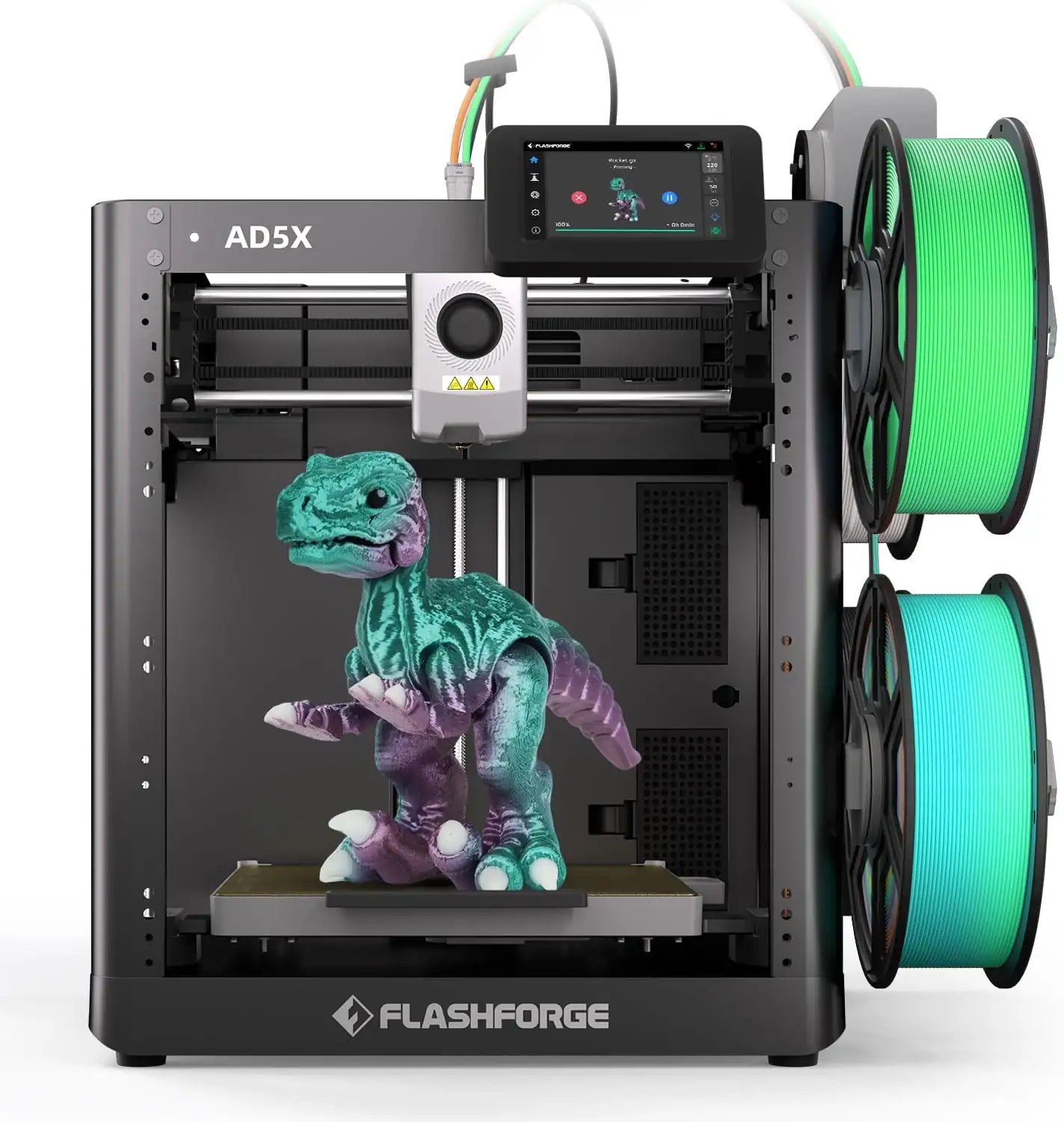
Flashforge Adventurer 5X (AD5X)
By Flashforge · Budget 3D Printers · 3D Printing · More from Flashforge
- Build volume 220x220x220 mm
- Max travel speed 600 mm/s
- Max nozzle temperature 300 C
- Max bed temperature 110 C
- 4-color IFS filament system
Lowest price seen
~$349.00 (approx.)
from $349.00 at Amazon
- Amazon ~$349.00 (approx.)View at Amazon
- FlashforgeView at Flashforge
- eBay (used) eBay: used, open-box, refurbishedView at eBay (used)
- eBayView at eBay
- 3D Printers DepotView at 3D Printers Depot
- WalmartView at Walmart
Prices are snapshots. Check the current price with the store.
Summary
The Flashforge Adventurer 5X (AD5X) is an open-frame CoreXY printer with a built-in four-color filament system, made for hobbyists who want multi-color prints without an external AMS-style box. The hardware is the strong part and the bundled Orca-Flashforge slicer is the weak one, so decide how much buggy software you can live with before you buy.
Strengths
- Four colors are built in: four spools feed a side switch box and the toolhead changer, with no external feeder box.
- The one professional review praises print quality across PLA-CF, PETG, TPU, Lightweight PLA, ASA and PC.
- The nozzle is quick-swap with a 300 °C steel insert, and replacement is tool-free.
- Owners call setup easy: one says it was the easiest of their seven printers to get running.
- Auto-leveling runs before every print by default, and the machine resumes after power outages.
- Flashforge’s support draws praise, including free redesigned hotends and heatsinks for early-run owners.
Weaknesses
- The bundled Orca-Flashforge slicer crashed about every third print in testing and drops filament and color info between tabs.
- It does not report filament wasted in color swaps: 23 swaps on a 9 g printed frog wasted 11 g.
- The base unit has no camera, no chamber lighting and no enclosure; the enclosure is a DIY kit whose structural parts you print yourself.
- Adhesion failures are a recurring owner topic; reported fixes include glue stick, an 80 °C bed, a brim and Z-hop.
- One owner lost a 6-hour print to a nozzle-heating error at about 90% completion.
- The IFS is picky about filament: a long-term owner reports old or brittle spools are painful to unload and many PETGs perform poorly.
Verified specifications
| Model | Flashforge Adventurer 5X (AD5X), the multi-color variant of the Adventurer 5M platform. |
|---|---|
| Build volume | 220 × 220 × 220 mm. |
| Speed | up to 600 mm/s travel and 300 mm/s print per the official page; Micro Center lists 600 mm/s print speed. |
| Acceleration | up to 20,000 mm/s². |
| Nozzle | 0.4 mm quick-swap default, with 0.25, 0.6 and 0.8 mm optional; tool-free replacement, steel insert rated to 300 °C. |
| Max nozzle temperature | 300 °C; two-piece magnetic heat break. |
| Max bed temperature | 110 °C on a PEI flexible steel sheet. |
| Layer thickness | 0.1–0.4 mm per the official page; Micro Center lists 0.05–0.4 mm. |
| Auto leveling | yes, runs before every print by default; initial calibration includes vibration compensation and PID tuning. |
| Multi-color | four colors via the integrated IFS; four Bowden tubes run from a side switch box to a toolhead color changer; a spool running out mid-print switches automatically. |
| Filament detection | yes. |
| Supported filaments | PLA, PETG, TPU95A (single-color), TPU64D–75D (multi-color), PLA-CF and PETG-CF; Micro Center also lists ASA and ABS. |
| Connectivity | USB, Ethernet and Wi-Fi. |
| Display | 4.3-inch color touchscreen, not angle-adjustable. |
| Slicer | Orca-Flashforge (a skinned OrcaSlicer); stock OrcaSlicer also has an AD5X profile. |
| Power | 100–220 VAC, 50–60 Hz, 650 W supply. |
| Weight | 11 kg net, 14.2 kg gross; packaging 440 × 440 × 515 mm. |
| Dimensions | 363 × 363 mm (L × W) per the HK page; 376 × 413 mm including the screen and gantry per Micro Center. |
| Power-outage recovery | yes; the manufacturer claims 99% resume success. |
| Camera, chamber lighting and enclosure | not included; all sold separately. |
| Warranty | 12 months, with 30-day returns. |
| In the box | printer, IFS module with mounting plate and cable, four spool holders, Bowden tubes, power cord, toolkit and quick-start guide; US listings include one spool of filament. |
Full research notes and sources
Hardware and print quality
Tom’s Hardware’s 2025-10-12 review calls the print quality “excellent” and the machine capable once enclosed. It printed 33 multicolor articulated frogs at 200 mm/s with 0.2 mm layers in 10 h 10 min, TPU koozies at 45 mm/s with no stringing, Polymaker Lightweight PLA cleanly at 75 mm/s (the first machine in that reviewer’s experience to do so), and ASA via a modified ABS profile. The CoreXY frame hides two steppers; the bed rides on four linear rods with three belted lead screws and an automatic belt tensioner. On Reddit, the color-change system gets the same verdict: “the multi-filament thing just works.”
Software and connectivity
The slicer is the weak point. Orca-Flashforge crashed about every third print when left running in testing, fails to carry filament types and colors from the device tab to the prepare tab, and shows only purge-tower usage, not total filament wasted in swaps. Stock OrcaSlicer is more stable but still misses the wasted-filament data. Owners add complaints about unreliable network connectivity, firmware updates that “search for hours” without result, and touchscreen calibration offset; one owner reports a firmware update fixed connectivity, after which they run full calibration after each upgrade. A community troubleshooting thread for the 5M/5X platform says 90% of issues are a dirty bed, wet filament, a bad first layer, loose belts or lack of maintenance, and that layer shifts are almost always mechanical.
Enclosure, camera and running costs
The base unit ships without a camera, chamber lighting or enclosure. The DIY enclosure kit costs $49.99, the camera $39.99 and LED chamber lighting $15.30 from Flashforge (2025). The kit is clear panels plus hardware; the structural parts are yours to print, and Tom’s Hardware paid about $19 in filament and roughly 19 hours of printing before the review unit was enclosed. Multi-color work burns extra filament on purges and the slicer will not tell you how much, so budget for it. There is no subscription lock-in, and third-party filaments from eSun, Bambu Lab, Creality and Elegoo work with parameter adjustment. Owners fighting adhesion report reaching for glue stick.
Is it worth it?
At the $349 US street price — Best Buy, Target and Flashforge’s own store, against a $549 retail list (Tom’s Hardware, 2025-10-12) — this is the cheapest integrated four-color CoreXY with a tool-free nozzle, 300 °C capability and a 110 °C bed. Flashforge’s refurbished unit is $315. At $400–459 the AD5X overlaps the Anycubic Kobra S1 Combo at $459, which bundles an enclosure, camera, lights and a filament dryer, and matches the Bambu Lab A1 Mini Combo at $349. Above $460, pay for a more complete ecosystem unless the integrated IFS or Flashforge’s support record decides it for you.
Which model this is
This page covers the Flashforge Adventurer 5X, manufacturer part AD5X (UPC 618996783854), announced in Japan on 2025-04-08 with shipping planned for June 2025. It is the multi-color variant of the Adventurer 5M platform; the single-color 5M and 5M Pro and the newer Creator 5 series are different machines. Micro Center lists it under SKU 894030.
The US listing is ASIN B0DNZ2Q9Y6.
Sources
Manufacturer:
- Flashforge AD5X official product page (US)
- AD5X — Flashforge HK
- AD5X Q&A — Troubleshooting, Tips, and More — Flashforge UK blog
- Flashforge AD5X Refurbished 3D Printer — Flashforge US
- 次世代FFF方式 3Dプリンター「FLASHFORGE AD5X」登場! — Flashforge Japan
Independent reviews:
Retailers:
Owner reports:
- Really want to like the AD5X, cute machine but the software is awful! — r/FlashForge
- Flashforge AD5X What your thoughts junk or okay or beginners — r/3dprinter
- Fair Review of the AD5X — r/FlashForge
- Adhesive issues with AD5X — r/FlashForge
- Flashforge 5M / 5X – Common Problems & Fixes — r/FlashForge
- Flashforge customer reviews — Trustpilot