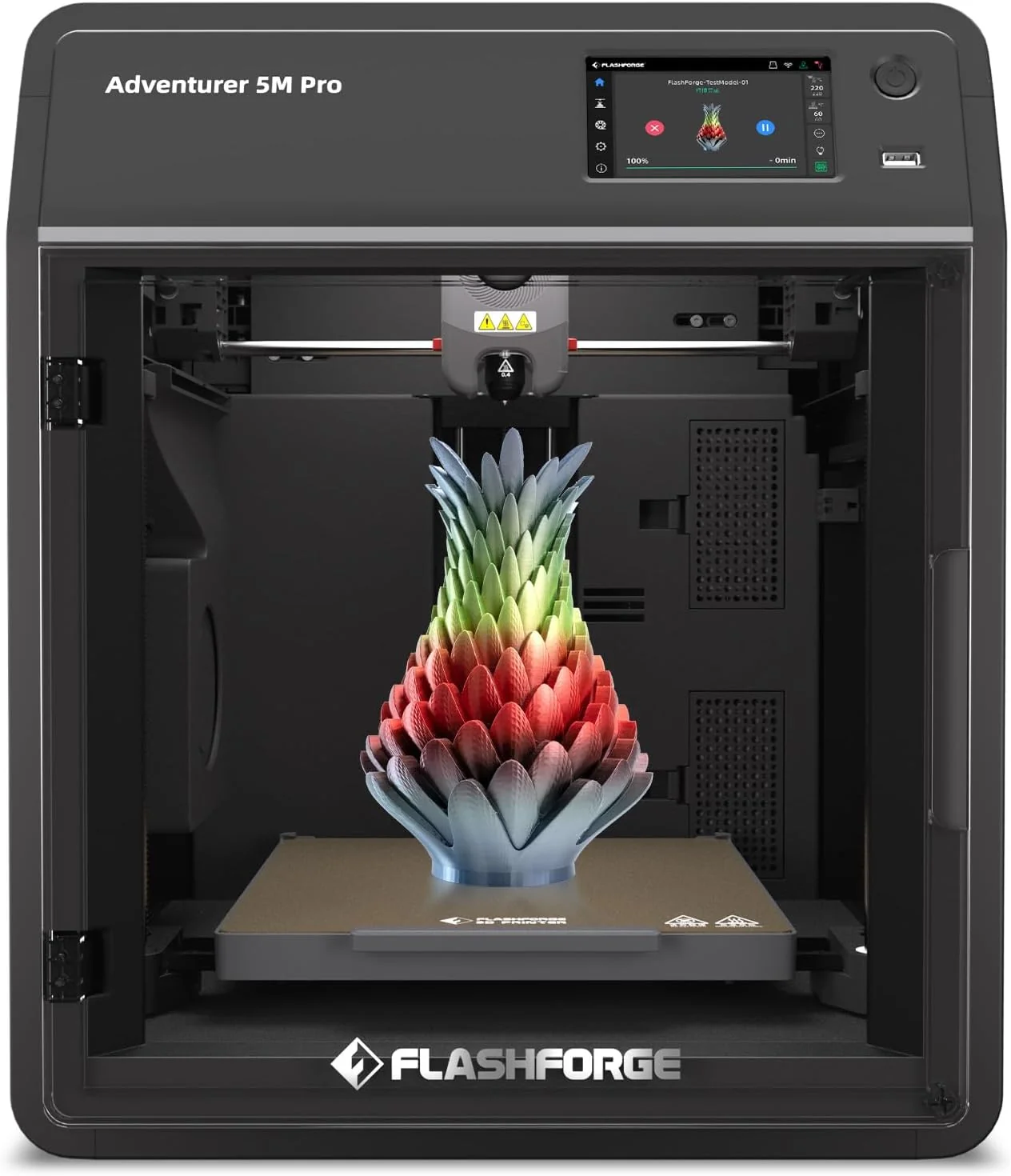
FlashForge Adventurer 5M Pro Enclosed 3D Printer
By FlashForge · Enclosed 3D Printers · 3D Printing · More from FlashForge
- 220 x 220 x 220 mm build volume
- 600 mm/s max speed
- 20,000 mm/s2 max acceleration
- 280 C max nozzle temperature
- 350 W power supply
Price not listed
- FlashForgeView at FlashForge
- eBay (used) eBay: used, open-box, refurbishedView at eBay (used)
- eBayView at eBay
- AmazonView at Amazon (paid link)
Stores are listed in a fixed order, never by price or commission. Prices are snapshots. Check the current price with the store.
Summary
A fully enclosed CoreXY FDM printer for buyers who want speed and a filtered chamber more than a large build volume. Check the software before you buy: the stock FlashPrint 5 slicer ships with one profile per nozzle, and serious tuning means moving to a third-party slicer.
Strengths
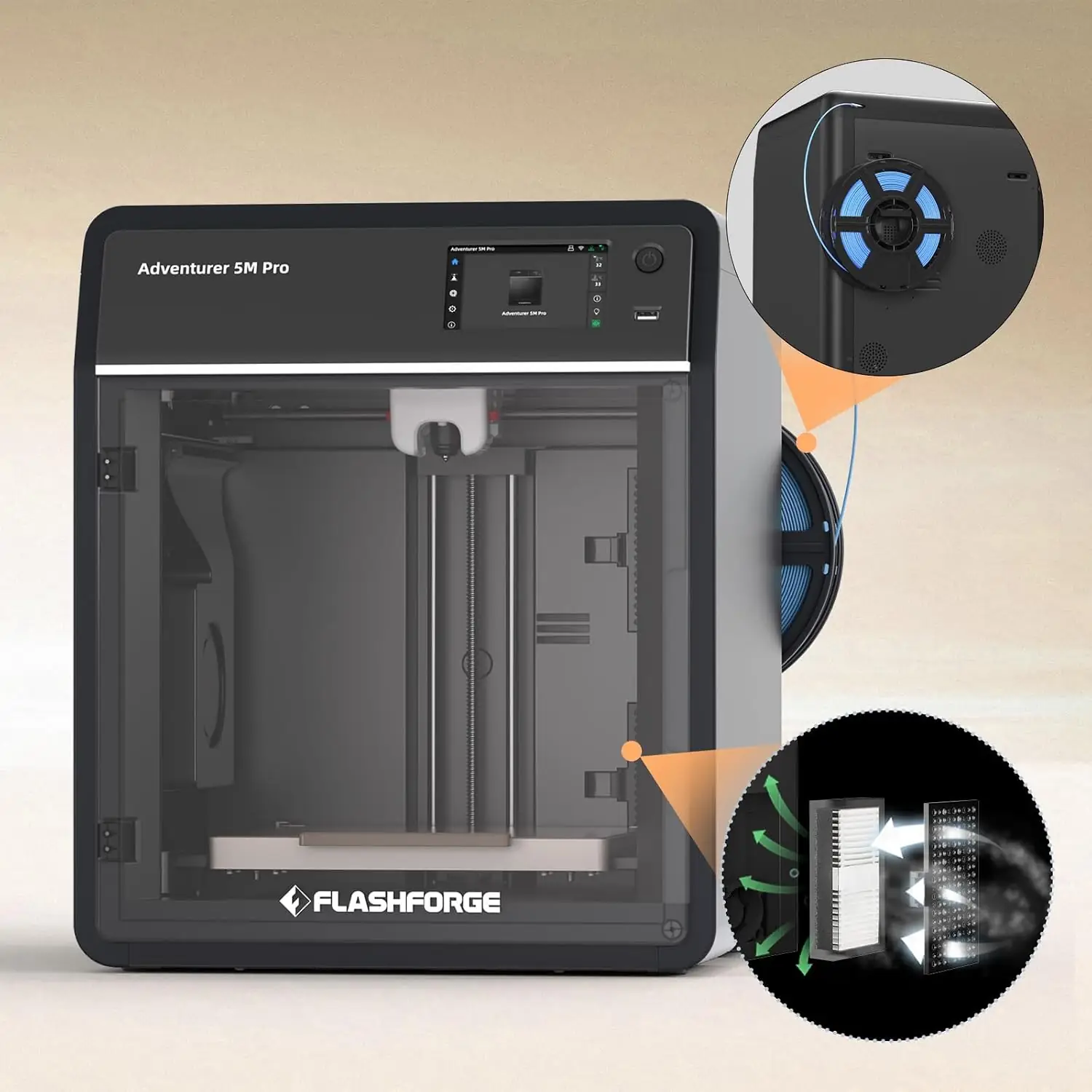
- The sealed, filtered chamber is the point: HEPA plus activated carbon, claimed to block 99% of particles and VOCs, with a particulate sensor that auto-triggers the filter.
- Fast: Tom’s Hardware’s verdict was “Fast, but not First,” and Makers Empire printed a Benchy in 17 minutes.
- Quiet for an enclosed machine: The 3D Printer Bee measured about 65 dB with the door open and under 60 dB closed.
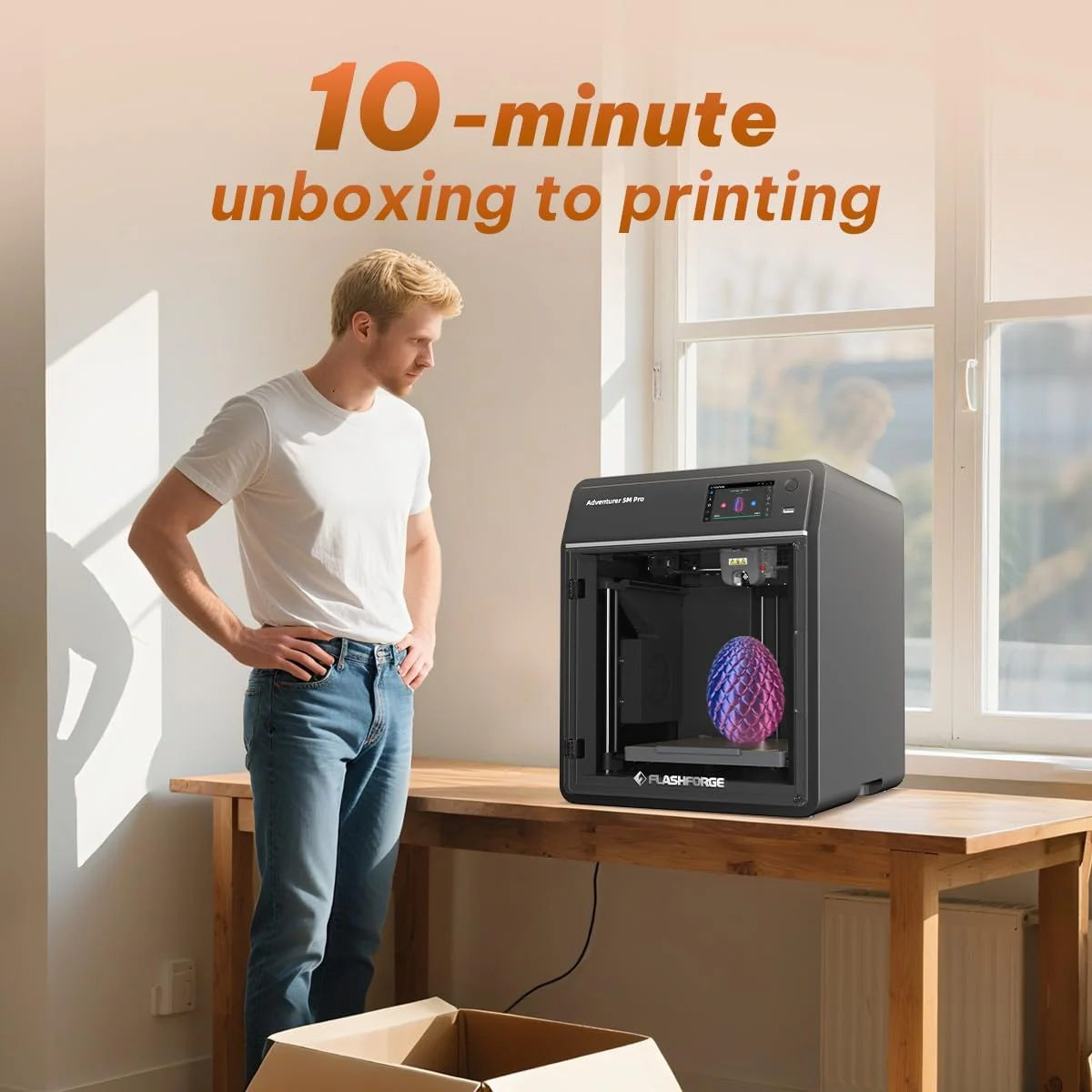
- Easy setup, an intuitive 4.3-inch touchscreen, and USB, Wi-Fi and Ethernet connectivity.
Weaknesses
- Tom’s Hardware’s unit needed auto-levelling run several times before the Z height was correct, and TPU jammed in its extruder.
- The webcam is only 640 × 480, and the 220 mm cube build volume is small for this class.
- No native multicolor: FlashForge’s IFS system is designed for the AD5X, not the 5M Pro.
- Proprietary quick-swap nozzles cost roughly $10–20 each (3D Tech Valley, 2026) against $2–5 for commodity nozzles.
- The filament spool mounts on the rear, which is awkward when the printer sits against a wall.
Verified specifications
| Motion | CoreXY with a direct-drive extruder. |
|---|---|
| Max print speed | 600 mm/s advertised; about 300 mm/s is the default or normal speed. |
| Max acceleration | 20,000 mm/s². |
| Max nozzle temperature | 280 °C (536 °F). |
| Max bed temperature | 110 °C (230 °F). |
| Power supply | 350 W. |
| Build platform | removable flexible textured PEI steel sheet. |
| Nozzles | 0.4 mm installed and 0.6 mm included; 0.25 mm and 0.8 mm optional; quick-swap hotend system. |
| Bed levelling | automatic mesh levelling using force sensors. |
| Connectivity | USB, Wi-Fi and Ethernet. |
| Interface | 4.3-inch color touchscreen with a single physical power button. |
| Camera | integrated webcam for monitoring and time-lapse, 640 × 480 per Tom’s Hardware. |
| Filament | PLA, PETG and TPU on the 0.4 mm nozzle; ABS, ASA, PLA-CF and PETG-CF on 0.6/0.8 mm nozzles. |
| Software | ships with FlashPrint 5; OrcaSlicer, Cura and PrusaSlicer supported. |
| Other features | power-loss recovery, filament run-out reminder, auto shutdown and cloud printing. |
| Enclosure | fully enclosed with a magnetic front door and a liftable top panel; the spool holder mounts externally on the rear. |
| Dimensions | 14.96 × 15.75 × 17.83 in (380 × 400 × 453 mm), excluding the spool holder; 19 kg. |
| In the box | 0.6 mm hardened-steel nozzle, glue dabber, Allen wrenches, Phillips screwdriver, unclogging pin, grease, side cutters, spool holder and a user manual. Tom’s Hardware’s unit arrived missing the glue stick and 0.6 mm nozzle, so contents can vary. |
| Warranty | no first-party terms could be read; installing Klipper or ZMOD firmware is reported to typically void it. |
Full research notes and sources
Speed, print quality and setup
The verdict was “Fast, but not First”: it liked the speed, the direct-drive CoreXY motion, the enclosure and the filtration. Makers Empire, a school-focused hands-on, printed a Benchy in 17 minutes and a sample print in 1 h 25 min against 4 h 36 min on the older Adventurer 4. 3DWithUs reported excellent print quality and clean overhangs on the 0.4 mm and 0.6 mm nozzles, sliced with OrcaSlicer over USB.
Setup is mostly easy, but two cautions carry over from testing. Makers Empire had to adjust settings to get prints to stick to the included bed, and it described early firmware as “a little buggy,” with FlashForge issuing updates. Tom’s Hardware’s unit needed automatic levelling run several times before the Z height was correct, and its calibration menu had no global Z-offset; the same unit had TPU jam in the extruder after printing. Nobody has published measured speeds against the advertised 600 mm/s and 20,000 mm/s², so treat those as maxima — normal printing is around 300 mm/s.
Enclosure, filtration and noise
The sealed chamber is the reason to pay for the Pro over the base 5M: a magnetic front door, a liftable top panel for extruder access, and an internal-plus-external HEPA and activated-carbon filtration loop. The 3D Printer Bee showed why the door matters: ABS warped with the door open or the bed too cool, and printed cleanly when fully enclosed above a 100 °C bed.
Noise figures vary by measurement condition, so keep them apart. The 3D Printer Bee measured about 65 dB with the door open and below 60 dB closed. For a shared office or apartment, the closed-chamber numbers are the ones that matter.
Software, nozzles and running costs
The quick-swap hotend is genuinely convenient — one review cites 30–60 seconds per nozzle change with no tools — but the ecosystem is proprietary. One 2026 review quotes roughly $10–20 per nozzle versus $2–5 for commodity V6/MK3 nozzles, and parts availability depends on FlashForge’s supply chain. A filament spool is not included beyond sample material, so filament is the main recurring cost.
Is it worth it?
No 2026 US street price could be verified from the sources read. Tom’s Hardware’s October 2023 review listed a $599 retail price, and 3DWithUs reported a $599–$695 range in 2024. Where the machine sits today decides the value.
The enclosure, filtration, quiet operation and quick-swap nozzles are the only justification for the Pro’s premium over the base 5M, and they matter most for ABS, ASA and shared indoor spaces. The case against overpaying: the 220 mm cube build volume is small for this class, multicolor is unsupported, and the stock slicer pushes you toward third-party software for tuned results. If you print PLA or PETG on a desk, the Pro’s premium buys you little; if you print ABS or ASA in a shared space, the sealed, filtered chamber is the feature worth paying for. Owner-level evidence is thin: one r/FlashForge thread on whether the 5M or 5M Pro is worth it survives only as a search-result snippet quoting an owner who calls their recently bought 5M Pro “wonderful”; the page itself could not be fetched.
Which model this is
This page covers the FlashForge Adventurer 5M Pro, the fully enclosed CoreXY version of the 5M line. Do not confuse it with the base Adventurer 5M, an open-frame machine with no enclosure or filtration; the AD5X, which adds native IFS multicolor; or the older Adventurer 4 and 4 Pro. The Amazon listing for this model is ASIN B0FG7MHGRH.
Sources
Manufacturer:
- No first-party spec sheet or manual could be read; flashforge.com returned HTTP 429 on every attempt.
Independent reviews:
Owner reports:
- Is the Adventurer 5m or 5m Pro worth it? (r/FlashForge) — only a search-result snippet was readable; the page was not fetched.